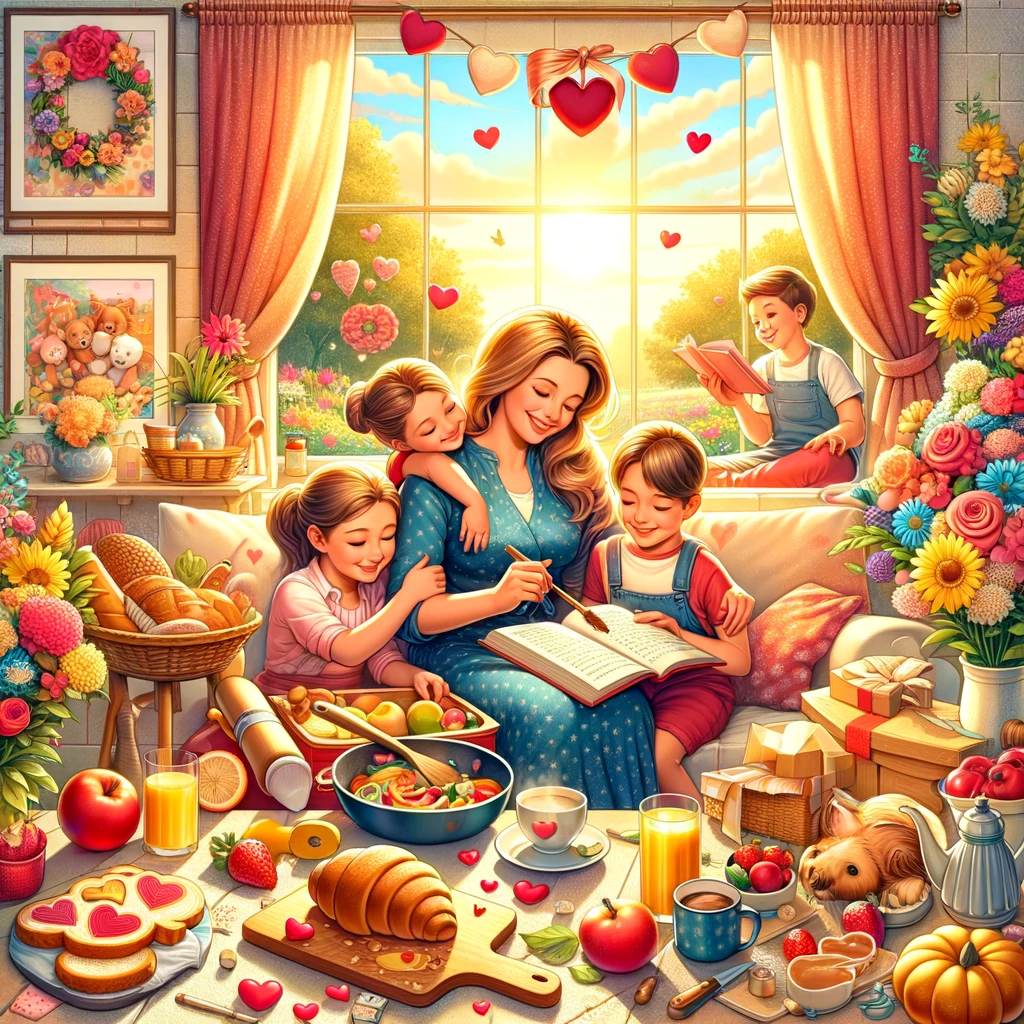
Mother’s Day is a special occasion celebrated worldwide, offering a unique opportunity for English as a Second Language (ESL) learners to expand their vocabulary and express their feelings about family in English. This article will guide ESL learners through essential vocabulary and phrases, enhancing their ability to describe family relationships, characteristics, and activities related to Mother’s Day.
Understanding Family Vocabulary
Immediate Family Members
- Mother (Mom, Mama): The woman who has given birth to or raised a child. Synonyms include ‘mommy,’ ‘mum,’ or ‘mama.’Example: “My mom is my best friend; she always supports me.”
- Father (Dad, Papa): The man who has fathered or raised a child. Often called ‘daddy,’ ‘dad,’ or ‘papa.’Example: “I often go fishing with my dad on weekends.”
- Siblings (Brother/Sister): A person’s brothers and sisters.Example: “I have two siblings – an older sister and a younger brother.”
Extended Family Members
- Grandparents (Grandmother/Grandfather): The parents of one’s parents. Grandmother can also be ‘grandma’ or ‘nana,’ and grandfather ‘grandpa’ or ‘pops.’Example: “My grandparents often tell me stories about their childhood.”
- Aunts and Uncles: The siblings of one’s parents or the spouses of those siblings.Example: “My uncle is a pilot, and he travels a lot.”
- Cousins: The children of one’s aunts and uncles.Example: “I have a cousin who lives in Canada; we meet during holidays.”
Describing Family Relationships
When learning English, it’s not only about knowing the titles of family members but also how to describe the relationships between them. Here are some phrases that can be useful:
- “She is my elder sister.” – Used to indicate a sister who is older.
- “He is my younger brother.” – Refers to a brother who is younger.
- “We are cousins.” – Indicates a familial relationship between children of siblings.
Talking About Mother’s Day
Mother’s Day is an ideal time for ESL learners to practice their English skills by talking about their family, especially their mothers. Here are some phrases and vocabulary that can be helpful:
- “We celebrate Mother’s Day by…” – Use this phrase to describe traditions or activities.
- “My mom loves when…” – Share what makes your mother happy or special traditions you follow.
- “I appreciate my mother because…” – Express gratitude and reasons why your mother is important to you.
Mother’s Day Activities Vocabulary
- Brunch: A late morning meal that combines breakfast and lunch.Example: “We’re planning a special brunch for Mother’s Day.”
- Gift/Giving: Presenting someone with something as a show of affection.Example: “I’m giving my mom a handmade card for Mother’s Day.”
- Celebration: The act of marking a special event or occasion.Example: “Our family has a small celebration at home for Mother’s Day.”
Describing Personality and Appearance
Describing a family member’s personality and appearance is an excellent way for ESL students to practice their descriptive skills. Here are some adjectives and phrases:
- Personality Descriptions:
- Caring: Showing kindness and concern for others.
- Example: “My mother is very caring; she always helps me with my homework.”
- Supportive: Providing encouragement or emotional help.
- Example: “My dad is supportive of my decisions.”
- Caring: Showing kindness and concern for others.
- Appearance Descriptions:
- Tall/Short: Height description.
- Example: “My elder brother is quite tall.”
- Curly Hair/Straight Hair: Describing hair texture.
- Example: “My sister has beautiful curly hair.”
- Tall/Short: Height description.
Crafting Sentences with Family Vocabulary
To help ESL learners, here are some sample sentences combining the vocabulary and phrases discussed:
- “We are throwing a surprise party for my grandma on Mother’s Day.”
- This sentence combines family vocabulary (grandma) with an activity (throwing a surprise party).
- “My mom has a caring personality; she volunteers at the local community center.”
- Describes the mother’s personality trait (caring) and an example of her actions (volunteering).
- “My little brother is the youngest in our family, and he’s always full of energy.”
- Describes the family position (youngest) and a personality trait (full of energy).

Advanced Family Vocabulary
Expanding your vocabulary to include more complex family-related terms allows for richer descriptions and conversations. Here are some advanced terms:
- Stepmother/Stepfather: A woman/man who has married one’s father/mother after the death or divorce of their original spouse.Example: “My stepfather is very kind; he taught me how to play chess.”
- Half-brother/Half-sister: A brother/sister who shares only one parent with you.Example: “My half-sister, from my father’s first marriage, visits us every summer.”
- In-laws: The family of one’s spouse.Example: “My in-laws are coming over for dinner next weekend.”
Idiomatic Expressions Involving Family
Idioms add a native speaker’s touch to language proficiency. Here are some common English idioms related to family:
- “Like father, like son” – This idiom suggests that a son’s character or behavior can be expected to resemble that of his father.Example: “He’s as good in mathematics as his dad. Like father, like son.”
- “The apple doesn’t fall far from the tree” – Used to indicate that a family member has traits similar to their relatives.Example: “She’s a brilliant painter, just like her mother. The apple doesn’t fall far from the tree.”
- “Blood is thicker than water” – This means that family relationships are stronger than other relationships.Example: “We always support each other, because blood is thicker than water.”
Celebrating Mother’s Day Around the World
Mother’s Day is celebrated in various ways across English-speaking countries. Understanding these cultural nuances can be enlightening for ESL learners.
United States
In the United States, Mother’s Day is celebrated on the second Sunday of May. It is common for children to give their mothers cards, flowers, and gifts. Families often have a special meal together.
United Kingdom
In the UK, Mother’s Day is known as “Mothering Sunday” and is celebrated on the fourth Sunday of Lent. Traditionally, it was a day when people would visit their ‘mother church’ and children would pick flowers to give to their mothers.
Australia
Australians celebrate Mother’s Day similarly to the United States, with gifts, cards, and family gatherings. It’s also common to do charity runs or events on this day to honor mothers.
Expressing Gratitude and Love
One of the key aspects of Mother’s Day is expressing gratitude and love. Here are some phrases that can help ESL learners articulate these feelings:
- “Thank you for always being there for me.” – Expressing gratitude for constant support.
- “You mean the world to me.” – Showing deep affection and importance.
- “I admire your strength and kindness.” – Appreciating specific qualities.
Engaging in Conversations About Family
Finally, being able to engage in conversations about family is an essential skill for ESL learners. Here are some conversation starters:
- “Can you tell me about your family?” – A general question that opens up family-related discussions.
- “What traditions does your family have for Mother’s Day?” – A question specific to the holiday.
- “How do you usually celebrate family occasions?” – This can lead to discussions about cultural practices and family dynamics.
Conclusion
Describing family in English is an essential skill for ESL learners, especially in the context of celebrating Mother’s Day. By learning family-related vocabulary, idiomatic expressions, and cultural nuances, learners can more effectively communicate their thoughts and feelings about family. This celebration not only strengthens language skills but also fosters a deeper understanding of family dynamics and cultural diversity.
Remember, language learning is not just about grammar and vocabulary; it’s about connecting with others and sharing experiences. Mother’s Day provides a perfect opportunity for ESL learners to practice their English while honoring and expressing gratitude to their mothers and family members.
Frequently Asked Questions
1. What is the significance of learning family vocabulary when celebrating Mother’s Day in an ESL context?
Learning family vocabulary is incredibly important for ESL learners, especially when celebrating occasions like Mother’s Day, which is all about acknowledging and celebrating family bonds. Understanding and using the correct vocabulary enables learners to express their appreciation, love, and sentiments accurately and meaningfully. It also helps them partake in conversations centered around family, share stories, express emotions, and even understand cultural nuances related to family celebrations. Improving their vocabulary in this context not only enhances their language proficiency but also helps them to integrate better into English-speaking environments, where such family-related celebrations are common. By mastering family vocabulary, ESL learners can connect more deeply with the traditions and values expressed on Mother’s Day, thereby enriching their learning experience.
2. How can ESL learners practice and master family vocabulary effectively?
ESL learners can master family vocabulary by engaging in various interactive and practical exercises. Here are some methods to consider: – **Flashcards & Vocabulary Lists:** Create flashcards with family-related terms and their meanings. Regularly review these cards to reinforce memory. – **Role-Playing Activities:** Engage in role-playing scenarios where learners simulate family conversations. This can be done in pairs or groups, where they discuss topics such as planning a Mother’s Day celebration. – **Storytelling Sessions:** Encourage learners to share personal stories about their mothers or family, prompting them to use new vocabulary naturally. – **Use of Multimedia:** Leverage videos, songs, or movies that depict family settings. Watching and listening to these can help learners understand the context in which certain vocabulary is used. – **Writing Exercises:** Assign learners to write essays or letters, perhaps a thank you note to their mother, using family vocabulary. This prompts them to think critically about word choices and improves their writing skills. These approaches, combined with regular review and practice, can significantly enhance ESL learners’ mastery of family-related vocabulary.
3. What are some essential family-related vocabulary words that ESL learners should know when celebrating Mother’s Day?
Celebrating Mother’s Day opens up an expansive array of vocabulary that is essential for ESL learners. Some fundamental terms include: – **Immediate Family Members:** Mother (mom, mama), father (dad, papa), sister, brother, daughter, son. – **Extended Family:** Grandmother (grandma, nana), grandfather (grandpa, pop), aunt, uncle, cousin. – **Descriptive Words:** Caring, loving, supportive, hardworking, affectionate, nurturing. – **Mother’s Day Specific Phrases:** Mother’s Day card, gift, bouquet, breakfast in bed, family gathering, celebration, appreciation. – **Actions or Activities:** Celebrate, honor, thank, cherish, give, receive, prepare (as in preparing a meal or gift for mothers). Understanding and using these words in context can empower ESL learners to engage more deeply during Mother’s Day events and conversations in English-speaking communities.
4. How does understanding cultural significance enhance an ESL learner’s appreciation of Mother’s Day?
For ESL learners, understanding the cultural significance of Mother’s Day enhances their appreciation and celebration of the day beyond language. Mother’s Day is celebrated globally, but each culture has unique customs and traditions. By understanding these cultural elements: – **Appreciation of Diversity:** Learners can appreciate the different ways love and respect for mothers are expressed around the world. – **Enhanced Conversations:** Being aware of cultural nuances allows learners to participate in deeper, more meaningful conversations about Mother’s Day customs. – **Broadening Perspectives:** It broadens learners’ perspectives on family dynamics and values, contributing to a more comprehensive understanding of human relationships. – **Personal Connection:** Learners often feel a personal connection when they discover similar traditions in their own culture, fostering an inclusive learning environment. Educators should incorporate cultural learning alongside language instruction to provide ESL learners with a holistic understanding of Mother’s Day celebrations.
5. How can ESL teachers support students in using family vocabulary during classroom activities related to Mother’s Day?
ESL teachers play a crucial role in guiding students to effectively use family vocabulary during Mother’s Day-themed classroom activities. Here are some strategies: – **Thematic Lessons:** Design lessons specifically focused on Mother’s Day, incorporating vocabulary exercises, discussion questions, and visual aids related to family. – **Interactive Activities:** Conduct activities like creating Mother’s Day cards, writing short essays about family traditions, or discussing the role of mothers in different cultures. – **Pair and Group Work:** Encourage collaborative learning with pair or group activities where students create presentations or skits about Mother’s Day celebrations. – **Feedback and Corrections:** Provide constructive feedback on students’ use of family vocabulary to help them correct mistakes and refine their communication skills. – **Modeling Language Use:** Model the use of new vocabulary in realistic conversations, setting an example for correct pronunciation and usage. By systematically integrating these strategies, teachers help ESL learners gain confidence and competency in using family vocabulary, allowing them to participate fully in Mother’s Day celebrations and discussions.