
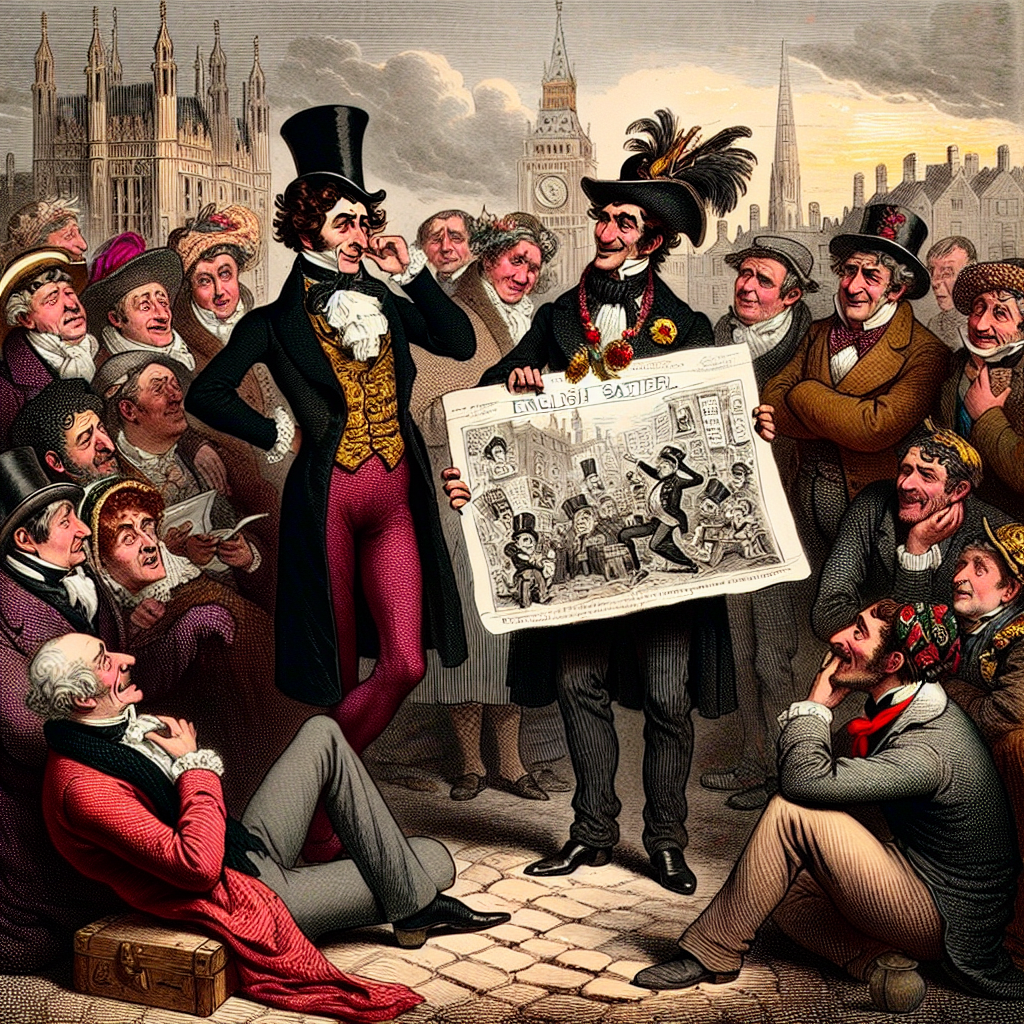
In the vast universe of language and literary forms, satire holds a special place for its unique ability to entertain and critique simultaneously. For English learners, grasping satire can be a delightful yet challenging endeavor. Unlike straightforward humor, satire goes beyond making people laugh; it serves as a mirror reflecting society’s follies, vices, and absurdities, aiming not just for a chuckle but to inspire thought and provoke change.
It’s a form of artistic expression that has been in existence for centuries, wielded by authors like Jonathan Swift and Mark Twain. These writers used satire to highlight societal issues, forcing audiences to confront uncomfortable truths wrapped in wit and irony. However, understanding satire can be akin to unraveling a complex web, especially for those still navigating the tricky waters of idioms, slang, and cultural contexts inherent in the English language.
To appreciate English satire requires more than just translating words. It calls for understanding context, recognizing nuances, and appreciating sharp wit. This article aims to demystify English satire, breaking it down into digestible insights that ESL learners can grasp and enjoy. We will explore what satire means, how it differs from simple humor, the role it plays in society, the challenges of interpreting it, and strategies to understand and appreciate its layers.
Defining Satire
At its core, satire is a genre that uses humor, irony, and exaggeration to expose and criticize human vice or folly. While similar to comedic storylines that evoke laughter, satire distinguishes itself by the gravity of its intent: to provoke thought and inspire reform. It’s not merely about being funny; it’s about creating a platform for discussions on significant issues such as politics, culture, and morality.
Satire often manifests in various formats, including writings, performances, and visual arts. Classic works like “Gulliver’s Travels” or “Animal Farm” serve as poignant examples of how satire operates beyond surface-level mockery. In these works, the writers craft layered narratives that compel readers to think deeply about the societal structures and ideologies being critiqued.
Though often exaggerated, the underlying truths in satire are what resonate with audiences. An exaggerated depiction of a political situation, for instance, may seem comical, but it forces the audience to consider the absurdity of real-life issues. Herein lies the dual power of satire: its ability to amuse while prompting reflection and action.
Types of Satire
Satire broadly falls into two categories: Horatian and Juvenalian, each with distinct tones and purposes. Horatian satire is named after the Roman poet Horace and tends to be light-hearted, aiming to correct folly with gentle humor and mild mockery. It’s friendly satire, almost inviting laughter as a way of pointing a finger at human stupidity. A modern equivalent might be television shows like “The Simpsons,” which lightly poke fun at social and family dynamics.
In contrast, Juvenalian satire, named after the Roman poet Juvenal, is much more severe and scornful. It addresses social evil through outrage and ridicule, maintaining a dark and biting tone. Instead of inducing light-hearted laughter, Juvenalian satire aims to shock and provoke a deeper realization of societal wrongs. Think of works like George Orwell’s “1984,” a dystopian critique of totalitarian regimes, sparking outrage and critical thought among its readers.
Both types of satire serve vital functions and cater to different tastes and purposes. By understanding these types, ESL learners can better identify the tone and intent behind various satirical works, aiding in their comprehension and appreciation of English satire.

The Role of Satire in Society
Satire has played a pivotal role throughout history as a vehicle for social commentary and political critique. In societies where freedom of speech is restricted, satire becomes a powerful mode of resistance, cleverly bypassing censorship to highlight inequities and injustices. This subversive power of satire has led to its place as both a celebrated and controversial tool within the socio-political arena.
Historically, satirists have risked persecution to voice dissent and draw attention to societal flaws. For example, during the Enlightenment era, satirical writings stimulated debates and reforms, pushing the boundaries of free thought. Today, satire continues to be relevant through platforms like late-night talk shows and political cartoons, which tackle contemporary issues with sharp wit and humor.
In social culture, satire acts as a pressure valve, allowing individuals to express frustrations and concerns about their world in a palatable manner. This diffuses tension while fostering a collective understanding and acknowledgment of societal shortcomings. For ESL learners, understanding the role of satire enhances their cultural literacy, providing insights into the socio-political landscapes of English-speaking countries.
Challenges in Understanding Satire for ESL Learners
For many ESL learners, the intricate layers within satire can pose significant challenges. Language proficiency is one hurdle, as satire often relies on puns, wordplay, and idiomatic expressions that may not have direct translations. Moreover, cultural references that seem implicitly obvious to native speakers might be completely foreign to learners new to the cultural intricacies of English-speaking societies.
Additionally, the subtlety and indirectness inherent in satirical work can confuse those accustomed to more straightforward forms of communication. The irony and sarcasm that define satire don’t always resonate clearly across cultural and linguistic borders, sometimes leading to misunderstanding or offense instead of amusement and understanding.
Familiarity with specific cultural histories and current events is also crucial for interpreting satire accurately. Without this context, the satirical work’s full meaning and significance may be lost, diminishing its impact and humor. These nuances highlight why developing cultural competence and linguistic dexterity is critical for ESL learners aiming to decode satire effectively.
Strategies for ESL Learners to Appreciate Satire
Understanding satire demands a multifaceted approach that combines language skills, cultural awareness, and critical thinking. One effective strategy is immersion in the cultural and socio-political fabric of English-speaking communities. Engaging with English media, including news, films, and literature, can bolster an ESL learner’s understanding of context, thereby making them more attuned to satirical content.
Another practical approach is to explore annotated versions of satirical works. Annotations provide explanations of complex or culturally specific references, shedding light on the nuanced meanings and critiques within the text. Discussion groups, whether online or in academic settings, also present opportunities for learners to discuss and dissect satirical works, exchanging insights and clarifying misunderstandings.
Finally, cultivating a habit of reflecting on current events and societal issues within one’s own culture can provide a valuable frame of reference when engaging with satire from different contexts. This comparison can illuminate similarities and differences, enriching understanding and appreciation of satirical wit across the board.
Conclusion
English satire stands as a multifaceted genre that challenges, entertains, and educates, making it a crucial element of the language’s literary and cultural landscape. For ESL learners, mastering the art of understanding satire is a journey filled with linguistic challenges and cultural revelations.
Despite these challenges, the endeavor to comprehend satire offers considerable rewards. It unlocks a deeper appreciation of English literature and media, fosters critical thinking, and enhances cross-cultural understanding. By integrating linguistic skills with cultural knowledge and critical analysis, ESL learners can navigate the complex yet enriching world of English satire with confidence and enjoyment.
As learners progress, they find that satire not only sharpens their language skills but also equips them with a broader perspective on global issues and human behavior. This, in turn, enriches their language learning experience, making it more engaging, relevant, and impactful.





