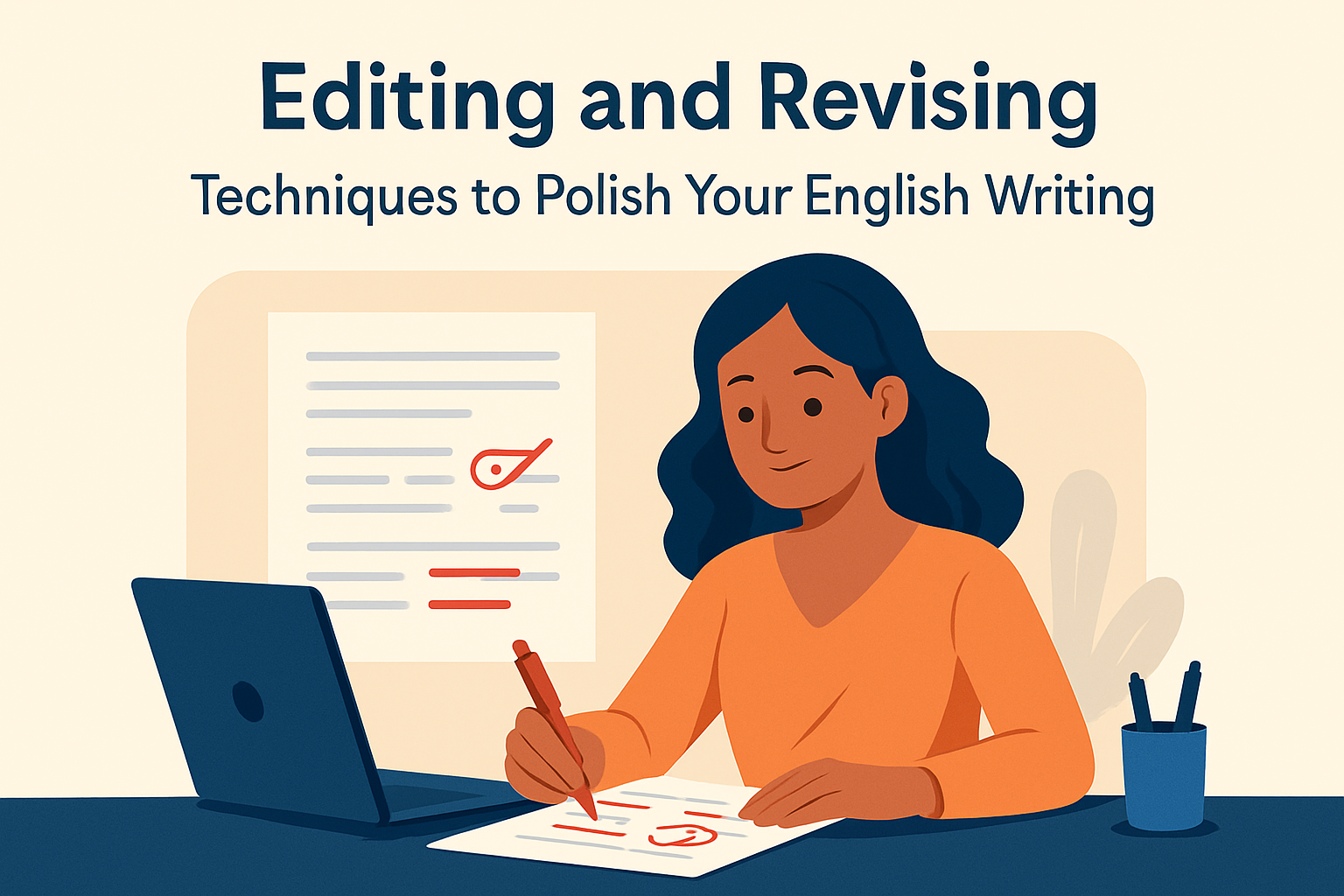
Introduction to Editing and Revising
Editing and revising are crucial processes in the art of writing. These steps go far beyond simple corrections of grammatical errors; they encompass a thorough evaluation of content, structure, and style to refine the writing into its best possible form. Understanding and implementing effective editing and revising techniques can elevate your writing from good to exceptional. But what do these terms actually mean? Editing involves making corrections, clarifying ideas, and enhancing the flow of the text. Revising, on the other hand, means re-envisioning the work and possibly making significant changes to improve clarity and impact. Together, these tasks are essential for ensuring your message is clear, concise, and compelling—qualities that are particularly important in English writing where clarity and precision are crucial.
Why does this matter? Whether you’re composing an academic essay, crafting a business report, or writing a novel, the quality of your writing can determine its success. Errors and unclear writing can lead to misinterpretations, reduce credibility, and ultimately, disengage your audience. By polishing your work through careful editing and revising, you ensure that your writing is not only free of errors but also engaging and easy to read. This article delves into the techniques of editing and revising, providing practical insights and real-world examples to help you hone your skills.
Techniques for Editing: Ensuring Clarity and Precision
Editing primarily focuses on grammar, punctuation, spelling, and syntax. It’s about going over each sentence to ensure it is technically correct. Consider the task of editing a corporate email: the content must be precise, and free from typos as errors can lead to miscommunication. For instance, writing “lose” instead of “loose” could misguide the interpretation of the entire sentence. Thus, every word must be checked for accuracy.
Case in Point: Common Mistakes
Let’s consider a real-world scenario. Suppose you’re a product manager drafting an email to launch a new product. An error such as “definitely” spelled as “definably” can drastically change the interpretation of your message. Employing simple read-aloud techniques or using software tools that highlight grammatical errors can prevent such issues.
For practical editing, use a checklist:
- Zero in on homophones: they sound alike but have different meanings, like “there” and “their”.
- Consistency in tense and point of view.
- Avoid passive voice unless necessary—active sentences are often more direct.
- Keep sentences succinct; break lengthy ones into smaller, more digestible parts.
Revising for Effective Communication
While editing addresses surface-level errors, revising is about looking at the big picture—the content itself. It involves reevaluating the arguments, rearranging sections for better flow, and sometimes, rewriting paragraphs for clarity.
Overhauling Your Draft: A Narrative Example
Imagine you’re writing a short story. During the initial drafting phase, you may write freely to get your ideas on paper. Upon revising, you realize that the introduction lacks a hook to capture readers’ attention. By rewriting the beginning to introduce a dynamic scenario or an intriguing question, you instantly make your story more engaging.
Consider the following points while revising:
- Are your ideas clearly articulated and logically arranged?
- Does the introduction effectively set up what follows?
- Is your argument or narrative coherent and compelling through to the conclusion?
- Are there redundant sections that can be eliminated to strengthen the message?
An effective approach to revising includes stepping away from your work for a period after completing it. This break allows you to return to the text with fresh eyes, making it easier to spot inconsistencies and areas where the flow can be improved.
Focusing on Style: Voice and Tone Adjustment
Writing style is your unique fingerprint; it’s how you express your thoughts and ideas. Editing and revising should include an assessment of whether your voice or tone is appropriate for the intended audience.
Tailoring Tone: An Instructional Guide
Suppose you’re tasked with composing an instructional guide for beginners learning to bake. Your tone should be friendly and encouraging, rather than formal and terse. A phrase like “You must meticulously weigh every ingredient” can be softened to “Carefully weighing your ingredients ensures the best results!”
Stylistic considerations include:
- Sentence rhythm: Vary sentence length to maintain reader interest.
- Word choice: Opt for words that match the reader’s level of understanding.
- Imagery and descriptions: Use vibrant language to create mental pictures and elicit emotional responses.
Employing synonyms or analogies can greatly enhance the style, making the content more vivid and engaging.
Visualizing the Revision Process
The revision process can be broken down into steps that help ensure thorough evaluation and modification. Consider organizing your tasks into a table for clarity and efficiency:
| Step | Action | Purpose |
|---|---|---|
| 1 | Read the draft aloud | Identify awkward phrasing and clarity issues |
| 2 | Check overall structure | Ensure logical flow and coherence |
| 3 | Focus on individual paragraphs | Evaluate unity and focus |
| 4 | Refine sentences | Enhance clarity and conciseness |
| 5 | Style and tone review | Adjust to suit the audience and purpose |
Summing Up the Importance of Editing and Revising
Editing and revising are not merely steps in the writing process; they are integral components that ensure your writing communicates precisely what you intend. By addressing both surface-level errors via editing and deeper structural issues through revising, you significantly enhance the readability and efficacy of your text. From educational content to business communications, mastering these techniques allows you to present your ideas assertively and engagingly.
The editing and revising process might seem daunting at times, but its benefits are profound. Whether improving grammar, reorganizing content, or refining style and tone, these efforts lead to better communication and a greater chance of achieving your writing goals. So, the next time you draft a piece, dedicate ample time to these polishing phases. You’ll find that the outcome is not only free from errors but also able to capture and maintain the reader’s interest more effectively.
As a final call to action, embrace the practice of editing and revising as an essential part of your writing routine. Incorporate these techniques, experiment with them, and watch how they transform your writing into a polished, compelling, and professional piece. Remember, great writing rarely emerges from the first draft—it is revealed through the careful craft of revision.
Frequently Asked Questions
1. What is the difference between editing and revising?
Great question! Editing and revising are both essential parts of the writing process, but they focus on different aspects to help enhance your work. Editing is primarily concerned with correcting grammatical errors, improving clarity, ensuring proper sentence structure, and maintaining consistency throughout the piece. This includes attention to accurate punctuation, spelling, and adherence to a particular style guide if necessary. When you’re editing, you’re essentially polishing your writing to ensure it reads well and adheres to standards of good language use.
Revising, on the other hand, goes deeper and involves a broader evaluation of the content and overall message. This process is about reassessing the ideas, arguments, and structure. During revisions, you might decide to reorganize paragraphs for better flow, add or delete sections to enhance understanding or shift the focus of the narrative to make your point more compelling. Revising is often more creative and reflective than editing and often requires a critical look at how every part of your writing contributes to the whole. Together, these processes can turn a decent draft into a finished work that showcases your best writing.
2. How do I decide what needs editing or revising in my writing?
Understanding what needs editing or revising starts with a clear objective: knowing what you want your writing to accomplish. Begin by reviewing the overall structure; is the introduction engaging, is the conclusion satisfying, and do the body paragraphs logically convey the intended message? For editing, read through your work with a critical eye for errors in grammar and syntax—consider reading it out loud to catch awkward phrasing or punctuation mistakes you might otherwise miss. Tools like spelling and grammar checkers can help catch basic errors, but don’t rely solely on them as they can miss contextual issues.
When it comes to revising, focus on the coherence of your arguments or narrative. Ask yourself questions about clarity: Can a reader follow your logic from one point to the next? Are your arguments supported with evidence, or are there gaps to fill? This step may involve brainstorming and even rewriting sections to better convey your ideas. You should be open to removing parts that don’t serve the piece’s purpose or adding more detail where necessary. Having someone else read your draft can also provide an objective perspective, often highlighting areas that need attention you might have overlooked.
3. Are there any specific techniques for effective editing?
Absolutely, there are several editing techniques that can vastly improve your writing. Start with a ‘big picture’ read-through to ensure there are no major inconsistencies in your narrative or argument. Then, move into more detailed edits. One useful technique is to focus on one type of error at a time. For example, you might first comb through your work looking solely for tense consistency, then on a subsequent pass, focus on paragraph transitions or logical coherence.
Reading your work backwards—sentence by sentence, or even paragraph by paragraph—can help you identify errors you might miss when reading it in its normal flow, since this method forces you to see each part as a standalone piece. This technique is particularly valuable for detailed line editing. Additionally, using style guides, such as The Chicago Manual of Style or what your particular audience requires, can provide valuable guidelines for structuring your edits.
4. What are some strategies for a successful revision process?
Revising effectively often requires stepping away from your work for a bit to return with fresh eyes. After taking a break, start by reassessing your thesis or main argument—is it clear and strong? Does your introduction cover what is to come? Establish whether your supporting evidence is robust enough to substantiate your claims. During the revision process, you may have to be ruthless in cutting unnecessary words or redundancy to tighten your prose.
Consider creating an outline after drafting. Putting your content into an outline format during revisions can show you where there may be structural weaknesses or a need for additional information. Additionally, try to view your work from the reader’s perspective—what questions might they have as they read, and are those answered in your writing? Collaboration can be incredibly helpful here; peer feedback can uncover areas for improvement that you might not have noticed.
5. How can I maintain my voice while editing and revising my work?
One of the main challenges writers face during editing and revising is balancing corrections and improvements with maintaining one’s unique voice. Your voice is the personality and style that comes through your writing, making it authentically yours. To preserve this while refining your work, consistently ask yourself if the changes are enhancing clarity while still sounding like you. Read your edits out loud—does it still capture the essence of what you initially wrote?
If you find that your voice is getting lost, try to pinpoint why the writing felt authentic initially. Reflect on your typical language use, tone, and the way you typically present ideas. If necessary, revisit earlier drafts focusing specifically on how you originally captured your voice there, incorporating this natural style into your refined draft. It is often in the subtle word choices and expressions that your unique voice lies, so aim to refine those rather than eliminate them.