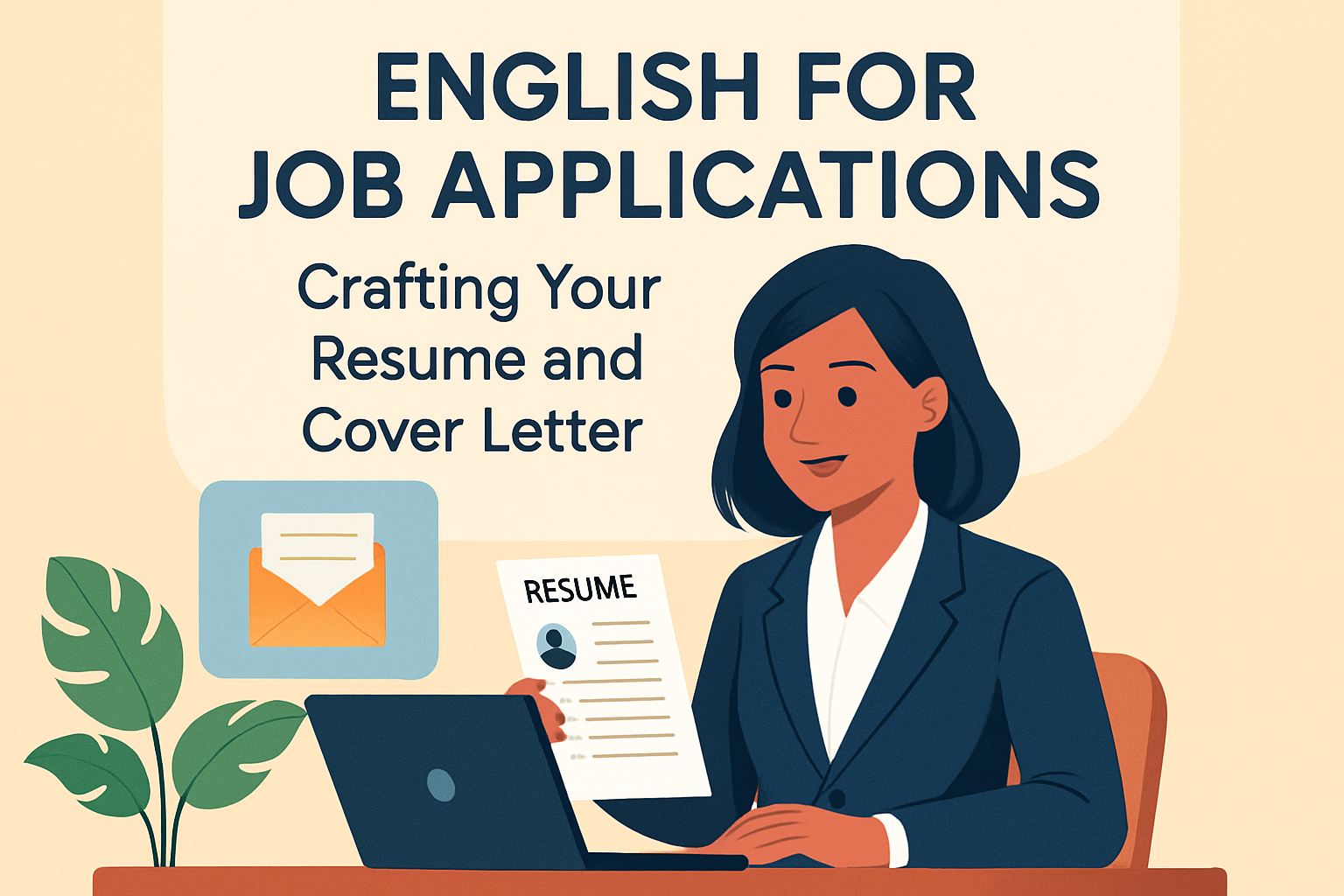
In today’s competitive job market, having a polished resume and cover letter is not just beneficial, but essential. They are often your first introduction to potential employers, making the difference between getting an interview and having your application dismissed. The importance of mastering English for crafting these documents cannot be overstated, especially in industries and regions where English is the primary language of business. This article aims to guide you through the nuances of creating a strong resume and cover letter, enhancing your job prospects significantly.
A resume is a formal document that itemizes and summarizes your education, work experience, skills, and accomplishments, tailored for a specific job application. Meanwhile, a cover letter accompanies your resume, offering a brief introduction and detailing why you are suitable for the job. Both documents must be impeccably written and well-organized to make a compelling case for your candidacy.
Investing time and effort into crafting these documents ensures that you present yourself as a professional, articulate candidate. This not only increases your chances of securing an interview but also leaves a lasting impression on hiring managers. With that in mind, let’s delve deeper into how you can effectively write an impressive resume and cover letter in English.
Resume Writing: Structure and Content
Getting the structure and content of your resume right is fundamental. Typically, a resume should include sections such as contact information, a professional summary or objective, work experience, education, skills, and potential additional sections like certifications or volunteer experience. Each of these sections should be meticulously crafted to highlight your most relevant experiences and skills.
For example, consider John, a recent college graduate applying for his first job in software development. John’s resume begins with his contact information, followed by a professional summary: “Recent Computer Science graduate with strong analytical skills and experience in software development, eager to contribute to innovative projects at XYZ Corporation.” His work experience section highlights internships that involved programming and team collaboration, while his education section lists his degree and relevant coursework. In his skills section, John includes languages like Java, Python, and SQL, along with soft skills such as problem-solving and teamwork.
When crafting your resume, ensure that each section aligns with the job description, using specific keywords the employer is looking for. Tailoring your resume to the job not only helps in passing through applicant tracking systems but also makes it easier for hiring managers to see your potential as a fit for the role.
Cover Letter Crafting: Purpose and Personalization
A cover letter serves as a complement to your resume. Its purpose is to elaborate on your resume by describing why you are uniquely qualified for the position. This document should express your enthusiasm for the role and the company, as well as your understanding of both.
Lisa, an experienced marketing professional, provides an excellent example of an impactful cover letter. After addressing it to the hiring manager by name, she starts with a compelling introduction: “With over five years of experience in digital marketing and a proven track record of increasing online engagement, I am excited to apply for the Marketing Manager position at ABC Corporation.” Lisa then recounts a specific instance where her strategy led to a significant boost in company sales, tying it back to how she can bring similar success to ABC Corporation. She concludes by expressing her eagerness to discuss how she can contribute to the company’s goals.
Your cover letter should be personalized for each application. Research the company, understand its culture, and weave that information into your letter to demonstrate genuine interest. A generic letter fails to stand out; a personalized one, however, shows that you have invested time and effort, making you a more attractive candidate.
Using Action Words and Quantifiable Achievements
Both resumes and cover letters benefit from the strategic use of action words and quantifiable achievements. Action words, such as “developed,” “managed,” and “implemented,” convey confidence and proactivity. When paired with quantifiable achievements, these words vividly illustrate your capabilities.
Imagine Sarah, a project manager, stating in her resume: “Led a cross-functional team of 10 to deliver a project three weeks ahead of schedule, resulting in a 15% reduction in costs.” This statement not only showcases her leadership skills but also provides measurable evidence of her impact, which is far more convincing than a vague claim.
To consistently integrate this principle, utilize a list to compare weak versus strong statements:
- Weak: “Responsible for a team” vs. Strong: “Supervised a team of 8, enhancing productivity by 20%.”
- Weak: “Worked on market analysis” vs. Strong: “Conducted comprehensive market analysis that informed strategic planning, increasing revenue by $50,000.”
By focusing on specific achievements measurable with data, you can clearly communicate your value and past contributions, thus increasing your appeal to potential employers.
Formatting and Design: Creating a Visual Impact
While the content of your resume and cover letter is paramount, the presentation also plays a critical role. A clean, professional format ensures that your documents are easy to read and navigate, providing a positive first impression.
Consider the following table that outlines essential formatting elements:
| Element | Recommendation |
|---|---|
| Font Style | Use simple, professional fonts like Arial or Times New Roman. |
| Font Size | Body text should be 10-12 points; headings can be larger. |
| Margins | Set margins to 1 inch on all sides for ample white space. |
| Bullet Points | Use for listing experiences and achievements to enhance readability. |
| Structure | Organize sections logically and consistently. |
By adhering to these guidelines, you ensure that your resume and cover letter are not only content-rich but visually appealing as well, increasing the likelihood of engaging a potential employer’s attention.
Common Mistakes to Avoid
Despite best efforts, there are common pitfalls that many applicants fall into when crafting their resumes and cover letters. Recognizing and avoiding these errors can significantly enhance the quality of your application.
One frequent mistake is using overly complex language or jargon that may not be understood by everyone. While industry-specific terms are sometimes necessary, clarity should always be the priority. Additionally, many candidates neglect to thoroughly proofread their documents, resulting in spelling and grammatical errors that undermine professionalism.
Another common issue is failing to customize each application, which was highlighted in Jennifer’s case. She submitted a generic cover letter for multiple job postings and received limited responses. Once she tailored each letter, referencing specific company names and job details, she received noticeably more interview invitations.
Avoid duplicating content across your resume and cover letter; each should serve its unique purpose. Similarly, ensure your contact details are current and correct—these are minor mistakes that can have major repercussions.
Conclusion: Your Path to Success
Crafting an effective resume and cover letter in English is more than stringing together your experiences and qualifications; it’s about communicating your value, aligning with your potential employer’s needs, and standing out in a sea of applicants. Through this article, we have outlined the vital components to include, the power of personalization, the importance of quantifiable achievements, and key formatting guidelines, all of which contribute to a compelling application.
By avoiding common mistakes and ensuring your documents are both content-rich and visually appealing, you set the stage for success. As you prepare your applications, remember that each job opportunity represents a distinct chance to showcase your capabilities. Prioritize clarity, relevance, and precision, and don’t be afraid to let your enthusiasm and unique qualities shine through.
Now that you are equipped with these insights, take the next step: revisit your existing resume and cover letters, apply these strategies, and enhance them. This improved approach will undoubtedly position you as a strong candidate, increasing your chances of securing the interviews and job opportunities you have been aiming for.
Frequently Asked Questions
1. Why is it important to customize my resume and cover letter for each job application?
Customizing your resume and cover letter for each job application is crucial because it shows potential employers that you have a genuine interest in the position and that you’ve taken the time to understand their company’s goals and needs. Think about it: a generic application might pass you by unnoticed, but a tailored one will likely catch a hiring manager’s attention. When you personalize your documents, you highlight the specific skills and experiences that make you a perfect fit for that particular job. Rather than presenting yourself as a jack-of-all-trades, you come across as the precise solution to the employer’s specific problem—this approach is always more appealing! Moreover, customization allows you to strike the right tone and adapt your language to match the company’s brand and culture, which can further increase your chances of landing an interview.
2. What are the key components of an effective resume?
An effective resume generally includes several essential components. First, there’s the header, which should clearly present your name and contact information, making sure these elements are easy to read and prominently placed. Next, a strong professional summary or objective statement is crucial—this is where you capture the reader’s interest with a brief, compelling overview of your career and what you bring to the table. Following this, your work experience section should be meticulously detailed. Each job should list not just your duties, but your accomplishments, demonstrating how you’ve made an impact at previous positions. Quantify these achievements whenever possible—numbers resonate more than abstract descriptions. Additionally, your education and certifications need to be clearly stated, particularly those that are relevant to the position you’re applying for. Skills should also be tailored to the job, listed in a way that makes them obvious to the hiring manager. Lastly, consider including any relevant volunteer work or projects that showcase skills pertinent to the job. Remember, concise and relevant information is key—don’t overwhelm the reader with unnecessary details!
3. How can I ensure my cover letter complements my resume?
Think of your cover letter as your sales pitch where you highlight your most relevant strengths and elaborate on how they align with the job role. While your resume lists facts and experiences, your cover letter offers the narrative that connects these dots. To ensure your cover letter complements your resume, start by referencing the job description and outlining how your background fits the requirements. Use the same language and keywords found in the job posting—this serves to pass both manual reviews by hiring managers and automated ATS scans that might be in place. Differentiate your cover letter by including some personality—this is an opportunity to convey enthusiasm and a bit of who you are beyond the bullet points. Moreover, rather than rehashing your resume, use the cover letter to explore particular achievements in detail and discuss how these motivate your interest in the job and align with your career goals. By doing so, you create a cohesive application package where both documents work harmoniously to sell you as the best candidate for the position.
4. What language and tone should I use in my resume and cover letter?
When crafting your resume and cover letter, it’s critical to strike the right balance in terms of language and tone. Both documents should aim to be clear, concise, and professional. Jargon or overly complex language can impede understanding, so focus on industry-standard terms that clearly communicate your skills and achievements. As a rule of thumb, use active voice and strong, direct language—phrases like “led a team,” “increased sales,” and “developed a strategy” convey assertiveness and ownership of your accomplishments. When it comes to tone, consider aligning with the company culture. Many modern companies appreciate a personable tone while maintaining formality, so it’s useful to do a bit of research on the company’s communication style and brand image. Avoid cliches and vague terms that don’t convey real value to the employer. Instead, be specific and genuine in your claims to make a memorable impression.
5. How can I get past applicant tracking systems (ATS) with my resume?
getting past Applicant Tracking Systems (ATS), the software that many companies use to filter and rank applications, can be a challenging but vital step in your job application process. First, you need to ensure your resume is formatted correctly—simple, straightforward designs often work best because complex graphics and unusual fonts can confuse ATS software. Use standard headings like “Work Experience,” “Education,” and “Skills” to avoid misclassification of your sections. Another critical strategy is to include keywords from the job description in your resume, as these are often what ATS software is programmed to look for when filtering candidates. Be sure to use natural language rather than excessive ‘keyword stuffing,’ as this is detectable to both ATS and hiring managers. Lastly, avoid using headers and footers, and if possible, submit your resume in Word format, as some ATS have trouble parsing PDFs, potentially discarding your application before it even gets seen by a human. By focusing on these details, you significantly improve your chances of making it past ATS filters and into the hands of a recruiter.