In the realm of languages, English often serves as a gateway to understanding global cultures, professions, and fields of study. The language of art and design, however, transcends standard verbal communication, allowing for the expression of ideas and emotions through visual representation and aesthetics. As an ESL learner, enriching your vocabulary with terms from art and design not only broadens your linguistic capabilities but also cultivates a deeper appreciation of creativity and craftsmanship. This comprehensive guide will walk you through essential vocabulary associated with art and design, offering definitions, context, and practical applications to bolster your understanding.
Art and design vocabulary can empower you to communicate effectively about various forms of creative expression, whether you’re discussing a painting’s style, a sculpture’s form, or the conceptual framework of a design project. From painters and architects to graphic designers and fashion creators, each artist contributes uniquely to this vibrant field using a language that is rich in terminology yet universally understood.
The Basics of Art Vocabulary
To start with the vocabulary of art, it’s essential to familiarize yourself with fundamental terms. The term ‘art’ itself encompasses a multitude of expressions, often categorized broadly into several disciplines like visual arts, performing arts, and literary arts. Within visual arts, words like ‘medium’, ‘composition’, ‘palette’, and ‘perspective’ frequently appear. Knowing these keywords will equip you to articulate discussions about art pieces, whether describing the ‘medium’—the material used by an artist such as oil, watercolor, or charcoal—or ‘composition’ which refers to the arrangement of elements in a work.
The word ‘palette’ signifies the range of colors used by an artist, which is crucial when analyzing a painting’s mood or thematic presentation. ‘Perspective’, on the other hand, relates to the technique of depicting spatial depth, a skill mastered by greats like Da Vinci. These foundational terms bridge the gap between artist intent and audience interpretation, allowing art to be appreciated on multiple levels.
As you delve deeper, terms like ‘abstract’, ‘figurative’, and ‘still life’ become important. ‘Abstract’ art refers to artworks that do not attempt to represent an accurate depiction of visual reality. ‘Figurative’ pertains to art derived from real object sources, while a ‘still life’ depicts inanimate subjects, typically commonplace objects. A familiarity with these concepts will allow you to classify art effectively and convey your interpretations clearly.
Understanding Design Vocabulary
Design, much like art, boasts its own lexicon. Design vocabulary serves a crucial role across various specializations such as graphic design, interior design, and industrial design. Terms like ‘balance’, ‘proportion’, ‘contrast’, and ‘harmony’ are staples in discussions about design. ‘Balance’ in design pertains to the even distribution of visual weight, whereas ‘proportion’ involves the relationship in size between elements in a design.
Words like ‘contrast’ and ‘harmony’ help describe the visual and functional relationship between elements. ‘Contrast’ emphasizes differences, making designs stand out, while ‘harmony’ ensures different elements work together cohesively. Mastering these terms enables you to critically evaluate design work effectively, understanding not just what you see but why it succeeds or fails in its intent.
Advanced vocabulary also includes ‘typography’, ‘aesthetics’, and ‘ergonomics’. ‘Typography’ refers to the art and technique of arranging type to make written language legible, readable, and appealing. ‘Aesthetics’, a broader term, takes account of the nature and expression of beauty in design. Conversely, ‘ergonomics’ integrates human factors into design to optimize comfort and efficiency.
Exploring Painting Vocabulary
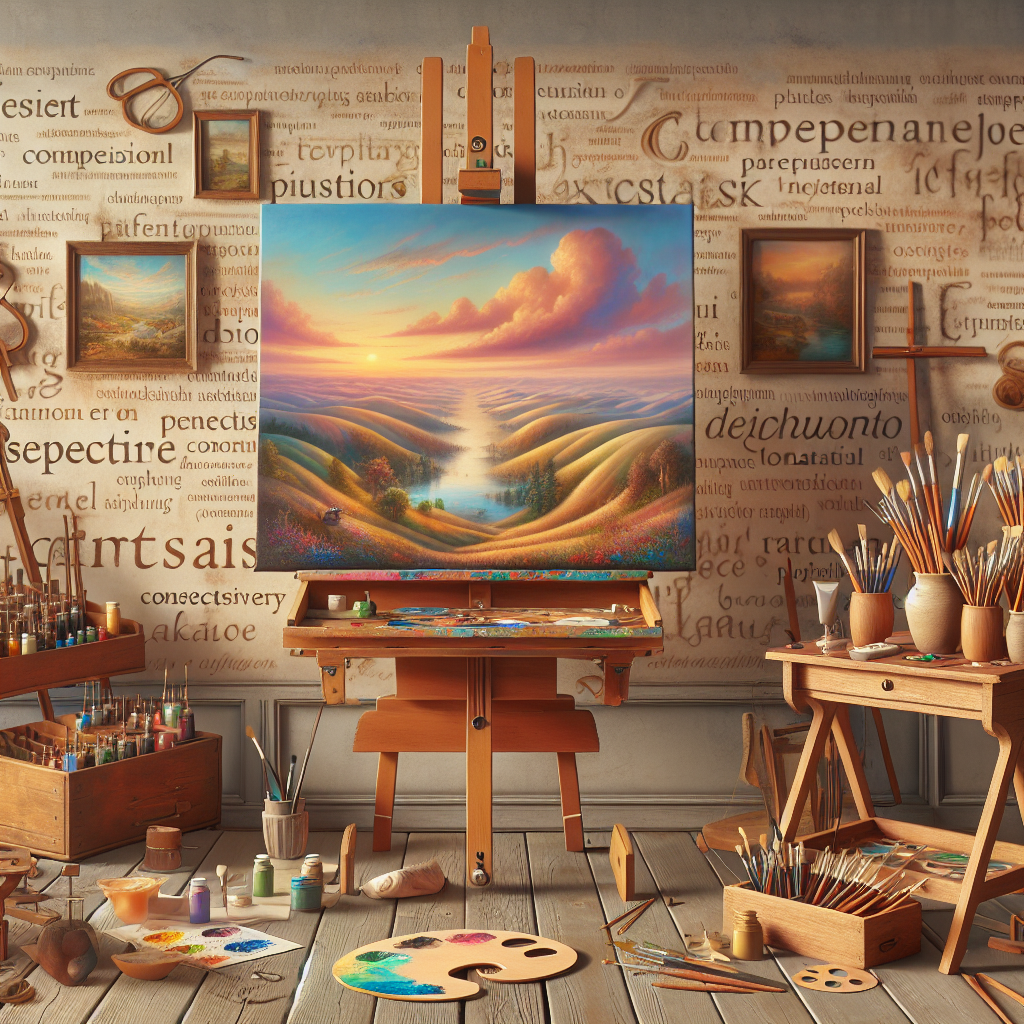
Painting, a profound form of visual art, utilizes an extensive palette of vocabulary that aligns with both form and technique. Terminology like ‘impasto’, ‘glazing’, and ‘underpainting’ reveals more about methods applied by artists to bring their vision to life. ‘Impasto’ involves applying paint thickly to the canvas, often to create texture as seen in Van Gogh’s works.
‘Glazing’, a technique using semi-transparent layers to build up texture and color, highlights a different facet of artistry—one of patience and detail. Meanwhile, ‘underpainting’ sets the tonal foundation by creating a monochromatic sketch over which other paints will be layered.
Further terms such as ‘chiaroscuro’, which describes the treatment of light and shade in drawing and painting, allow us to discuss not only the technical execution but the emotional tone conveyed. Similarly, ‘grisaille’—a method of painting in shades of grey—invites discussions around tone, depth, and drama in a composition. Learning these terms empowers you to interpret the cognitive and emotional facets of a painting better.
Unveiling Sculpture Vocabulary
Sculpture, whether traditional or modern, offers another rich vein of vocabulary to explore. Key terms like ‘carving’, ‘casting’, and ‘assemblage’ define types of sculptural processes. ‘Carving’ involves subtracting material to reveal form, a method used prominently in wood and stone creations. ‘Casting’ involves creating a sculpture by pouring a liquid material like bronze or plaster into a mold, a practice dating back to ancient civilizations.
‘Assemblage’, akin to collage in the art world, involves piecing together disparate elements to form a new structure, often incorporating found objects into meaningful commentary. These processes, captured succinctly in vocabulary, tell the story of materiality and innovation within sculpture.
Furthermore, terms like ‘relief’, which describes sculpture that projects from a flat background, and ‘freestanding’, sculptures existing independently without external support, highlight the structural and contextual nature of sculptural art. Understanding these terms will not only aid in discussing the physical and conceptual aspects of sculptures but can also evoke the historical and cultural significance attributed to these works.
Exploring Photography Vocabulary
Photography, converging technology and creativity, brings forth a distinct set of terms including ‘aperture’, ‘exposure’, and ‘composition’. ‘Aperture’ refers to the opening through which light enters a camera, crucial for determining a photograph’s depth of field. ‘Exposure’ captures the amount of light reaching the camera sensor, shaping the brightness of the photograph.
‘Composition’, a term shared with painting and drawing, directs the organization of elements within the frame. Mastery of composition can shift a photo from mundane to remarkable by emphasizing balance, focus, and movement. Understanding these terms allows for precise articulation of photographic practices and critiques.
Additional vocabulary like ‘depth of field’, denoting how much of a photograph is in sharp focus, and ‘ISO’—a setting controlling the camera’s sensitivity to light—further enrich your photographic dialogue. Familiarity with photography terms not only enhances your ability to analyze photos but also elevates your practice in photography, whether hobbyist or professional.
The Role of Vocabulary in Artistic Interpretation
Vocabulary in art and design plays a crucial role in the interpretation and critique process. Learning how to interpret an artwork or a design project extensively relies on expressing opinions and insights with clarity and understanding. Terms like ‘symbolism’, ‘iconography’, and ‘contextualization’ guide discussions beyond initial visual impressions to delve into meanings layered within, influenced by culture, history, and personal narrative.
‘Symbolism’ refers to the use of symbols to signify ideas and qualities by giving them symbolic meanings that are different from literal sense. Through ‘iconography’, art historians can identify and interpret the cultural significance of these symbols. ‘Contextualization’ enriches critiques by situating works within appropriate cultural, historical, and social paradigms.
Incorporating this vocabulary into discussions not only sharpens one’s analytical capabilities but also enriches conversations allowing for deeper, more meaningful engagement with the art. Bridging these terms with your observations will allow you to articulate thoughts effectively whether in educational settings, casual discussions, or professional critiques.
Conclusion: The Integrated Approach to Learning Art and Design Vocabulary
In conclusion, delving into the vocabulary of art and design opens new perspectives, empowering ESL learners in their communication about visual arts and aesthetics. Not only does this vocabulary enhance literary prowess, but it also cultivates a keen understanding of artists’ intentions, cultural significance, and philosophical impacts of art.
Developing a robust vocabulary in art and design gives learners the tools needed to engage profoundly with various artistic forms, leading not only to better appreciation but also to enhanced critical thinking and conversational skills. As you continue to explore and encounter different art forms, allow yourself to embrace both the common and sophisticated language that supports artistic expression.
Consider how each term contributes to the nuanced interpretation of works you encounter, whether it’s a classic painting, an innovative sculpture, or a contemporary design. Let each new word expand your perception, allowing for a richer, more contextual discourse in your journey of mastering English. Use resources such as art museums, galleries, design workshops, and online platforms to continuously update and practice your newfound vocabulary in real-world settings.
Ultimately, the integration of art and design vocabulary into your repertoire as an ESL learner not only enhances your language skills but also connects you more intimately with the world of creativity and expression. Relish this journey of discovery as you uncover the depths of communication through the lens of art and design.