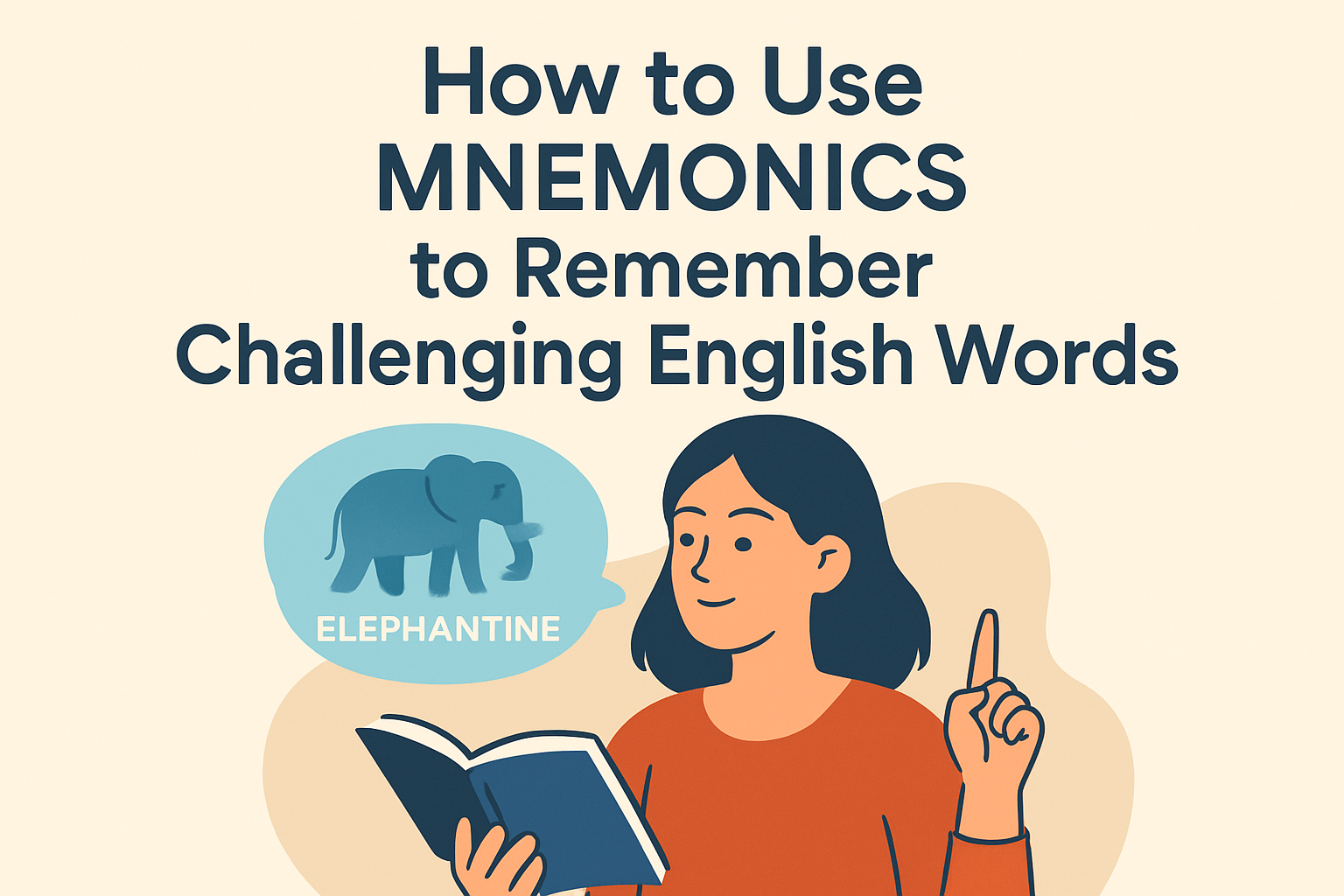
In a world where communication reigns supreme, mastering language becomes a powerful tool. Among the language skills one can develop, having a robust vocabulary is indispensable. However, memorizing new and challenging English words can sometimes feel like an insurmountable task. This is where mnemonics come into play. Mnemonics, often described as memory aids or tricks, are techniques that aid in the retention and recall of information. They work by associating complex information with something simpler, often leveraging rhymes, acronyms, visual imagery, or stories to make the information memorable. As words form the backbone of effective communication, having the ability to remember and accurately use challenging words can enhance both personal and professional interactions. In this article, we will delve into the world of mnemonics, exploring its various types and showcasing how these mnemonic techniques can be effectively utilized to remember challenging English words.
The Visual Mnemonic Method
Visual mnemonics rely on creating vivid and often exaggerated mental pictures to help remember information. These images can be bizarre, humorous, or straightforward, but the key is that they should be memorable and directly associated with the word you’re trying to remember. For example, consider the word “gregarious,” which means sociable. To remember this word, you can create a mental image of Greg, a friendly character who is always surrounded by a group of friends. This association makes it easier to recall the meaning of “gregarious” as being sociable or fond of company.
| Word | Visual Mnemonic |
|---|---|
| Loquacious | Picture a parrot named Lou, constantly chattering. |
| Vivacious | Visualize a lively character named Viv dancing energetically. |
| Cacophonous | Imagine a concert of clashing instruments in chaos. |
These mental images function as hooks on which your memory can attach the word’s meaning, ensuring the retention of the word far better than mere rote memorization.
Using Acronyms and Acrostics
Acronyms and acrostics are another effective mnemonic methodology, typically more useful when dealing with a set of words or a phrase rather than a single, specific word. Acronyms create a new word from the initial letters of a series of words. For instance, to remember the order of operations in mathematics, students use the phrase “PEMDAS,” which stands for Parentheses, Exponents, Multiplication and Division, and Addition and Subtraction.
Similarly, acrostics are phrases in which the initial letters of each word correspond to the words you’re trying to remember. For example, if you wanted to remember the words “prolific,” “affluent,” “meticulous,” and “excursion,” you might devise the acrostic phrase: “Peter Ate Many Eggs.” Here, each word in the sentence helps to recall the first letter of the vocabulary terms being memorized.
This technique simplifies the process of memorization by breaking down complicated sequences into manageable pieces, making the learning experience both effective and engaging.
The Storytelling Approach
Stories are inherently memorable because they engage our emotional and cognitive faculties, making them a powerful mnemonic device. The storytelling approach involves crafting a short, imaginative story that incorporates the word that needs memorizing. For instance, the word “ebullient,” which describes someone or something displaying a lively enthusiasm, can be remembered through a tale about an effervescent bull named Ebull who leads a parade with exuberant energy and zest.
Here is a brief outline of how a storytelling mnemonic can be structured:
- Identify the word and its definition.
- Create a character or context that embodies the word.
- Develop a short narrative that illustrates the word in action.
- Create a concluding event that reinforces the word’s meaning.
Such stories, while seemingly simple, harness the power of narrative, making those elusive words stick in our long-term memory. The emotional connection stories often elicit makes this approach especially effective for learners of all ages.
Rhyme and Alliteration Techniques
Rhyme and alliteration are classic mnemonic devices that capitalize on the natural rhythm and sound patterns of language. By using rhyming words or phrases, the target word becomes easier to recall. Consider the word “perspicacious,” meaning having keen insight. A mnemonic rhyme you might use is, “A suspicious perspicacious guy, who sees through every lie.”
Alliteration, which involves repeating consonant sounds, can also be a useful mnemonic tool for remembering words or sequences. For example, if attempting to recall the word “malfeasance,” you might say, “Malfeasance makes many messes,” where the repeated ‘m’ sound helps reinforce the word.
These poetic devices, with their simple and repetitive sound patterns, resonate well with our brains, promoting easier recall of new vocabulary.
Chunking Information
Chunking is another effective mnemonic technique, particularly useful when dealing with longer lists or multi-part concepts. It involves breaking down a large set of information into smaller, more manageable units or “chunks.” For example, if you’re learning a list of adjectives like “capricious,” “benevolent,” “pugnacious,” and “intrepid,” you can group them based on their common characteristics or themes.
This technique relies on the brain’s natural ability to process ‘chunks’ of information. Using existing knowledge structures, chunking enables us to remember more effectively, organizing vast swathes of data in logical groupings. For vocabulary learning, this can mean categorizing words by their meanings or origins, which provides context and makes them easier to remember.
Key Takeaways and Further Steps
The vast array of mnemonic techniques available offers a wide palette of options for language learners looking to expand their vocabulary. Whether through captivating visual imagery, the playful structure of an acronym, the engaging context of a story, the memorable cadence of rhyme and alliteration, or the strategic organization of chunking, mnemonics provide practical pathways to learning. The key takeaway is finding the technique that resonates best with your cognitive style, maximizing your capacity to memorize and recall challenging English words.
Equipped with a new arsenal of mnemonic strategies, you are encouraged to experiment with different techniques to determine what best suits your individual learning preferences. Start by selecting a few challenging words and applying a chosen mnemonic device to each. With consistent practice, these new words will soon become a natural part of your vocabulary arsenal.
As you become more comfortable with using mnemonics, the task of memorizing complex English words will transform from daunting to rewarding. A powerful vocabulary not only enhances your personal and professional communication but also boosts your confidence and cognitive skills. So, take this opportunity to incorporate mnemonics into your language-learning journey and unlock the doors to more effective and enjoyable word mastery.
Frequently Asked Questions
1. What are mnemonics, and how can they help me remember challenging English words?
Mnemonics are essentially techniques or strategies that aid in memory retention and recall. They’re like little brain hacks that make remembering complex information much easier. When it comes to challenging English words, mnemonics can be particularly useful. They work by creating associations between the difficult word and something you already know or can easily recall. For example, if you’re trying to remember the word “lachrymose,” meaning tearful or mournful, you might use a mnemonic such as “Lachrymose sounds like ‘lack of Rose,’ so think of someone crying over a lost rose.” These mental connections make the word easier to recall when needed. The beauty of mnemonics is that they can be visual, auditory, or even kinesthetic, allowing you to tap into different sensory pathways for more effective learning. By utilizing mnemonics, you’re not just relying on rote memorization, but instead actively engaging with the vocabulary, which can lead to stronger and longer-lasting memories.
2. How can I create my own mnemonics for English vocabulary words?
Creating your own mnemonics is a creative and personal process that can be both fun and effective. To start, focus on the word you want to learn and break it down phonetically or morphologically. Look for familiar sounds, roots, or syllables that you can connect with something memorable. For example, if you want to remember the word “gregarious,” which means sociable, you might note that “greg” sounds like “group.” You could then create a visual or sentence, such as “Greg is always with a group because he’s sociable.” Another approach is to use imagery; visualizing vivid, often exaggerated or humorous images can make the association more memorable. If you’re trying to remember “ubiquitous,” picture an octopus with a big “U” on its head, sprawling everywhere like something that is ubiquitous or present everywhere. Using rhymes, acronyms, or stories can also enhance the mnemonic’s effectiveness. The key is to tailor them to what resonates with you personally, making them easier to retrieve from memory when you need them.
3. Can mnemonics be used for any type of vocabulary or are they better suited for certain words?
Mnemonics can be used for any type of vocabulary, but they are especially beneficial for words that are difficult, foreign-sounding, or lack a straightforward translation. While simple or commonly used words may not require additional memory aids, words that don’t have a clear connection to your daily language use can benefit from mnemonic devices. They are particularly effective for abstract concepts, technical jargon, or words with complex spellings. By crafting a mnemonic, you bridge the gap between unfamiliar territory and your current knowledge base. For instance, in the medical field, a mnemonic like “SOAP” – Subjective, Objective, Assessment, Plan – helps recall the format of clinical notes. In learning languages, such devices are invaluable for bridging cultural and linguistic differences. Ultimately, using mnemonics is about making challenging vocabulary more accessible, regardless of the type or context of the word.
4. Are there any limitations or downsides to using mnemonics for vocabulary building?
While mnemonics can be incredibly effective for vocabulary building, they do come with limitations that it’s important to acknowledge. One downside is that developing personalized mnemonics can be time-consuming, especially if you’re working with a large set of vocabulary words. Furthermore, relying solely on mnemonics without understanding the context or usage of a word may lead to knowing words in isolation without grasping how to apply them in real-life scenarios. Additionally, some people might find certain mnemonic techniques, such as visual imagery, less effective based on their personal learning style. Mnemonics are most effective when used as one component of a comprehensive language learning strategy, which includes practicing speaking, reading, and writing. Also, overcomplicated mnemonics might become confusing, so simplicity is often key. While mnemonics can provide a significant advantage in mastering difficult words, they should complement, rather than replace, other learning methods.
5. How do I know if the mnemonics I create are working effectively for me?
Determining the effectiveness of mnemonics is a matter of noticing improvements in recall and retention. Start by regularly testing yourself on the vocabulary words you’ve created mnemonics for. If you find that you can remember the words faster and with greater accuracy, it’s a sign that your mnemonics are working. Over time, you should also notice an increase in your confidence and comfort in using the vocabulary in conversation or writing. Pay attention to any patterns in the type of mnemonics that work best for you; some people may find visual mnemonics more effective, while others may prefer auditory or verbal connections. Reflecting on your learning process can also be valuable; if certain mnemonics aren’t as effective, consider revising them or trying different techniques. Remember, mnemonics are a highly individualized tool—it’s about finding what clicks for you personally to enhance your language learning journey.