
Skip to content
5 Minute English

5 Minute English

  • ESL Homepage
    • The History of the English Language
  • Lessons
    • Grammar – ESL Lessons, FAQs, Practice Quizzes, and Articles
    • Reading – ESL Lessons, FAQs, Practice Quizzes, and Articles
    • Vocabulary – ESL Lessons, FAQs, Practice Quizzes, and Articles
    • Listening – ESL Lessons, FAQs, Practice Quizzes, and Articles
    • Pronunciation – ESL Lessons, FAQs, Practice Quizzes, and Articles
    • Slang & Idioms – ESL Lessons, FAQs, Practice Quizzes, and Articles
  • ESL Education – Step by Step
    • Academic English
    • Community & Interaction
    • Culture
    • Grammar
    • Idioms & Slang
    • Learning Tips & Resources
    • Life Skills
    • Listening
    • Reading
    • Speaking
    • Vocabulary
    • Writing
  • Education
  • Resources
  • ESL Practice Exams
    • Basic Vocabulary Practice Exam for Beginner ESL Learners
    • Reading Comprehension Practice Exam for Beginner ESL Learners
    • Speaking Practice Exam for Beginner ESL Learners
    • Listening Comprehension Practice Exam for Beginner ESL Learners
    • Simple Grammar Practice Exam for Beginner ESL Learners
    • Complex Grammar Practice Exam for Intermediate ESL Learners
    • Expanded Vocabulary Practice Exam for Intermediate ESL Learners
    • Advanced Listening Comprehension Practice Exam for Intermediate ESL Learners
    • Intermediate Level – Reading and Analysis Test
  • Toggle search form

Confused or confusing – Lesson, FAQs, and Practice Quiz

When learning English, distinguishing between “confused” and “confusing” can be quite challenging for ESL students. These words, although related, function differently in sentences. “Confused” is an adjective that describes the state of being perplexed or unclear about something. It is used to express a feeling experienced by a person. On the other hand, “confusing” is also an adjective, but it describes something that causes confusion. This section aims to clarify the usage of these terms through practical examples and explanations, helping you to understand and use them correctly in everyday situations.

How do you know when something is confused or confusing? When the movie wasn’t so great, was I bored or boring? Does it make a difference if I tell my friend he’s annoyed or annoying?

It does. And there’s an easy way to know which one to choose.

Words that end with -ed talk about a person’s feelings.

Examples-

      1. John was so bored on his date. He really wanted to leave.

      1. Karen was annoyed with her employee. This employee was always late.

      1. Curt was confused about the new rules. They were very complicated.

      1. The children were excited about the school trip.

      1. Melanie was surprised to get a gift.

      1. The class was interested in the game.

    *****

    Words that end with -ing, however, talk about the situation or thing that cause a person’s feelings.
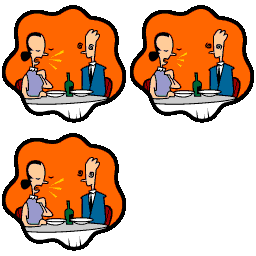
    Examples-

        1. The date was really boring. John wanted to leave.

        1. The employee was annoying. He was always late.

        1. The rules were confusing. They were complicated.

        1. The school trip was exciting.

        1. The gift was surprising.

        1. The game was interesting.

      So …

      John was bored/ the date was boring

      Karen was annoyed/ the employee was annoying

      Curt was confused/ the rules were confusing

      The children were excited/ the school trip was exciting

      Melanie was surprised/ the gift was surprising.

      The class was interested/ the game was interesting

      Practice Quiz on “Confused” and “Confusing”

      To further solidify your understanding, here’s a practice quiz with five questions. Each question will present a sentence where you have to decide whether “confused” or “confusing” should be used. This will help test your knowledge on the distinction between being in a state of confusion and encountering something that causes confusion.

      Choose the correct word

      1. I always feel excited/exciting when I take a vacation.

      2. The news was very interested/ interesting.

      3. Everyone was surprised/ surprising when Tom Cruise came to the party.

      4. Teri is always so confused/ confusing when she reads English.

      5. That loud TV is so annoyed/ annoying.

      6. When I am in the office, I am bored/ boring.

      Answer Key:

      1. excited (person’s feeling)

      2. interesting (situation that caused the feeling)

      3. surprised (person’s feeling)

      4. confused (person’s feeling)

      5. annoying (situation that caused the feeling)

      6. This is a trick question-

      If you say “I am bored,” you don’t feel happy or excited.

      If you say “I am boring,” other people feel bored because of you.

      Frequently Asked Questions About "Confused" and "Confusing"

      What is the difference between "confused" and "confusing"?

      “Confused” describes a person’s state of mind when they do not understand something (e.g., “I am confused by the instructions.”). “Confusing” describes something that is difficult to understand and causes confusion (e.g., “These instructions are confusing.”).

      Can "confused" and "confusing" be used interchangeably?

      No, they cannot. “Confused” refers to the emotional or mental state of a person, while “confusing” attributes the quality of causing confusion to an object or situation.

      How do I use "confused" in a sentence?

      You can use “confused” when talking about someone’s feelings of misunderstanding, for example, “She was confused about which road to take.”

      What are some examples of "confusing" used in a sentence?

      You can describe anything that makes understanding difficult with “confusing,” such as “The lecture was confusing,” or “His directions were confusing.”

      Is it correct to say "I am confusing"?

      Saying “I am confusing” means you are causing confusion to others, which is not typically intended. Usually, one would say “I am confused” to express personal difficulty in understanding.

      Helpful ESL Links

      • ESL Worksheets
      • List of English Words
      • Effective ESL Grammar Lesson Plans
      • Bilingual vs. ESL – Key Insights and Differences
      • What is Business English? ESL Summary, Facts, and FAQs.
      • English Around the World
      • History of the English Language – An ESL Review
      • Learn English Verb Tenses

      ESL Favorites

      • Longest Word in the English Language
      • Use to / Used to Lessons, FAQs, and Practice Quiz
      • Use to & Used to
      • Mastering English Synonyms
      • History of Halloween – ESL Lesson, FAQs, and Quiz
      • Marry / Get Married / Be Married – ESL Lesson, FAQs, Quiz
      • Have you ever…? – Lesson, FAQs, and Practice Quiz
      • 5 Minute English
      • Privacy Policy

      Copyright © 2025 5 Minute English. Powered by AI Writer DIYSEO.AI. Download on WordPress.

      Powered by PressBook Grid Blogs theme