
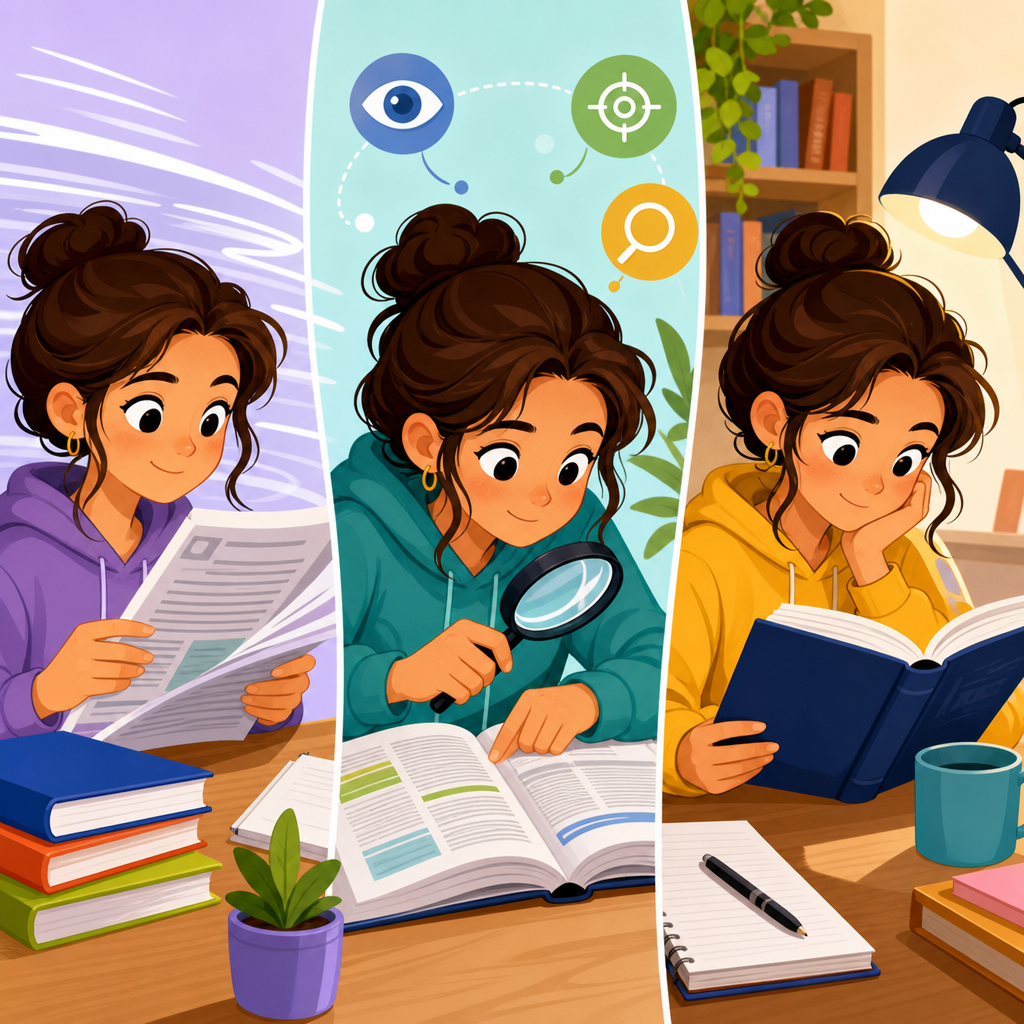
Academic success depends as much on how you read as on how much you read. Students often treat every page the same way, moving line by line whether they are checking a deadline in a syllabus, locating evidence in a journal article, or studying a theory for an exam. That approach wastes time and weakens comprehension. The stronger method is to match your reading strategy to your purpose by skimming, scanning, or reading deeply. These are not vague study tips. They are distinct, learnable techniques used in universities, test preparation, and research-heavy workplaces.
Skimming means reading quickly to grasp the main idea, structure, and tone of a text. Scanning means searching a text for a specific fact, term, date, name, or example without reading everything. Deep reading means slow, deliberate reading for full comprehension, analysis, and long-term retention. In my work with academic English learners, I have seen that many students struggle not because texts are impossible, but because they use deep reading when skimming would do, or skim when the assignment requires close analysis. Once they separate these modes, reading becomes faster and more accurate.
This matters in every discipline. A biology student may need to skim five articles before choosing one to study in detail. A history student may scan an archive for a date or policy term. A literature student may read a poem deeply, noticing diction, imagery, and argument. Standardized exams also reward strategic reading. IELTS, TOEFL, and university placement tests often require quick navigation through long passages, while seminar discussions and research papers demand precise understanding. Learning when and how to switch modes helps students save time, reduce fatigue, and produce better notes, stronger arguments, and more confident class participation.
When to Skim, Scan, or Read Deeply
The first question students should ask is simple: what is my purpose? If you need a general overview before class, skim. If you need one exact detail, scan. If you must evaluate an author’s claim, learn a method, or cite evidence accurately, read deeply. Purpose determines pace. Without that decision, students drift through texts inefficiently and often finish with poor recall.
Skimming works best at the start of the reading process. Before I assign full annotation, I tell students to read the title, abstract or introduction, headings, first sentences of major paragraphs, visuals, and conclusion. In a textbook chapter, this usually reveals the main argument and organization within five to ten minutes. In a journal article, skimming can show whether the paper is theoretical, empirical, or a literature review. That early map prepares the brain to absorb later detail.
Scanning is more targeted. You already know what you want, and you move your eyes strategically through the page looking for signals such as capital letters, numbers, repeated terminology, citation dates, or bold subheadings. For example, if a sociology assignment asks for the year a policy changed, scanning is faster than rereading the entire chapter. Digital reading makes this even easier with browser find functions, but students still need judgment because a keyword may appear in multiple contexts.
Deep reading begins when the text matters enough to justify full attention. This includes core readings, difficult arguments, methods sections, theoretical definitions, and passages you may quote. Deep reading is active. You pause, paraphrase, test the logic, connect ideas across sections, and note unfamiliar vocabulary in context rather than collecting isolated definitions. It is slower, but it prevents superficial understanding, which is the main cause of weak essays and confused seminar comments.
How to Skim Efficiently Without Missing the Main Point
Good skimming is selective, not careless. Start with the title and ask what problem the text seems to address. Then read the introduction for the central question or thesis. Move to headings because they reveal the sequence of ideas. Read topic sentences, since many academic paragraphs place the controlling idea near the beginning. Look closely at graphs, tables, examples, and conclusion paragraphs because authors often restate claims there in clearer language.
One practical method is the three-pass skim. On the first pass, identify the subject and purpose. On the second, mark the sections that appear most relevant or difficult. On the third, write a two-sentence summary in your own words. If you cannot summarize, you did not really skim; you only looked. This brief written check is especially useful before lectures, because it gives you a framework for listening and helps you ask sharper questions later in discussion. Students who want to improve participation can also build on this habit by reviewing guidance in this seminar questioning guide.
Skimming should not be used for everything. Dense philosophy, legal reasoning, and statistical interpretation can punish readers who move too fast. A common mistake is assuming that recognizing familiar terms equals understanding the argument. It does not. Skim to preview, prioritize, and predict. Then decide whether the text deserves deeper work.
How to Scan for Precise Information
Scanning is a search technique, and effective scanning depends on narrowing the target before your eyes hit the page. Define exactly what you need: a definition, a result, an example, a date, a theorist, or a formula. Then predict where that information is likely to appear. Definitions often sit near introductions or in bold terms. Results often appear in abstracts, findings sections, charts, or conclusion paragraphs. Examples may follow signal phrases such as for instance or such as.
Students often scan poorly because they search for whole sentences instead of visual anchors. Train yourself to notice typographic and structural clues: headings, bullet-like lists, parenthetical citations, numerals, italicized terms, and repeated names. On printed pages, use your finger or a pencil to guide downward movement; it reduces backtracking. On screens, zoom levels matter. Too much zoom hides structure; too little makes details disappear.
| Reading mode | Main goal | Best text features to use | Common mistake |
|---|---|---|---|
| Skimming | Get the gist and structure | Title, headings, topic sentences, conclusion | Reading every line too slowly |
| Scanning | Find one specific detail fast | Keywords, numbers, names, visual cues | Losing focus on the target information |
| Deep reading | Understand, analyze, remember | Full paragraphs, notes, cross-references, evidence | Highlighting without thinking |
A real example shows why scanning matters. In a public health article, a student may only need the sample size and the final conclusion for a comparison chart. Those details are usually easy to locate in the abstract and results section. Spending thirty minutes reading every paragraph before recording two facts is inefficient. Scanning lets you gather essential data quickly, then reserve your energy for the sources that truly require analysis.
How to Read Deeply for Understanding and Retention
Deep reading is where academic learning becomes durable. Start by slowing down enough to notice the author’s moves: claim, evidence, method, limitation, and implication. In research articles, pay special attention to definitions and methods because later arguments depend on them. In humanities texts, track how examples support interpretation. In textbooks, identify cause-and-effect relationships, classifications, and contrasts. These patterns are the skeleton of comprehension.
Annotation works when it is purposeful. Instead of highlighting large blocks, label the function of a sentence: thesis, evidence, counterargument, assumption, key term, or question. I advise students to write short margin notes such as “main claim,” “example only,” or “important limitation.” This creates a usable record for later review. Cognitive science supports this approach. Generative note-making, where learners restate ideas in their own words, generally improves recall more than passive rereading.
Deep reading also requires strategic pauses. After a section, close the book or look away from the screen and explain the idea aloud or in writing from memory. This retrieval practice exposes gaps immediately. If you cannot explain the passage simply, reread only the part that failed. Another effective method is to build a question chain: What is the author saying? Why does the author believe it? What evidence is used? What assumptions remain unstated? Where does this connect to the course theme? Those questions turn reading into analysis.
Environment matters more than students think. For difficult reading, reduce notifications, keep a dictionary and course glossary nearby, and work in blocks of twenty-five to forty minutes. Long, distracted sessions feel productive but usually produce shallow understanding. Deep reading is mentally expensive, so it should be reserved for texts that deserve that level of effort.
Building a Flexible Reading Routine for Coursework
The most successful students combine all three modes in one workflow. Begin with a skim to map the text. Scan for assignment-related details such as definitions, data points, or theorists your instructor emphasized. Then read deeply only the sections central to your task. This layered approach is how strong readers handle heavy weekly workloads without sacrificing quality.
For example, before writing a literature review, skim ten abstracts to identify relevant studies, scan the chosen articles for methods and findings, and deeply read the three or four most important sources. Before a seminar, skim the reading the night before, then deeply read the pages tied to the discussion question. Before an exam, scan old chapters for names, formulas, and dates, but deeply read the concepts you still cannot explain confidently.
Track your results. If skimming leaves you unable to identify the thesis, you are moving too fast. If deep reading takes an hour for six pages and you remember little, your annotation system may be too passive. Adjust deliberately. Academic reading is a trainable skill, not a fixed talent. Students who practice switching among skimming, scanning, and deep reading usually become faster, calmer, and more precise within a single term.
Skimming, scanning, and deep reading are not competing methods. They are complementary tools for different academic jobs. Skim to understand the big picture, scan to capture exact information, and read deeply to master complex ideas. When you choose the right method at the right time, you save hours and improve comprehension, note quality, discussion performance, and writing accuracy.
The main benefit is control. Instead of letting long readings overwhelm you, you decide how to approach each text based on purpose, difficulty, and assignment demands. That shift is what strong academic readers do consistently. In practical terms, start with your next article or chapter: spend five minutes skimming, two minutes identifying scan targets, and then commit deep reading time only where it will matter most. Build that routine this week, and your reading will become more efficient and more effective.
Frequently Asked Questions
What is the difference between skimming, scanning, and deep reading in academic work?
Skimming, scanning, and deep reading are three different reading strategies, and each serves a different academic purpose. Skimming is used to get the main idea quickly. When you skim, you look at titles, headings, topic sentences, summaries, and key terms to understand the overall structure and argument of a text without reading every word. This is especially useful when previewing a textbook chapter, reviewing lecture notes before class, or deciding whether a source is relevant to your assignment.
Scanning is more targeted. Instead of trying to understand the entire text, you search for a specific piece of information such as a definition, date, formula, statistic, deadline, citation, or example. In academic settings, scanning helps when you need to locate supporting evidence in a journal article, find a professor’s policy in a syllabus, or pull out a quotation from a source you have already reviewed.
Deep reading is the slowest and most demanding method, but it is also the most important for true learning. It involves careful, sustained attention to meaning, evidence, assumptions, and implications. During deep reading, students pause to reflect, annotate, connect ideas, ask questions, and test their understanding. This is the strategy to use when studying complex theories, analyzing arguments, preparing for exams, or reading material that will directly shape your writing or class discussions. The key to academic success is not choosing one strategy over the others. It is learning when to use each one so your time and attention match the task in front of you.
When should a student skim instead of read everything closely?
Students should skim when their goal is orientation, preview, or quick evaluation rather than full mastery. In other words, if you need to understand what a text is about before deciding how much attention it deserves, skimming is the right choice. For example, before reading a full journal article, it makes sense to skim the title, abstract, headings, introduction, conclusion, and any charts or figures. This allows you to identify the main claim, the scope of the research, and whether the source is useful for your assignment.
Skimming is also effective before class, before an exam review session, or before a deeper study block. A fast preview of a chapter can prime your brain to notice key concepts later. It gives you a mental map of the material, which makes detailed reading easier and more organized. In textbooks, skimming can include reviewing bolded terms, chapter objectives, section summaries, review questions, and visual aids. In essays or academic articles, you might skim topic sentences and transitions to follow the line of reasoning.
What students should avoid is confusing skimming with careless reading. Good skimming is intentional. You are still looking for structure, central ideas, recurring concepts, and the author’s purpose. If the text turns out to be central to your course, your essay, or your exam preparation, skimming should be followed by a second pass using deeper reading. Skimming saves time at the beginning of the process, but it works best when it helps you decide where your full effort belongs.
How can scanning help students work faster without missing important information?
Scanning helps students work faster because it narrows attention to a specific target. Instead of processing an entire text word by word, you move through it strategically to locate exactly what you need. This is one of the most practical academic skills because student reading often involves retrieval tasks, not full comprehension tasks. You may need to find a due date in a course outline, a theorist’s name in your notes, a key statistic in a research paper, or a direct quotation for a discussion post. In those situations, scanning is far more efficient than rereading everything.
To scan effectively, start by being precise about what you are looking for. Search for keywords, names, numbers, headings, formatting cues, and repeated phrases. Your eyes do not need to move evenly across every line. Instead, let them jump to places where the information is most likely to appear, such as subheadings, tables, figure captions, bullet points, introductions, conclusions, or paragraphs that mention your topic. In digital texts, search functions can make scanning even more efficient, but students should still verify the surrounding context so they do not misinterpret an isolated line.
Scanning does not mean ignoring meaning altogether. Once you find the target information, pause and read the nearby sentences carefully enough to understand how that information is being used. A statistic without context, for example, can be misleading, and a quotation pulled too quickly may not support your point accurately. The real benefit of scanning is that it lets you conserve time and mental energy for the moments when careful reading matters most. Used well, it improves both efficiency and accuracy.
What does deep reading look like in practice, and why is it so important for academic success?
Deep reading is active, deliberate, and analytical. In practice, it means slowing down enough to engage with the text instead of simply moving through it. A student reading deeply does more than recognize words on the page. They identify the author’s argument, examine how evidence is used, notice assumptions, define unfamiliar terms, compare ideas to previous readings, and ask whether the conclusions are convincing. This kind of reading often includes annotation, margin notes, highlighting with purpose, summarizing sections in your own words, and stopping periodically to check comprehension.
Deep reading is essential because many academic tasks depend on more than surface familiarity. Exams often test understanding, not just recognition. Essays require accurate interpretation, thoughtful analysis, and strong use of evidence. Class discussions reward students who can explain ideas, compare perspectives, and respond critically. None of that happens reliably when reading remains passive or rushed. If a text introduces a central theory, a complicated method, or a nuanced argument, reading deeply helps move that material into long-term understanding.
Another reason deep reading matters is that it improves judgment. Students are constantly evaluating sources, distinguishing strong arguments from weak ones, and deciding what evidence is trustworthy. Deep reading sharpens those skills by teaching you to notice how claims are built and whether they hold up. It also supports stronger memory because meaningful engagement increases retention. In short, deep reading is not just about reading slower. It is about reading in a way that produces analysis, insight, and durable learning.
How can students choose the right reading strategy for different assignments and deadlines?
The best way to choose a reading strategy is to start with your purpose. Ask yourself what you need from the text right now. If you need a quick overview, skim. If you need one specific detail, scan. If you need to understand, remember, analyze, or use the material in an exam or paper, read deeply. This simple decision-making habit can save enormous amounts of time because it prevents students from treating every reading task as if it requires the same level of attention.
For example, if you are sorting through possible research sources, begin by skimming several articles to identify which ones are most relevant. Once you select the best sources, scan them for sections that contain the evidence, methods, or quotations you need. Then read those sections deeply, especially if you plan to cite, analyze, or challenge them in your own writing. The same layered approach works with textbooks. Skim the chapter first for structure, scan later to relocate key concepts, and read deeply when studying material likely to appear on an exam.
Deadlines also matter. Under time pressure, students often either rush everything or overread the wrong material. A better approach is triage. Identify high-value readings first: assigned texts tied directly to lectures, major concepts, essay prompts, or likely test topics deserve deeper attention. Secondary or supplemental materials may only require skimming unless a professor highlights them as essential. By matching strategy to purpose, importance, and timing, students become more efficient without sacrificing understanding. That is the real advantage of knowing how to skim, scan, and read deeply for academic success.





