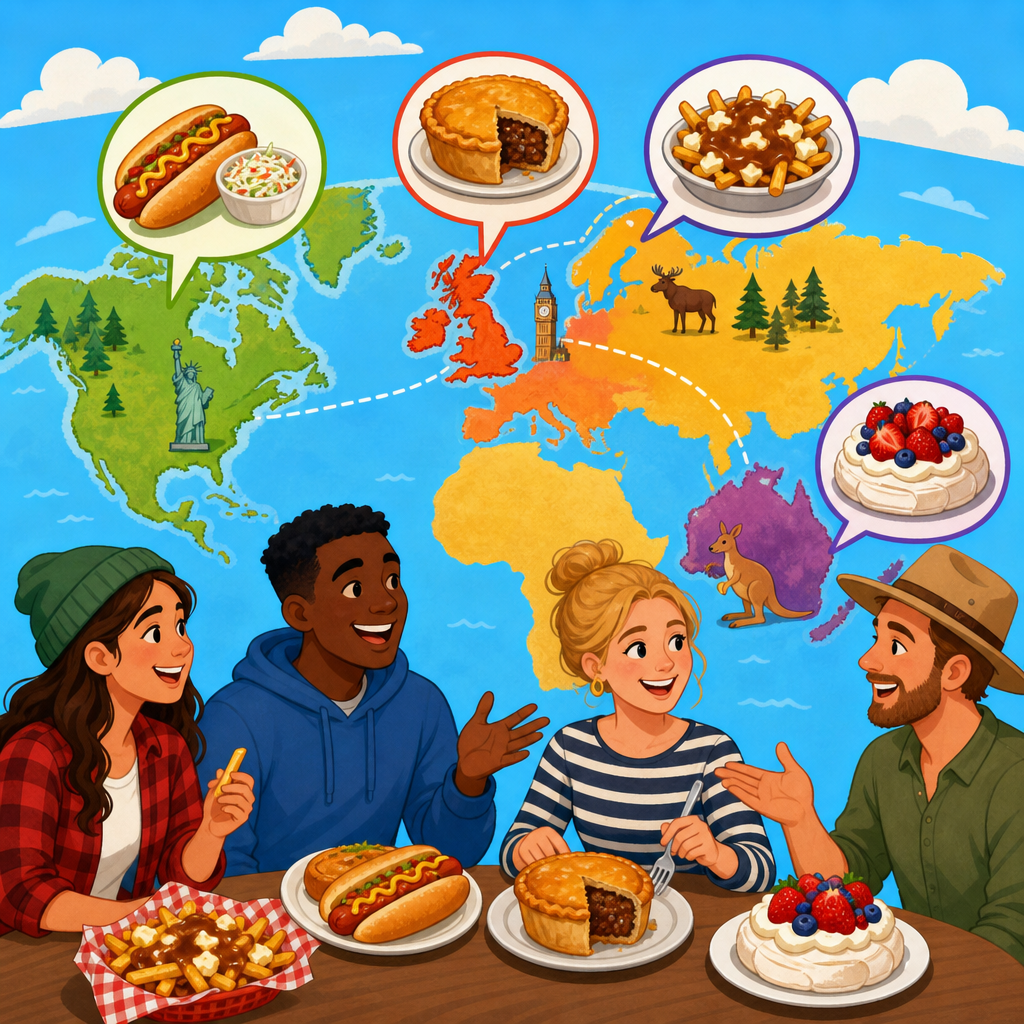
Regional food terms shape everyday English in ways that surprise even advanced speakers. A traveler who orders chips in London, biscuits in Georgia, or pudding in Melbourne may receive something very different from what they expected. In linguistics, these differences are examples of lexical variation: words that belong to the same language but carry different meanings across regions. Food vocabulary is one of the clearest places to see this because meals are practical, emotional, and deeply tied to local history. I have seen this firsthand while working with English learners who could discuss politics or business comfortably, then freeze when a café menu used familiar words in unfamiliar ways. Understanding how regional food terms change across English-speaking countries matters because these words affect travel, hospitality, migration, and ordinary conversation. They also reveal how colonial history, immigration, trade, and class shaped English differently in the United States, the United Kingdom, Canada, Australia, New Zealand, Ireland, and South Africa. When people learn these terms in context, they do more than avoid ordering mistakes. They understand culture more accurately, interpret humor more easily, and follow small talk with less friction. That makes food vocabulary a practical entry point into cultural fluency, not just a list of quirky differences.
Why Food Vocabulary Diverges So Sharply
Food terms change regionally because language follows supply chains, settlement patterns, and social habits. When English spread through colonization, it encountered Indigenous ingredients, immigrant cooking traditions, and local farming systems. New words entered the language, and old words shifted meaning. In Britain, pudding grew into a broad category that can mean a specific steamed dish or, informally, dessert in general. In the United States, pudding narrowed to a soft, spoonable sweet similar to custard but usually thickened differently. In Australia and New Zealand, tea may refer not only to the drink but also to an evening meal in some households, reflecting older British usage that survives unevenly.
Class and region also matter. In northern England, bread roll terms such as bap, bun, cob, and barm compete across short geographic distances, each carrying local identity. In the United States, a carbonated drink becomes soda, pop, or coke depending on the region, and those labels extend into food ordering rituals. These patterns are not random. Linguists map them as dialect features, and restaurant chains routinely adjust menus to match local expectations. McDonald’s, for example, has long localized product names and descriptions because the same English word does not trigger the same mental image everywhere. Food language changes sharply because meals are purchased, shared, and discussed daily, making them highly sensitive to local norms.
High-Confusion Terms and What They Mean by Country
Some regional food terms create predictable misunderstandings because the same word points to different foods. Chips is the classic case. In the UK and Ireland, chips are thick-cut fried potato pieces, while thin crispy packaged slices are crisps. In the US and most of Canada, chips usually means the packaged snack, and the thicker fried side dish is fries. Biscuit is another frequent trap. In the UK, a biscuit is generally what Americans call a cookie. In the US South especially, a biscuit is a soft quick bread served with breakfast or gravy. Entrée reverses expectations in formal dining: in American English it is the main course, while in traditional British-influenced usage and French-derived menu structure it can refer to a course before the main dish.
Pudding, jelly, jam, mince, and lemonade also shift. Jelly in the US is a fruit spread, while in the UK jelly is a gelatin dessert and jam is the spread. Mincemeat in British tradition may contain dried fruit and spices rather than meat, even though the name suggests otherwise. Lemonade in the US is usually still, sweetened lemon juice diluted with water; in the UK, Australia, and New Zealand, lemonade commonly means a clear carbonated soft drink similar to lemon soda. These are not minor curiosities. They affect menus, recipes, shopping lists, and social assumptions about what counts as comfort food.
| Term | United States | United Kingdom/Ireland | Australia/New Zealand |
|---|---|---|---|
| Chips | Thin packaged potato snack | Thick-cut fried potatoes | Usually hot fries; packaged version often chips or crisps by context |
| Biscuit | Soft savory quick bread | Cookie-like baked sweet | Cookie-like baked sweet |
| Pudding | Soft sweet dessert cup | Dessert generally or specific steamed dish | Dessert generally in many contexts |
| Lemonade | Still lemon drink | Clear fizzy lemon soft drink | Clear fizzy lemon soft drink |
The History Behind the Words
Historical layers explain why these meanings diverged. British settlers brought terms like pudding, tea, and biscuit abroad, but those words adapted to new environments. In North America, wheat production, commercial baking, and industrial food processing pushed some meanings in new directions. The American biscuit developed from baking traditions that favored quick breads leavened with baking powder or soda rather than yeast, especially in Southern cooking. Meanwhile, biscuit in Britain stayed closer to the hard-baked, dry category inherited from older European forms. The Oxford English Dictionary traces many of these developments through centuries of shifting usage, showing that semantic change is normal rather than accidental.
Immigration added more layers. In South Africa, braai is not merely a barbecue but a socially meaningful cooking event with Afrikaans roots and distinct cultural expectations. In Canada, poutine names a specific dish tied to Quebec French and has become nationally recognizable. In the US, terms such as hoagie, grinder, hero, and sub show how immigrant neighborhoods and regional commerce create parallel vocabularies for similar foods. Even when dishes overlap, the preferred label signals local belonging. I often tell learners that if they remember the historical path of a word, they remember the meaning more reliably than by memorizing isolated translations.
Menus, Small Talk, and Real-World Misunderstandings
Regional food terms matter most when people interact in real time. In restaurants, asking for clarification is normal, but many learners hesitate because they think vocabulary confusion shows weakness. In practice, native speakers ask too. A Canadian ordering biscuits and gravy in Texas may still ask what style of biscuit is meant. A British visitor in the US might assume pudding appears as a generic dessert section and miss that it refers to one specific item. These moments spill into conversation. If a coworker says they brought pudding to a potluck, the listener’s mental picture depends entirely on their dialect background.
This is one reason food talk is central to cultural competence. Meals are common low-stakes topics in workplaces, homestays, and travel. Knowing the regional meaning lets you participate smoothly in the kind of everyday conversation explained in this broader guide to American small talk rules that surprise ESL learners. I have coached professionals who spoke fluent technical English yet stumbled when colleagues debated whether stuffing and dressing were the same thing, or whether supper differed from dinner. Those are not grammar problems. They are regional meaning problems, and they influence rapport more than many textbooks admit.
How to Interpret Terms Without Memorizing Endless Lists
The most efficient way to understand regional food terms is to use context, category, and setting. First, identify the situation: menu, recipe, grocery store, or casual speech. On a British fish-and-chips menu, chips cannot mean packaged crisps. At an American Southern breakfast diner, biscuits will not mean sweet cookies. Second, look for collocations, the words that commonly appear together. Biscuits and gravy, sticky toffee pudding, mince pies, soda bread, and braai meat all narrow the likely meaning immediately. Corpus tools such as the Corpus of Contemporary American English and the British National Corpus are useful because they show repeated patterns across authentic sources.
Third, pay attention to brand behavior and packaging. Supermarkets and chain restaurants localize labels because consumer misunderstanding hurts sales. If a bottle in New Zealand says lemonade, the carbonation and clear appearance usually confirm the regional meaning instantly. Fourth, ask short direct questions: “Do you mean fries or crisps?” or “Is pudding a course or one dessert?” This is efficient, natural, and culturally safe. The goal is not to master every localism. It is to build a decision-making habit that works across English-speaking countries.
Why These Differences Persist in a Global Media Age
Streaming platforms, social media, and international tourism expose people to more varieties of English than ever, but regional food terms remain stubbornly local. One reason is that food vocabulary is reinforced by family habit. Children learn these words at home long before they study global media. Another reason is that local restaurants, school cafeterias, and supermarkets keep the regional term in daily circulation. Even when people understand alternatives, they often preserve the home term as a marker of identity. Australians may understand cookie perfectly well and still say biscuit. Americans may recognize crisps from British television and still call the snack chips.
Global exposure does create overlap, especially in urban areas and online spaces, but it rarely erases the local default. Instead, speakers become bidialectal in limited ways: they can decode another region’s term without adopting it. That is why these differences continue to matter. The practical takeaway is simple: treat regional food words as cultural signals, not errors. Learn the high-confusion items, watch the context, and ask when needed. Doing that improves comprehension fast, prevents awkward ordering mistakes, and makes conversations feel easier. If you want clearer English in real situations, start with the menu, because regional food vocabulary teaches culture at the exact moment people live it daily.
Frequently Asked Questions
Why do food words change meaning across English-speaking countries?
Food words change across English-speaking countries because language develops locally, even when speakers share the same base language. As communities spread, migrate, trade, and form their own cultural habits, they keep some older terms, invent new ones, and assign familiar words to different foods. Over time, these regional choices become normal within each country or even within a specific state, province, or city. That is why one English word can feel completely ordinary in one place and surprisingly different in another.
Food vocabulary is especially prone to lexical variation because it is tied to daily life. People name what they cook, buy, grow, and serve based on local traditions. A word like “biscuit” reflects more than dictionary meaning; it reflects a food culture. In the United States, especially in the South, a biscuit is a soft, savory quick bread. In the UK, a biscuit is closer to what Americans call a cookie. Neither usage is wrong. Each belongs to a regional system of meaning that makes perfect sense to local speakers.
History also plays a major role. British colonial influence, immigration, Indigenous food traditions, and later American cultural exports all shaped modern English food vocabulary. Some regions preserved older British meanings, while others created new distinctions. As a result, food terminology offers one of the clearest examples of how English is not a single uniform system, but a family of related varieties with their own practical vocabularies.
What are some of the most common food term differences travelers notice?
Travelers often notice differences in everyday words first, especially when ordering in restaurants, cafés, or grocery stores. One of the best-known examples is “chips.” In the UK, chips are thick-cut fried potatoes that Americans would usually call fries. In the US, chips are thin, crisp slices sold in bags, which the British usually call crisps. This single contrast causes confusion constantly because both meanings are extremely common in daily speech.
Another classic example is “biscuit.” In Britain, Ireland, Australia, and many other places influenced by British usage, a biscuit is generally a sweet baked snack. In much of the US, a biscuit is a soft bread roll often served with breakfast or dinner. “Pudding” is another highly variable term. In some places it refers to a specific dessert texture, while in the UK and Australia it can also function as a broader word for dessert in general. That means someone invited to have pudding may be getting cake, custard, ice cream, or something else entirely.
Other useful examples include “entrée,” which means the main course in the US but traditionally refers to a course before the main dish in some other systems; “jelly,” which can differ from “jam” depending on region; and “capsicum,” used in Australia and New Zealand for what Americans usually call a bell pepper. These differences matter because they affect real-world interactions. A traveler may not just misunderstand vocabulary in theory; they may order the wrong dish, buy the wrong ingredient, or misread a menu. That practical impact is why regional food terms are such memorable examples of lexical variation.
Are these differences just slang, or are they real parts of the language?
These differences are real parts of the language, not merely slang. In linguistics, regional food terms are a standard example of lexical variation, which means that speakers of the same language use different words or different meanings depending on location. These are not random mistakes or informal distortions. They are established, widely understood patterns within speech communities, and they often appear in dictionaries, educational materials, packaging, menus, and media.
Slang usually carries a sense of novelty, informality, or social-group identity. Regional food vocabulary works differently. Words like “biscuit,” “chips,” “pudding,” and “courgette” are often the default everyday terms in their regions. A British speaker saying “courgette” instead of “zucchini” is not being playful or casual; they are using the standard local word. The same is true for an American saying “eggplant” instead of “aubergine.” Each term belongs to a legitimate regional variety of English.
This is an important point for learners and travelers because it shifts the goal from finding the one “correct” word to understanding the right word for the right audience. Standard English is not globally identical. It has multiple accepted norms, and food vocabulary shows that clearly. Recognizing this helps people communicate more effectively and also appreciate how language reflects culture, identity, and history rather than just grammar rules.
How can English learners avoid confusion with regional food vocabulary?
English learners can avoid confusion by treating food vocabulary as region-specific, not universally fixed. Instead of memorizing a single word for each item, it helps to learn common equivalents across major English varieties such as American, British, Australian, Canadian, and regional Southern US usage. For example, a learner who knows both “fries” and “chips,” or both “cookie” and “biscuit,” will be much better prepared for real conversations and travel situations.
Context is also essential. Menus, grocery stores, and everyday conversation usually provide clues. If someone in London offers “chips” with fish, they almost certainly mean fries. If someone in Georgia serves “biscuits and gravy,” they are not talking about sweet cookies. Learners should also pay attention to nearby words, meal settings, and local accents, because meaning often becomes clear when vocabulary is read in a cultural context rather than in isolation.
Another smart strategy is to ask simple clarification questions without embarrassment. Native speakers do this too when crossing regional boundaries. Questions like “Do you mean fries or crisps?” or “Is pudding a specific dessert or dessert in general?” are natural and useful. Watching regional cooking shows, reading restaurant menus from different countries, and comparing supermarket labels can also build familiarity quickly. The key is flexibility. Advanced English is not just about grammar accuracy; it is also about recognizing how meaning shifts from one English-speaking community to another.
Why is food vocabulary such a powerful example of cultural identity in English?
Food vocabulary is powerful because it connects language to memory, family, class, migration, and local tradition. People do not just eat food; they build routines, celebrations, and identities around it. As a result, the words used for meals and ingredients often carry emotional weight. A term like “pudding,” “grits,” “tea,” or “biscuits” may signal where someone grew up, what traditions they follow, and what kind of speech community they belong to. These are not just labels for products. They are markers of belonging.
Regional food words also preserve cultural history. They can reveal colonial influence, trade routes, agricultural patterns, and contact between communities. For example, differences in naming vegetables, breads, desserts, and snack foods often reflect which cuisines became dominant locally and which outside influences were absorbed. In that sense, vocabulary acts like a cultural map. A simple menu term may carry decades or even centuries of linguistic and social history.
That is why misunderstandings around food words are often both funny and revealing. They show how speakers can share English fluently while still organizing everyday life through different lexical systems. For readers, travelers, and language learners, paying attention to food terms is one of the fastest ways to understand that English is deeply regional. It is also one of the most human ways to see language change, because food sits at the center of ordinary life and personal identity.