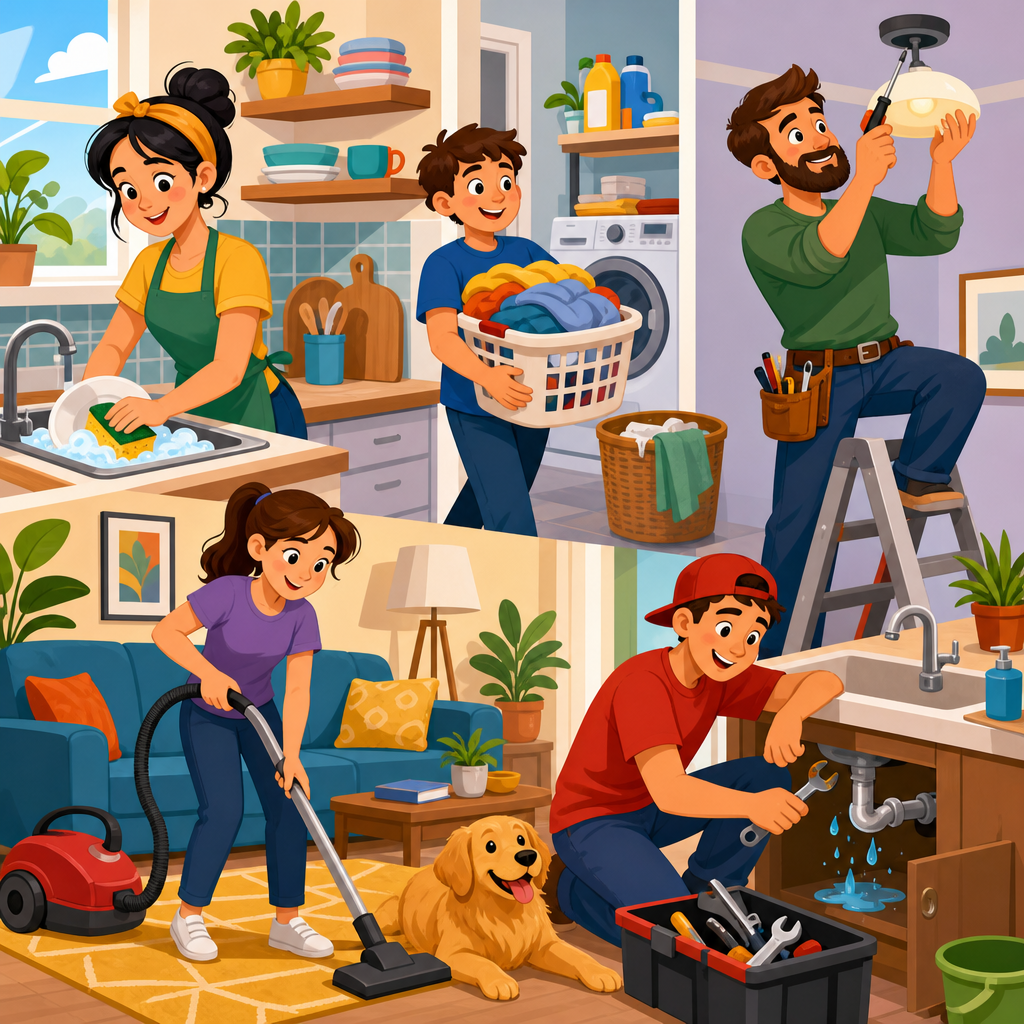
Household idioms for chores, repairs, and daily life turn ordinary domestic tasks into vivid English. If you have ever heard someone say they are “cleaning up their act,” “putting the house in order,” or “doing a patch-up job,” you have already met the way home life shapes everyday speech. In this article, household idioms means expressions drawn from cleaning, cooking, fixing, organizing, and sharing space with other people. They matter because native speakers use them constantly at work, in family conversations, in news coverage, and in casual messages, often without noticing the household image behind the phrase.
I teach these expressions to learners because they solve a practical problem: many advanced students understand grammar and still miss tone, intent, or implied meaning when idioms appear. A manager who says “we need to mop up the remaining issues” is not talking about a floor. A friend who says “my schedule is up in the air, but I’m trying to keep the home fires burning” is using domestic language to describe stability and responsibility. Knowing these phrases improves listening, reading, and speaking because it helps you decode real English instead of textbook English.
Household idioms also reveal how English speakers think about responsibility. Chores suggest routine effort, repairs suggest problem solving, and home life suggests comfort, order, and conflict management. That is why these idioms show up far beyond the home. Politicians promise to “clean house.” Teams try to “get their house in order.” Couples “air dirty laundry” when private conflict becomes public. The literal images are simple, but the figurative meanings can be nuanced. Some sound supportive, some critical, and some mildly humorous. The key is to learn the image, the meaning, and the most common context together.
Why household idioms are so common in modern English
Household idioms are common because nearly everyone understands the source image. You do not need technical knowledge to picture sweeping a mess, fixing something broken, or keeping a room tidy. That shared experience makes these expressions efficient. When a supervisor says, “Let’s tidy up this report,” everyone understands that the document needs small improvements, not a full rewrite. When a parent says, “We need to patch things up,” the idea is a damaged relationship that can still be repaired.
In my experience, learners remember domestic idioms faster than abstract business phrases because the image is concrete. “Sweep something under the rug” is memorable because you can picture hiding dirt where guests will not see it. The phrase means to conceal a problem instead of dealing with it properly. News reports use it for scandals, schools use it for misconduct cases, and families use it for unresolved tension. The image stays fixed even as the context changes.
Another reason these idioms persist is flexibility. “House” can mean a literal home, a company, a government, or your own personal life. “Clean up” can mean becoming more organized, correcting behavior, or making a profit, depending on context. That range makes household idioms productive vocabulary. If you want a wider foundation for body-based expressions too, this related guide on hand idioms in English pairs well with domestic phrases because both groups appear constantly in conversation.
Chore idioms: cleaning, organizing, and dealing with messes
Chore idioms often describe order, responsibility, and unfinished business. “Get your house in order” means organize your affairs before addressing something bigger. A company may need to get its house in order before seeking investors. A student may need to get her house in order before applying for graduate school. The phrase usually implies that internal problems exist and should be fixed first. “Put your house in order” is a close variant with nearly the same meaning.
“Clean house” usually means remove problems decisively, often by replacing people or changing systems. In sports, an owner may clean house after a losing season by firing the coach and front office. In business, a new executive may clean house by ending ineffective policies. The tone is stronger than “tidy up.” It suggests major change, not minor improvement.
“Air dirty laundry” means expose private problems in public. Native speakers often use it critically: “They argued on social media and aired their dirty laundry for everyone to see.” “Sweep under the rug” is the opposite move: hide an unpleasant issue. Both idioms are common in workplace and family settings.
| Idiom | Plain meaning | Typical use |
|---|---|---|
| Get your house in order | Organize your own problems first | Business, finances, personal planning |
| Clean house | Make sweeping changes | Management, politics, sports |
| Air dirty laundry | Make private conflict public | Relationships, media, workplace drama |
| Sweep it under the rug | Hide a problem | Scandals, family tension, mistakes |
| Mop up | Deal with what remains | Projects, negotiations, operations |
“Mop up” is especially useful. Literally, it means clean remaining liquid. Figuratively, it means finish the leftover issues after the main work is done. A sales team may mop up remaining leads after a campaign. Emergency crews may mop up small fires after the main blaze is controlled. It often suggests a final, necessary stage that is less dramatic but still important.
Repair idioms: fixing damage, restoring order, and making do
Repair idioms focus on damage control and practical solutions. “Patch things up” means restore a relationship after conflict. The emotional force is moderate: not every problem disappears, but enough repair happens for people to move forward. Friends patch things up after an argument. Departments patch things up after a dispute over budget. The phrase implies prior damage and some goodwill on both sides.
“Paper over the cracks” is more critical. It means hide structural problems with superficial fixes. I often explain it by comparing a cracked wall and a weak process. If a company keeps losing invoices and management creates a prettier template instead of changing the approval system, they are papering over the cracks. British English uses this phrase more frequently than American English, but the meaning is widely understood.
“A patch-up job” describes a temporary or low-quality repair. It can be literal, like a leaking pipe fixed for one night, or figurative, like a rushed policy update. “Held together with duct tape” is a vivid modern variation that suggests something barely works because of improvised fixes. In technology teams, people say an old system is held together with duct tape and hope, meaning it functions but lacks reliability.
“On the blink” refers to equipment not working properly, usually intermittently. “The washing machine is on the blink” is literal; “our booking system is on the blink” is figurative. The idiom is conversational and common enough to deserve recognition. “Hit the skids,” while not purely domestic, can describe a home repair budget or household plan that suddenly declines. These expressions help speakers discuss everyday breakdowns without sounding overly technical.
Daily life idioms: routines, relationships, and running a home
Some household idioms are less about tasks and more about the rhythms of living together. “Keep the home fires burning” means maintain stability while someone is away or while conditions are difficult. During military deployments, long business trips, or family illness, the person managing daily routines may be described this way. The phrase sounds supportive and slightly traditional, but it remains current.
“Make yourself at home” is both literal hospitality and a model for other idioms about comfort. When people say a coworker has “made himself at home” in a new office, the meaning can be positive or mildly critical depending on tone. “Home and dry” means safely finished or certain to succeed. After the final exam is submitted, a student might say, “One more paper and I’m home and dry.”
“Bring home the bacon” means earn the income that supports a household. It can be playful, affectionate, or outdated if used carelessly, because modern families often reject older assumptions about who earns money. Still, it remains common in headlines and conversation. “Close to home” means emotionally relevant or personally affecting. A discussion about rising rent, elder care, or childcare costs may hit close to home for many listeners.
Another useful phrase is “not exactly house-trained,” used humorously for someone with poor domestic habits, such as never cleaning dishes or leaving tools everywhere. Because it originally describes pets, it can sound teasing or rude if directed at a person. Tone matters with household idioms more than learners sometimes expect. The same expression can sound warm among friends and sharp in a formal meeting.
How to use household idioms naturally without sounding forced
The best way to use household idioms naturally is to match the phrase to the scale of the situation. Use “tidy up” for small corrections, “clean house” for major reform, and “patch things up” for relationships rather than technical repairs. Also pay attention to register. “Air dirty laundry” works in conversation and opinion writing, but it may sound too informal in legal or academic prose. “Get your house in order” is more versatile and appears comfortably in professional settings.
I recommend learning each idiom with one literal picture and two realistic examples. For “sweep under the rug,” picture hidden dirt, then connect it to a school ignoring bullying and a company concealing quality defects. That method creates durable recall because you store image, meaning, and context together. Corpus tools such as YouGlish, the Cambridge Dictionary, and Merriam-Webster examples are useful for checking tone and frequency.
Avoid stacking too many idioms in one sentence. Native speakers usually use one strong image at a time. “We need to clean house, mop up the leftovers, and keep the home fires burning” is understandable, but it sounds theatrical. Choose the clearest phrase for the point you want to make. Accuracy beats performance. When learners do that consistently, household idioms become one of the fastest ways to sound more natural in daily English.
Household idioms for chores, repairs, and daily life are powerful because they turn familiar actions into precise social meaning. Cleaning idioms often signal organization, concealment, or decisive reform. Repair idioms describe reconciliation, temporary fixes, and weak systems. Daily life idioms express stability, comfort, personal impact, and the work of keeping routines going. Together, they form a practical vocabulary set that appears far beyond the home, from offices and classrooms to news reports and family chats.
The main benefit of learning these expressions is immediate comprehension. Once you recognize the household image, you can infer the speaker’s intention faster and respond more naturally. That matters in meetings, friendships, and everyday media. Start with ten high-frequency phrases, listen for them in real conversations, and practice using each one in a sentence from your own life. With steady exposure, these idioms stop feeling figurative and start feeling like ordinary English.
Frequently Asked Questions
What are household idioms, and why are they so common in everyday English?
Household idioms are expressions that borrow images from chores, repairs, cooking, cleaning, organizing, and living with other people. Instead of describing a situation in a literal way, speakers use familiar home-based activities to make their meaning more vivid. For example, when someone says they need to “put their house in order,” they usually do not mean cleaning every room. They mean getting their life, work, plans, or priorities organized. In the same way, “cleaning up your act” often means improving your behavior, not actually scrubbing anything.
These idioms are so common because home life is universal. Nearly everyone understands the ideas behind mess, order, patching, fixing, cooking, and sharing space, so these images are easy to remember and easy to apply to non-household situations. Native speakers use them in business, friendships, school, family conversations, and media because they quickly communicate emotion, judgment, and tone. A phrase like “papering over the cracks” instantly suggests a temporary fix, while “everything but the kitchen sink” immediately conveys excess. That makes household idioms practical, expressive, and deeply rooted in daily communication.
Are household idioms usually literal, figurative, or both?
They can be both, and that is one reason they are so useful. At the literal level, a phrase may describe a real household task such as patching a wall, cleaning a room, or putting items away. At the figurative level, the same language can describe behavior, relationships, plans, or problems. Context tells you which meaning is intended. If a manager says the team needs to “tidy up the report,” nobody expects a broom or mop. The meaning is to improve the report by making it clearer, neater, or better organized.
Many of the most memorable idioms work because the literal image remains easy to picture. “Patch-up job” suggests a repair that is quick but not permanent. Figuratively, it can describe a weak solution to a larger problem. “Sweeping something under the rug” creates the image of hiding dirt instead of removing it, so the figurative meaning becomes clear: ignoring a problem or hiding it from others. Understanding both levels helps learners remember the idiom and use it naturally. The key is to focus on the image first, then connect that image to the broader meaning in conversation.
How can I tell whether a household idiom is appropriate in formal or informal situations?
The best approach is to think about tone, audience, and purpose. Many household idioms are common in relaxed conversation because they sound warm, natural, and familiar. Expressions such as “cleaning up your act,” “doing a patch-up job,” or “keeping the home fires burning” often fit well in speech, storytelling, and informal writing. However, some also work in semi-formal settings, especially when you want to make your language more engaging. A team leader might say a department needs to “put the house in order,” and that would usually sound acceptable in a meeting or workplace email.
That said, not every idiom suits every context. In highly formal writing, legal communication, academic work, or sensitive discussions, literal language is often safer and clearer. Idioms can sometimes sound too casual, too emotional, or too culturally specific for readers who expect precision. If you are unsure, ask yourself whether the idiom adds clarity or creates ambiguity. If it makes your point easier to understand and matches the tone of the situation, it is probably a good choice. If it risks confusion, choose a direct alternative. A useful strategy for learners is to notice where native speakers use these expressions and then imitate those contexts rather than forcing idioms into every sentence.
What are some common household idioms related to chores, repairs, and daily life, and what do they mean?
Several household idioms appear again and again in modern English. “Put the house in order” means to organize or fix problems before moving forward. “Clean up your act” means to improve your behavior or performance. “Sweep something under the rug” means to hide a problem instead of dealing with it honestly. “Everything but the kitchen sink” refers to including almost too much, often far more than necessary. “Patch-up job” describes a temporary or incomplete fix, whether physical or figurative.
Other useful examples include “on the back burner,” which means delayed or given lower priority, and “too many cooks in the kitchen,” which describes a situation where too many people are involved and create confusion. “Boil down to” means reduce something to its essential point, while “stir the pot” means create trouble or provoke disagreement. “Air your dirty laundry” means reveal private problems in public. Each of these idioms grows out of ordinary domestic experience, but speakers use them far beyond the home. Learning them in groups by theme, such as cleaning, cooking, and fixing, can make them easier to remember and more natural to use.
What is the best way to learn and use household idioms naturally without sounding forced?
The most effective method is to learn idioms through context, not as isolated vocabulary items. Start by choosing a small number of high-frequency expressions, such as “put the house in order,” “sweep under the rug,” and “clean up your act.” Learn what they mean, but also pay attention to who says them, in what situation, and with what tone. Then build short example sentences related to real life: work deadlines, family plans, shared apartments, money, or relationships. This helps you connect the idiom to actual communication instead of memorizing it as a dictionary phrase.
It also helps to notice common patterns and limits. Some idioms are flexible, while others are usually fixed. Native speakers may say “We need to put the house in order before expanding” or “He finally cleaned up his act,” but changing too many words inside a set phrase can sound unnatural. Listening to podcasts, interviews, shows, and everyday conversations will train your ear for natural usage. Finally, do not try to use too many idioms at once. One well-placed idiom sounds fluent; five in a single paragraph can sound exaggerated. Aim for accuracy, timing, and relevance. When the image fits the situation, household idioms can make your English sound more vivid, confident, and native-like.