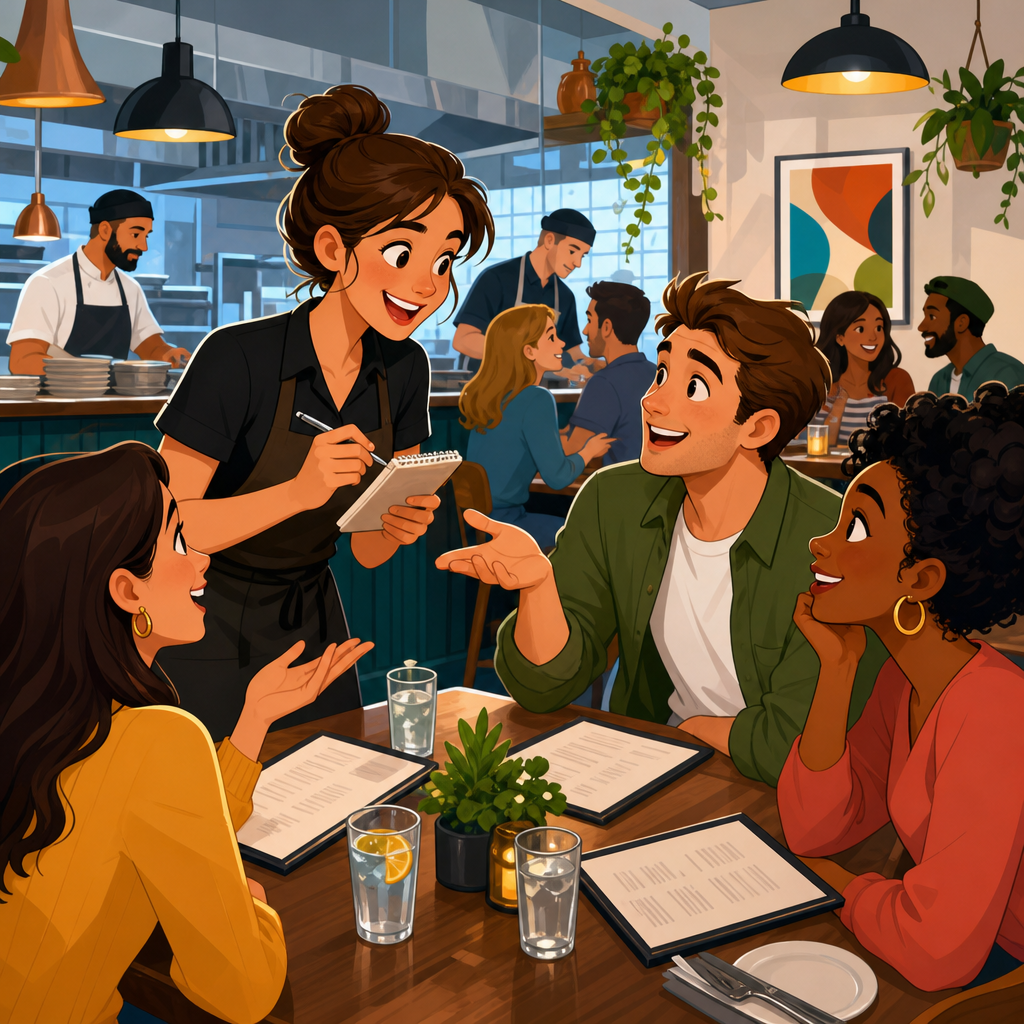
Restaurant slang and informal English can make a simple meal feel confusing if you only know textbook vocabulary. In real restaurants, servers, hosts, bartenders, and cooks often use quick shorthand that sounds nothing like the English taught in standard lessons. You might hear a server say a table was “cut,” a dish is “86’d,” or a customer wants a “to-go box,” and each phrase carries a specific meaning shaped by restaurant culture. Understanding restaurant slang matters because dining out is a real-world listening test: the language is fast, contextual, and often informal. If you study English for travel, work, or daily life, this is the kind of spoken English that helps you follow what is happening without asking people to repeat themselves every minute.
When I have helped English learners prepare for travel, restaurant language has always been one of the first problem areas. Learners usually know words such as menu, bill, waiter, and reservation, but they get stuck on phrases like “Can I start you with something to drink?” or “We’re slammed right now.” The issue is not grammar. It is that restaurants run on routines, and routines create specialized slang. Some expressions are customer-facing, meaning staff say them directly to diners. Others are mainly used between employees, but customers still overhear them. This article focuses on the most common restaurant slang and informal English you might hear dining out, what each phrase means, when it is used, and how to respond naturally.
Common restaurant slang used by staff around customers
The most useful place to start is with phrases you are likely to hear in the dining room. “Party of two” means a group of two guests. Hosts rarely say “group” in busy restaurants; “party” is the standard term. “We can seat you now” means a table is ready. If the host says “There’s a 20-minute wait,” that is the estimated waiting time before you can be seated. In American English, “sit” is often used casually in place of “seat,” as in “We can sit you by the window.” It sounds odd to some learners because it is not the textbook pattern, but it is common and natural in restaurants.
Servers also use highly predictable informal lines. “What can I get you started with?” usually means drinks or appetizers. “Are you still working on that?” is a polite way to ask whether you have finished eating. “Can I take that out of your way?” means the server wants to remove an empty or nearly empty plate. “To go” means packed for leaving with you; in British English, you may hear “takeaway” in other contexts, but in many North American restaurants “to go” is the standard expression. If someone asks, “Do you need a box?” they mean a takeout container for leftovers. “Separate checks” means each person pays individually, while “one check” means a single bill for the table.
Some terms describe how busy the restaurant is. If staff say they are “slammed,” the restaurant is extremely busy and under pressure. If a server says, “Thanks for your patience, we’re a little backed up,” the kitchen or bar is delayed. “In the weeds” is a classic industry phrase meaning overwhelmed by too many tasks at once. Customers may hear it less directly, but they often hear the effects: longer waits, rushed movement, and apologies. Another common phrase is “on the fly,” which means something is needed urgently, usually because of a mistake or a rush request. Knowing these phrases helps you interpret the situation without taking delays personally.
Kitchen slang and code words customers often overhear
Many diners hear kitchen slang without understanding it. The most famous term is “86,” which means an item is unavailable or must be removed. If the kitchen tells the server, “Salmon is 86’d,” the salmon is sold out. In some places, “86” can also mean remove something from an order, such as “86 onions.” Another common phrase is “all day,” which means the total number of a dish needed across multiple tickets. For example, if three tables together need five burgers, a cook may call out, “Five burgers all day.” This helps the kitchen track the real workload instead of focusing on one order at a time.
“On the line” refers to the cooking line where stations such as grill, sauté, and fry operate. “Expo” or “the pass” is the area where finished plates are checked and handed off to servers. If you hear “behind,” “corner,” or “hot,” these are safety calls. “Behind” warns someone that a person is passing close behind them. “Corner” warns others when turning a blind corner. “Hot” means a pan or plate is dangerously hot. These are not decorative slang words; they prevent burns, spills, and collisions in tight spaces. In well-run restaurants, these short calls are constant because speed matters, but safety matters more.
Timing language is another category diners may overhear. To “fire” an order means begin cooking it. If a server says, “Fire table twelve,” the kitchen should start those dishes now. In restaurants that pace courses carefully, an appetizer may be prepared first, and entrées are not fired until the right moment. “Runner” refers to a staff member who brings food from the kitchen to the table. “Hands” means help is needed carrying plates, as in “Need hands at the window.” These terms may sound abrupt, but they are efficient. Restaurant teams rely on compressed language because a full sentence takes too long during service.
| Expression | Meaning | Where you may hear it |
|---|---|---|
| 86 | Unavailable, sold out, or remove from order | Kitchen, server updates |
| Slammed | Extremely busy | Host stand, dining room |
| In the weeds | Overwhelmed and falling behind | Staff conversation |
| Fire | Start cooking now | Kitchen line, expo |
| All day | Total quantity needed across tickets | Kitchen calls |
| Separate checks | Individual bills for diners | Server at table |
Informal English diners use with servers
Restaurant slang is not only used by staff. Customers also rely on informal English, and understanding it makes conversations smoother. “I’m ready to order” is direct and standard, but many people say, “I think I’m gonna do the chicken,” which means that is the dish they plan to order. “Can I get…” is the most common casual ordering phrase in the United States, even though some learners are first taught “I would like.” Both are correct, but “Can I get the soup?” sounds more natural in many casual restaurants. Diners also say “No ice,” “dressing on the side,” “extra crispy,” or “sub fries for salad,” all of which are compact modification requests.
You will also hear socially soft phrases that reduce directness. “Could we get a minute?” means the table is not ready to order yet. “We’re good for now” means nothing else is needed at the moment. “Can we do two checks?” means the bill should be split. “I’ll have…” is neutral and common, while “Hook me up with…” is very informal and should only be used in relaxed settings because it can sound rude if your tone is off. If a diner says “This isn’t what I ordered,” that is a direct complaint. A softer version is “I think I had the pasta, not the chicken.” Tone changes everything in restaurants.
Tipping language appears at the end of the meal, especially in the United States. “Gratuity” means tip, and some menus note that gratuity is automatically included for large parties. “Comped” means removed from the bill, usually because of a problem or as a courtesy. “On the house” means free, paid for by the restaurant. Diners sometimes ask for a “rain check” in retail, but not usually in restaurants, so it is better not to transfer expressions automatically across contexts. If you are building broader informal vocabulary, this kind of context-sensitive meaning also appears in idiomatic English more generally, and a useful reference point is the main guide at 5 Minute English.
How to respond naturally when you hear restaurant slang
The best response strategy is simple: listen for function, not every individual word. If a host says, “It’ll be about ten minutes,” the function is waiting time. If a server asks, “Still working on that?” the function is checking whether you are finished. You do not need to decode every expression perfectly to respond well. Short, natural replies work best. You can say, “Yes, please,” “Not yet, thank you,” “Could we get another minute?” or “Can we take this to go?” These answers fit the rhythm of restaurant conversation and reduce stress for both sides.
It also helps to recognize regional and business-type differences. Fine dining tends to avoid visible slang in front of guests, while diners, bars, cafés, and casual chains use more direct informal English. In the United States, “check” is more common than “bill,” though both are understood. In Britain, “bill” is more frequent. Some restaurants say “server” instead of “waiter” or “waitress” because it is more neutral and standard in the industry. The exact vocabulary shifts, but the communication patterns stay stable: greeting, seating, drinks, order, check-in, clearing, bill, and farewell. Learn those moments, and slang becomes easier to predict.
Restaurant slang and informal English are practical, patterned, and easier to learn than they first appear. The key is to focus on recurring phrases tied to specific moments: waiting for a table, ordering food, handling changes, hearing kitchen updates, and paying the check. Terms like “86,” “slammed,” “to go,” “separate checks,” and “fire” are common because they save time and communicate precise meaning in a fast environment. Once you understand them, restaurant conversations stop sounding chaotic and start sounding organized.
For English learners, this knowledge brings an immediate benefit: more confidence when dining out. You can follow what staff mean, ask for what you need, and respond politely without freezing. You do not need to memorize every piece of industry jargon, but you should know the high-frequency expressions that appear in real service. The next time you eat out, listen for these phrases, notice when they appear, and practice one or two natural responses. That small habit will turn passive understanding into active, usable English.
Frequently Asked Questions
What does “86’d” mean in a restaurant, and how might you hear it used?
“86’d” is one of the most common pieces of restaurant slang, and it usually means that something is unavailable. In most dining situations, if a server says a menu item is “86’d,” they mean the kitchen has run out of it or it cannot be served right now. For example, you might hear, “The salmon is 86’d tonight,” which means you should choose something else. In some workplaces, “86” can also mean to remove or cancel something, such as taking an ingredient off a dish or, in a stronger sense, refusing service to a disruptive guest. The exact meaning depends on the situation, but the core idea is that the item or option is no longer in play.
For English learners, this phrase can be confusing because the number itself gives no obvious clue. It is not textbook English, and that is exactly why restaurant slang can feel so hard to follow. The good news is that you do not need to memorize every origin story behind the expression. What matters is recognizing how it functions in real conversation. If you hear “86 the fries,” “We’re 86’d on bread,” or “That dessert is 86,” the safe interpretation is that it is gone, unavailable, or being removed from the order. Knowing this one phrase can instantly make fast restaurant speech easier to understand.
What does it mean when a server says a table was “cut”?
When a server says they were “cut” or that a table was “cut,” they are usually talking about the rotation of service, not about anything physical happening to the table. In many restaurants, managers assign tables in turns so the workload is distributed fairly among servers. If a server is “cut,” it often means they are no longer being given new tables because their shift is winding down. They may still need to take care of the guests they already have, clean their section, and finish side work, but they are closer to the end of their shift.
This term matters because it helps you understand the flow of service. For example, if your server seems to be wrapping up their responsibilities, another team member might help with refills, payment, or clearing plates. You may hear phrases like “I’ve been cut,” “She’s on cut,” or “That table goes to him; I’m cut.” None of this means you are being rushed out. It is simply part of restaurant organization. For diners and English learners, understanding “cut” gives useful insight into why staff change roles during a meal and why service patterns sometimes shift near closing time or during quieter parts of the day.
What is a “to-go box,” and how is it different from more formal English?
A “to-go box” is a container given to customers so they can take unfinished food home. In more formal or textbook English, you might learn phrases such as “takeaway container,” “carry-out container,” or “box for leftovers.” In everyday American restaurant English, though, “to-go box” is extremely common. A server may ask, “Do you want a to-go box?” or “Should I box that up for you?” Both questions mean the same thing: would you like to take the remaining food with you instead of leaving it at the restaurant?
This is a great example of how real-world English often sounds more practical and less formal than classroom vocabulary. The phrase is especially useful because it appears in a very common dining situation. If your portion is large, asking for a to-go box is completely normal in many restaurants, especially in the United States. You can also use related expressions such as “Can I get this to go?” if you want your meal packed to take away rather than eat inside. Learning this phrase helps you sound more natural and also helps you understand a very common part of restaurant culture, where taking leftovers home is expected rather than unusual.
Are restaurant slang terms only used by staff, or will customers hear and use them too?
Restaurant slang often begins as staff shorthand, but customers regularly hear it and sometimes use it themselves. In fast-paced service environments, employees need short, efficient language to communicate quickly with each other. That is why so many expressions sound clipped, coded, or informal. However, these terms do not stay hidden in the kitchen. Diners often hear them from servers, hosts, bartenders, and cashiers, especially in casual restaurants. Over time, some expressions become familiar enough that customers start using them too, particularly phrases like “to go,” “check,” “split the bill,” or “86’d.”
That said, not every slang term needs to become part of your own vocabulary. As a learner, your first goal should be recognition. If you understand what the staff mean, you can follow the situation comfortably even if you choose more standard English yourself. For instance, you might say, “It seems that dish is unavailable,” even if the server says, “It’s 86’d.” Both are acceptable, but one is more insider language. It is also smart to notice the setting. In a trendy bar or busy diner, slang may be everywhere. In a fine dining restaurant, the staff may use it behind the scenes but speak more formally to guests. Understanding the slang, even passively, helps you interpret tone, speed, and service culture much more accurately.
Why is learning restaurant slang useful if I already know standard English vocabulary for dining out?
Knowing standard English gives you an important foundation, but restaurant slang helps you understand how people actually speak in real dining situations. Textbook vocabulary teaches you words like “reservation,” “menu,” “bill,” and “appetizer,” which are all useful. But real restaurants move fast, and staff often rely on shortened, informal expressions that may not resemble textbook language at all. If you only know formal vocabulary, you may understand the general situation but miss important details. For example, hearing that a server is “cut,” a dish is “86’d,” or an order is “to go” gives you specific information about service, availability, and what happens next.
There is also a cultural reason this matters. Restaurant slang is part of workplace identity, hospitality rhythm, and everyday spoken English. Understanding it can make you feel more confident, less lost, and better able to respond naturally. It can also improve practical communication. You will know when an item is unavailable, when leftovers can be packed up, when service is changing, and when a staff member is speaking casually rather than formally. In short, standard English helps you survive the interaction, but slang helps you truly follow it. That difference can turn a confusing meal into a comfortable and enjoyable experience.