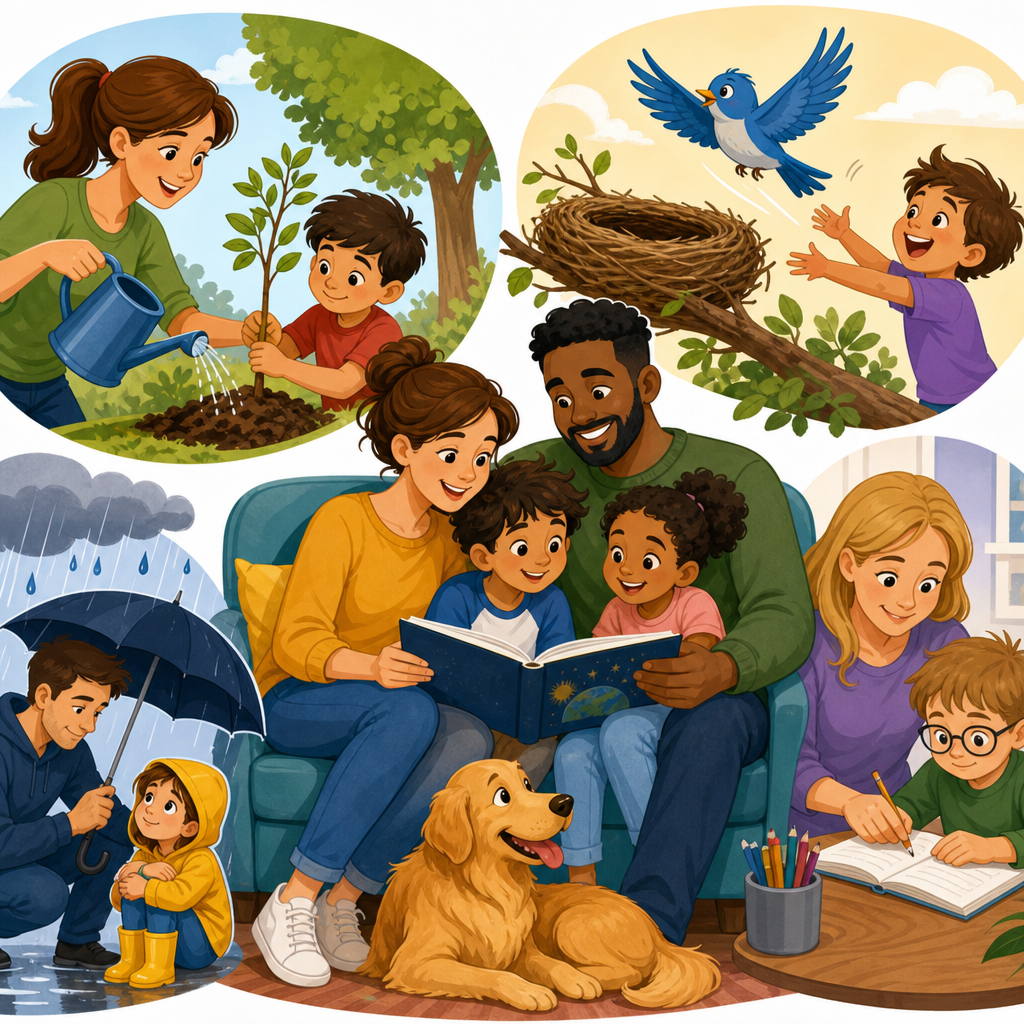
Parenting idioms in English-speaking families do more than decorate conversation; they compress advice, discipline, affection, and family expectations into short phrases that children hear repeatedly at home. A parenting idiom is an expression parents use figuratively rather than literally, such as “because I said so,” “it takes a village,” or “the apple doesn’t fall far from the tree.” These phrases matter because they shape how children interpret rules, understand relationships, and absorb cultural norms. In my work with English learners and bilingual families, I have seen that misunderstanding an idiom can create more confusion than a difficult grammar point, especially when the phrase appears during a stressful moment like an argument, bedtime refusal, or sibling conflict. Parenting language is highly contextual, emotionally charged, and often passed down across generations. That is why a focused look at parenting idioms in English-speaking families is useful for parents, teachers, caregivers, and learners who want to understand not just vocabulary, but family life itself.
Unlike textbook idioms about weather or animals, parenting idioms are embedded in daily routines. They appear when adults set boundaries, encourage resilience, warn against bad choices, or praise responsibility. Some are gentle, such as “use your inside voice.” Others are blunt, such as “don’t push your luck.” Many come from older cultural values and still survive because they are efficient. A parent can say one familiar phrase and communicate a whole script of expected behavior. At the same time, these expressions are not universal across all English-speaking homes. Region, class, religion, and generation all influence which idioms families prefer and how strongly they use them. A British parent might say “keep your hair on,” while an American parent is more likely to say “take it down a notch.” Understanding these differences helps decode real speech and prevents learners from taking figurative language literally.
Another reason this topic matters is that family idioms teach pragmatics, the social meaning behind words. When a parent says “pick your battles,” the lesson is not only about conflict; it is about judgment, emotional energy, and priorities. When someone says “kids don’t come with a manual,” they are admitting that parenting involves uncertainty and improvisation. These are compact expressions of worldview. For children raised in English-speaking families, such phrases become part of their inner vocabulary. For outsiders, they can sound confusing, even harsh, unless the intended meaning is clear. Learning parenting idioms therefore improves comprehension in films, school meetings, parenting books, and ordinary family conversation.
What counts as a parenting idiom
A parenting idiom is any fixed or semi-fixed phrase commonly used in family settings to guide, correct, comfort, or interpret children’s behavior. Some are classic idioms with meanings impossible to guess from individual words, like “spare the rod, spoil the child,” though that one is now controversial and less acceptable in many homes. Others are formulaic sayings that function like idioms because their social meaning is larger than the literal wording. “Go ask your mother,” for example, can signal shared authority, avoidance, or household division of roles depending on tone. “Wait till your father gets home” historically suggested a disciplinary hierarchy, though it now often appears jokingly or in discussions of outdated parenting models.
In practice, I group parenting idioms into four useful functions: discipline, encouragement, realism, and family resemblance. Discipline phrases include “shape up,” “cut it out,” and “don’t test me.” Encouragement phrases include “you’ve got this” and “get back on the horse,” especially after failure. Realism phrases include “kids will be kids” and “choose your battles.” Family resemblance phrases include “the apple doesn’t fall far from the tree.” These categories help learners infer meaning from context. If a phrase appears after a child breaks a lamp, it probably manages behavior or consequences. If it appears after a poor test score, it may express support or perspective. Families rely on these stock expressions because they save time and communicate emotion fast.
Common parenting idioms and what they really mean
The most common parenting idioms are short, memorable, and tied to repeat situations. “Because I said so” is perhaps the clearest example. It does not offer a reasoned explanation; it asserts parental authority when discussion is over. “It takes a village” means raising children requires support from relatives, teachers, neighbors, and community institutions. “The apple doesn’t fall far from the tree” means children often resemble their parents in behavior, talents, or flaws. “Don’t push your luck” warns a child not to keep demanding after already receiving leniency. “Pick your battles” advises parents not to turn every minor problem into a confrontation.
Other highly productive phrases include “tough love,” meaning firm care that prioritizes long-term growth over immediate comfort, and “empty nest,” which describes the stage when children have left home. “Helicopter parent” and “free-range parenting” are newer labels rather than traditional idioms, but they function similarly by compressing complex parenting styles into memorable images. In many English-speaking families, “use your words” tells a child to express feelings verbally instead of hitting, whining, or shutting down. “Use your inside voice” means speak more quietly indoors. These are partly literal, yet they carry a standardized family meaning that children recognize instantly. For readers who enjoy broader figurative patterns, this guide to hand idioms in English shows how everyday body-based expressions develop fixed meanings across contexts.
| Idiom | Typical Family Context | Meaning in Plain English |
|---|---|---|
| Because I said so | Rule enforcement | The discussion is finished; obey the instruction |
| Pick your battles | Parent decision-making | Focus on important conflicts, ignore minor ones |
| Kids will be kids | Minor misbehavior | Some childish behavior is normal and expected |
| It takes a village | Community support | Raising children requires help from others |
| The apple doesn’t fall far from the tree | Family resemblance | Children often act like their parents |
How tone changes the meaning inside families
Parenting idioms are never just vocabulary; tone, timing, and relationship determine how they land. “Kids will be kids” can excuse harmless mess, but it can also minimize behavior that actually needs correction. “Because I said so” can be a practical safety shortcut when a child is about to run into a parking lot, yet overuse may shut down trust and explanation. In families I have observed, the same phrase can sound loving, tired, sarcastic, or authoritarian depending on pace, volume, and facial expression. That is why learners should study the social function of the phrase, not only its dictionary meaning.
Consider “don’t make me come up there,” a phrase many children hear when a parent is downstairs and a child is avoiding bedtime. Literally, it describes movement up the stairs. Pragmatically, it is a final warning: comply now or face immediate intervention. Another example is “I’m at the end of my rope.” A parent saying this is not discussing rope; they are signaling exhaustion and depleted patience. In family communication, idioms often mark emotional thresholds. Recognizing that threshold helps listeners respond appropriately. If a caregiver says “I can’t be in two places at once,” the hidden meaning is a request for cooperation, not a lesson in physics.
Regional, generational, and cultural variation
English-speaking families do not share one uniform idiom set. In the United States, parents commonly say “time-out,” “grounded,” or “not happening.” In Britain, you may hear “pack it in,” “stop mucking about,” or “I’m not made of money.” In Australia, “good on you” can serve as warm encouragement, while “don’t get cheeky” may warn against disrespect. These are not trivial differences. A learner who understands American parenting media may still miss key meanings in a British household because the family script is different.
Generational change matters too. Earlier parenting language often emphasized obedience and hierarchy. Phrases like “children should be seen and not heard” were once widely recognized, but today many parents reject that message as dismissive of children’s voices. Newer family language reflects emotional literacy and child development research. Expressions such as “big feelings,” “natural consequences,” and “gentle parenting” show how modern households increasingly frame behavior in psychological rather than purely moral terms. Still, older idioms remain alive, sometimes sincerely and sometimes ironically. A millennial parent may say “wait till your father gets home” as a joke precisely because the old authority model is no longer taken for granted. Knowing whether a phrase is current, dated, humorous, or critical is essential to accurate interpretation.
How to understand and use parenting idioms accurately
The best way to learn parenting idioms is to attach each phrase to a situation, a speaker intention, and a likely emotional tone. Start by asking three questions. What just happened? Is the parent trying to stop behavior, teach a lesson, or comfort the child? Is the phrase literal, figurative, or partly both? For example, if a parent says “you made your bed, now lie in it,” the meaning is not about furniture. It means you must accept the consequences of your own choices. If someone says “I have my hands full,” they mean they are overwhelmed by childcare demands, not that their palms are physically occupied.
Use these idioms carefully if English is not your first language. Some phrases are common but sharp, and they can sound harsher coming from a nonparent or from someone outside the family. “Spoiled rotten,” “brat,” or “bad seed” carry strong judgment. Even useful phrases like “tough love” can be misunderstood if context is missing. I advise learners to recognize more idioms than they actively use. Listen first, notice who says what to whom, and copy expressions that fit your relationship and setting. Parenting idioms are powerful because they are compact. That same compactness means they can comfort, control, or criticize in a single line.
Parenting idioms in English-speaking families reveal how culture turns daily stress into memorable language. They help parents set limits, share wisdom, and describe the realities of raising children, from “pick your battles” to “it takes a village.” The key lesson is that these expressions are never only about vocabulary. They carry tone, authority, emotion, and assumptions about what good parenting looks like. When you understand the idiom, you understand more of the family dynamic behind it.
For learners, teachers, and caregivers, the practical benefit is immediate. You can follow real conversations more accurately, interpret films and books with less confusion, and avoid taking figurative language literally at the exact moment meaning matters most. Focus on common phrases, connect them to family situations, and pay close attention to tone. If you want to build stronger idiom fluency, start noting the parenting expressions you hear most often and compare how different families use them.
Frequently Asked Questions
What are parenting idioms, and why are they so common in English-speaking families?
Parenting idioms are figurative expressions that parents and caregivers use to communicate lessons, rules, expectations, comfort, or family values in a quick and memorable way. Instead of explaining an idea from scratch every time, parents often rely on familiar phrases such as “because I said so,” “it takes a village,” “the apple doesn’t fall far from the tree,” or “children should be seen and not heard.” These expressions are common in English-speaking families because they condense complex messages into language that is easy to repeat and easy to recognize. In many homes, they become part of the family’s everyday vocabulary and are passed down across generations.
What makes parenting idioms especially powerful is that they do more than decorate conversation. They often carry emotional weight, cultural history, and social expectations. A phrase may signal authority, affection, frustration, encouragement, or a moral lesson all at once. For children, hearing the same idioms repeatedly can shape how they interpret discipline, understand relationships, and make sense of what “good behavior” looks like in their household. In that way, parenting idioms are not just sayings. They are small, repeated scripts that help define family culture.
How do parenting idioms influence children’s behavior and understanding of family rules?
Parenting idioms influence children by turning abstract expectations into memorable verbal shortcuts. A child may not remember a long explanation about responsibility, but they are likely to remember “you made your bed, now lie in it.” In practical terms, idioms help children connect words with patterns of behavior. Over time, these repeated phrases become signals. Some warn that consequences are coming, some encourage resilience, and some reinforce respect for authority or community support.
These idioms also shape how children interpret the emotional tone of parenting. For example, “because I said so” emphasizes obedience and parental authority, while “it takes a village” highlights shared care and collective responsibility. A phrase like “the apple doesn’t fall far from the tree” can be playful, proud, or critical depending on context. Because children often learn meaning from repetition and tone, the same idiom can teach very different lessons in different families. This is why parenting language matters so much: the phrase itself is only part of the message, and the surrounding relationship gives it force. Repeated often enough, these expressions can influence how children think about fairness, identity, accountability, and even their place within the family.
Are parenting idioms always meant literally, or do children need help understanding them?
Parenting idioms are generally not meant literally, and children often need time, context, and explanation to understand them. Young children in particular tend to interpret language more concretely, so an expression such as “the apple doesn’t fall far from the tree” may sound confusing if they are hearing it for the first time. The real meaning emerges through repeated use, observation, and guidance from adults. That is one reason these phrases can be so influential: children learn not only vocabulary but also how figurative language works inside family life.
Parents can make idioms more helpful by pairing them with clear explanations. If a caregiver says, “it takes a village,” they might follow up by explaining that raising children works best when family, teachers, neighbors, and friends all contribute support. Without that added context, a child may memorize the phrase without understanding the value behind it. This is especially important in multilingual households, cross-cultural families, or homes where children are still developing language skills. When adults explain what an idiom means and why they use it, they turn a stock phrase into a teachable moment rather than a confusing command.
What do common parenting idioms reveal about values in English-speaking family culture?
Common parenting idioms often reveal a great deal about the values and assumptions that shape family life in English-speaking settings. Many traditional expressions emphasize obedience, self-control, personal responsibility, and respect for elders. Phrases like “because I said so” point to authority and hierarchy, while sayings about consequences reflect the belief that choices lead to outcomes. Other idioms stress community and support, such as “it takes a village,” which suggests that child-rearing is not only a private task but also a shared social effort.
At the same time, these idioms can expose generational attitudes toward discipline, independence, gender roles, and emotional expression. Some older sayings may sound strict or outdated to modern parents, while others remain popular because they still capture useful truths in a concise way. This makes parenting idioms interesting from both a linguistic and cultural perspective. They preserve family wisdom, but they also reveal how ideas about parenting change over time. In many households today, parents still use familiar idioms, but they may reinterpret them through a more emotionally aware or child-centered lens. As a result, the same phrase can reflect tradition while also adapting to contemporary parenting values.
How can parents and learners use parenting idioms more effectively in real-life conversation?
Parents and English learners can use parenting idioms more effectively by paying attention to meaning, tone, and situation. Because these expressions are compact and often emotionally loaded, they work best when the speaker understands not just the dictionary meaning but also the social effect. A phrase like “because I said so” can end an argument quickly, but it can also sound dismissive if overused. On the other hand, an idiom such as “it takes a village” can build a sense of gratitude and connection when talking about support systems. Effective use depends on matching the phrase to the moment.
For language learners, it helps to study parenting idioms as part of family communication rather than as isolated vocabulary items. Listen to how native speakers use them, notice whether they sound affectionate, firm, humorous, or critical, and practice using them in context. For parents, the best approach is to use idioms intentionally. If a phrase is likely to confuse a child, explain it. If it carries a harsh tone, consider whether there is a clearer or kinder alternative. Parenting idioms are most effective when they support understanding instead of replacing it. Used thoughtfully, they can make family communication richer, more memorable, and more connected to shared values.