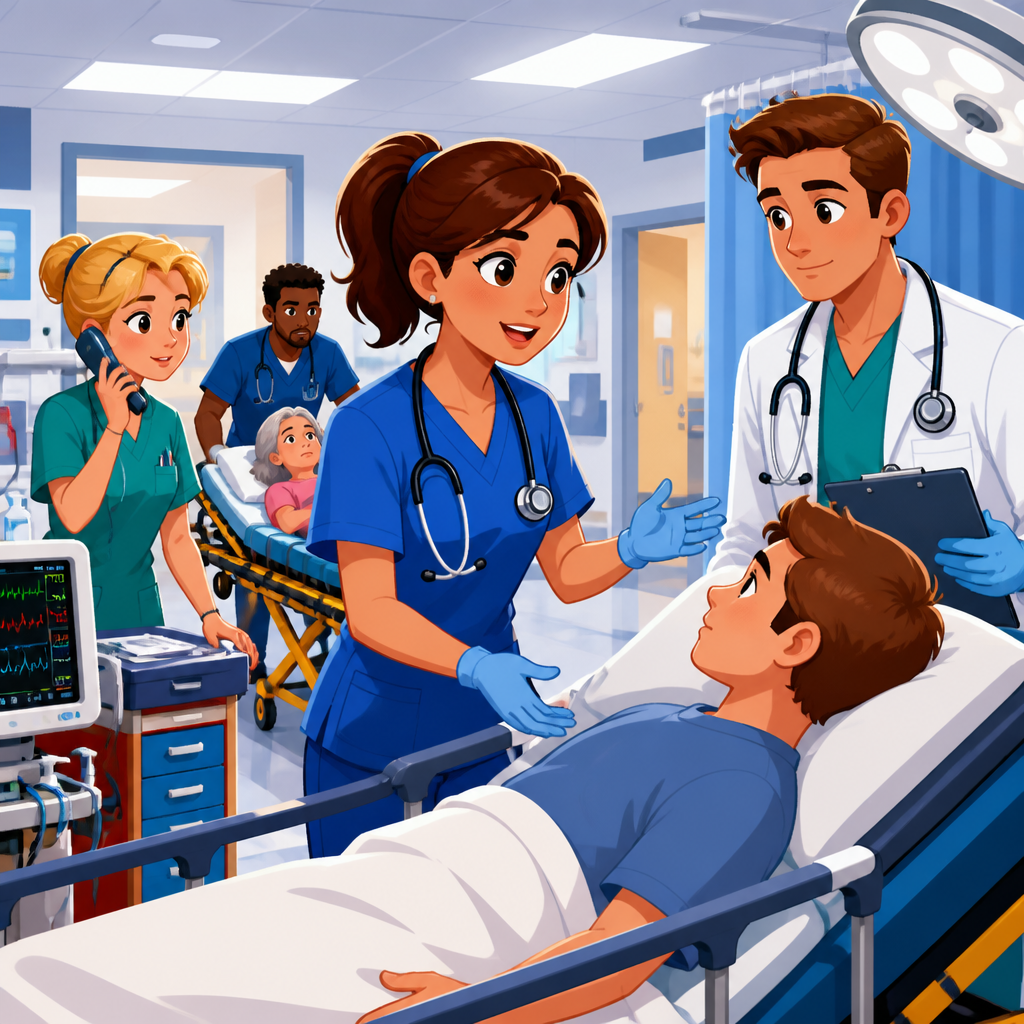
English for emergency rooms is not about perfect grammar. It is about saying the right words fast enough to get safe care when pain, injury, or fear make thinking harder. In an emergency department, even simple phrases can change how quickly staff understand the problem, what tests happen next, and whether a family member can help. I have worked with learners who could discuss work projects in English but froze when a triage nurse asked, “What brought you in today?” That gap matters because emergency communication is compressed, high stakes, and full of unfamiliar medical terms.
An emergency room, often called the ER or ED, is the hospital department for urgent and life-threatening problems. Triage is the first assessment that decides who needs care first based on severity, not arrival time. Registration collects identity, insurance, and contact details. Consent means permission for treatment. Discharge instructions explain what to do after leaving. If you understand those four stages, you can predict the questions coming next and prepare practical English for each one. That preparation reduces delays, lowers stress, and helps you describe symptoms accurately.
Why does this matter so much? Because emergency staff make decisions from short conversations combined with visible signs, vital signs, and test results. If a patient says “pressure in my chest spreading to my arm” instead of only “pain,” the nurse may recognize a cardiac warning pattern faster. If a parent can say “He has a peanut allergy and used an epinephrine auto-injector ten minutes ago,” the team has immediately useful information. Clear English does not replace medical evaluation, but it improves handoff quality. In emergency medicine, better information early usually means better decisions earlier.
What to say at triage first
Triage is the most important first conversation because it determines urgency. The nurse usually wants four things quickly: the main problem, when it started, how severe it is, and whether there are danger signs. A strong opening sentence is direct: “I have severe stomach pain since this morning,” “I cut my hand and it will not stop bleeding,” or “My father is short of breath and feels dizzy.” Keep the first sentence short. If you give a long story before the core symptom, key facts can get buried.
Use symptom language that emergency staff hear every day. Say “chest pain,” “shortness of breath,” “fainting,” “vomiting,” “high fever,” “allergic reaction,” “burn,” “sprained ankle,” or “possible fracture.” Add location, timing, and intensity. For example: “The pain is on the lower right side,” “It started two hours ago,” or “It is eight out of ten.” If symptoms changed, say so clearly: “It is getting worse,” “The swelling is spreading,” or “She was confused for five minutes but now is alert.” Those details often matter more than polished English.
If someone may be having a stroke, use the signs directly: “Sudden facial droop, arm weakness, and trouble speaking started at 6:20 p.m.” For a possible heart attack, say “crushing chest pressure,” “pain going to the jaw or left arm,” “sweating,” and “nausea.” For serious infection, mention “high fever,” “shaking chills,” or “new confusion.” Emergency teams are trained to react to these patterns. When I coach learners for medical situations, I tell them to memorize symptom clusters, not just single vocabulary words, because triage decisions depend on combinations.
Essential phrases for registration, consent, and medication questions
After triage, registration staff may ask for your name, date of birth, address, emergency contact, insurance, and identification. Useful answers include: “My legal name is…,” “Here is my ID,” “This is my insurance card,” and “Please call my spouse at this number.” If speaking is difficult, say, “I need help filling out this form,” or “English is not my first language. Please speak slowly.” Hospitals usually have interpreter services, and asking for one is appropriate: “I need an interpreter, please.” That request can prevent dangerous misunderstandings.
Consent and medication history are equally important. You may hear questions like “Do you have any allergies?” “What medications do you take?” “Are you pregnant?” “When did you last eat or drink?” or “Have you had surgery before?” Answer with complete, concrete information. Instead of “I take blood pressure medicine,” say “I take lisinopril, ten milligrams, once a day.” Instead of “I’m allergic to medicine,” say “I’m allergic to penicillin. I get hives and trouble breathing.” If you do not know an answer, do not guess. Say, “I’m not sure,” or “Let me check my phone.”
Many patients first build healthcare vocabulary in lower-pressure settings, such as routine scheduling. That foundation helps in emergencies because terms like symptoms, medications, referrals, and insurance appear again under stress. For a useful starting point, review English for booking a doctor’s appointment by phone. In the ER, however, speed and precision matter more. Staff need the exact medicine name, dosage, timing, and reaction history, especially before imaging with contrast, pain medication, antibiotics, or emergency procedures.
Fast phrases for common emergency situations
The most effective emergency English is pattern based. Memorize short phrases for the situation you are most likely to face: injury, breathing trouble, severe pain, infection, or allergic reaction. Parents should also know child-focused wording such as “He is not acting like himself,” “She has fewer wet diapers,” or “He cannot keep fluids down.” Below is a practical reference I use because it organizes the exact facts staff need: problem, timing, danger sign, and urgent request.
| Situation | Fast phrase | Why it helps |
|---|---|---|
| Chest symptoms | I have chest pressure, shortness of breath, and sweating. | Signals a possible cardiac emergency. |
| Stroke signs | Her face drooped and her speech changed at 6:20 p.m. | Gives classic signs plus exact onset time. |
| Bleeding | He cut his arm and the bleeding has not stopped for twenty minutes. | Shows severity and duration. |
| Allergic reaction | I ate peanuts, my lips are swelling, and I used my EpiPen ten minutes ago. | Names trigger, symptom, and treatment already given. |
| Broken bone | I fell, heard a crack, and cannot put weight on my ankle. | Describes mechanism and functional loss. |
| Child illness | My child has a fever of 39.5°C, is very sleepy, and is not drinking. | Highlights dehydration and lethargy. |
These phrases work because they combine plain English with medically meaningful details. Emergency clinicians often think in patterns: mechanism of injury, onset time, severity, associated symptoms, and response to treatment. For example, “I slipped on wet stairs, landed on my wrist, and now my fingers feel numb” is better than “My arm hurts.” It gives the mechanism, body part, and a neurologic symptom. If you are helping another person, identify your role: “I’m her son,” “I witnessed the fall,” or “I gave him acetaminophen at 3 p.m.”
How to answer questions from doctors and nurses clearly
Once you are in an exam room, the questions usually become more detailed. Clinicians often use OPQRST for pain assessment: onset, provocation, quality, region, severity, and time. You do not need to know the acronym, but your answers should cover those points. For example: “The pain started after dinner, gets worse when I move, feels sharp, is in the upper right abdomen, is seven out of ten, and comes in waves.” That level of detail helps distinguish possibilities such as gallbladder pain, muscle strain, kidney stone, or appendicitis.
Be careful with common language traps. Dizzy can mean lightheaded, spinning, weak, or unsteady; those are different symptoms. Numb can mean no feeling, tingling, or weakness. Allergy is often used for side effects, but clinicians separate true allergic reactions from intolerance. If ibuprofen upsets your stomach, say “It causes stomach pain,” not automatically “I’m allergic.” If you fainted, say whether you lost consciousness and for how long. Precise wording improves safety because it guides testing, medication choices, and whether a specialist should be called.
You should also know how to ask clarifying questions. Useful phrases include: “What test are you doing?” “What are you looking for?” “What does that result mean?” “Is this urgent?” “What side effects should I watch for?” and “Can you explain that in simpler words?” If the plan changes, ask for the reason. In my experience, patients remember more when they repeat information back: “So I need blood tests, an X-ray, and no food for now, correct?” That simple confirmation reduces errors during a stressful visit.
Discharge, follow-up, and when to return immediately
Leaving the ER safely requires as much language as arriving. Before discharge, ask for the diagnosis, the treatment given, the medicine schedule, activity limits, and specific warning signs. Strong phrases are: “Can you write the instructions down?” “How often should I take this?” “Should I take it with food?” “When can I go back to work?” and “When should I come back immediately?” Good discharge teaching is concrete. For example, after a concussion, return precautions may include worsening headache, repeated vomiting, confusion, seizure, or difficulty waking the patient.
Follow-up matters because the emergency room stabilizes urgent problems; it does not manage every condition long term. You may need a primary care doctor, orthopedist, cardiologist, or wound check within a set time. Ask, “Who should I follow up with and by when?” If a test is pending, say, “How will I get the results?” If cost or transport is a barrier, mention it before leaving. The main benefit of emergency room English is simple: it turns panic into usable information. Practice a few key phrases today, save them on your phone, and share them with family members before an emergency happens.
Frequently Asked Questions
What are the most important English phrases to know in an emergency room?
The most important emergency room phrases are the ones that help you explain the problem quickly, clearly, and safely. Start with simple statements such as “I need help,” “I have chest pain,” “I can’t breathe well,” “I fell,” “I hit my head,” “I am bleeding,” “I feel dizzy,” or “I have a severe headache.” These short phrases matter because emergency staff first need to understand the main symptom, how serious it sounds, and how fast you may need care. You do not need advanced grammar. In fact, simple words are often better under stress because they are easier to remember and less likely to be misunderstood.
It also helps to know phrases that describe time and intensity. For example: “It started 20 minutes ago,” “The pain is getting worse,” “It is sudden,” “It comes and goes,” “My pain is 8 out of 10,” or “I vomited twice.” If you can add location, that is even better: “The pain is in my chest,” “My right side hurts,” “My lower back hurts,” or “My left arm feels numb.” These details help triage nurses and doctors decide what questions to ask next and what tests may be needed.
Other essential phrases involve safety information: “I am allergic to penicillin,” “I take blood thinners,” “I have diabetes,” “I am pregnant,” “I have asthma,” or “I had surgery last week.” In emergencies, these facts can directly affect treatment decisions. If you cannot remember full sentences, focus on key words: symptom, body part, timing, pain level, allergy, medicine, and medical condition. That combination gives staff a fast and usable picture of what is happening.
How should I answer the question, “What brought you in today?”
This is one of the most common triage questions, and it often causes people to freeze because it sounds broad. The best answer is short, direct, and structured. A simple formula is: main problem + when it started + one important detail. For example: “I have strong stomach pain since this morning,” “I cut my hand 30 minutes ago and it will not stop bleeding,” or “I started having trouble breathing about an hour ago.” That kind of answer gives staff exactly what they need first: the symptom, the timeline, and the urgency.
If possible, add a brief description of severity or change. You might say, “The pain is getting worse,” “I fainted once,” “I have a fever too,” or “I cannot walk on it.” These small details can be more useful than long explanations. In an emergency department, staff are trained to ask follow-up questions, so your job is not to tell your whole medical story immediately. Your job is to state the core problem clearly enough that they understand why you are there.
If you are nervous, it can help to memorize a few ready-made models before you ever need them. For example: “I am here because…,” “It started…,” “It feels…,” and “It is getting better/worse.” Then fill in the blanks. “I am here because I have chest pressure. It started last night. It feels heavy. It is getting worse.” That is effective emergency English. It is not polished, but it is useful, and useful is what matters most in the ER.
What information should I be ready to give besides my main symptom?
Besides your main symptom, emergency room staff often need a fast summary of your medical background because it can change how they evaluate and treat you. Be ready to share allergies, current medications, chronic conditions, recent surgeries, pregnancy status if relevant, and whether you have had this problem before. For example, “I am allergic to shellfish,” “I take insulin,” “I take medicine for high blood pressure,” “I have epilepsy,” or “I had this pain last month.” These details are not small. They help doctors avoid unsafe medications, recognize patterns, and choose the right tests sooner.
You should also be prepared to answer questions about timing, severity, and triggers. Staff may ask when the symptom started, whether it happened suddenly or slowly, whether anything makes it better or worse, and whether the problem spread to another area. Useful phrases include “It began suddenly,” “It started after I fell,” “It hurts more when I breathe,” “It gets worse when I walk,” or “The pain moves to my back.” If you have a fever, vomiting, numbness, weakness, shortness of breath, or loss of consciousness, say that early. Those associated symptoms can signal a higher level of urgency.
Practical information matters too. Know how to say your date of birth, the name of any medicine you take, and the phone number of an emergency contact if possible. If you do not know a medication name, say what it is for: “I take a pill for blood pressure,” “I use an inhaler for asthma,” or “I take medicine to prevent seizures.” Emergency communication is about speed and clarity, not perfect detail. Staff can work with incomplete information if the key safety facts are communicated clearly.
What can I say if I do not understand the nurse or doctor?
If you do not understand, say so immediately and simply. This is one of the safest things you can do in an emergency room. Useful phrases include “Please speak slowly,” “Please say that again,” “I do not understand,” “Can you explain in simple English?” and “Can you write it down?” Medical situations are stressful even for native speakers, so asking for repetition or simpler language is completely appropriate. In fact, it can prevent dangerous misunderstandings about symptoms, consent, tests, medications, or discharge instructions.
If your English is limited, ask directly for language support. You can say, “I need an interpreter,” “Do you have an interpreter for Spanish?” or “Can my family member help explain?” Professional interpreters are especially important for serious symptoms, consent forms, treatment decisions, and discharge instructions. A family member may help in some situations, but a trained medical interpreter is usually better for accuracy, privacy, and safety. If you know only a little English, combine basic symptom words with a request for help: “Chest pain. Started today. Need interpreter.” That is enough to begin.
It is also smart to confirm what you heard. Try phrases like “Do you mean I need an X-ray?” “Should I stop eating now?” or “I take this medicine tonight?” Repeating instructions back in your own words is one of the best ways to reduce mistakes. In emergency care, understanding matters more than sounding fluent. Clear clarification is a strength, not an embarrassment.
How can I prepare in advance so I can speak more effectively during a real emergency?
The best preparation is simple, practical, and focused on high-pressure communication rather than textbook English. Start by learning and practicing a short emergency script about yourself: your name, age, allergies, medications, major conditions, and a few common symptoms. For example: “My name is Ana Ruiz. I am 42. I am allergic to penicillin. I have asthma. I use this inhaler. Today I have trouble breathing.” If you rehearse that kind of script out loud several times, it becomes much easier to use when fear or pain makes thinking harder.
It is also helpful to build a small personal phrase list based on your health needs. Someone with diabetes should know phrases about blood sugar, insulin, dizziness, and confusion. Someone with a history of heart problems should know phrases like “chest pressure,” “shortness of breath,” and “pain in my left arm.” Parents should learn phrases for fever, vomiting, allergic reaction, seizure, and injury. This kind of targeted vocabulary is more useful than trying to memorize dozens of random medical terms you may never need.
Finally, prepare tools, not just phrases. Keep a note on your phone or in your wallet with your medications, allergies, diagnoses, emergency contact, insurance information if relevant, and preferred language. If you wear glasses or use hearing aids, bring them if possible because they improve communication. You can even save a short bilingual note that says, “I need medical help. My main medical conditions are…” Preparation does not guarantee calm, but it reduces confusion and gives you a much better chance of communicating the right information quickly when every minute counts.