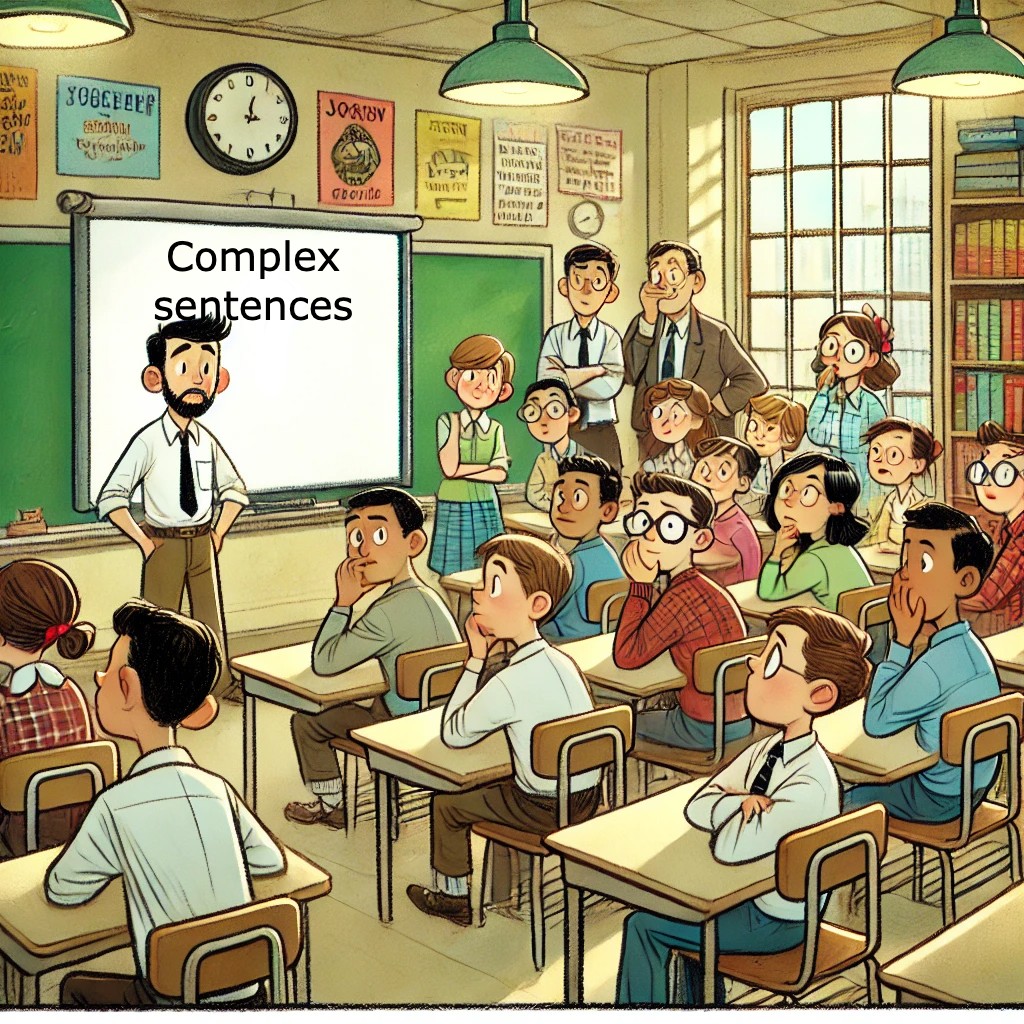
A complex sentence has one independent clause and at least one dependent clause. For example, in Although it was raining, she walked home, she walked home can stand alone, while although it was raining depends on it. Use the structure to express a relationship such as time, reason, condition, or contrast.
But what exactly is a complex sentence? In simple terms, a complex sentence consists of one main (independent) clause and one or more subordinate (dependent) clauses. The dependent clause, which cannot stand alone as a complete sentence, provides additional information about the main clause. Understanding and using complex sentences correctly can greatly improve both your written and spoken English.
This comprehensive guide is designed to help you break down the components of complex sentences, understand how to construct them effectively, and recognize their usage in everyday English. Whether you’re preparing for an exam, writing an essay, or simply trying to improve your conversational skills, mastering complex sentences will give you an edge. Let’s dive in and explore the intricacies of complex sentences together!
Components of a Complex Sentence
Before we delve into constructing complex sentences, it’s essential to understand their components: the independent clause and the dependent clause. A thorough understanding of these two parts is crucial for mastering complex sentence structures.
The independent clause is essentially a complete sentence. It contains a subject and a predicate, and it can stand alone as a coherent idea. For example: “She decided to take a walk.” This sentence is complete on its own; it does not require additional information to make sense.
The dependent clauses in these examples contain a subject and a finite verb but cannot stand alone as complete sentences. Words such as although, because, if, and when can introduce subordinate clauses. Which can introduce a relative clause, but it is a relative pronoun in that use, not a subordinating conjunction. Not all dependent clauses have the same form or function.
To create a complex sentence, you simply combine these two types of clauses: “Although it was raining, she decided to take a walk.” Here, “Although it was raining” is the dependent clause, and “she decided to take a walk” is the independent clause. Together, they form a complex sentence that conveys a complete thought. Understanding how these components work individually will make it easier to piece them together into more complex statements.
Constructing Complex Sentences
Now that you understand the components of a complex sentence, let’s learn how to construct them. One of the most important aspects of forming complex sentences is the proper use of subordinating conjunctions. These conjunctions help join the independent and dependent clauses to create a cohesive thought.
Subordinating conjunctions serve a specific function; they establish the relationship between the dependent clause and the independent clause. Here are a few examples of how subordinating conjunctions can be used:
- “Because”: This conjunction indicates a cause-and-effect relationship. E.g., “She was late because the bus broke down.”
- “Although”: This conjunction indicates a contrast. E.g., “Although it was raining, she decided to take a walk.”
- “When”: This conjunction indicates time. E.g., “When the timer goes off, take the cake out of the oven.”
- “If”: This conjunction introduces a condition. E.g., “If you study hard, you’ll pass the exam.”
For an introductory adverbial dependent clause, normally put a comma before the main clause: Although it was raining, she walked home. A following adverbial clause often needs no comma: She walked home because the bus had left. A following contrast clause may be set off by a comma. Relative clauses follow separate essential/nonessential punctuation rules, so clause order alone does not determine every comma.
Dependent clause first: “Although it was raining, she decided to take a walk.”
Independent clause first: “She decided to take a walk although it was raining.”
With practice and careful attention to details, constructing complex sentences will become an integral part of your English skills.
Identifying Complex Sentences
Recognizing complex sentences when you encounter them in reading materials or conversational contexts is crucial for improving your English comprehension and writing skills. Here are a few tips to help you identify complex sentences:
1. Look for Subordinating Conjunctions: These conjunctions usually signal the beginning of a dependent clause. Terms like “although,” “because,” “if,” and “when” are good indicators.
2. Count the independent clauses: One independent clause plus a dependent clause makes a complex sentence. Two or more independent clauses with no dependent clause make a compound sentence. Two or more independent clauses plus at least one dependent clause make a compound-complex sentence.
3. Test the whole structure: A dependent clause alone is normally a fragment in formal sentence writing. To identify a complex sentence, also locate the independent clause. Finding a word such as because or when is a clue, not enough evidence by itself.
Here are a few examples for practice:
“Even though he was tired, he finished his homework.”
Independent clause: “he finished his homework.”
Dependent clause: “Even though he was tired”
“She plans to travel to Europe if she saves enough money.”
Independent clause: “She plans to travel to Europe”
Dependent clause: “if she saves enough money”
By regularly practicing identifying complex sentences, you can develop a deeper understanding of English grammar and improve your reading and writing skills.
Common Mistakes to Avoid
As you practice creating and identifying complex sentences, it’s important to be aware of common mistakes that learners often make. By understanding these mistakes, you can avoid pitfalls and improve your grammar skills more effectively.
1. Misplacing the Comma: One of the most common mistakes is incorrect comma placement. Remember, if the dependent clause comes first, a comma should follow it. If the independent clause comes first, typically, no comma is needed.
Both Although it was raining, she decided to take a walk and She decided to take a walk, although it was raining can be grammatical. The second comma can mark the following contrast. Do not label the second version incorrect merely because the main clause comes first.
2. Sentence fragments: When the sun rises is a complete dependent clause, but it is not a complete sentence by itself in this use. Add an independent clause to complete the sentence.
Incorrect: “When the sun rises.”
Correct: “When the sun rises, she goes for a jog.”
3. Overusing Coordinating Conjunctions: While coordinating conjunctions like “and,” “but,” and “or” are useful, they are not the same as subordinating conjunctions. Ensure you’re using the correct type of conjunction for complex sentences.
Compound: She was tired, but she finished her homework.
Complex: Although she was tired, she finished her homework.
Both express contrast. Coordinating with but is not itself a grammatical error; it produces a different sentence structure.
4. Mixing Up Clause Types: Be clear about which is your dependent and which is your independent clause. Mixing them up can lead to confusing sentence structure.
Both orders are correct: If she saves enough money, she plans to travel to Europe and She plans to travel to Europe if she saves enough money. The clause beginning with if remains dependent in either position.
By being mindful of these common mistakes and practicing regularly, you’ll find it easier to form complex sentences correctly and confidently.
Conclusion
Understanding and mastering complex sentences is a crucial step in your journey to becoming proficient in English. These sentences allow for more nuanced and detailed expression, setting you apart as a competent and articulate communicator.
By learning the components of complex sentences, practicing their construction, and recognizing them in various contexts, you can significantly enhance both your written and spoken English. Remember to watch out for common mistakes, like incorrect comma placement and incomplete dependent clauses, to ensure your sentences are grammatically sound.
The journey to mastering complex sentences may seem daunting initially, but with practice and dedication, it becomes much more manageable. Make use of resources such as grammar guides, writing exercises, and language exchange partners to gain more exposure and practice.
At our ESL website, we are committed to helping you every step of the way. Continue exploring our other resources and guides to further enhance your English skills. With time, patience, and consistent practice, you’ll find yourself navigating complex sentences with ease and confidence.
Relative clauses also create complex sentences
The book that you lent me is useful. The relative clause that you lent me identifies the book. Compare This book, which you lent me, is useful. Here the relative clause adds nonessential information and is set off with commas. A complex sentence does not have to begin with a conjunction.
Practice with explanations
Classify these as a fragment, compound sentence, complex sentence, or compound-complex sentence: 1. Because the train was late. 2. We waited, and we called home. 3. Because the train was late, we called home. 4. Because the train was late, we waited, and we called home.
Answers: 1. fragment: only a dependent clause; 2. compound: two independent clauses; 3. complex: one independent and one dependent clause; 4. compound-complex: two independent clauses and one dependent clause.
Check further examples in Purdue OWL’s sentence punctuation patterns and Cambridge’s relative-pronoun guidance.