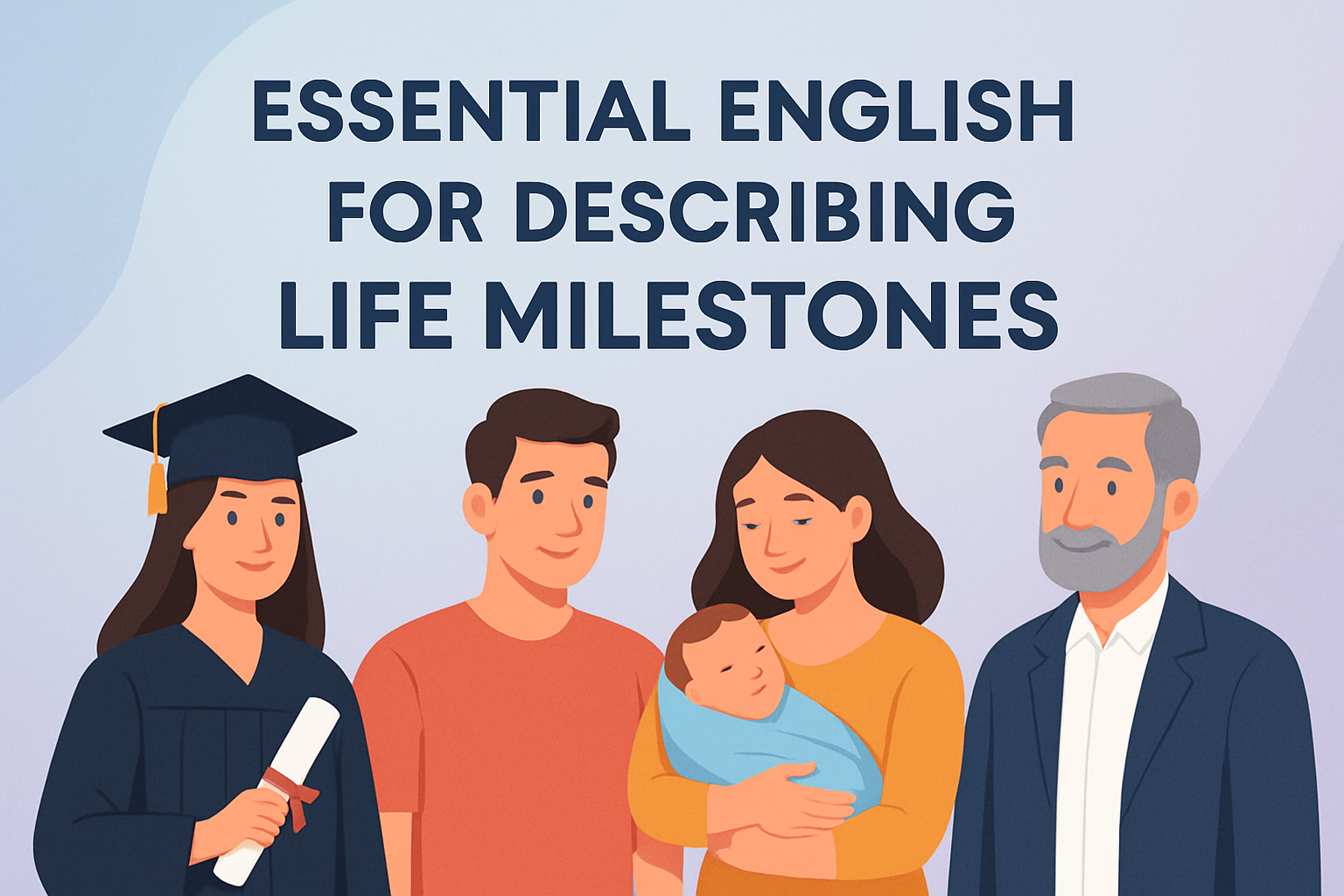
Introduction to Life Milestones
Life milestones are the significant achievements or benchmarks that mark our journey through life. These milestones, such as graduating from college, getting married, or retiring, often carry profound meaning and are integral to our personal narratives. The language we use to describe these moments provides not only a way to celebrate and remember them but also a means to connect with others by sharing our experiences. Whether you are an English speaker or a student learning the language, being able to articulate these occasions accurately and vividly is crucial.
Understanding how to discuss life’s milestones in English can enhance communication, help forge deeper connections, and even offer comfort and camaraderie through shared experiences. This topic matters because it touches every human, regardless of cultural background, making the capacity to express these experiences universally valuable. This article will explore essential English phrases and vocabulary for describing life milestones, guiding you through various key stages of life.
Academic Milestones
Academic milestones, such as graduating from high school or earning a degree, are pivotal moments in a person’s life. These events often mark the transition into adulthood and the starting point of a career. To describe an academic milestone, it is crucial to use precise and descriptive language that conveys the significance and the emotions surrounding the event.
For instance, when discussing graduation, terms like “commencement,” “diploma,” “degree,” “ceremony,” “caps and gowns,” and “valedictorian speech” often surface. An individual might say, “I felt a mix of relief and excitement as I walked across the stage to receive my diploma during the commencement ceremony.” This sentence not only states the event but also conveys the emotional weight and setting involved.
Let’s consider the process of describing an academic achievement more descriptively:
- Identify key terms specific to the event: diploma, degree, honor roll.
- Include details like location or attendees: audience, family, classmates.
- Express feelings and emotions: pride, achievement, bittersweetness.
Real-world Example: Emily graduated from Stanford University with a degree in Computer Science. To express her accomplishment, she might say, “Walking through Memorial Court and hearing my name called was surreal. The joy of tossing my cap into the sunny sky, surrounded by friends and family, marked the culmination of years of hard work and late-night study sessions.”
Career Milestones
Career milestones go beyond the professional transformations in one’s life, such as starting a first job, receiving a promotion, or retiring. These achievements often shape our identities and future trajectories. In English, accurately describing these career events requires specific terminology that appropriately captures the essence of the professional journey.
To illustrate, here is an example of how someone might describe a promotion: “Receiving news of my promotion to Senior Manager was invigorating. It felt as though all the late nights and strategic planning had paid off, and it was gratifying to know my efforts were recognized and valued by the company.”
Key terms and phrases that often accompany career milestones include “promotion,” “achievement,” “goal accomplished,” “networking,” “professional growth,” “mentor,” and “retirement party.”
Real-world Example: Tim had always aspired to become an entrepreneur. After years of working in corporate roles, he launched his tech startup. Tim shared, “Leaving my steady job to pursue entrepreneurship was daunting, yet exhilarating. The freedom to innovate and implement my vision invigorated my passion for technology and leadership.”
| Term | Definition |
|---|---|
| Promotion | A move to a higher position or rank within a company. |
| Retirement | The act of leaving one’s job and ceasing to work, typically after reaching a certain age. |
| Entrepreneurship | The process of starting and managing a new business venture. |
Relationship Milestones
In any discussion of life milestones, relationship milestones command significant attention. These include beginnings and transitions in personal relationships, such as getting engaged, married, or even starting a family. Describing these relationships and transformations involves conveying the emotional depth and future aspirations associated with them.
Consider the vocabulary used in discussing a wedding: “ceremony,” “vows,” “reception,” “honeymoon.” To vividly recount the occasion, one might say, “Our wedding day felt like a dream. Sharing vows in a quaint chapel and being surrounded by loved ones filled us with overwhelming joy and gratitude for the journey we were embarking on together.”
Real-world Example: Michael and Sarah celebrated their 25th wedding anniversary with a vow renewal. Michael might describe the occasion thus: “Standing together, twenty-five years later, and reaffirming our love felt like rewriting the promises we made but with deeper understanding and stronger bonds.”
Personal Growth Milestones
Personal growth milestones are individual achievements that reflect personal development, such as overcoming obstacles or reaching personal goals. They are often deeply personal and can transform one’s sense of self-esteem and capability.
To articulate personal growth, consider this example: “After miles of tracks and countless races, crossing the marathon finish line felt like the triumph of persistence and spirit over adversity. The sweat, tears, and determination crystallized into a moment of pure elation.”
Key phrases might include “personal goal,” “self-improvement,” “overcoming challenges,” and “milestone achievement.”
These personal milestones often reveal an individual’s inner resilience and drive, serving as testimony to one’s personal journey and evolution.
Summarizing Essential English for Life Descriptions
Life milestones form the framework of our existence, marking transitions and achievements in our journeys. Understanding and expressing these milestones in English is vital for sharing meaningful narratives and connecting with others. From academic to personal milestones, the language employed must capture not only the events themselves but the emotions and significances intertwined with them.
This exploration provides the vocabulary and examples necessary for accurately and expressively conveying the essence of life’s major events. Mastering these expressions helps in recounting personal stories with clarity and depth, enhancing both personal reflection and communication with others.
As you reflect on your own life milestones, consider practicing these descriptions. Whether it’s journaling your own achievements or articulating your experiences to others, refining your language skills will enable you to share your journey more effectively. Start crafting narratives that celebrate your milestones, enriching your interactions and personal introspection with the tools and insights shared here.
Frequently Asked Questions: Essential English for Describing Life Milestones
1. What are life milestones, and why are they important?
Life milestones are significant achievements or events that occur throughout an individual’s life. These can include occasions such as graduating from high school or college, getting married, having a child, buying a home, or retiring. Each milestone represents a pivotal moment that reflects personal growth, changes, and achievements.
Understanding and appreciating these milestones are important because they help us to track progress and growth, celebrate success, and sometimes, re-evaluate our goals and aspirations. These moments are not just about the events themselves but also about the stories, emotions, and experiences tied to them. They give us a narrative of our lives that can be shared with others, fostering a deeper connection through shared experiences.
2. How can I effectively describe my life milestones in English?
Effectively describing life milestones in English involves using detailed, vivid language that captures the essence and emotions of the milestone. Here are some strategies to consider:
- Be Descriptive: Use adjectives and adverbs to add color and detail to your narrative. For example, instead of saying “I graduated,” you might say, “I proudly graduated with honors in a stunning ceremony surrounded by my supportive family.”
- Chronological Order: Organize your description by starting from the beginning, detailing key events leading to the milestone, and ending with the outcome or significance of the event.
- Share Personal Feelings: Including your personal thoughts and emotions gives insight into how the milestone impacted you. Express your joy, pride, relief, or even the challenges you faced along the way.
- Use Dialogue or Quotes: Occasionally incorporating a piece of advice, a comment from a loved one, or even something you said can enrich your description and make it relatable.
- Reflect on Importance: Conclude by explaining why the milestone is significant to you, what it represents in your life journey, and how it may shape your future.
3. What are common terms or phrases in English used to describe life milestones?
Several common terms and phrases are frequently used in English to describe life milestones. Here are some of them, along with examples:
- “Coming of age”: This term is often used to describe the transition from childhood to adulthood. For example, “Turning 18 was a significant coming-of-age moment for me.”
- “Tie the knot”: A popular phrase for getting married. For instance, “We decided to tie the knot after three wonderful years together.”
- “Proud moment”: Often used to highlight achievements like graduating or achieving a long-term goal. As in, “Walking across the stage was a proud moment I’ll cherish forever.”
- “Milestone birthday”: Refers to significant birthdays such as 18th, 21st, 30th, etc. An example could be, “My 21st was a milestone birthday I celebrated with friends and family.”
- “New chapter”: Used to describe the beginning of a new phase in life, such as starting a new job or retiring. “Moving to a new city marked a new chapter in our lives.”
4. Why is it beneficial to share my life milestones with others?
Sharing life milestones with others can be beneficial in numerous ways. Firstly, it helps to reinforce your achievements by acknowledging and celebrating them openly with friends and family. This acknowledgment often leads to a sense of pride and accomplishment.
Additionally, sharing can create closer bonds with others. As you disclose your experiences, others might share similar stories, fostering empathy and understanding. This creates a supportive community that celebrates and learns from one another’s successes and challenges.
Moreover, discussing your milestones allows others to see you in a fuller, richer light, which can foster deeper relationships. Sharing your narrative can also provide inspiration and motivation for others who are pursuing their own life goals.
5. Can describing life milestones improve my English language skills?
Yes, describing life milestones can significantly enhance your English language skills by expanding your vocabulary, improving sentence structure, and increasing your proficiency in storytelling. Through practice, you become more adept at choosing precise and impactful words to convey emotions and events accurately.
Engaging in writing or speaking about these experiences challenges you to organize your thoughts, enhancing your ability to construct coherent and engaging narratives. This practice also helps in better understanding nuances in language, such as idioms, cultural expressions, and context, all of which enrich your English communication skills.
Additionally, sharing your life milestones with native speakers or in language learning settings can provide you with feedback, allowing you to learn and correct any language missteps, thus refining both your spoken and written English.