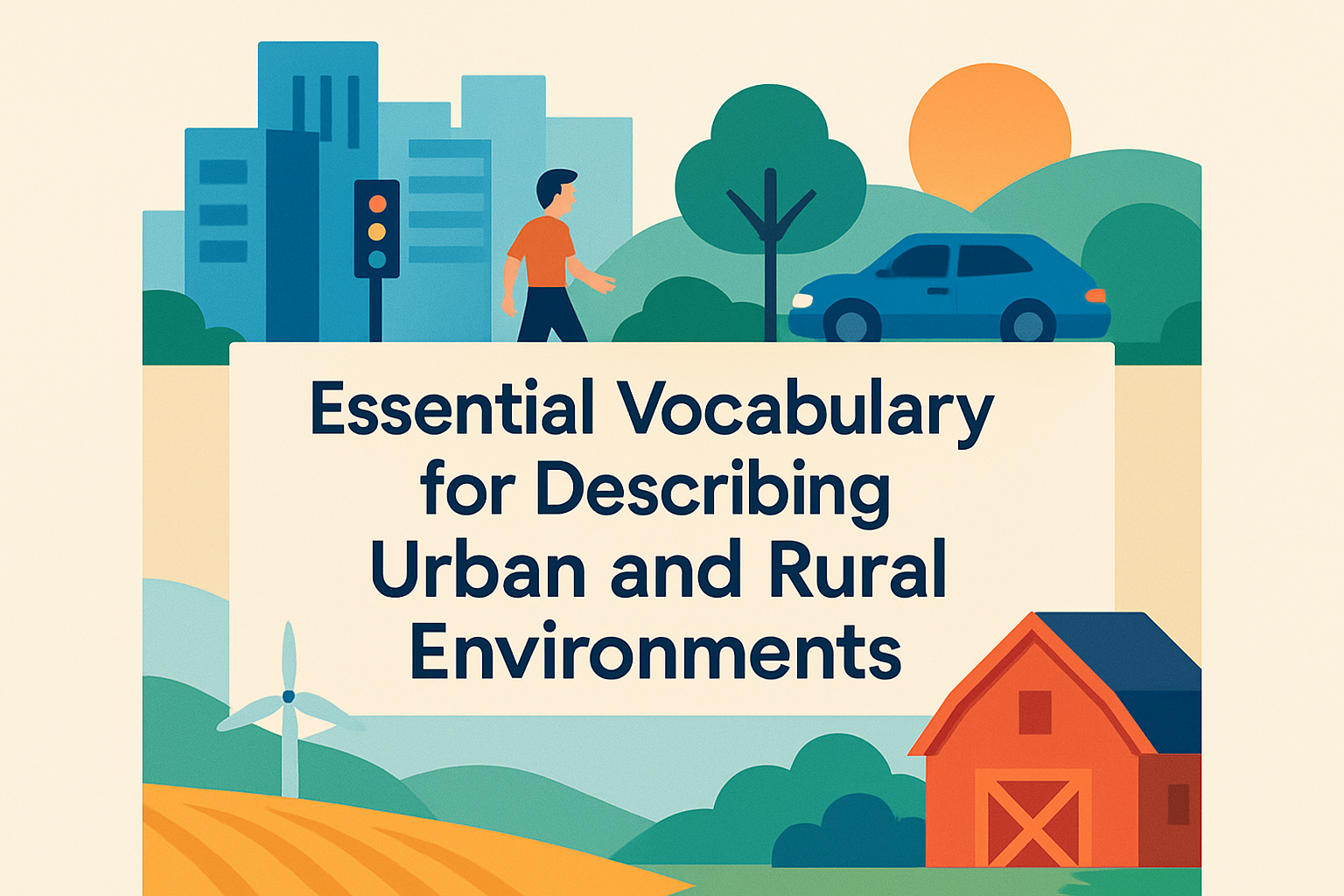
Describing urban and rural environments involves understanding and employing a variety of terms that convey not just the physical characteristics of these places, but also the life and activities within them. The vocabulary used to discuss urban and rural settings provides clarity, communication, and insight into the dynamics of different environments. Proper terminology is crucial for architects, urban planners, sociologists, environmentalists, local governance, and anyone with a stake in land-use development and community planning. Utilizing the right words can influence perception and decision-making regarding issues like infrastructure, social services, cultural dynamics, and future development strategies. Our vocabulary helps everyone from policy makers to community members articulate their experiences and aspirations accurately. As urbanization continues to evolve and expand across the globe, alongside the preservation and development of rural areas, having a comprehensive vocabulary ensures that discourse around these subjects is rooted in shared understanding and clarity.
Understanding Urban Environment Terminology
Urban environments are characterized by their dense populations, infrastructures, and cultural diversities. The vocabulary used to describe urban settings falls into several categories, including geography, economy, and culture. Words like “metropolis” or “conurbation” refer to large city expanses that blur the lines between individual municipalities. For example, the Tokyo-Yokohama area illustrates a conurbation where societal and economic activities seamlessly connect several cities into a singular sprawling urban landscape. Terms like “infrastructure” cover facilities that support urban life, such as transportation networks, water supply, and waste management systems. The word “gentrification” is often used to describe changes where wealthier individuals move into an area, resulting in increased property values and shifts that could displace long-time residents. Lastly, concepts like “urban sprawl” refer to the uncontrolled expansion of urban areas. Understanding these terms allows for a nuanced discussion of urban challenges and opportunities.
Characteristics of Rural Environments
Rural environments are generally defined by open spaces, lower population densities, and a greater reliance on agriculture and natural resources. Terms specific to rural settings include “agrarian” to describe societies or economies primarily focused on farming and related activities. The word “pastoral” captures idyllic qualities often associated with the countryside, where landscapes are dominated by open fields and livestock grazing. “Hamlet” refers to a very small settlement smaller than a village, often without a church, highlighting the sparse human habitation typical of many rural areas. Rural economies often focus on primary sector activities, such as farming, extractive industries, and fisheries, with terms like “subsistence farming” indicating agriculture that meets the direct needs of the farmer or community without off-site sales. Understanding these terms helps support discussions around policy decisions, sustainability efforts, and economic development in rural areas.
Infrastructure Differences Between Urban and Rural Areas
Infrastructure in urban and rural environments differs both in design and function. In urban settings, infrastructure must accommodate high-density living with systems capable of supporting massive populations. Terms such as “public transit” versus “mass transit” reflect the scale of service required; while “smart cities” refer to urban areas utilizing digital technology to improve performance and quality of services. The “subway” is synonymous with urban environments, providing efficient underground transportation to avoid traffic congestion that would otherwise cripple streets with limited space. In contrast, rural infrastructure frequently covers wider distances with less immediate demand, focusing on essentials like reliable road networks, water delivery systems, and basic telecommunications. A challenge in these areas is often “infrastructure gap,” where there is a lack of necessary systems impacting quality of life. Investing in concepts like “renewable energy systems” offers rural areas sustainable ways to improve their service offerings. Appreciating these distinctions is essential for planning and investing in appropriate solutions.
| Urban Infrastructure | Rural Infrastructure |
|---|---|
| High-density public transit systems | Reliable road networks |
| Digital and smart technologies | Basic telecommunications |
| Complex waste management | Septic systems for waste |
| Advanced water filtration facilities | Wells and local water sources |
Demographic and Social Vocabulary
The demographics of urban and rural areas can vary considerably, with specific terms to describe the age distribution, economic situations, and social dynamics found in each. In urban settings, “diversity” often refers to a range of racial, ethnic, and socio-economic backgrounds, reflecting cities’ roles as melting pots of culture and tradition. Concepts like “urban poverty” and “income disparity” highlight how some urban environments grapple with significant divides among their residents. On the other hand, rural areas frequently face “population decline” and “aging populations,” indicating challenges tied to migration towards cities and lowered birth rates. Economic terms like “rural poverty” or “economic migration” further describe situations driving individuals from rural to urban spaces in search of better opportunities. Recognizing these terms aids in identifying the core issues and targeting effective interventions to bridge gaps in equality and access, catering to the needs of both urban and rural populace alike.
The Role of Nature and Environment
Nature is an integral part of both urban and rural settings, albeit in contrasting roles. In urban vocabularies, we often encounter terms such as “urban green spaces” or “urban forests” which describe parks and vegetation integrated within city landscapes. These spaces are vital for recreation and improving urban dwellers’ quality of life, providing respite from concrete surroundings. Contrarily, “rural landscapes” refer to extensive natural environments underscoring the inherent relationship rural areas have with the natural world. Words like “ecosystem services” capture the benefits humans derive from nature, such as clean air, water filtration, and pollination, adding value to communities nationwide. Important threats identified through words like “urban heat island” effect reflect urban settings’ susceptibility to environmental changes, as densely built environments can trap more heat. Meanwhile, rural settings might confront “land degradation” from over-farming or resource extraction. Understanding these terms is crucial for supporting sustainable development initiatives and lifestyle improvements.
Economic Activities and Opportunities
Economic activities significantly diverge between urban and rural areas, as highlighted through essential vocabulary. Urban environments conjure terms like “commercial hubs” or “financial districts,” reflecting the concentration of commerce, business headquarters, and market prowess found in many cities. “Startups” and “innovation ecosystems” further describe the thriving, dynamic business landscapes within these areas that often attract entrepreneurs and investors globally. In rural settings, economic discussions might include terms like “agribusiness,” indicating large-scale agricultural production activities maximizing profit through sustainable means. Another term, “rural tourism,” refers to efforts to encourage visitors to explore rural areas’ cultural and natural resources, contributing to economic growth and diversification. “Cottage industries,” or home-based production of goods, suggest smaller-scale economic activities sustaining rural communities financially. Mastering this vocabulary allows stakeholders to foster growth, identify new opportunities, and respond appropriately to shifting economic circumstances.
Visual Planners and Regional Contexts
The vocabulary employed to navigate urban and rural regions often draws upon mapping and visual tools to enhance decision-making and communication. In urban sites, terms like “zoning” emerge, referring to legal plans defining how parcels of land can be used. For instance, “mixed-use zoning” is a strategy that permits residential, commercial, and industrial establishments within a given area to achieve strategic urban planning. In contrast, “land use zoning” in rural contexts might focus more on preserving agricultural land or preventing overdevelopment. Techniques like “geographic information systems” play crucial roles in both environments, integrating detailed data and graphics into interactive maps for more effective analysis and planning. Appreciating these terms fosters a better grasp of spatial development for efficient, sustainable planning and thriving communities.
Conclusion: Building Vocabulary to Shape the Future
In essence, a comprehensive vocabulary for urban and rural environments empowers individuals and organizations to communicate effectively and push for informed decision-making. From infrastructures to demographics, nature to economic opportunities, these terms allow speakers, writers, and stakeholders to navigate complex discussions with precision and confidence. Understanding these concepts not only bridges urban-rural divides but also fosters a culture of shared responsibility for sustainable progress. This vocabulary is pivotal in shaping everyday conversations and societal narratives that drive innovative ideas, equity, and transparency in community development endeavors. As you acquaint yourself with these terms, take action by engaging in community dialogues, advocating for inclusive policies, and sharing knowledge that elevates the conversation around urban and rural challenges to promote broad-based, sustainable solutions.
Frequently Asked Questions
1. What are some essential vocabulary terms to describe urban environments?
In discussing urban environments, there are several key terms that are essential for a comprehensive understanding. First, we have “metropolitan,” which refers to a large city and its suburbs. Similarly, the “urban core” or “downtown” is used to describe the central area of a city where business districts are concentrated. The term “infrastructure” is crucial—it refers to the physical structures that support urban life, such as roads, bridges, water supply, and electric systems. “High-density” generally describes areas with a large population living within a compact area, typical of city life. “Mixed-use development” is another important term, referring to structures that combine residential, commercial, cultural, and institutional uses in one space. “Public transit” and “commuter” are terms that study the movement of people within urban settings. Socially, phrases like “cultural melting pot” indicate a city’s diverse population and influences, making urban vocabulary not just about structures and systems, but also about the dynamic human elements.
2. How can one effectively describe rural environments using specific vocabulary?
Describing rural environments involves terms that bring out their unique characteristics. “Countryside” is a broad term used to describe these areas, often consisting of farmlands and forests. “Agricultural” or “farming communities” highlight the primary economic activities present in rural life. “Pastoral” settings specifically refer to areas with a strong focus on agriculture, especially livestock farming. The term “bucolic” paints a picturesque and serene image of rural life. “Sparse” and “low-density” are terms used to describe the population distribution, indicating fewer people spread over larger areas. The concept of “homesteading” is about individuals or families living self-sufficiently on their own land, which is key to understanding rural economies and cultures. “Natural resources” are immensely critical, defining the reliance on and interaction with the land in rural areas. Finally, discussing “rural development” involves looking at efforts to improve the quality of life and economic well-being in these parts.
3. What role does vocabulary play in urban and rural planning?
Vocabulary in urban and rural planning is essential for clear communication and successful implementation of ideas and projects. For urban planners, terms like “zoning,” “land use,” “redevelopment,” and “sustainable” create a framework for discussion around how land is used now and will be used in the future. In rural planning, words like “land conservation,” “sustainable agriculture,” and “rural revitalization” become critical. Both urban and rural planners need to understand terms related to “infrastructure development,” “public transportation,” and “community engagement,” as these elements are vital in shaping the physical layout and lifestyle of areas. The use of specific and precise language helps in creating shared understanding among diverse stakeholders like governments, businesses, and the public, thereby facilitating better decision-making and effective communication of ideas and plans that align with community goals.
4. Why is it important for local governance to use precise vocabulary when discussing urban and rural settings?
For local governance, using precise vocabulary is crucial because it ensures clear communication and a common understanding between government entities, stakeholders, and the community. Accurate terminology helps local authorities to plan and execute policies effectively, addressing specific needs of urban and rural settings. For example, talking accurately about “urban sprawl” as opposed to “urban growth” can significantly affect policy direction, focusing on minimizing unwanted expansion rather than merely increasing an area’s population. In rural settings, distinguishing between “farmland preservation” and “land conservation” can guide initiatives towards agricultural productivity or overall ecological sustainability. Moreover, clear communication using the right vocabulary is vital in drafting regulations, setting development objectives, and engaging communities in dialogue about changes and improvements within their environments. Miscommunication or misuse of terms could lead to policies that do not align with actual needs or intended outcomes, which can impact community relations and the success of governance initiatives.
5. How does vocabulary related to urban and rural environments impact sociological understanding?
The vocabulary used to describe urban and rural environments profoundly impacts sociological understanding by framing the dynamics of how individuals and communities interact with their surroundings. In urban environments, terms like “gentrification,” “urbanization,” and “social stratification” help sociologists analyze the processes affecting social hierarchies and demographic shifts within cities. These terms can indicate disparities, lifestyle changes, and economic development, which are foundational for understanding urban social dynamics. In contrast, rural terminology such as “community cohesion,” “rural depopulation,” and “agrarian societies” helps examine the social structures, migration patterns, and community life in rural settings. Vocabulary serves as a tool for sociologists to communicate nuanced social phenomena effectively, enabling them to analyze and interpret the implications of social policies, community changes, and economic development on both individual and collective levels. Academic discourse, policy-making, and public awareness are all enriched by the precise application of this vocabulary, providing insights into challenges and opportunities unique to urban and rural contexts.