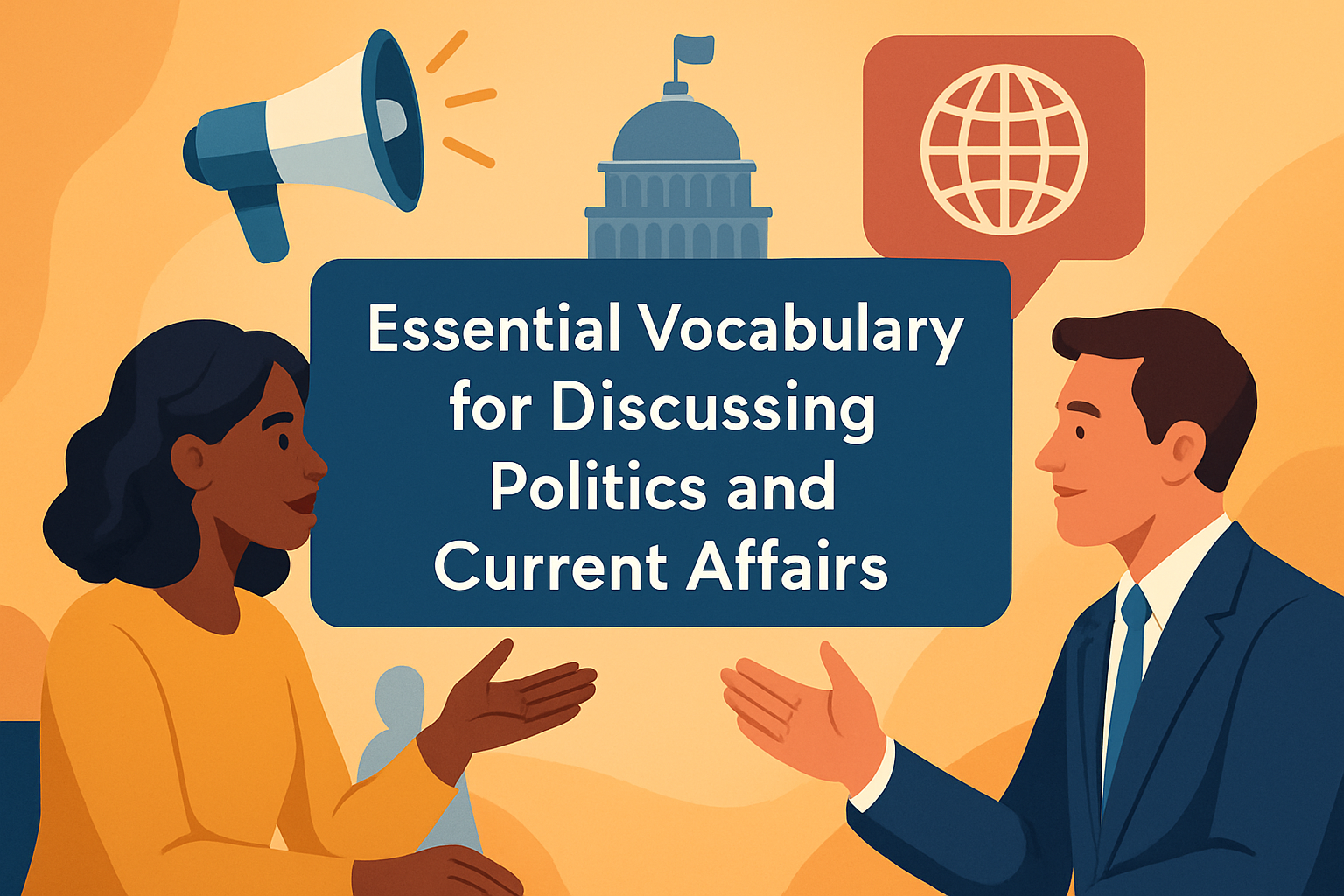
Language is a powerful tool that shapes how we understand and engage with the world around us. This is particularly true in discussions involving politics and current affairs, where specific vocabulary is crucial in accurately conveying ideas, arguments, and emotions. With the global nature of modern-day politics, possessing the right vocabulary not only allows individuals to follow and partake in dialogues but also aids in developing a nuanced understanding of the issues at hand. This vocabulary covers a range of topics from governance to policy-making, reflecting the complexity of the political landscape. Grasping these terms enables a more informed discussion, ensuring participants are well-equipped to engage with issues critically and thoughtfully. Knowing the right words can bridge the gap between misinformation and informed debate, making it an indispensable skill for anyone interested in understanding or influencing political discourse. In this article, we will dive into essential political vocabulary, explain their meanings using real-world examples, and demonstrate their importance in discussions.
Understanding Political Ideologies
Political ideologies form the backbone of political discourse. They represent a set of beliefs or philosophies about how a society should be organized. Common ideologies include liberalism, conservatism, socialism, and more. Understanding these terms can significantly enhance your ability to engage in political debates.
For instance, liberalism champions individual freedoms and equitable opportunities in market economies. The United States, particularly the Democratic Party, often promotes liberal policies such as universal healthcare and climate change regulations that align with liberalist values. By contrast, conservatism emphasizes tradition, authority, and continuity with a tendency towards gradual change. The Republican Party in the United States frequently advocates for conservative approaches, such as reducing taxes and government spending.
Socialism, another key ideology, supports the idea that the means of production should be owned or regulated by the community as a whole. Countries like Sweden incorporate elements of socialism in their welfare state models, offering universal healthcare and extensive social security systems.
Each of these ideologies has its unique approach to governance, and recognizing these distinctions will allow for richer and more precise discussions on any political topic. Whether discussing economic policies or social reforms, using the right ideological term is crucial for conveying precise arguments and facilitating mutual understanding.
The Role of Governance Structures
Governance refers to the methods and structures in place for making and implementing collective decisions. Familiarity with terms related to governance is crucial for anyone trying to grasp the intricacies of political systems.
A common term is “democracy,” a system where individuals elect representatives to make decisions on their behalf. The United States is often cited as a prime example of a democratic system, where citizens vote for a president, governors, and other representatives in regular elections. Contrarily, “authoritarianism” describes a system with concentrated power, often in the hands of a single leader or a small group, such as seen in countries like North Korea.
“Federalism” describes a political structure where power is divided between a central authority and individual states or regions. The United States follows a federal system wherein states have significant autonomy from the federal government. By contrast, a “unitary system,” as found in the United Kingdom, centralizes power predominantly within a national government, with regional authorities having little autonomous power.
Grasping these governance concepts enables individuals to appreciate the different ways countries structure their political authority and power distribution. This understanding is essential not only in evaluating one’s country’s political system but also in comparing and critically analyzing international governance models.
Policy Development and Implementation
Policy-making is a critical component of politics and refers to the development of strategies and plans by governments to address various issues. Numerous terms surrounding policy provide a framework for understanding governmental actions and their impacts.
“Legislation” denotes laws passed by a government body, such as a parliament or congress. In the U.S., examples include the Affordable Care Act, which aimed at extending health insurance coverage. Executive orders, another term to understand, are directives issued by a head of state like a president to manage operations within the federal government without requiring legislative approval. President Joe Biden’s executive order rejoining the Paris Agreement is a recent instance.
The “policy agenda” reflects the set of issues that policymakers prioritize, shaped by public opinion, political ideologies, and pressures from interest groups. Prioritizations often shift with administration changes or evolving social concerns, influencing new legislative pushes like climate reform under current governments.
Effective policy development relies heavily on these terms, as clear understanding and communication are fundamental in advocacy, debate, and decision-making processes. Mastery of this vocabulary enables more accurate descriptions of policy motives, methods, and potential outcomes.
International Relations and Global Politics
International relations are vital in understanding political discussions on a global scale. Whether examining trade agreements or peace treaties, the vocabulary of international politics facilitates nuanced discourse across global contexts.
Terms such as “diplomacy” denote the practice of negotiation between countries. The recent diplomatic talks between the U.S. and China illustrate continuous efforts to address trade tensions and achieve cooperative agreements. “Sanctions” represent punitive measures imposed by countries to influence a nation’s actions, often used against countries like Iran to curb nuclear activities.
“Multilateralism” involves multiple countries working collaboratively on issues, such as the climate agreements negotiated through the United Nations, showcasing cooperation beyond borders. Meanwhile, “unilateralism” highlights actions taken by a single state without broader international consultation or agreement.
The field of international relations employs these terms to describe complex scenarios and facilitate dialogue across divergent political landscapes. This understanding is crucial for comprehending global power dynamics, economic collaborations, and conflict resolutions.
| Term | Definition | Example |
|---|---|---|
| Diplomacy | Negotiation between countries | U.S.-China trade talks |
| Sanctions | Punitive measures against a nation | Sanctions on Iran |
| Multilateralism | Collaborative action by multiple countries | UN Climate Agreements |
| Unilateralism | Independent action by a single country | U.S. withdrawal from Paris Agreement under Trump |
Media and Public Perception
The media plays a decisive role in shaping public perception through its representation of political events and issues. Understanding related vocabulary is crucial for analyzing how information is disseminated and interpreted.
“Bias” refers to the disproportionate emphasis or slant in reporting, based on ideology, ownership, or audience demographics. Accusations of bias often arise, affecting outlets like Fox News or CNN perceived to have ideological tilts. Understanding “agenda-setting” illustrates how media prioritizes certain topics, influencing which issues receive public attention.
“Fake news” describes misinformation or disinformation presented as news, prompting significant concern regarding its impact on democratic processes. Notable examples include false narratives widely spread during the 2016 U.S. presidential election.
The term “spin” involves presenting information in a favorable light, often used by political representatives to manipulate public perception. An understanding of these terms enables individuals to assess the reliability of media sources and discern fact from opinion or misrepresentation.
Summary and Next Steps
The political landscape is intricate and multifaceted, requiring a robust vocabulary to navigate effectively. From understanding ideological differences to grasping governance structures, mastering political terms is essential for engaging thoughtfully in debates. This insight into policy formulation and international relations, enriched by an awareness of media influences, equips individuals with the tools necessary for participating in informed, meaningful discussions.
For those seeking to deepen their engagement with political issues, the next step involves actively participating in dialogues, whether through following current events, engaging in community discussions, or contributing to policy development processes. By honing one’s vocabulary and staying informed, one not only enhances personal understanding but also contributes positively to the broader discourse within society.
Engage with your local representatives, stay informed through varied media sources, and continue to expand your political vocabulary to better understand and influence the world around you.
Frequently Asked Questions
1. Why is essential vocabulary important for discussing politics and current affairs?
Language is undeniably a vital tool in navigating the complex world of politics and current affairs. Having a solid grasp of the essential vocabulary involved in these discussions is crucial for several reasons. Firstly, it allows individuals to accurately express and articulate their ideas, opinions, and emotions. Politics is an arena where clarity and precision in language can significantly influence perceptions and decisions. Essential vocabulary helps avoid misunderstandings and ensures that your message is delivered as intended.
Secondly, understanding political jargon and terms can empower you to decode the nuances and underlying messages in political rhetoric and media coverage. Political language often contains implicit meanings, and knowing these terms can help you critically analyze information rather than take it at face value. Thirdly, possessing the right vocabulary facilitates meaningful participation in dialogues about political and social issues. It opens the door to more substantive conversations about complex topics, allowing engagement with diverse viewpoints. Ultimately, developing a robust political vocabulary can lead to more informed citizens equipped to contribute thoughtfully to the democratic process.
2. What are some key political terms that everyone should know?
Politics is a complex field teeming with specialized language that can sometimes be intimidating. However, there are a few key terms anyone engaging in political discussions should know. For instance, understanding what ‘bipartisanship’ means can offer insights into how political parties work together across their ideologies to pass legislation. The term ‘lobbying’ describes efforts by individuals or groups to influence political decisions, often through financial contributions or persuasive communication. ‘Gerrymandering’ is another critical term, referring to the manipulation of electoral district boundaries to favor a particular political party.
On an international level, knowing what ‘sanctions’ entail can be essential, as they are tools used by countries to influence or punish other nations. Terms like ‘nationalism’ and ‘populism’ have become increasingly relevant in describing certain movement trends and ideologies around the world. Additionally, understanding economic terms like ‘austerity’—policies meant to reduce government deficit spending by cutting public services—and ‘inflation’, which refers to the general rise in prices, can help contextualize many political discussions. To truly grasp the ongoing dialogues, make a point of familiarizing yourself with these and other foundational terms.
3. How can one effectively use political vocabulary in conversations about current events?
Using political vocabulary effectively requires balance, precision, and understanding. When incorporating these terms into conversations, it’s essential to ensure that you’re using them in the correct context. Misusing terms can mislead or confuse your audience, undermining the clarity of your message. Make it a habit to seek clarification if you’re unsure about a term’s meaning—misinterpretations can often lead to discussions that veer off course.
Moreover, being mindful of your audience is crucial. Tailor your language to ensure that your speech is both accessible and engaging for the listener. For example, when speaking to someone less familiar with the subject, it might be helpful to briefly explain any complex terms you choose to use. This practice not only enriches the conversation but also makes the subject matter more approachable for others. Remember, language is a tool for building bridges, not barriers. As you gain confidence in your use of political vocabulary, you’ll find it much easier to engage with current affairs actively and constructively.
4. How can one improve their political vocabulary?
Improving your political vocabulary is a journey that involves regular exposure to diverse sources of information. Start with consuming a variety of news outlets, focusing on articles, podcasts, and programs that analyze political events. These can introduce you to new terms and concepts through their context. Additionally, follow debates and political discussions, either on broadcast platforms or through social media, to see the vocabulary in action and understand its practical application.
Reading is another excellent way to expand your vocabulary. Books, essays, and scholarly articles on political science can provide deeper insights into the mechanisms of politics and current affairs. To make the process enjoyable, consider exploring political novels or biographies about influential political figures—they often incorporate real political speak within captivating narratives. Participate in discussion groups or forums that focus on political matters. Engaging in dialogue challenges you to apply what you’ve learned and helps reinforce your understanding and retention of new vocabulary. Lastly, don’t shy away from seeking out academic resources like glossaries or online courses dedicated to political science; they often provide structured learning paths adorned with explanations and examples.
5. How does understanding political vocabulary benefit critical thinking and analysis?
Having a well-rounded knowledge of political vocabulary significantly enhances one’s ability to think critically and analyze information effectively. This understanding allows you to deconstruct complex political narratives and identify biases or agendas embedded within the language used by politicians, media, and commentators. Instead of simply absorbing information, you can question it, looking for hidden assumptions or implications that might sway public opinion.
Moreover, this vocabulary acts as a lens through which you can view issues from different perspectives. Recognizing nuanced terms helps in evaluating the motives behind policy positions, campaign promises, and legislative actions. Critical thinking is about asking the right questions, and knowing the right vocabulary equips you to do just that. It encourages skepticism where necessary and fosters a more detailed and accurate worldview, essential for making informed decisions or forming your own opinions about political matters. Therefore, investing time in developing your political vocabulary will pay dividends in your ability to navigate current affairs with confidence and insight.