The world of theater is a mesmerizing blend of art, performance, and storytelling. At its core, it fosters a culture rich with tradition, and this culture includes a unique language of its own. Have you ever heard someone in the theatrical world say “Break a leg” and wondered what it actually means? Or perhaps you have come across the phrase “Spill the tea” in casual conversation and found yourself curious about its origins. These terms, along with many others, compose the fascinating lexicon of theater slang and idioms that are as colorful and dynamic as the performances they describe. Theater lingo has evolved over centuries, contributing to a camaraderie among insiders and formulating a linguistic tapestry that both baffles outsiders and intrigues linguists. Understanding these sayings adds a layer of appreciation to this timeless art form. Whether you’re a theater enthusiast or someone exploring this domain for the first time, unraveling the nuances of theatrical jargon is like stepping behind the curtain into a world that thrives on creativity, suspense, and historical grandeur. Let’s take an energized dive into the colorful vernacular of theater and examine how these unique phrases not only enrich theatrical culture but also gradually seep into the broader English lexicon. What do these idioms signify? What are their origins? How have they remained integral to theater life while spilling over into colloquial use? Journey with us as we dissect the language of drama and its delightful, sometimes puzzling, expressions.
From the Stage to your Mouth: Common Theatrical Phrases
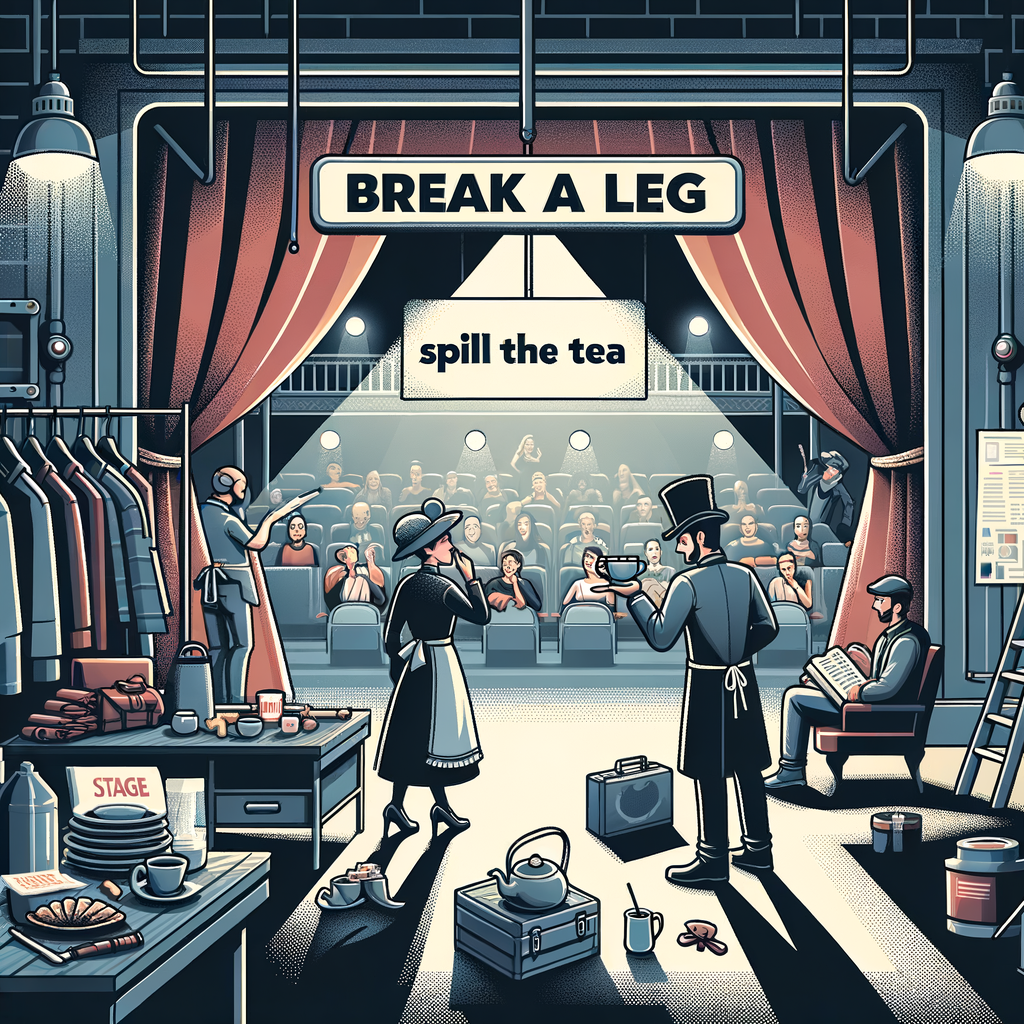
The theater has given birth to a multitude of idioms and expressions that have found their way into everyday language. Their meanings often relate specifically to the theater world but have evolved to be understood more broadly. Let’s examine some of these sayings in-depth, beginning with possibly the most famous: “Break a leg.” Originating from an era when openly wishing someone good luck was considered bad luck, performers instead adopted this counterintuitive expression as a way to bless each other with fortune before stepping onto the stage. The exact origin is shrouded in multiple theories, such as the bending of the leg signifying bowing or even the meaning evolving from vaudeville shows, where getting paid involved breaking the “leg” line of the stage curtains.
Another fascinating term is “Spill the tea.” This expression has come to mean sharing gossip or divulging sensitive information. Its roots are often connected not directly to theater but to Southern American culture and the drinking of sweet tea during social gatherings. However, its adoption into theater vernacular signifies actors’ penchant for social commentary and sharing backstage stories.
Then there’s “Curtain call,” a term used when the actors return to the stage to take a bow after the performance has ended. It highlights the acknowledgment and appreciation between actors and audiences but has crossed into general usage as a metaphor for completing an endeavor with acknowledgment.
The expression “On the boards” refers to performing on stage. The boards here represent the stage’s wooden planks. This idiom emphasizes the physicality and tradition embedded in theatrical performance and highlights how acting is deeply tied to the connection between performers and their audiences.
The term “Stage fright” describes an actor’s fear or nervousness before or during a performance. It has become a universal phrase to describe the anxiety associated not only with acting but also with public speaking or any situation that involves being in the spotlight. This idiom underscores the vulnerability inherent to performance.
“Upstage” and “downstage” describe positions on the stage but have also entered everyday language. To “upstage” someone is to overshadow or draw attention away from them, an origin rooted in the physical dynamics of performers moving further back (“upstage”) or closer to the audience (“downstage”).
Meanwhile, “Break character” refers to when an actor fails to maintain their role, often due to laughing or mid-performance slip-ups. This phrase underscores the actor’s commitment to their role and has been widely adopted to describe any break of continuity in concentration across various fields.
The term “Fourth wall” references the imaginary wall between performers and their audience. A “fourth-wall break” occurs when actors acknowledge the audience directly or break the suspension of disbelief. Now widely discussed in film and television, it still retains its theatrical roots.
“Greenroom” refers to the area where actors wait when not on stage, historically adorned with plants and green walls due to soothing effects. It is indicative of a space for reflection and preparation, adopted into theater culture universally.
The Historicity and Evolution of Theater Idioms
The history of these idioms reveals much about the context and culture of the theater. In ancient Greece, early theater forms had already begun to cultivate specific terms and expressions largely derived from the societal norms of that era. With the Roman adaptation of Greek theater, there emerged further intricate expressions around theater that would heavily influence medieval theatrical vocabulary. The establishment of theaters in Elizabethan England, notably the Globe Theatre, brought forth a distinctive blend of theatrical jargon that emphasized both the business and artistry of performance.
Crossing geographical and linguistic barriers, theater slang spread during periods of intense cultural exchange. The spread of commedia dell’arte throughout Europe introduced new idioms and comedic improvisation phrases that permeated the local languages, evolving subsequently into modern expressions.
The educational establishment of acting troupes also played a role in maintaining traditions of language. As actors traveled and shared their craft, they disseminated these sayings through their performances and interactions, embedding them into the cultural lexicon. This was a notable phenomenon during the 19th-century American theater boom, with vaudeville and early musical theater adopting and further disseminating European theater idioms in their uniquely American iterations.
In more recent times, the evolution of theater-based idioms has been strongly influenced by the media. With the advent of radio, film, and vocal-led performances, they migrated into these new art forms, adapted, and were carried onto emerging digital platforms. Terms like “Break a leg” and “Fourth wall” found even more fertile ground through movies and television, retaining their theatrical roots while adapting to new audiences.
The continuous transmission and adaptation of theater slang highlight its dynamic essence. It possesses an intrinsic ability to remain current while honoring its historical context, which explains its enduring appeal and relevance in both theater communities and broader cultural conversations.
Behind the Curtain: Insider Expressions
Beyond commonly recognized phrases lie deeper layers of theater-specific jargon that remain exclusively within the actor’s realm. Consider the term “The Scottish Play,” used as a euphemism for Shakespeare’s “Macbeth.” It arises from the superstitions around the supposed curse linked to uttering its name inside a theater, illustrating the belief systems inherent among actors.
“Ghost light” refers to a single light left on a theater stage when it’s not in use. Its purpose is part safety and part tradition, with some claiming it appeases supernatural spirits that supposedly haunt theaters.
“Tech week,” short for “technical week,” marks the final week of rehearsals before a performance opens, which involves integrating technical elements such as lighting, sound, and costumes. It demands intense focus from all production members and is colloquially known as “Hell week” due to its demands on time and energy.
Expressions like “Limited run” refer specifically to shows scheduled to close on a predetermined date, contrasting with “Open run” productions that continue as long as financially viable. This highlights the business side of theater and the critical considerations of timing in show production.
Another nuanced term is “Line reading,” which involves an actor delivering dialogue in a specific way as directed. “Line readings” delve into the subtleties of interpretation, accentuating the intellectual component of theater where every articulation shapes character portrayal.
The term “Corpse” has a technical meaning within theater, referring to a situation where an actor accidentally breaks into laughter on stage. Derived from the notion that actors must remain “dead” to their roles, it reflects the common camaraderie and humorous aspects of live performances.
Conclusion
While theater slang and idioms begin in niche settings among actors and production crews, their reach is indubitable, encroaching into general vernacular with cleverness and nostalgia. Understanding theater language offers anyone a gateway into a world rich with tradition, emotion, and collective history. The expressions that once echoed only in the dimly lit backstages or whispered through anxious moments before a show have become fixtures within the vast landscape of English expressions. Even as newer generations bring fresh inventions, the core foundation laid by these long-standing idioms will likely endure.
Plunging deeper into the etymology and usage of theatrical expressions not only enriches one’s perception of the theatrical arts but also provides insight into how cultural artifacts develop and sustain their influence. They transform abstract nuances of human behavior on stage into communicable concepts, connecting creators with their viewers while maintaining theatricality. The theatrical idiom is a testament to the dynamism of language, showcasing the adaptability and creativity inherent in human communication.
Let us continue to embrace such expressions, for they are not merely remnants of bygone eras but are living testaments to the human spirit’s ceaseless desire to connect, convey, and find joy in shared understanding. Whether through a casual “Break a leg” or a confiding “Spill the tea,” these phrases remind us of the power language has to both describe and shape the world in which we live.
“`
Frequently Asked Questions
1. What does the theatrical phrase “Break a leg” mean, and where does it originate from?
The phrase “Break a leg” is a theatrical idiom that wishes an actor or performer good luck. Although it might sound like a curse, it is used in place of “good luck” before a performance. The origins of this phrase are somewhat murky and there are several theories behind its peculiar choice of words. One popular explanation is linked to the superstition that wishing someone good luck outright could tempt fate, leading to the exact opposite result. Therefore, performers chose to say “Break a leg” to skirt bad fortune. Another theory suggests it relates to the idea of “breaking a leg” of the stage, meaning to induce such a strong performance that the audience will clap fervently enough for the actors to take multiple bows, potentially ‘breaking’ the locks or pegs that hold the stage curtains in place. This expression underscores how deeply steeped in tradition theater is, where superstition and historical anecdotes blend to create the cultural fabric of the performing arts community.
2. What does “Spill the tea” mean, and how did it enter the lexicon of theater slang?
The phrase “Spill the tea” is an idiomatic expression that means to disclose gossip or share confidential information. It started gaining popularity outside of theater, and its theatrical adoption is more recent as compared to traditional theater vernacular. The expression “tea” as slang for gossip is believed to have started in the drag community, particularly referencing a 1991 essay by author and drag queen Lady Chablis, published in John Berendt’s book “Midnight in the Garden of Good and Evil.” It became widespread in pop culture thanks to internet meme culture and shows like “RuPaul’s Drag Race,” where contestants and personalities often use it to refer to spilling gossip. Theater prides itself on being a diverse and fluid environment, readily adopting and embracing new cultural trends, and “Spill the tea” between cast members might often light up dressing rooms with tasty rumors or inside secrets about theater production happenings.
3. What are some other lesser-known theater slang terms that are still commonly used?
Beyond the more widely recognized idioms like “Break a leg,” the theater world is rich with its own distinct vernacular. For example, “ghost light” refers to the light left illuminated on stage when the theater is otherwise dark and empty, intended both for safety and a respectful nod to theater superstitions surrounding spirits. “Upstage” and “downstage” are technical terms that describe directions on stage relative to the audience; “upstage” is farther from the audience and “downstage” is closer. The terms derive from sloped stages, historically higher at the back. “Corpse” in theater means to break character by laughing unexpectedly on stage, disrupting the flow of performance. These terms illustrate the niche yet pervasive language ecosystem in theater, reflecting both necessity and the affectionately quirky nature of live performance environments.
4. Why is theater language and idioms so important in the performing arts community?
Theater language and idioms serve as both a practical toolkit and a symbolic bridge in the performing arts community. Practically speaking, these terms streamline the nuanced communication that takes place in the whirlwind of production – from rehearsals to live shows. It allows for an efficient exchange of complex ideas and instructions without lengthy explanations, crucial when time is of the essence. Symbolically, this vernacular envelops performers, directors, and crew in a shared cultural experience that promotes camaraderie. It fosters a sense of belonging to a storied, almost mythical realm where each phrase is laced with tradition and communal understanding. This shared language not only aids in the logistic aspects of theater production but also deepens the emotional connections between theater practitioners, honoring the craft’s rich heritage.
5. Can anyone use theater idioms, or is it reserved only for performers?
Theater idioms can technically be used by anyone, although comprehension and context significantly enrich their usage. While phrases like “Break a leg” and “Spill the tea” have transcended their original domains and entered mainstream colloquial language, understanding their background lends greater appreciation and accuracy in their use. Practitioners within the theater have deeper and more authentic grounding in using these idioms due to experience in applications that involve specific performances, superstitions, and traditions. However, the sharing of these terms with others outside the dedicated theatrical community enriches the cultural exchange and invites fresh perspectives to the world of theater. This openness is aligned with the inherently inclusive and educational nature of storytelling and performance, extending an invitation to involvement, even if in spirit. Plus, using theater idioms outside the stage is a fun way to bring drama into everyday conversation, captivating and connecting with others who appreciate the art from afar.