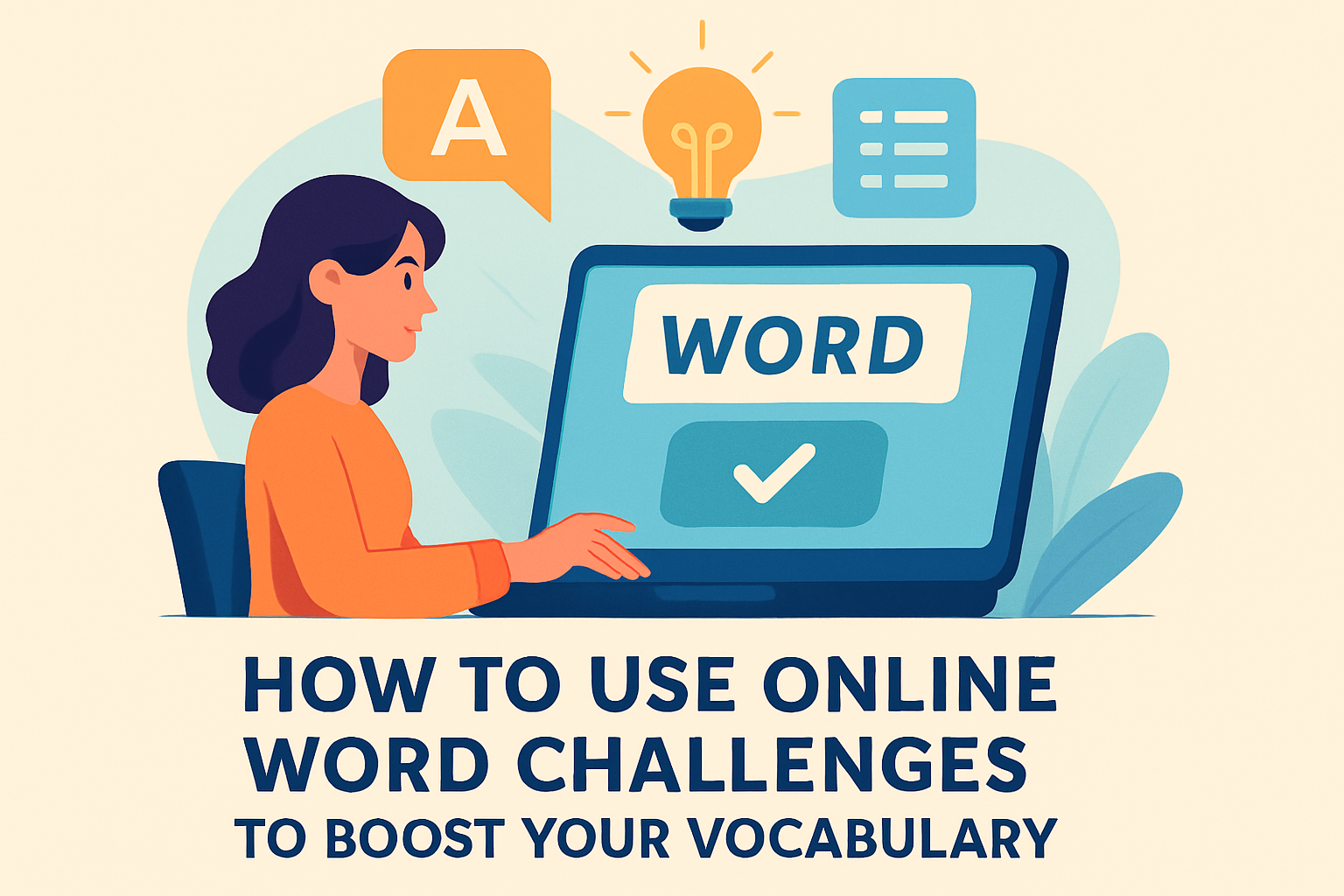
In the digital age, expanding one’s vocabulary is no longer confined to the pages of hefty dictionaries or the monotony of repetitive study methods. One innovative and engaging method that has gained popularity is the use of online word challenges. These digital platforms not only provide an avenue for learning new words but also offer an interactive way to improve overall language skills. But what exactly are online word challenges, and why should we care about them? Essentially, these are gamified applications or websites that present users with a series of word-related tasks designed to test and enhance vocabulary. Their significance lies in their ability to transform vocabulary building into a fun, social, and motivating experience, aligning perfectly with the needs of modern learners who thrive in dynamic digital environments.
While traditional methods of learning words have their merits, they often fail to engage and retain user interest. Online word challenges, however, leverage technology to make vocabulary acquisition more compelling and less of a chore. They help to develop not just rote memorization, but also comprehension, usage, and retention. This makes them a powerful tool for anyone eager to master a language, whether for personal, academic, or professional reasons. In essence, these platforms serve as a bridge between necessity and enjoyment, fostering a more profound and sustainable learning process.
The Anatomy of Online Word Challenges
Online word challenges typically operate on principles of gamification, the process of adding game-like elements to non-gaming scenarios to encourage participation. For instance, Wordle has become a social media phenomenon by combining the deductions and deductions within wordplay puzzles, creating a challenge that people look forward to daily. These platforms often incorporate point systems, levels, leaderboards, and rewards. Such elements engage a user’s competitive instincts and provide digital rewards for achievements, making the learning process both interactive and gratifying.
Consider, for example, the platform Lumosity, which, while primarily aimed at cognitive development, offers games specifically designed for vocabulary improvement. Users might face challenges where they need to discern synonyms or antonyms quickly or craft sentences under time pressure. The combination of time-bound challenges and varied word exercises keeps the learning process fresh and stimulating.
Real-World Applications and Benefits
Engaging in online word challenges can have tangible benefits in the real world. Improved vocabulary is closely linked with better reading comprehension, more precise communication, and an enhanced ability to grasp complex concepts, which in turn can lead to improved academic and professional performance. For instance, a college student regularly using these platforms might find their academic reading becoming noticeably easier, allowing them to extract and analyze information more effectively.
The workplace is another setting where a robust vocabulary can be particularly beneficial. Whether it involves crafting professional emails, drafting reports, or delivering presentations, a strong command of language can create a positive impression. A CEO who regularly engages with word challenges might be better equipped to communicate his vision clearly and persuasively.
Practical Tips for Optimizing Experience
When beginning with online word challenges, one practical tip is to set specific, achievable goals to maintain motivation and track progress. For instance, a beginner might aim to learn five new words daily, while more advanced learners might push for twenty. Balancing challenges with one’s current level is crucial to ensure the activities are neither too easy nor overwhelmingly difficult.
Additionally, incorporating variety in the learning process can prevent monotony. Learners are encouraged to explore different platforms and types of challenges for a well-rounded approach. This might include singular focus platforms like WordWorm, which immerses users in creating words from jumbled letters, a practice beneficial for honing quick-thinking and word-recall skills.
Engaging with Community and Leveraging Feedback
Many online word challenge platforms include social components that allow users to engage with others, participate in word duels, and share achievements. This community aspect can be a powerful motivator, turning vocabulary building into a social and collaborative experience. For instance, on platforms like Duolingo or Quizlet, users can join study groups, engage in discussions, and even challenge friends.
Feedback offered by these platforms is another critical feature that aids learning. Immediate feedback on activities helps users correct mistakes and reinforce learning more effectively. Knowing precisely which aspect of the task was challenging can assist learners in focusing future study efforts more strategically.
Inclusive Learning and Catering to Various Needs
Online word challenges are not a one-size-fits-all solution; they offer diverse activities to cater to varied learning styles. Visual learners might benefit from platforms offering picture-word association challenges, while auditory learners could excel in listening-based tasks where they must type words they hear. The adaptability of these platforms ensures that everyone can find a method that fits their personal learning preference.
People learning a new language can also take advantage of these platforms. Language challenges are often tailored to different skill levels and can include multi-lingual support to help users contextualize words in another language, providing both vocabulary and usage within correct linguistic frameworks.
| Platform | Features | Learning Style |
|---|---|---|
| WordWorm | Real-time word creation, leaderboards | Interactive, Visual |
| Duolingo | Multilingual support, gamified lessons | Comprehensive, Audio-visual |
| Quizlet | Flashcards, community challenges | Visual, Collaborative |
| Lumosity | Game-based brain training, specific vocabulary games | Strategic, Logical |
Addressing Concerns and Common Misconceptions
Despite the numerous benefits, some learners might be wary of digital platforms, concerned about comfort with technology or screen time. However, the intuitive design of modern word challenges makes them accessible even to those who aren’t digital natives. Many platforms are designed to be user-friendly, with clear instructions and support to guide new users through the initial stages.
Another concern might be the effectiveness of gamified learning versus traditional methods. However, several studies suggest that gamification in learning not only enhances engagement but also improves knowledge retention and application. This modern methodology can be significantly more effective than traditional rote learning methods, combining necessity with diversity and fun with functionality.
Conclusion: Taking the Next Step with Online Word Challenges
As we’ve explored, online word challenges are a powerful tool for anyone looking to expand their vocabulary and enhance their linguistic abilities. Whether you’re a student aiming to improve academic performance, a professional looking to sharpen communication skills, or simply someone eager to expand your lexicon, these platforms offer an engaging, efficient, and accessible way to achieve your goals. They transform what might otherwise be a tedious task into an enjoyable and motivating activity, ensuring that learning is both effective and enduring.
The key takeaway from this exploration is that vocabulary enhancement need not be a solitary, dull endeavor. Instead, by leveraging online word challenges, it can become an interactive, rewarding, and continuous journey. These platforms provide a unique opportunity to learn at your own pace, engage with like-minded individuals, and enjoy the satisfaction of gradual mastery.
Ready to enhance your vocabulary using online challenges? Start by exploring a few platforms introduced here, set achievable goals, and gradually integrate these engaging activities into your daily routine. You’ll soon notice not just an expansion in your vocabulary, but also a boost in confidence in using language effectively. Happy learning!
Frequently Asked Questions
1. What are online word challenges and how do they work?
Online word challenges are interactive platforms designed to enhance vocabulary through engaging gameplay and competition. They work by presenting users with a series of word-related tasks or puzzles, such as finding synonyms, completing word meanings, or unscrambling jumbled letters to form correct terms. These challenges often include time limits, scoreboards, and levels, giving a sense of achievement and progress. Users can experience various formats from single-player exercises to multiplayer games where they can go head-to-head against other participants, fostering a sense of community and friendly rivalry. The ultimate goal is to encourage active learning and help users internalize new vocabulary in a fun and dynamic way.
2. Why should I use online word challenges to improve my vocabulary?
There are several compelling benefits to using online word challenges to expand your vocabulary. First, they transform the often tedious process of vocabulary learning into an enjoyable pastime. By gamifying the experience, they provide motivation through fun and competition, which increases the likelihood of consistent practice. Second, many of these platforms offer personalized learning paths tailored to your proficiency level, ensuring that the content is neither too easy nor overwhelmingly difficult. Third, the use of varied multimedia elements, like illustrations and sound, enhances retention and improves comprehension in ways traditional methods cannot. Lastly, regular engagement with these challenges helps increase your confidence in using newly learned words, as they often include context-driven exercises that allow for practical application of vocabulary in sentences and everyday language use.
3. Are there different types of online word challenges available?
Yes, there are numerous types of online word challenges available to cater to different learning preferences and objectives. Some popular formats include crossword puzzles, word search games, spelling tests, and anagrams. Others might present fill-in-the-blank scenarios where context clues guide the completion of a sentence with the appropriate vocabulary. Some platforms offer thematic challenges, where all words relate to a particular subject like science or literature, enhancing both vocabulary and subject knowledge in tandem. Additionally, many of these platforms include competitive features that pit users against each other or against a clock, adding excitement and urgency to the learning process. This variety ensures that users can switch between different types of challenges to keep their learning experience fresh and stimulating.
4. How often should I engage with online word challenges to see results?
Consistency is key when it comes to maximizing the benefits of online word challenges. Ideally, setting aside as little as 15-20 minutes daily can lead to substantial vocabulary improvement over time. However, it is also important to consider your personal schedule and learning style. Some might find that longer, less frequent sessions yield better results because they allow for deeper immersion without interruption. Good practice is to engage with the challenges in short bursts, especially during spare moments throughout the day, such as while commuting or during breaks. Frequent exposure to new words enhances retention, while repeated practice reinforces your understanding and application of the vocabulary learned.
5. Can online word challenges help improve other language skills beyond vocabulary?
Absolutely! Beyond simply expanding your vocabulary, online word challenges can significantly bolster other language skills such as reading comprehension, spelling, and even writing. As many word challenges are context-based, they often require users to read and understand passages, inadvertently practicing reading skills. The repetition and application of correct spelling in many of these games naturally improves spelling abilities. Furthermore, exposure to new words within meaningful contexts can also enhance writing skills by providing users with a broader lexicon to articulate their thoughts more effectively. Many platforms also incorporate grammar and idiomatic expression exercises, offering comprehensive language development opportunities.