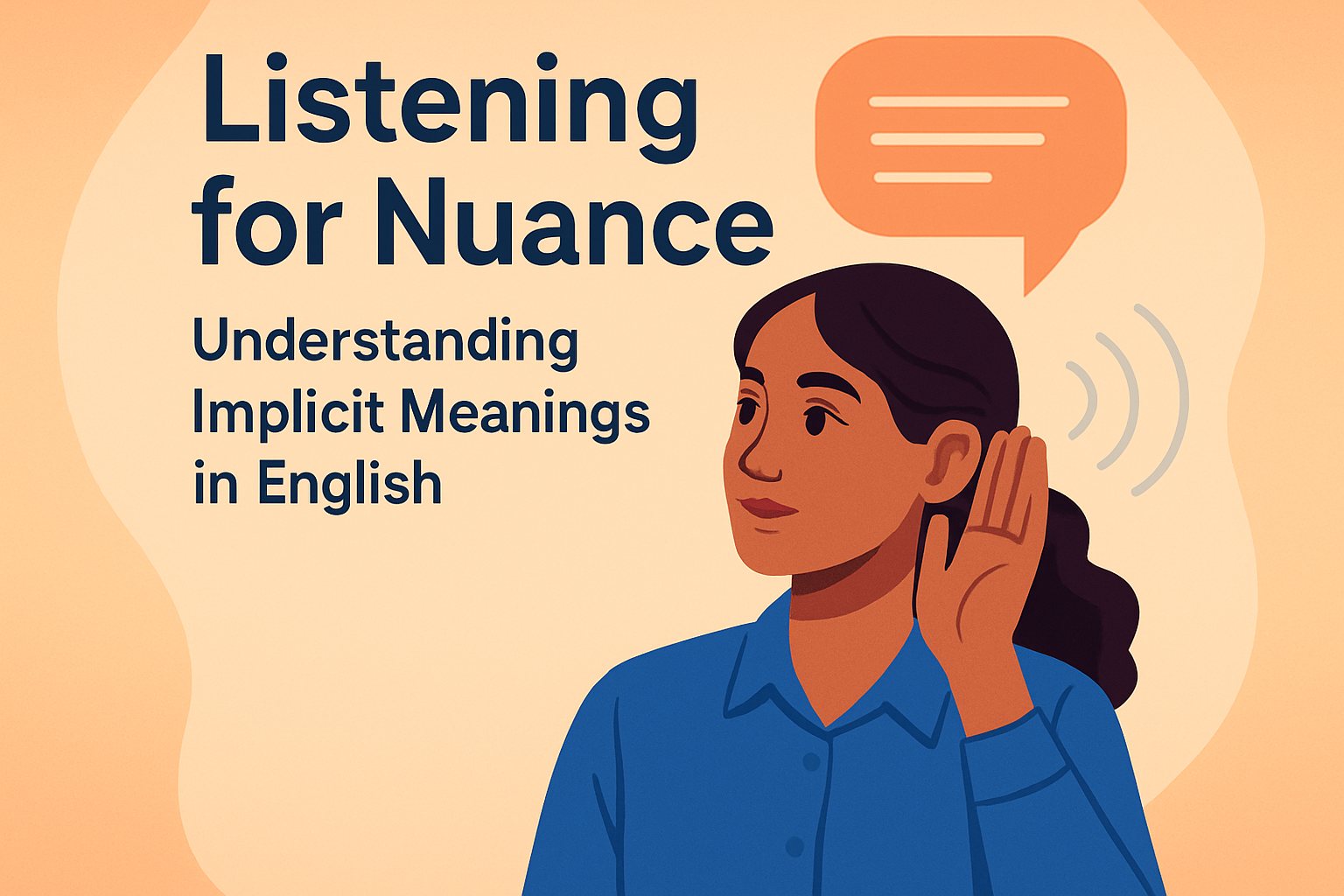
Language is a living organism, constantly evolving to reflect the nuances of human interaction. English, as a global lingua franca, is especially rich in subtleties that are not always immediately apparent. Understanding implicit meanings in English can transform the way we communicate, offering insights into not just language, but culture and human psychology as well. But what does implicit meaning actually entail? Essentially, it refers to the unspoken or unwritten layers of understanding that accompany the literal interpretation of words. Recognizing these nuances can deepen our connections with others. This skill matters because it equips us to navigate complex social dynamics, enriched conversations, and even cross-cultural exchanges.
Recognizing implicit meanings improves negotiation skills, heightens empathy, and sharpens critical thinking. Whether engaging in a professional setting, social interactions, or consuming media, understanding these nuances ensures that the messages received and conveyed are accurate and meaningful. It’s about listening with an intent to understand, delving beneath the surface, and engaging with the language in all its complexity and beauty. By grasping implicit meanings, we can become more effective communicators, enhancing both personal and professional relationships. Let’s explore this essential skill, the layers and forms it takes, and how it manifests in everyday situations.
The Art of Contextual Listening
Contextual listening is the first step in understanding implicit meanings in English. It involves discerning not just what is said, but also how it is said, when it is said, and in what circumstances. For instance, consider a workplace scenario where a colleague says, “It looks like you’re staying late again.” On the surface, this could appear to be a simple observation. However, listening contextually might reveal underlying layers of sympathy, criticism, or a subtle inquiry about workload management.
Contextual cues are often implicit, requiring attention to the tone of voice, body language, and even the environment. For example, a raised eyebrow or a slight change in intonation can completely alter the implied meaning. This skill is crucial in diverse settings, such as during negotiations or resolving conflicts, where recognizing subtle cues can lead to more effective outcomes.
Moreover, understanding the historical or cultural context can deeply influence how we interpret language. A statement might carry different meanings based on cultural backgrounds or historical precedents, underscoring the importance of a broad awareness of these factors in deciphering implicit messages.
Innuendo and Sarcasm: Reading Between the Lines
Innuendo and sarcasm are powerful tools in English that deliver implicit meanings through a facade of explicit content. Innuendo often hints at something more than it states directly, requiring the listener to infer the deeper intention. Imagine a dinner party where someone comments, “That’s an interesting outfit,” while glancing meaningfully at others at the table. The explicit words seem complimentary, but the innuendo might suggest otherwise.
Sarcasm, on the other hand, involves saying the opposite of what is meant, usually for humorous or emphatic effect. Someone late to an event might be greeted with, “So nice of you to join us on time!” While the words are welcoming, the sarcasm reveals the speaker’s annoyance. Recognizing sarcasm requires understanding the shared knowledge and expectations between the speaker and the listener.
Both innuendo and sarcasm enrich communication by adding layers of meaning that can convey subtle sentiments of humor, criticism, or irony. Effective interpretation demands that one pay attention to nuances in delivery, such as exaggerated emphasis or ironic detachment, to unveil the true message intended by the speaker.
Dialogue and Discourse: Navigating Indirect Speech Acts
In everyday conversation, not everything is said outright. English speakers often use indirect speech acts—a way of phrasing statements to elicit a response or action without directly commanding it. Consider the polite request disguised as a suggestion: “Could you close the window if you’re warm?” Here, the speaker may actually be cold and is requesting the window be closed as a comfort to both parties, though the question includes the alternative of keeping it open.
These speech acts reflect social etiquette, showing respect and consideration through phrased actions and responses. Interpreting indirect speech accurately requires awareness of social norms and the current conversational dynamics.
- Refusal: “I’m not sure I can make it tonight.” – A soft decline without saying ‘no’ outright.
- Advice: “You might want to check the weather before heading out.” – A suggestion with an implicit recommendation.
- Inquiry: “Do you know what time the store closes?” – Often a polite way to ask someone to find out or give direct information.
Here, understanding the speaker’s intent, the context, and even cultural or individual communication styles enhances the clarity and effectiveness of dialogue.
The Power of Subtext in Written Communication
Written communication, with its lack of immediate feedback and non-verbal cues, adds another layer of complexity in understanding implicit meanings. Whether in literature, emails, or even social media, subtext plays a crucial role in conveying nuanced messages. For instance, in literary works, authors often use descriptive language and symbolism to express themes that are not overtly stated. A character described as “swimming against the current” might indicate their struggle with societal expectations.
Emails, particularly in professional settings, can be rich with subtext. Phrases like “Per my last email” or “I hope this finds you well” can convey varying degrees of politeness, urgency, or frustration, depending purely on the textual context and the relationship dynamic between sender and receiver.
Social media adds another dimension where brevity and audience play significant roles. A well-placed hashtag, meme, or GIF can carry layers of idiosyncratic meaning beyond the text itself. Understanding these requires a keen awareness of current trends, shared knowledge, and cultural references, underscoring the need for astute reading skills to decipher the often implicit communicative intent behind written interactions.
Implicit Cultural Norms: Navigating Cross-Cultural Communication
Implicit meanings in language often stem from cultural norms and shared historical contexts that might be unfamiliar to outsiders. For example, English expressions such as “break the ice” or “hit the books” have figurative origins rooted in specific cultural practices or idioms. A literal interpretation could lead to confusion for non-native speakers, highlighting the importance of cultural literacy.
When engaging in cross-cultural communication, being attuned to these subtleties can prevent misunderstandings and foster mutual respect. Encouraging openness and curiosity about different cultural expressions can bridge gaps and enable empathic connections. For instance, Asian cultures may favor indirect communication, where dissent or disagreement is subtly embedded rather than overtly expressed, amplifying the need for delicacy in interpretation and response.
By navigating cultural nuances with sensitivity, individuals can enhance interpersonal effectiveness, ensuring that communication is respectful, nuanced, and inclusive, regardless of linguistic or cultural backgrounds.
Practical Applications: Everyday Scenarios and Strategies
To practically apply the understanding of implicit meanings in English, one can start by honing active listening and observational skills. In workplace settings, listen for tone variations and context to navigate implicit communications adeptly, from understanding managerial feedback to comprehending peer interactions.
Engage in reflective practices: consciously interpret conversations, identifying possible implicit meanings and questioning initial interpretations. Consider journaling or discussing interactions to explore alternative perspectives, which fosters an inclination to perceive underlying messages.
Improve comprehension skills by reading widely across genres to recognize varied styles and subtext, enhancing your ability to decipher nuanced meanings in both verbal and written forms.
Lastly, practice patience and empathy, ensuring that responses are considerate and mindful of implicit content. Encourage clarification when in doubt, which not only aids personal understanding but also demonstrates your commitment to effective communication.
Conclusion: Embrace the Layers of Language
Understanding implicit meanings in English is more than a linguistic skill; it is a gateway to richer, more effective communication. By listening for nuance and engaging deeply with language, we unlock pathways to more profound relationships and enhanced personal and professional life. From the subtleties of indirect speech acts to deciphering cultural norms, embracing these layers enriches our interactions in countless ways.
Through ongoing practice, reflection, and cultural curiosity, the ability to understand and appreciate implicit meanings becomes an inherent part of our communicative competence. So, listen intentionally, reflect deeply, and engage openly with the vast expanse of language nuances—enhancing not just how we speak and interpret but also how we understand one another and the world around us.
As your next step, challenge yourself to actively engage with conversations, literature, and media in a quest to uncover implicit meanings and enrich your communicative repertoire. Your newfound awareness will not only open doors to greater personal insight but also position you as a more empathetic, effective communicator in diverse contexts.
Frequently Asked Questions
1. What are implicit meanings in English, and why are they important to understand?
Implicit meanings in English are those unspoken or unwritten cues that convey messages beyond the literal words used. They’re like the subtext in a conversation—what’s hinted at but not directly stated. These meanings arise from cultural norms, context, tone of voice, and shared knowledge between speakers. Understanding them is crucial because they enrich communication, allowing us to grasp subtleties in dialogue that might reveal true emotions, intentions, or social dynamics. When you’re able to pick up on these nuances, you’re better equipped to interpret what’s really being communicated. For example, when someone says, “It’s getting late,” it might imply more than just the time; it could suggest they’re ready to leave a party, signaling to you the social cue to wrap up the evening. In a nutshell, implicit meanings make communication more effective and empathetic, enabling deeper connections and avoiding misunderstandings.
2. How can I improve my ability to detect implicit meanings in conversations?
Improving your ability to detect implicit meanings involves honing your listening skills and being attuned to more than just the words spoken. Start by paying close attention to non-verbal cues such as body language, facial expressions, and tone of voice. These can often convey the real message behind words. Additionally, consider the context of the conversation—who is speaking, where it’s taking place, and what the potential motivations of the speaker might be. Another approach is to actively reflect on similar past conversations to discern patterns or cultural norms that might be at play. Practicing active listening, where you focus on understanding the speaker without planning your response, can greatly enhance your ability to catch implicit cues. Lastly, immersing yourself in diverse social and cultural situations can expose you to new forms of implicit communication styles, broadening your understanding and appreciation for subtlety in language.
3. Can you give examples of implicit meanings in everyday English conversations?
Certain phrases in English carry implicit meanings that depend heavily on context and tone. For instance, when a colleague says, “I’ll get back to you on that,” it might imply a polite delay or even a subtle way of saying ‘no,’ depending on their tone and past interactions. Similarly, if someone comments, “That’s an interesting choice,” they could be genuinely intrigued or politely questioning your decision without directly criticizing it. Even simple pleasantries like, “How are you?” aren’t always inquiring about your well-being, but rather serving as a social nicety. Recognizing these nuances comes from observing the situation and the relationship between the speakers. Such phrases show how tone, context, and history between people shape implicit meanings, serving as everyday examples of how intricate communication can be.
4. Why does English have so many nuances, and how does it compare to other languages in this regard?
English is particularly rich in nuances due to its history and role as a global lingua franca. It borrows heavily from a variety of languages, cultures, and regions, making it a mosaic of influences that naturally lead to a plethora of subtle meanings. Furthermore, English’s continued evolution is driven by its widespread use in international business, media, and academia, where diverse cultural interactions further fuel the development of implicit meanings. Compared to other languages, English is often deemed more flexible, with a large vocabulary that provides multiple ways to express similar ideas, each carrying different connotations. Many languages have their own unique nuances based on cultural and historical backgrounds. However, English’s status as a global bridge between many linguistic traditions gives it unparalleled breadth and diversity when it comes to implicit meanings, making it both a challenging and fascinating language to master.
5. How do context and cultural knowledge influence implicit meanings in English?
Context and cultural knowledge are key to interpreting implicit meanings in English. Context involves the situation in which communication occurs, including the relationship between speakers, the setting, and the current circumstances. For instance, sarcastic remarks might be humorous among friends but deemed inappropriate in a professional setting. Cultural knowledge, on the other hand, comprises the shared belief systems and social norms understood by a group. For example, in some cultures, not explicitly stating a desire (like hesitating to ask directly for something) is typical, while in others direct communication is the norm. Knowing such cultural nuances can prevent misinterpretations. Someone familiar with Anglo-American culture might recognize that phrases like “We should catch up sometime” often imply a polite gesture rather than a firm commitment. In essence, mastering implicit meanings requires an awareness that goes beyond just words—it’s about knowing the interplay between language, social conventions, and cultural values, which frames communication in subtle, significant ways.