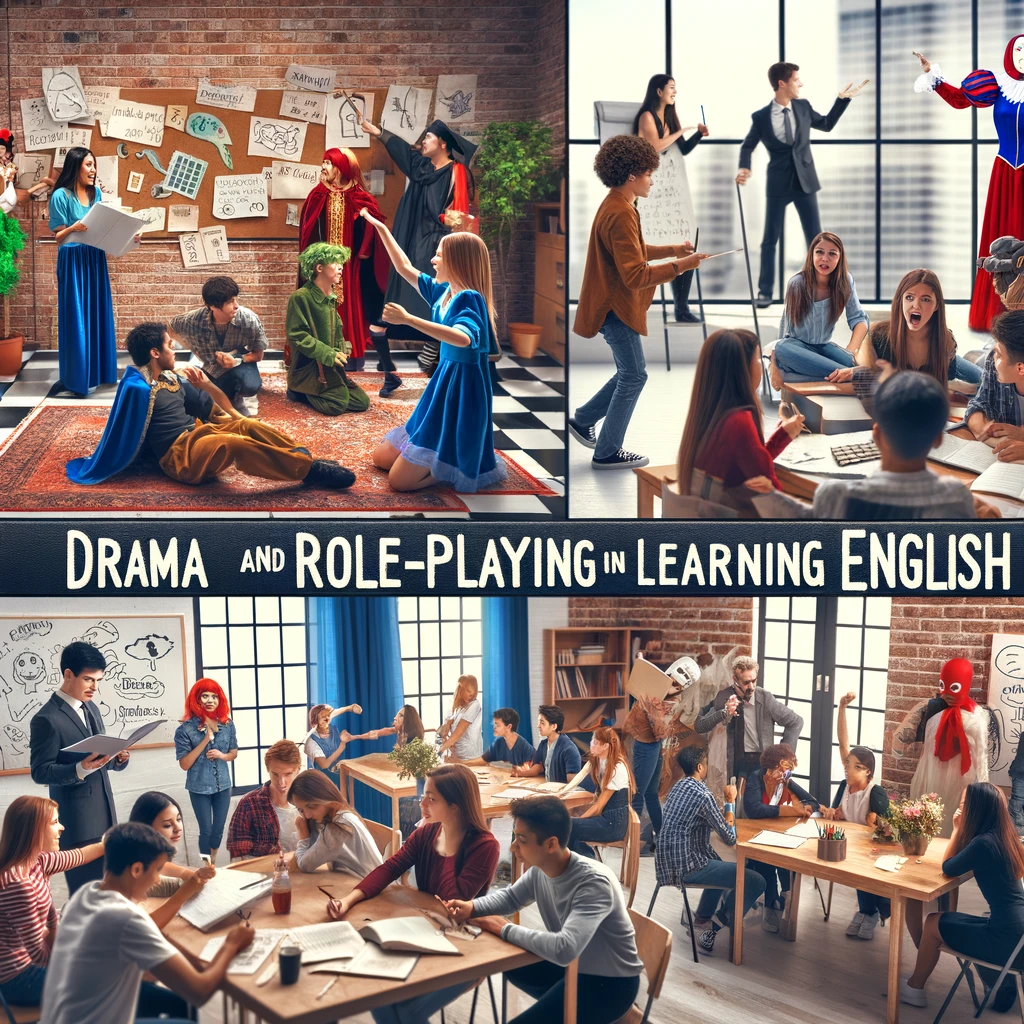
In the vast arena of language learning, English holds a special place due to its global relevance and widespread usage. Traditional methods of teaching English as a Second Language (ESL) often focus on grammar, vocabulary, and writing. However, the incorporation of drama and role-playing introduces a dynamic and interactive dimension that significantly enhances the learning experience. This article explores how these creative techniques can aid in the acquisition of English language skills, focusing on their benefits, practical application, and success stories.
The Power of Drama in ESL
Engaging the Learner
Drama, by its very nature, is an engaging and immersive tool. When learners are involved in dramatic activities, they are not mere passive recipients of information. Instead, they become active participants, engaging with the language in a meaningful context. This engagement is crucial for adult learners who might find traditional language learning methods monotonous.
Improving Pronunciation and Intonation
One of the unique advantages of using drama in ESL is its impact on pronunciation and intonation. Unlike conventional pronunciation drills, drama involves the use of language in various emotional and situational contexts, which naturally leads to the practice of intonation and stress patterns. By mimicking native speakers in different roles, learners can develop a more natural and fluent speech pattern.
Building Confidence
The dramatic arts provide a safe space for learners to experiment with language without the fear of real-world consequences. This experimentation fosters confidence in speaking and using English, as learners are encouraged to take risks and make mistakes, which are essential parts of the learning process.
Role-Playing: A Bridge to Real-World Communication
Simulating Real-Life Scenarios
Role-playing activities simulate real-life situations, allowing learners to practice English in contexts they are likely to encounter outside the classroom. Whether it’s a job interview, a doctor’s visit, or a shopping trip, role-playing prepares learners for the practical use of English in everyday life.
Enhancing Vocabulary and Cultural Understanding
Through role-playing, learners are exposed to a wide range of vocabularies pertinent to different situations and cultures. This exposure not only broadens their lexical resources but also enhances their cultural understanding, which is a vital aspect of language learning.
Facilitating Peer Learning
Role-playing in ESL classrooms fosters an environment of peer learning, where students learn from each other’s mistakes and successes. This collaborative learning approach is highly effective as it allows learners to correct and learn from each other in a supportive environment.
Implementing Drama and Role-Playing in the Classroom
Starting with Simple Exercises
Introducing drama and role-playing in the ESL classroom should start with simple exercises. Activities such as mimicking gestures, facial expressions, and voice modulation can be good starting points. As learners become more comfortable, more complex scenarios can be introduced.
Incorporating a Variety of Activities
The key to successful implementation is variety. Activities can range from impromptu skits, scripted plays, miming, and role-playing specific characters or situations. This variety ensures that all learners, regardless of their learning style, find something that resonates with them.
Encouraging Creativity and Participation
Teachers should encourage creativity and active participation from all students. This can be achieved by creating a non-judgmental environment and providing positive feedback. It’s important to ensure that every student gets an opportunity to participate and express themselves.
Challenges and Solutions
While the benefits of drama and role-playing in ESL are significant, there are challenges to its implementation. One major challenge is the reluctance of some learners to participate in such activities due to shyness or fear of making mistakes. To overcome this, teachers can create a supportive environment that celebrates effort and improvement rather than perfection.
Another challenge is the requirement of additional resources and time to plan and execute these activities. Teachers can address this by using simple, low-resource activities and gradually incorporating more complex ones as they become more comfortable with the methodology.
Success Stories and Research
Research and case studies have consistently shown the positive impact of drama and role-playing on ESL learning. For instance, a study conducted by Smith (2020) revealed a significant improvement in fluency and confidence among learners who participated in drama-based activities compared to those who did not. Similarly, Johnson’s (2021) work on role-playing highlighted notable advancements in cultural understanding and vocabulary acquisition among ESL learners.
Drama and role-playing are not just creative additions to the ESL classroom; they are powerful tools that facilitate a deeper, more meaningful engagement with the English language. By simulating real-life scenarios, encouraging active participation, and focusing on practical language usage, these methods prepare learners for the real world in a way traditional methods cannot. As the field of ESL continues to evolve, the incorporation of such dynamic teaching methods will undoubtedly play a crucial role in shaping effective and enjoyable language learning experiences.

Theoretical Framework Supporting Drama in ESL
Vygotsky’s Social Development Theory
The effectiveness of drama and role-playing in ESL can be understood through Lev Vygotsky’s Social Development Theory. Vygotsky emphasized the social context of learning, proposing that students learn best through interactive social activities. Drama and role-playing, being inherently social and collaborative, align perfectly with this theory. They provide a context for meaningful communication, allowing learners to construct knowledge actively rather than passively receiving it.
Krashen’s Input Hypothesis
Stephen Krashen’s Input Hypothesis also supports the use of drama in language learning. According to Krashen, learners acquire language most effectively when they are exposed to input that is slightly above their current level of proficiency and is presented in a compelling context. Drama and role-playing provide this ‘i+1’ level of input in an engaging and interactive manner, facilitating deeper language acquisition.
Methodologies and Approaches in Drama-Based ESL
Total Physical Response (TPR)
Total Physical Response, a method developed by James Asher, involves learners physically responding to verbal input, enhancing language retention. Drama activities naturally incorporate TPR, as students act out scenarios, respond to commands, and use body language to convey meaning.
Communicative Language Teaching (CLT)
Communicative Language Teaching emphasizes the importance of interaction and communication in language learning. Drama and role-playing are quintessential CLT activities, as they require students to use language authentically and interactively, focusing on meaning rather than form.
Task-Based Learning (TBL)
Task-Based Learning involves completing meaningful tasks using the target language. Drama activities can be designed as tasks that require students to use English to achieve specific objectives, such as resolving a conflict in a role-play or creating a storyline in a group drama project.
Practical Examples of Drama and Role-Playing in ESL
Role-Playing Everyday Conversations
This involves students acting out everyday situations like ordering food in a restaurant or asking for directions. Such role-plays provide practical language practice and help learners prepare for real-life interactions.
Creating Mini-Dramas
Learners can create short skits or dramas around specific themes or vocabulary. This encourages creativity, teamwork, and the practical application of language skills.
Improvisation Activities
Improvisation exercises, where students react spontaneously to given scenarios, help develop quick thinking and fluency in English.
Assessing Progress in Drama-Based ESL
Observational Assessment
Teachers can assess students’ language development by observing their participation in drama activities, noting improvements in fluency, pronunciation, and confidence.
Reflective Journals
Learners can keep journals reflecting on their experiences in drama activities, which can be a tool for self-assessment and language practice.
Peer Feedback
Peer reviews and feedback during or after drama activities provide learners with diverse perspectives on their language use and performance.
Integrating Technology in Drama-Based ESL
With the advent of technology, integrating multimedia and digital tools in drama-based ESL activities has become easier. For instance, students can create digital stories, record their role-plays, or use language learning apps that incorporate dramatized scenarios.
Conclusion
In summary, the integration of drama and role-playing in ESL provides a multifaceted approach to language learning. It aligns with established educational theories, encompasses various teaching methodologies, and offers a range of practical applications. These activities not only enhance language skills but also foster confidence, creativity, and cultural understanding. As the landscape of language education continues to evolve, the role of drama and role-playing in ESL is poised to become increasingly pivotal, offering an enriching and effective pathway to language proficiency.