
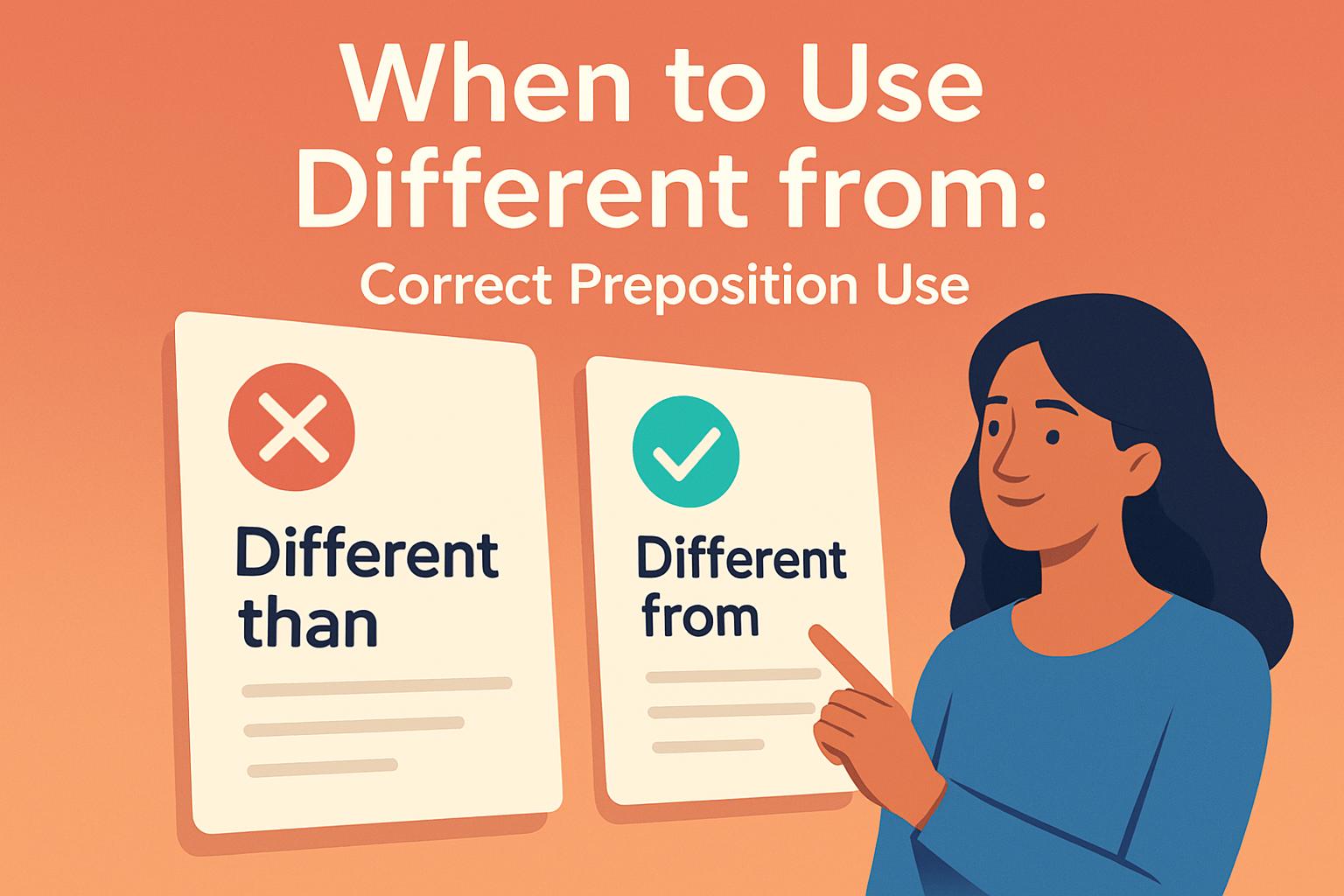
Choosing the right preposition after the adjective “different” seems minor, but in professional writing, education, and everyday communication, it affects clarity, tone, and credibility. The core question is simple: should you write different from, different than, or different to? In standard usage guidance, “different from” is the safest and most widely accepted choice, especially in formal American and British English. The phrase directly marks distinction between two things, as in “This contract is different from the earlier draft.” Because prepositions signal relationships, a small shift can change how natural a sentence sounds to readers in different regions.
I have edited marketing copy, legal summaries, and academic reports for years, and this exact issue appears constantly. Writers often know what they want to say but hesitate because they have seen all three forms in print. That confusion is understandable. English usage varies by region, register, and sentence structure. Still, there is a practical answer: use “different from” by default, choose alternatives only when a clear grammatical or stylistic reason supports them, and stay consistent within a document. That approach aligns with major style expectations and reduces the risk of distracting readers.
To use these forms correctly, it helps to define the terms. A preposition is a word that shows the relationship between elements in a sentence. In “different from the original,” the word “from” connects “different” to the thing being compared. The adjective “different” expresses non-identity, distinction, or variation. The usage question matters because readers notice patterns they associate with education level, regional background, and editorial care. In business communication, the right form improves readability. In academic and journalistic writing, it supports precision. In search-driven content, it also helps answer a frequent grammar question directly.
Why “Different From” Is the Standard Choice
“Different from” is the standard recommendation because it is grammatical, widely accepted across dialects, and rarely sounds awkward. It works in simple comparisons, complex noun phrases, and formal prose. For example: “The updated privacy policy is different from the 2023 version.” “Her teaching style is different from mine.” “Results in the test group were different from results in the control group.” In each case, “from” clearly introduces the point of comparison without forcing a restructuring of the sentence.
Major usage authorities have long treated “different from” as the primary form. You will find it consistently in edited newspapers, university materials, and professional style guidance. That does not mean the other forms are always wrong, but it does mean “different from” is the least risky choice when audience expectations are unknown. If you write for international readers, this matters even more. A global audience may include Americans, Britons, and non-native speakers taught standardized textbook English, and “different from” is the version most likely to feel neutral to all of them.
From an editorial perspective, “different from” also preserves rhythm and avoids unnecessary debate. I routinely replace “different than” with “different from” in white papers and website copy unless a sentence genuinely needs revision for infinitive structure. That small edit prevents copy reviews from getting sidetracked by a usage issue that has nothing to do with the substance of the piece. Good grammar choices are often the invisible ones: they support comprehension and let the main message stand out.
When “Different Than” Can Be Acceptable
“Different than” appears frequently in American English, and in some contexts it is acceptable, especially when followed by a clause rather than a noun phrase. A common example is “The experience was different than I expected.” Many editors still prefer to revise this to “different from what I expected,” but the original is common and understandable. The reason some writers choose “than” is efficiency. It can sound less heavy than inserting “what” or recasting the entire sentence.
The practical rule is this: if a noun or pronoun follows, use “different from.” If a full clause follows, “different than” may appear in informal or moderately formal American usage, but a rewrite is often stronger. Compare these sentences: “This outcome is different from the forecast.” “This outcome is different than we forecast.” The second is common, yet many editors would prefer “This outcome is different from what we forecast” or “This outcome differs from our forecast.” Those versions remove doubt and fit conservative style standards.
There is also a tonal issue. “Different than” can sound conversational, which may suit blog posts, dialogue, or informal newsletters. It is less suitable in legal drafting, technical documentation, or formal academic prose, where consistency and broad acceptance matter more than conversational flow. If you are writing under AP, Chicago, or institutional house style, “different from” will almost always pass review faster. That is why I treat “different than” as permissible but limited: common in speech, sometimes efficient in clauses, yet rarely the best first choice in polished writing.
Where “Different To” Fits in British English
“Different to” is most common in British English and some other Commonwealth varieties. You might read sentences such as “This version is different to the one we tested last week.” In the United Kingdom, that construction may sound ordinary in speech and light business writing. In the United States, however, it often sounds nonstandard or regionally marked. That makes audience awareness essential. If your readers are primarily British, “different to” may be acceptable. If your audience is mixed or international, “different from” remains the better default.
The key point is not that “different to” is inherently incorrect, but that it carries stronger regional identity than “different from.” In global content operations, I advise teams to avoid region-specific grammar when the goal is universal readability. Product pages, knowledge base articles, and policy documents benefit from a shared neutral standard. “Different from” delivers that. By contrast, a UK-targeted campaign can preserve “different to” if the brand voice is intentionally local and the rest of the copy follows British conventions consistently.
Writers sometimes ask whether using “different to” harms meaning. Usually, no. Readers still understand the comparison. The issue is reader expectation, not semantic failure. Good usage decisions depend on context, not rigid rule memorization. If you know your market, understand your style guide, and maintain consistency, you can make deliberate choices. But if you want one answer that works almost everywhere, “different from” is that answer.
How to Choose the Right Form in Real Sentences
The easiest way to choose is to identify what comes after “different.” If it is a noun phrase, use “from”: “different from the old system,” “different from her approach,” “different from market norms.” If it is a clause, first ask whether you can rewrite the sentence more cleanly with “from what,” “from the way,” or the verb “differs.” For example, instead of “The rollout was different than we planned,” write “The rollout was different from what we planned” or “The rollout differed from our plan.” Both are clearer in formal prose.
Writers should also watch for idiomatic traps. One common mistake is mixing structures, such as “different than the others,” where “from” is standard. Another is overusing “than” because it appears after comparative adjectives like “better than” or “faster than.” Although that analogy feels natural, “different” historically and syntactically aligns most comfortably with “from,” not “than.” In editing workshops, I show side-by-side examples because pattern recognition helps writers remember the distinction faster than abstract grammar explanations.
| Form | Best use | Example | Editorial recommendation |
|---|---|---|---|
| different from | Formal and general use | This draft is different from the approved version. | Use by default |
| different than | Mostly American English before a clause | The result was different than we expected. | Often revise for formality |
| different to | British English and regional use | This model feels different to the earlier release. | Use only for a clearly British audience |
Another effective test is substitution. If “distinct from” sounds natural, “different from” is probably right too. If the sentence sounds clumsy, recast it instead of forcing a disputed form. For instance, “My responsibilities are different than before” can become “My responsibilities are different from what they were before” or simply “My responsibilities have changed.” Strong writing is not about defending every original phrasing; it is about choosing the clearest version for the reader.
Common Mistakes, Style Guide Advice, and Better Rewrites
The most common mistake is assuming all three options are equal in every context. They are not. “Different from” is broadly standard; “different than” is conditional; “different to” is regional. Another mistake is using a disputed form in highly formal writing when a simple revision would eliminate the issue. For example, “The findings were different than predicted” can become “The findings differed from predictions.” That sentence is shorter, sharper, and fully acceptable in academic or technical contexts.
Style guides and dictionaries vary in tone but not in overall direction. Conservative editors, educational publishers, and many institutional standards favor “different from.” Some dictionaries note that “different than” is established in American usage, especially before clauses. British references often acknowledge “different to” as common. The practical takeaway is straightforward: know the norm, know the exception, and choose based on audience and register. This is how experienced editors work. We do not treat usage as trivia; we treat it as part of reader-centered communication.
If you want cleaner sentences, use rewrites strategically. Replace “different than I expected” with “different from what I expected.” Replace “different to last year” with “different from last year” for international audiences. Replace “very different than before” with “markedly different from before” or “substantially changed.” These edits improve precision and tone at the same time. They also help with SEO and AEO because direct, standard phrasing is easier for search engines and answer engines to parse accurately.
In the end, correct preposition use after “different” is less about memorizing a rigid ban and more about making an informed choice. Use “different from” as your default because it is standard, clear, and globally understood. Treat “different than” as an occasional American alternative, mainly before clauses and usually worth revising in formal work. Recognize “different to” as a legitimate British form, but one best reserved for clearly British audiences. That framework gives you accuracy without unnecessary complexity.
The main benefit of following this rule is consistency readers never have to think about. Your sentences sound edited, your meaning stays precise, and your writing avoids regional friction unless you intend it. That matters in emails, reports, landing pages, and essays alike. Small grammar decisions shape trust. When the wording feels natural, readers focus on the message rather than the mechanics.
If you are unsure in the moment, choose “different from” or rewrite the sentence entirely. That habit will serve you well in almost every professional context. For stronger writing overall, review other comparison structures in your style guide and apply the same audience-first logic in every draft.
Frequently Asked Questions
Is “different from” always the correct choice?
In most situations, yes. “Different from” is the safest, clearest, and most widely accepted option in both formal American English and formal British English. It is the standard construction recommended in many style guides, grammar references, and educational settings because it directly expresses distinction between one thing and another. For example, “This approach is different from the one we used last year” sounds natural, polished, and correct in nearly every context. If you are writing for work, school, publishing, or any audience that expects standard edited English, “different from” is usually the best choice. While other forms do appear in real usage, “different from” carries the least risk of sounding regional, informal, or stylistically questionable.
Is “different than” grammatically wrong?
Not necessarily. “Different than” is common in American English, and many native speakers use it naturally in speech and writing. However, it is still viewed by some editors, teachers, and careful readers as less formal or less preferable than “different from,” especially when a simple noun or pronoun follows. For example, many would prefer “Her results were different from mine” over “Her results were different than mine.” That said, “different than” can be useful when it introduces a full clause, such as “The experience was different than I expected.” Even in that kind of sentence, some writers still revise to “different from what I expected” to maintain maximum formality. So the key point is this: “different than” is not automatically wrong, but it is often less universally accepted than “different from.”
When should I use “different to”?
“Different to” is more common in British English and some other English varieties, especially in everyday conversation. You may hear or read sentences like “This version is different to the old one” in UK usage, and many speakers consider that perfectly natural. However, it is less accepted in formal American English, where it may sound unfamiliar or incorrect to some readers. If your audience is international or if you are writing in a professional, academic, or business context, “different from” remains the most dependable choice. In other words, “different to” is not simply a mistake, but it is more region-specific. If your goal is broad clarity and standard acceptance across dialects, “different from” is still the strongest option.
Why do grammar experts usually recommend “different from” in formal writing?
Grammar experts and editors often recommend “different from” because it is the most established, neutral, and broadly accepted construction. It works well in both British and American English, avoids regional preferences, and rarely distracts readers. In formal writing, consistency and credibility matter, and word choices that draw attention to themselves can weaken the tone of otherwise strong prose. “Different from” is straightforward: it clearly signals comparison and distinction without raising usage questions. For example, in a report, essay, email, or article, a sentence like “The new policy is different from the previous one” sounds precise and professional. That is why many writers treat it as the default choice whenever there is any doubt.
What is the easiest rule to follow if I want to avoid mistakes?
The easiest rule is simple: use “different from” by default. If you consistently choose that form, you will be correct in the vast majority of situations, especially in formal or edited writing. This approach is helpful because it removes uncertainty and keeps your language clear for readers in different regions. For example, instead of debating whether to write “different than” or “different to,” you can reliably write “different from” in sentences such as “My perspective is different from yours” or “The final draft looks different from the original.” If you are a student, professional, teacher, or content writer, this habit will help you maintain a polished and credible style. Unless you have a specific dialect reason or a sentence structure that strongly favors another form, “different from” is the most practical and dependable choice.





