
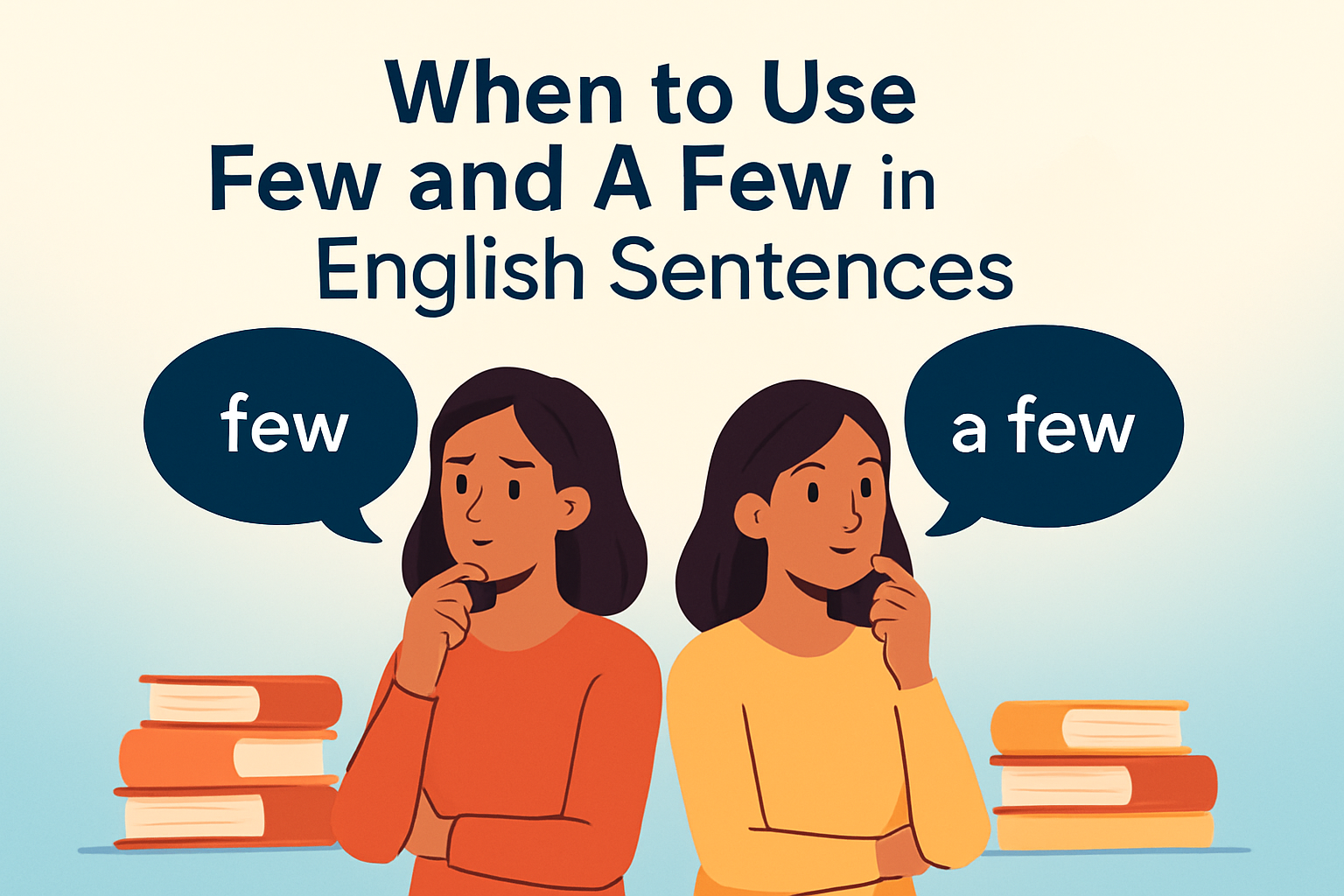
Few and a few look similar, but they send different signals in English, and that small difference changes meaning, tone, and reader expectations. In everyday writing, business emails, academic essays, and SEO content, choosing the right phrase helps you sound precise rather than vague or careless. I correct this mistake often when editing web copy and client reports, because writers usually know the grammar rule in theory but miss the attitude each form carries in a sentence. “Few” means not many and often suggests insufficiency or disappointment. “A few” means some, a small number, and usually sounds more positive or at least neutral. Both phrases modify countable nouns, so they work with words like books, ideas, customers, or errors, not with uncountable nouns like water or advice. Understanding this distinction matters because it affects clarity, tone, and credibility. Searchers often ask, “What is the difference between few and a few?” The direct answer is simple: use “few” when you want to emphasize scarcity, and use “a few” when you want to emphasize that a small but usable number exists. Once you see that contrast clearly, better sentence choices become much easier.
What “few” means and when to use it
Use “few” before plural countable nouns when you want to stress that the number is small and not enough, or at least smaller than hoped. In practical editing work, I treat “few” as a limiting word with a negative edge. If a manager writes, “Few employees understood the new policy,” the sentence implies a problem: understanding was limited. If a teacher says, “Few students submitted the assignment on time,” the listener expects concern, not satisfaction. This is why “few” appears often in performance reviews, survey summaries, and analytical writing where lack matters. It does not merely count; it evaluates the count. A useful test is this: if you could replace the phrase with “hardly any” without changing the core message, “few” is probably the right choice. For example, “Few customers renewed their subscriptions” is close in meaning to “Hardly any customers renewed their subscriptions.” Grammatically, “few” works as a determiner before a noun, but it can also stand alone when the noun is understood, as in “Many were invited, but few attended.” That structure is common in formal English and headline-style writing. The key point is consistent: “few” highlights shortage.
What “a few” means and when to use it
Use “a few” before plural countable nouns when you mean a small number that is still real, useful, or worth noting. The article “a” softens the sense of shortage and changes the emotional temperature of the sentence. When I revise landing pages or blog drafts, this is one of the quickest tone adjustments I make. “We received a few inquiries after the campaign launched” sounds encouraging. “We received few inquiries after the campaign launched” sounds like underperformance. The quantity may be similar, but the framing is different. “A few” often appears in helpful instructions, reassuring explanations, and conversational replies because it acknowledges limitation without sounding negative. For instance, “I have a few suggestions” tells the reader that some helpful ideas are coming. “There are a few seats left” signals limited availability, but not total scarcity. In education, support agents often use “a few” to lower anxiety: “You need to complete a few steps before checkout.” That sounds manageable. If you can replace the phrase with “some” and keep the intended meaning, “a few” is usually appropriate. It can also stand alone: “Some proposals were rejected, but a few were approved.” Here again, the phrase does more than count. It implies that the small number still matters.
The core difference in tone, logic, and intent
The easiest way to understand when to use few and a few in English sentences is to compare the implied message behind each one. Both refer to a small number, but they point in opposite rhetorical directions. “Few” points toward absence, lack, or insufficiency. “A few” points toward presence, possibility, or adequacy. This distinction is not academic; it changes how readers interpret results, opportunities, and problems. In marketing copy, “Few brands offer this level of warranty protection” can be a strong competitive statement because scarcity is the point. In customer communication, “A few brands offer similar protection” sounds more balanced and less promotional. In workplace writing, “Few errors were caught before publication” suggests a process failure. “A few errors were caught before publication” suggests quality control worked, at least to some extent. Native speakers hear that difference instantly, even if they cannot explain the rule. For learners, the fastest route to mastery is to connect the grammar to intent. Ask yourself what you want the sentence to do: highlight a shortfall or acknowledge a modest amount. That question usually solves the choice. The table below shows how the same noun can create different meanings depending on whether you choose “few” or “a few.”
| Phrase | Core meaning | Likely tone | Example |
|---|---|---|---|
| few applicants | not many; fewer than needed or expected | negative or concerned | Few applicants met the job requirements. |
| a few applicants | some applicants; small but real number | neutral or positive | A few applicants had strong project portfolios. |
| few options | limited choices, possibly a problem | restrictive | After the deadline passed, few options remained. |
| a few options | several choices available | constructive | We still have a few options for reducing costs. |
Common sentence patterns and frequent mistakes
The most common mistake is using these phrases with uncountable nouns. You can say “few emails” or “a few emails,” but not “few information” or “a few advice.” For uncountable nouns, English uses “little” and “a little.” Another frequent error is assuming the difference is only about number. It is not. In most contexts, it is mainly about attitude toward that number. Writers also confuse “quite a few,” which actually means many or a surprisingly large number. “Quite a few customers returned” is much stronger than “a few customers returned.” In edited prose, I also watch for mismatch between the phrase and the wider context. If a sentence says, “The campaign exceeded expectations, and few leads came in,” the logic clashes unless the writer is being ironic. “A few leads came in” might fit, but if expectations were truly exceeded, even that may be too weak. Subject-verb agreement is usually straightforward because the noun is plural: “A few issues remain,” not “remains.” Position matters less than countability and tone, but these phrases most often appear directly before nouns. In more formal constructions, they can follow quantifiers or pronouns: “Only a few of the entries were eligible” and “Very few of them responded.” Cambridge Dictionary and practical style guides treat these as standard patterns. When learners practice with real contexts rather than isolated rules, error rates drop quickly.
How context changes the best choice
Context decides whether “few” or “a few” is better, because the surrounding sentence tells readers how to judge the quantity. In performance analysis, legal writing, and technical documentation, precision about sufficiency matters. “Few incidents were reported” may be good news in a safety report because low numbers are desirable. In that case, the phrase is still about scarcity, but scarcity is positive. “A few incidents were reported” sounds more neutral and may invite follow-up detail. In customer support, “A few users experienced login delays” often works better because it acknowledges a limited issue without implying systemic failure. In journalism, tone control is critical. “Few witnesses agreed on the sequence of events” emphasizes weak consensus. “A few witnesses agreed on the sequence of events” emphasizes that some agreement existed. I have seen this distinction matter in executive summaries, where one phrase can make results sound alarming and the other can make them sound manageable. Audience expectations matter too. If readers want reassurance, “a few” often serves better. If they need to understand constraints or risk, “few” is more honest and exact. The right choice is the one that matches the real implication of the facts. Good writers do not swap these phrases casually, because the smallest article in English can reshape the whole message.
Practical examples for conversation, exams, and professional writing
In conversation, these phrases often reveal attitude more than raw count. “I have a few friends in Madrid” sounds warm and normal. “I have few friends in Madrid” sounds lonely or matter-of-fact about limited connections. In exam writing, especially for IELTS or other proficiency tests, this distinction can improve task response and lexical accuracy. “Few governments have solved housing affordability” makes a broad analytical claim about scarcity of success. “A few governments have introduced rent-control measures” reports limited but real action. In business English, precision is essential because tone affects trust. “Few clients renewed after the price increase” is a warning sign. “A few clients renewed after the price increase” may fit if the point is that retention did not disappear entirely. In presentations, I advise teams to pair these phrases with evidence when possible: “Few respondents, just 8% in our SurveyMonkey sample, selected option C.” That wording is stronger than a vague statement alone. In content marketing, answer-focused writing benefits from direct formulations such as, “Use ‘few’ for a negative small number; use ‘a few’ for a positive or neutral small number.” That sentence is snippet-friendly and accurate. The more your examples match real use cases, the faster the rule becomes automatic. Memorization helps, but meaningful repetition in realistic sentences helps more.
The difference between few and a few is one of the clearest examples of how tiny grammar choices carry large meaning in English. If you remember only one rule, make it this: “few” stresses shortage, while “a few” stresses the existence of some. Both are used with plural countable nouns, and both can appear in formal or informal writing, but they create different expectations in the reader’s mind. That is why this choice matters in emails, essays, reports, headlines, and everyday speech. When the number feels insufficient, use “few.” When the number is small but still enough to mention positively or neutrally, use “a few.” If you are unsure, test the sentence with substitutes. “Hardly any” usually matches “few,” and “some” usually matches “a few.” Also check whether your noun is countable; if it is not, switch to “little” or “a little.” These quick checks prevent most errors. Strong English writing depends on control of nuance, not just grammar rules. Review your next paragraph and look for places where quantity and tone interact. Changing one article may make your sentence more accurate, more natural, and more persuasive. Practice with a few examples today, and you will make few mistakes tomorrow.
Frequently Asked Questions
What is the difference between “few” and “a few” in English sentences?
The difference is small in form but important in meaning. “Few” means not many, and it usually carries a negative or limiting tone. It suggests that the number is smaller than expected, smaller than needed, or disappointing in some way. For example, “Few students understood the assignment” implies a problem because the number was low. “A few,” by contrast, means some, and it has a more positive or at least neutral tone. It suggests that although the number is not large, it is still enough to matter. For example, “A few students understood the assignment” tells us that some students did understand it. This is why the choice affects more than grammar. It changes the attitude of the sentence, the reader’s impression, and sometimes even the practical meaning. In professional writing, academic work, and everyday communication, choosing between these two expressions helps you sound precise and intentional rather than vague.
Why does “few” sound more negative than “a few”?
“Few” sounds more negative because it emphasizes shortage. It draws attention to what is missing rather than what is available. When someone says, “Few options remain,” the sentence highlights limitation and may create concern or urgency. It suggests scarcity. When someone says, “A few options remain,” the focus shifts slightly. The number is still small, but now the sentence reassures the reader that some options are available. That article “a” changes the tone from deficiency to presence. This distinction matters in tone-sensitive writing such as business emails, customer communication, website copy, and reports. For example, “Few customers responded” can sound discouraging, while “A few customers responded” sounds more balanced and constructive. Both may describe a similar number, but the emotional effect is different. That is why strong writers pay attention not only to literal meaning but also to implication, attitude, and reader expectation.
When should I use “few” instead of “a few”?
Use “few” when you want to stress that the quantity is lower than desired, lower than expected, or insufficient for the situation. It works best when your point is about lack, limitation, or a problem. For example, “Few applicants met the qualifications” tells the reader that the applicant pool was disappointingly small or that the standards were difficult to meet. “Few resources were available” suggests constraint. In contrast, if your purpose is simply to mention that some people or things exist without stressing scarcity, “a few” is usually the better choice. This is especially important in persuasive and professional writing, where tone shapes credibility. If you accidentally write “few” when you mean “a few,” your message may sound harsher, more pessimistic, or more critical than intended. A useful test is to ask yourself whether you want to emphasize insufficiency or merely indicate a small number. If the emphasis is on not enough, use “few.”
Can “few” and “a few” change the meaning of a sentence in business, academic, or SEO writing?
Yes, absolutely. In business writing, the difference can affect how results, risks, or opportunities are perceived. “Few clients renewed their contracts” suggests a weak outcome and may alarm the reader. “A few clients renewed their contracts” sounds more measured and indicates at least some retention. In academic writing, precision matters even more because the wrong phrase can distort your analysis. “Few studies support this theory” means there is limited evidence, while “A few studies support this theory” means there is some evidence available. In SEO and content writing, word choice affects both clarity and trust. Readers notice tone even when they do not consciously analyze it. If a landing page says, “Few businesses understand this strategy,” it creates a stronger sense of rarity and exclusivity. If it says, “A few businesses have already adopted this strategy,” it suggests early adoption without sounding overly negative. In each case, the grammatical choice shapes interpretation, so careful writers treat it as a meaning decision, not just a rule to memorize.
What are some easy examples and tips to help me remember when to use “few” and “a few”?
A simple way to remember the difference is this: “few” points to not enough, while “a few” points to some. Compare these examples: “Few people attended the meeting” suggests poor attendance. “A few people attended the meeting” simply states that some people came. “Few errors were corrected” implies a problem because the number corrected was too low. “A few errors were corrected” means some progress was made. Another useful tip is to listen for the emotional tone. If the sentence feels discouraging, critical, or restrictive, “few” may be the right fit. If it feels calm, factual, or mildly positive, “a few” is often better. Also remember that both expressions are typically used with countable plural nouns, such as books, employees, ideas, or minutes. You would say “few reasons” or “a few reasons,” not “few information.” For editing, try replacing the phrase in your mind: if “not many” matches your meaning, use “few.” If “some” matches your meaning, use “a few.” That quick test works well in everyday writing and helps prevent one of the most common tone mistakes in English sentences.





