
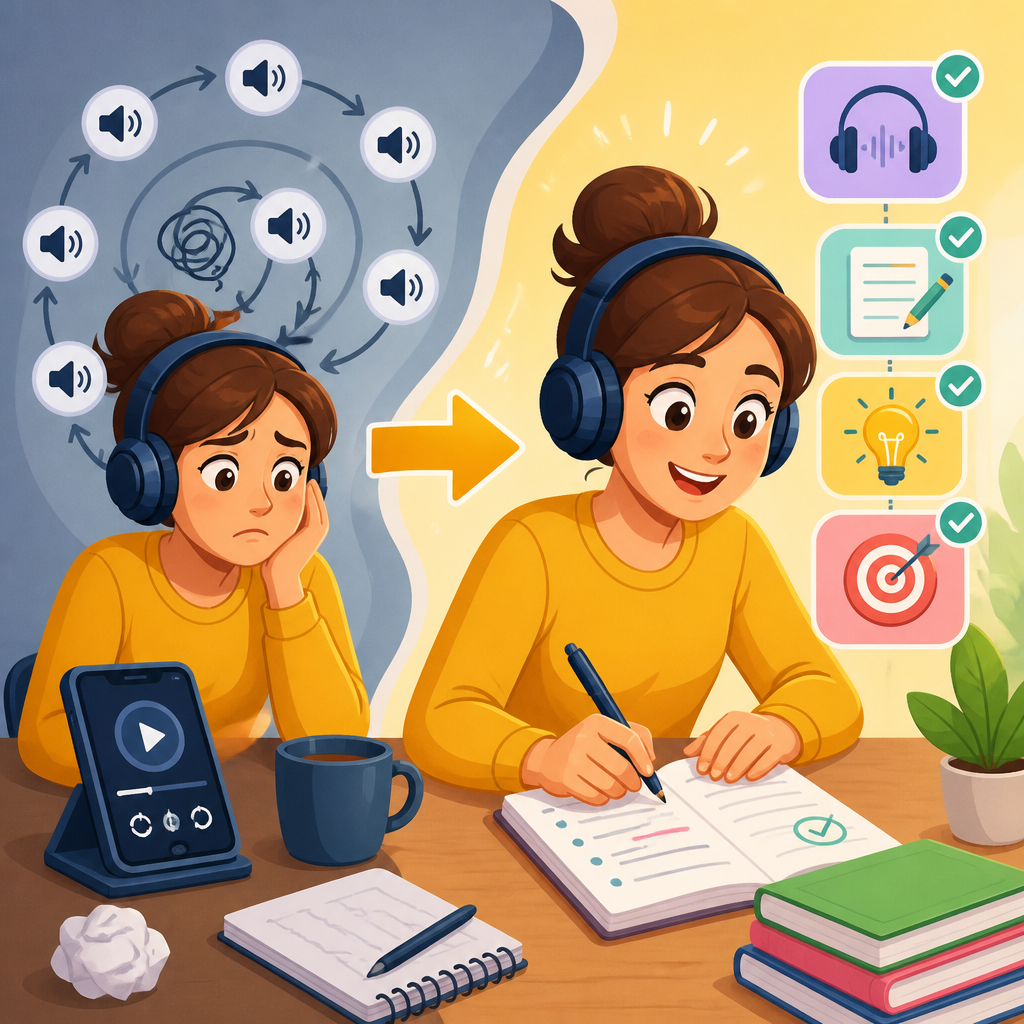
Replaying audio can sharpen listening, but endless repetition often turns practice into avoidance. Productive replay means using repeated listening with a clear purpose, a stopping point, and a method for noticing what changed between passes. In language study, especially at beginner level, learners commonly replay the same clip because they missed a name, a number, or a date and assume one more listen will solve everything. Sometimes it does. More often, unlimited replay hides the real problem: the task is too vague, the chunk is too long, or the listener has no system for deciding what to hear first.
I have seen this pattern repeatedly while building listening drills and reviewing learner logs. Students say they “listened many times,” yet they cannot explain which detail became clear on the third play or why the fifth play added nothing. That is the difference between hearing and practicing. Hearing again is passive exposure. Practicing with replay is targeted listening. The goal is not to squeeze every syllable from a recording. The goal is to extract the specific information the exercise is designed to train, then move on before fatigue and frustration flatten attention.
For beginners, replay matters because spoken language disappears fast. Connected speech, weak forms, reduced vowels, and unfamiliar accents make simple information easy to miss. A phone number can blur into one sound stream. A date can vanish inside surrounding words. Replaying helps only when it is structured around a question: What exactly am I trying to catch, and what evidence in the audio will confirm it? Once that question is explicit, repetition becomes efficient. You listen with narrower focus, compare each attempt, and stop when returns diminish. That approach builds confidence, accuracy, and better transfer to new recordings.
Why infinite replay stops helping
Unlimited replay feels productive because it creates motion without forcing a decision. Yet attention declines when the brain predicts the recording instead of actively processing it. By the seventh or eighth listen, many learners are no longer decoding fresh sound. They are matching fragments to memory, guessing from context, or waiting for one difficult part to “pop.” In practical terms, that means time rises while learning falls. Cognitive load theory helps explain this: working memory has limited capacity, so repeating a confusing clip without reducing the task keeps overload in place instead of resolving it.
There is also an accuracy trap. When listeners replay too often, they become attached to an incorrect guess. I have watched learners confidently insist they heard “thirteen” when the speaker said “thirty,” simply because repeated exposure strengthened the wrong interpretation. Productive replay interrupts that trap by setting a cap and changing the task after each pass. If two or three listens do not reveal the answer, the next step is not blind repetition. The next step is narrowing the target, shortening the segment, checking a transcript if available, or comparing likely options.
Another cost is motivation. Listening practice works best when sessions end with visible progress. Endless replay creates the opposite feeling: a single clip consumes ten minutes and still feels unsolved. Beginners then conclude they are bad at listening when the real issue is poor method. A better approach preserves momentum. You get the main target, note one unresolved phrase, and continue. Consistent small wins are more valuable than one exhausting battle with a ten-second recording.
A simple replay framework that keeps you moving
The most effective replay routine I use has four passes, each with a distinct job. Pass one is for gist: identify the setting and the information type, such as a time, address, or number. Pass two is for target capture: write the exact detail you think you heard. Pass three is for verification: listen only to confirm or revise that detail. Pass four is optional and should answer a precise question, such as whether the speaker said fifteen or fifty. If the answer is still unclear after that, stop and use support.
This limit matters because it turns replay into a decision tool instead of a habit loop. You are not asking, “Should I listen again?” after every pass. You already know the plan. That reduces hesitation and keeps energy for the listening itself. In beginner drills, especially short transactional clips, four passes are usually enough to separate “I truly cannot hear this yet” from “I did not focus correctly on the first two attempts.”
| Pass | Goal | What to write down | When to stop |
|---|---|---|---|
| 1 | Catch gist and context | Topic and likely detail type | If you know what to listen for next |
| 2 | Make a first concrete guess | Name, number, or date as heard | After one full attempt |
| 3 | Verify or correct | Revised answer plus confidence level | If confidence reaches about 80 percent |
| 4 | Resolve one specific confusion | Exact contrast, such as 13 vs 30 | If still unclear, switch to support |
This framework works because each replay has a narrower task than the one before. The recording does not change, but your attention does. That is the core principle of productive replay. Repetition should sharpen focus, not simply add exposure minutes.
How to replay short clips for names, numbers, and dates
Short factual details require a slightly different strategy from general comprehension. When the target is a name, number, or date, listen for anchors around the detail, not only the detail itself. For example, in “My reservation is under Carla Mendes for June fourteenth,” the words “under” and “for” help mark where the critical information begins and ends. Learners who train themselves to hear these cue words often improve faster than learners who focus only on the difficult item.
Numbers deserve special care because English compresses them in predictable ways. Teen numbers and tens are a classic problem: thirteen versus thirty, fourteen versus forty. In natural speech, stress patterns help. Teen numbers typically stress the second syllable, while tens usually stress the first. Replay should target that acoustic contrast. Do not just listen again to the entire sentence. Replay the smallest usable chunk and ask one direct question: Where is the stress? The same applies to dates. “The fifteenth of May” can blur unless you isolate the ordinal ending and the month boundary.
For this kind of practice, use a “micro-chunk” rule. If a full sentence remains unclear after two passes, cut the focus mentally to the three to five words around the target. Then replay once for rhythm and once for the exact item. This prevents background words from competing for attention. If you want structured beginner exercises built around these details, the main guide at https://5minuteenglish.com/a1-listening-practice-catching-names-numbers-and-dates/ gives a useful starting point for focused drills.
What to do when replay fails
Replay is not a cure-all. When four passes fail, good listeners change tools. The first option is transcript confirmation. Check only the unresolved line, then replay once more while reading and once without looking. This sequence matters. Reading first without another listen can create a false sense of mastery. Hearing the corrected form immediately after seeing it builds the sound-text link that beginners actually need.
A second option is slowing the audio slightly, but use this sparingly. Many apps allow 0.75x speed, and it can reveal word boundaries. However, overreliance on slowed audio trains you on speech that real conversations do not use. I treat speed reduction as diagnostic support, not the main practice mode. A third option is contrast practice. If the issue is a minimal pair or number contrast, compare examples side by side: thirteen/thirty, fifteen/fifty, June/July. Short contrast sets often solve in two minutes what repeated full-sentence listening cannot.
Finally, log the miss. Write what fooled you: weak stress, linked sounds, unfamiliar name, background noise, or fast pacing. This step is underrated. Patterns emerge quickly. If five missed answers involve dates, the problem is probably not general listening ability. It is a narrow decoding weakness you can train directly.
How to measure whether your replay method is working
Productive replay should improve both accuracy and efficiency. Track three numbers for one week: average replays per clip, percentage correct, and time spent per correct answer. If your accuracy rises while replays and time fall, your method is working. If replays stay high but scores do not move, you need tighter tasks or easier material. In my experience, beginners often improve fastest when they limit themselves to short clips under fifteen seconds and target one information type at a time.
Also measure confidence honestly. After each answer, mark it high, medium, or low confidence before checking. This exposes a common problem: many learners replay not because they heard nothing, but because they distrust correct first impressions. Training yourself to commit on pass two, then verify on pass three, reduces unnecessary repetition. Over time, confidence calibration becomes part of listening skill.
The best sign of progress is transfer. A productive replay method should help you catch fresh details in new recordings, not only master one familiar clip. When you start recognizing stress cues in numbers, boundary words before names, and common date patterns across different speakers, replay has done its job.
Replaying audio productively is less about listening more and more about listening with rules. Set a purpose before pressing play. Use a fixed number of passes. Narrow attention from gist to one target detail. Switch tools when repetition stops adding information. Most important, judge success by what you can catch in new audio, not by how long you can stay with one clip.
For beginner listening, this approach turns repetition from a crutch into a training method. You save time, reduce frustration, and build the exact decoding habits that names, numbers, and dates require. Instead of hoping the answer appears on the eighth replay, you create a process that reveals whether the issue is focus, sound contrast, or material level.
Use your next practice session to test a four-pass limit on one short recording. Write the target, make one concrete guess, verify it, and stop when the method tells you to stop. That single change is often enough to replace endless replay with steady listening progress.
Frequently Asked Questions
What does it mean to replay audio productively instead of endlessly?
Replaying audio productively means listening again with a specific goal, a limited number of passes, and a way to evaluate what improved between listens. The key difference is intention. Endless repetition usually happens when someone feels that one more listen will magically make every unclear word understandable. Productive replay is more disciplined. You decide what you are trying to catch before pressing play again: a name, a number, the speaker’s main idea, a verb ending, the transition between sentences, or the pronunciation of a difficult phrase.
In practice, productive replay often looks like this: first listen for general meaning, second listen for a missing detail, third listen to confirm or correct what you heard. After that, you stop and do something with the result. You might check a transcript, compare notes, write down what you understood, or mark the exact point where comprehension broke down. That stopping point matters because repetition without feedback easily becomes avoidance. It can feel like practice while actually delaying the harder but more useful step of identifying the real weakness.
For beginners, this is especially important. Many learners replay the same clip because they missed a name, date, or number and assume more exposure alone will solve it. Sometimes it will. But often the issue is not insufficient repetition. The real issue may be unfamiliar pronunciation, weak vocabulary, poor sound discrimination, fast speech, or a lack of context. Productive replay helps you uncover which of those is actually happening so you can improve the skill that needs work rather than listening in circles.
How many times should I replay the same audio clip before I stop?
There is no universal perfect number, but in most cases a short limit works better than open-ended repetition. A practical rule is two to four purposeful listens for a short clip, especially if you are studying language at a beginner or lower-intermediate level. The first pass should be for general understanding. The second should focus on a clearly defined target, such as a key fact, a specific sentence, or a pronunciation pattern. A third pass can be used to verify your guess or notice what changed. If you are still not getting it after that, continuing indefinitely usually produces diminishing returns.
The reason a limit helps is that it forces diagnosis. If repeated listening is not improving comprehension, the problem is likely not just “I need to hear it more.” It may be that you do not know the word, you are mis-segmenting connected speech, the recording is too difficult for your level, or you are trying to process too many details at once. At that point, a better next step is to slow down the audio if appropriate, isolate a shorter section, look at a transcript, read supporting context, or switch the task entirely. Productive listening includes knowing when to stop listening and start analyzing.
A good benchmark is simple: if each replay gives you new information, keep going within your set limit. If each replay feels identical and you are only hoping for a breakthrough, stop. Productive replay creates measurable gains. Endless replay depends on wishful thinking. The more honestly you can tell the difference, the faster your listening practice becomes effective.
Why do beginners get stuck replaying audio when they miss small details like names, numbers, or dates?
Beginners often get trapped by small details because those details feel concrete and recoverable. Missing a person’s name or a time expression creates the impression that understanding is almost complete, so one more replay seems justified. That is why learners can spend far too long circling a short clip. The missing detail becomes the entire mission. But small details are often harder than they seem because they are delivered quickly, unstressed, reduced in connected speech, or embedded in unfamiliar sentence patterns.
There is also a psychological factor. Replaying feels safer than moving on without certainty. It gives the learner a sense of control and diligence. The problem is that certainty is not always available at the current skill level, especially if the audio contains sounds the learner has not yet learned to distinguish. If someone cannot reliably hear the difference between similar vowels, parse number words at natural speed, or recognize where one word ends and another begins, repeating the same sound stream ten times does not automatically build that ability in the moment.
The more useful response is to treat the missed detail as a clue. Ask what kind of detail it was and why it was difficult. Was it unfamiliar vocabulary? Was it pronounced in a reduced way? Did you understand the sentence except for one sound cluster? Did you lose the thread because you were translating word by word? Those questions turn frustration into diagnosis. Instead of assuming replay is the solution, you use replay to reveal the problem. That shift is what makes listening practice actually build skill.
What method can I use to notice what changed between replay attempts?
The most effective method is to give each replay a separate task and record the result, even briefly. Start with a first listen for gist only. After that pass, write a one-sentence summary of what you think the speaker said. On the second listen, choose a narrow target: maybe a specific number, a key phrase, or the reason the speaker gives for something. Write down exactly what you heard, including uncertain parts. On the third listen, compare your first and second attempts and mark what became clearer, what stayed uncertain, and what you now think was misheard.
This approach works because it creates visible evidence of progress or lack of progress. Without that record, many learners replay from memory of frustration rather than memory of data. They know something was unclear, but not exactly what changed. By writing notes, filling in blanks, or even timestamping the point where comprehension failed, you make listening more analytical. You stop treating replay as passive exposure and start using it as a controlled test of attention.
Another strong method is contrast listening. After a couple of independent attempts, check the transcript or subtitles if available, then replay the same segment once more while following along. Notice whether the issue was vocabulary, word boundaries, reduced pronunciation, or speed. For example, you may realize that you knew every word individually but could not hear them as connected speech. That insight matters because it tells you what to practice next. Productive replay is not just about hearing the audio again. It is about comparing versions of your understanding and identifying the reason the earlier version failed.
What should I do if replaying still does not help me understand the audio?
If replaying is no longer producing new understanding, the best move is to change the activity rather than continue repeating. Start by reducing the problem size. Listen to a shorter chunk instead of the full clip. A five-second segment is often more useful than replaying thirty seconds over and over. If that still does not help, use a support tool: a transcript, subtitles, playback speed adjustment, vocabulary lookup, or a teacher or study partner who can confirm what was said. These are not shortcuts that weaken listening. They are diagnostic tools that help you see why listening broke down.
It is also worth checking whether the material is appropriate for your current level. If the audio is packed with unknown vocabulary, dense information, multiple speakers, or fast native-speed reductions, repeated listening may fail simply because the input is too difficult right now. In that case, easier material can produce more growth than heroic effort on content that stays opaque. Productive listening is challenging, but it should still allow you to recover meaning with strategy. If nothing becomes clearer after several purposeful passes, the difficulty level may be part of the problem.
Finally, use the failure constructively. Ask what specifically blocked comprehension: unknown words, numbers at speed, weak recognition of names, linking between words, accent differences, or cognitive overload from trying to catch everything. Once you can name the obstacle, you can train that skill directly. Maybe you need number drills, proper-name recognition practice, more work with connected speech, or more beginner-friendly audio with transcripts. The goal is not to force understanding through unlimited repetition. The goal is to turn each listening obstacle into a clear next step for improvement.





