
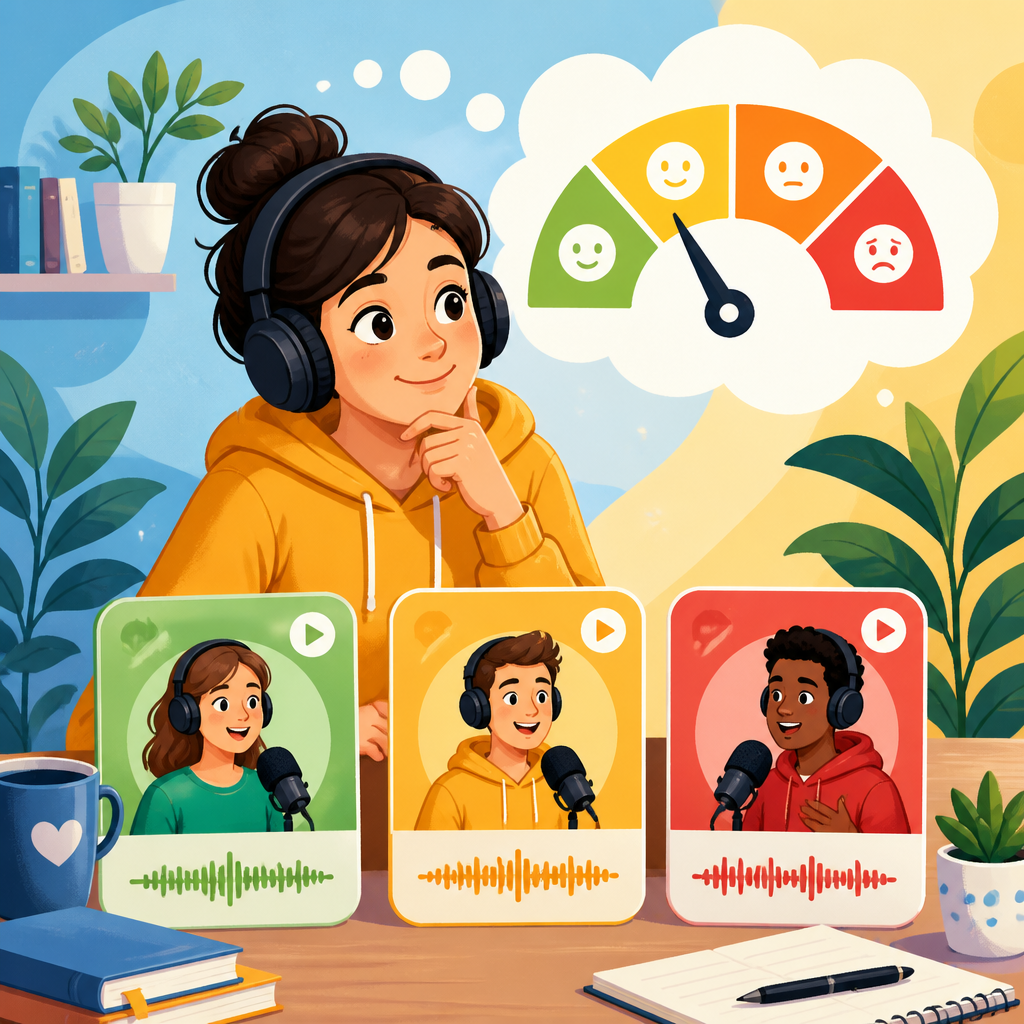
Choosing podcasts at the right difficulty level can accelerate English listening skills faster than almost any other habit, but only if the material is challenging enough to stretch you without becoming a blur of noise. In language learning, “right difficulty” means audio that you can follow well enough to stay engaged while still noticing new vocabulary, reduced speech, unfamiliar accents, and natural grammar patterns. If a podcast is far too easy, you may feel comfortable but make little progress; if it is too hard, your brain stops processing meaning and defaults to guessing. I have seen this repeatedly with adult learners who sincerely listen every day yet plateau because they choose shows based on popularity instead of fit. Difficulty depends on several variables working together: speaking speed, accent familiarity, vocabulary load, topic knowledge, episode structure, audio quality, and whether hosts interrupt each other. This matters because podcasts are one of the most practical tools for busy adults. They fit commutes, workouts, chores, and short study sessions, but convenience only helps when the listening input is level-appropriate. The goal is not to understand every word. The goal is to understand enough to build comprehension, stamina, and confidence consistently over time.
What Actually Makes a Podcast Easy or Hard
Many learners judge difficulty by topic alone, but the real answer is more technical. A business podcast can be easier than a lifestyle show if the host speaks clearly, follows a script, and repeats key points. Meanwhile, a casual comedy podcast can be much harder because it includes slang, overlapping speech, cultural references, laughter, and sudden topic changes. In practical terms, the biggest factor is speech rate. Native conversational English often runs between 150 and 180 words per minute, but some interview shows move beyond 190. For an intermediate learner, that difference is huge. Clear articulation also matters. Podcast hosts who reduce sounds heavily, swallow word endings, or speak with strong regional features demand more processing power even when the vocabulary is simple.
Another major factor is predictability. News recaps, educational explainers, and story-driven episodes usually have clearer structure than free-flowing discussions. Structured content gives your brain more chances to anticipate what comes next. Background knowledge lowers difficulty too. If you already understand a topic such as fitness, productivity, or travel, you can infer unknown words from context. I often tell learners to separate language difficulty from content difficulty. A simple topic delivered quickly with idioms can still be advanced. Audio quality is the final filter. Studio sound with one close microphone is easier than a remote interview with lag, echo, and uneven volume. When you assess a podcast, evaluate all these factors together rather than relying on the level label in an app description.
Use the 70 to 85 Percent Rule to Find the Sweet Spot
The most reliable way to choose the right difficulty is to aim for roughly 70 to 85 percent overall comprehension on the first listen. That means you understand the main idea, can follow the basic thread, and catch many details, but you still miss enough language to learn something new. Below that range, listening often becomes decoding without meaning. Above it, improvement slows because the input is too familiar. In my own teaching practice, this range consistently produces the best balance of motivation and measurable progress. Learners remain challenged but not overwhelmed, which keeps them listening long enough for the habit to matter.
You do not need a perfect test to estimate comprehension. After five minutes of an episode, pause and ask four questions: What is the episode mainly about? Can you summarize the last minute in one or two sentences? Are missed words occasional, or are entire stretches unclear? Can you identify why you are missing meaning: speed, accent, vocabulary, or topic knowledge? If you can answer the first two questions and clearly diagnose the third and fourth, the podcast is probably usable. If you cannot state the main point without guessing, drop down a level. If everything feels effortless, move up slightly. This simple self-check is more useful than labels like beginner or advanced because podcast creators use those labels inconsistently.
Match Podcast Features to Your Current Listening Goal
Not every listening session should serve the same purpose. Choosing the right difficulty becomes much easier when you decide what you want from that specific podcast. If your goal is extensive listening, where you build comfort and fluency through volume, choose easier episodes with high comprehension. If your goal is intensive listening, where you replay short segments, notice pronunciation, and mine useful phrases, you can handle somewhat harder material because you will study it closely. Confusion happens when learners try to use one show for every purpose.
For example, a lower-intermediate learner might use a graded English podcast for daily extensive listening during a commute, then spend ten minutes at home on a slightly harder interview episode with a transcript. An upper-intermediate learner preparing for workplace conversations might choose business explainers for confidence and one authentic panel discussion each week to push tolerance for faster speech. If you already follow a consistent study system, it helps to place podcasts inside it rather than treating them as random exposure. One practical model is pairing them with a broader habit framework such as this daily English routine for busy adults, where easier and harder listening each have a clear role. Difficulty should match the job the podcast is doing for you.
How to Evaluate a Podcast Before Committing
The fastest way to avoid wasted time is to test a podcast before subscribing to dozens of episodes. Start with a three-episode sample, not a single episode, because difficulty can vary by guest and topic. During the sample, track a few concrete indicators instead of relying on vague impressions.
| Indicator | What to Check | Good Fit Sign | Bad Fit Sign |
|---|---|---|---|
| Comprehension | Main idea after five minutes | You can summarize it clearly | You only catch isolated words |
| Speed | Speech feels manageable without constant rewinding | You miss details, not whole sections | Meaning disappears when pace rises |
| Vocabulary | Number of unknown key words | Some new terms, but context helps | Too many words block understanding |
| Structure | Episode has clear transitions and topic focus | You can predict the flow | Conversation jumps randomly |
| Support | Transcript, captions, or show notes available | You can verify what you heard | No support for checking errors |
Transcripts are especially valuable, but not because you should read them immediately. First listen without text. Then use the transcript to confirm what you missed. This reveals whether the true issue is sound recognition, vocabulary, or concentration. Apple Podcasts, Spotify, YouTube, BBC Learning English, NPR, and many independent creators now provide partial or full text support. Also notice whether hosts interrupt each other. Cross-talk sharply increases difficulty, even for advanced learners. After three episodes, ask whether challenge is consistent and productive. If every episode feels like rescue work, move on.
Choose by Level, Then Adjust with Topic, Accent, and Format
Once you find a rough level, refine from there using smaller difficulty controls. Topic familiarity is the easiest adjustment. If authentic native podcasts feel too hard, stay at the same language level but pick topics you already know well. A learner who understands cooking techniques in their first language will often follow recipe podcasts more easily than politics or pop culture. Accent is another lever. Start with accents you hear most often in your studies or work, then expand gradually. There is no prize for forcing yourself into the hardest accent too soon. Build success first, then range.
Format matters just as much. Solo-host explainers are typically easier than interviews; interviews are easier than roundtable discussions; comedy and unscripted banter are often the hardest. Episode length also changes the load. A twenty-minute focused episode may be better than a sixty-minute conversation, even if the shorter one is slightly faster. You can also adjust playback speed strategically. For many learners, 0.9x helps reveal word boundaries without making speech sound unnatural. Slowing everything to 0.7x, however, often distorts rhythm and creates a listening experience unlike real conversation. As your ear improves, return to normal speed quickly. The best choices are not the most prestigious podcasts. They are the ones you can understand, return to consistently, and grow with over months, not days.
Common Mistakes That Lead to the Wrong Difficulty
The most common mistake is choosing podcasts that match your reading level rather than your listening level. Listening is harder because spoken English includes linking, reductions, false starts, and incomplete sentences. A learner who reads B2 articles comfortably may still struggle with B1 audio. Another mistake is selecting podcasts only because they are made for native speakers. Authentic input is useful, but if you understand almost nothing, authenticity does not help. I have also seen learners stay too long with “learner” podcasts that no longer challenge them. Comfort becomes a trap when every sentence is slow and explained.
A third mistake is switching podcasts constantly. Every new host requires adaptation to voice, rhythm, and style. If you change shows every day, you lose the benefit of familiarity. Stay with a suitable podcast long enough for your brain to tune in. Finally, do not confuse boredom with level. Some podcasts are simply dull for you. If attention drops, comprehension drops too. The right difficulty should feel effortful but sustainable, not punishing or lifeless.
Choosing podcasts at the right difficulty level is less about guessing your level and more about measuring how well you can follow real audio under real conditions. The strongest choices sit in that productive middle zone: clear enough to understand the main message, challenging enough to expose new language, and interesting enough to keep you coming back tomorrow. Evaluate difficulty through speed, accent, vocabulary load, structure, and audio quality, then test each show with a short sample instead of trusting labels. Use easier podcasts for fluency and habit-building, slightly harder ones for focused study, and adjust with topic familiarity, format, and transcript support. Most important, remember that a good podcast is not the hardest one you can survive. It is the one that helps you understand more this week than you did last week. Audit the podcasts you currently follow, keep the ones that fit this standard, and replace the rest with better-matched listening.
Frequently Asked Questions
1. What does “the right difficulty level” actually mean when choosing an English podcast?
The right difficulty level is the point where a podcast feels challenging but still understandable. You should be able to follow the main topic, catch the speaker’s purpose, and recognize a good portion of the vocabulary without feeling completely lost. At the same time, there should still be enough unfamiliar language to push your listening skills forward. This is where real progress happens. You are not just hearing English; you are actively processing it, noticing pronunciation changes, reduced speech, connected sounds, natural grammar, and new expressions in context.
A useful way to think about it is this: if you understand nearly everything, the podcast may be too easy to produce strong improvement. If you understand almost nothing, it is probably too hard to be useful for regular practice. The ideal podcast sits in the middle. You may miss some details, but you can still stay engaged and reconstruct meaning from context. You might understand 70 to 90 percent overall, depending on your level and the goal of the session. That range is often difficult enough to stretch you without turning the listening experience into frustration.
Difficulty is not determined by vocabulary alone. Speaking speed, accent, topic familiarity, audio quality, number of speakers, use of humor, cultural references, and the amount of structure in the conversation all matter. A podcast with simple words can still be hard if the hosts interrupt each other and speak quickly. On the other hand, a podcast about a technical subject can feel manageable if the host speaks clearly, repeats key ideas, and follows a predictable format. The best choice is not the “hardest” podcast you can find, but the one that lets you understand enough to keep learning consistently.
2. How can I tell if a podcast is too easy, too hard, or just right for my current listening level?
The fastest way to judge a podcast is to listen to a short section, usually five to ten minutes, and evaluate both comprehension and effort. If you understand the main message easily, can summarize what was said, and only miss an occasional word or phrase, the podcast may be ideal for relaxed listening or fluency maintenance. If you understand every sentence with no strain at all, it is probably too easy for skill growth, even though it can still be useful for building confidence. On the other hand, if you lose the topic quickly, cannot tell where the conversation is going, and feel like the audio is just a stream of sounds, the podcast is too difficult right now.
There are several practical signs of a good match. You can follow the topic without constantly pausing. You notice unfamiliar language, but it does not stop your overall understanding. You sometimes need to replay parts, but not every sentence. You remain curious and focused rather than exhausted. After listening, you can explain the main points, identify a few new expressions, and remember examples of natural pronunciation or grammar. These are strong indicators that the difficulty level is productive.
It also helps to separate “temporary difficulty” from “true mismatch.” A podcast may feel hard because the topic is unfamiliar, not because your English is too weak. For example, an episode about economics or medicine may be difficult even for advanced learners if they do not know the subject. Before rejecting a podcast entirely, try a different episode on a more familiar topic. Likewise, if a podcast feels easy in one episode and hard in another, that is normal. Difficulty changes depending on guests, accents, topic complexity, and speaking style. The best approach is to test several episodes and judge patterns rather than making a decision based on one sample alone.
3. Should I choose learner podcasts or native-speaker podcasts if I want to improve faster?
Both can be valuable, and the best choice depends on your current level and your immediate goal. Learner podcasts are designed to be more accessible. They often have clearer pronunciation, more controlled vocabulary, slower pacing, and educational support such as transcripts, explanations, or repeated phrases. This makes them excellent for building a foundation, increasing confidence, and training your ear to process spoken English more accurately. If native-speaker podcasts still feel like noise, learner podcasts are not a shortcut or a weaker option; they are often the most efficient starting point.
Native-speaker podcasts become especially useful when you are ready to handle more natural rhythm, spontaneous speech, informal phrasing, varied accents, and real-world listening conditions. They expose you to the features that often make authentic listening difficult: contractions, reduced sounds, overlapping speech, idioms, jokes, and references that are not explained. This kind of input is essential eventually, but only when it is at a workable level. If a native-speaker podcast is so difficult that you cannot follow the thread, you are not getting the full benefit of authentic input.
For many learners, the smartest strategy is not choosing one or the other permanently, but using both on purpose. You might use learner podcasts for focused study and skill-building, then add easier native-speaker podcasts for gradual adaptation to real speech. As your listening improves, the balance can shift. The goal is not to prove that you can survive the hardest content. The goal is to spend more time with audio that helps you understand more today while preparing you for more advanced listening tomorrow.
4. What podcast features make listening easier or harder, even if the topic seems simple?
Many learners focus only on vocabulary difficulty, but podcast difficulty is shaped by several other features that can dramatically affect comprehension. One of the biggest is speaking speed. Faster speech gives you less time to process sounds, identify words, and connect ideas. Another major factor is pronunciation style. Some speakers articulate clearly, while others use strong reductions, swallow sounds, or link words together heavily. This is why a simple sentence in real conversation can be harder to catch than a more advanced sentence spoken slowly and clearly.
Accent is another important variable. Even advanced learners may struggle when a speaker has an unfamiliar regional or international accent. This does not mean the podcast is too advanced in grammar or vocabulary; it means your ear needs adaptation. The number of speakers also matters. A solo host is usually easier to follow than a lively group discussion with interruptions, laughter, and topic shifts. Interview formats can vary widely too. Some hosts ask structured questions and summarize key points, while others jump rapidly between ideas.
Topic familiarity can lower difficulty significantly. When you already understand the subject, your brain can predict vocabulary and meaning more easily. Audio quality matters as well. Clear studio recordings are easier than remote conversations with background noise, weak microphones, or unstable volume. Finally, structure makes a difference. A podcast with a clear introduction, organized sections, and repeated key ideas is easier than one with free-flowing conversation and many side comments. Paying attention to these features helps you choose more accurately, because a podcast may be difficult for reasons that have nothing to do with your actual English level.
5. How should I adjust podcast difficulty over time so I keep improving without getting discouraged?
The best approach is to increase difficulty gradually, not suddenly. Start with podcasts you can follow well enough to enjoy, then make small changes as your listening becomes stronger. You might move from slow, educational podcasts to natural-speed podcasts with one clear speaker. After that, you can try interviews, then informal conversations, then more complex shows with multiple speakers or unfamiliar accents. This step-by-step progression helps your brain adapt to real English without overwhelming you.
It is also useful to vary your listening by purpose. Keep some “comfort-level” podcasts for extensive listening, where the main goal is volume, fluency, and confidence. Add some “stretch-level” podcasts for focused practice, where you accept more difficulty in order to train your ear. This combination works well because easy listening reinforces patterns you already know, while harder listening reveals the next gaps you need to close. If every podcast is difficult, you may burn out. If every podcast is easy, your progress may slow. A mix gives you both stability and growth.
Track your progress with simple checkpoints. Can you understand more without transcripts than you could a month ago? Are you missing fewer words in fast speech? Can you handle longer episodes without mental fatigue? Are unfamiliar accents becoming less intimidating? These are better signs of improvement than whether a podcast feels “hard” in a general sense. As you improve, difficulty should evolve with you. The right level today may be too easy in two months, and that is a good sign. Regularly testing slightly more demanding material ensures that your listening practice continues to challenge you in a productive, sustainable way.





