
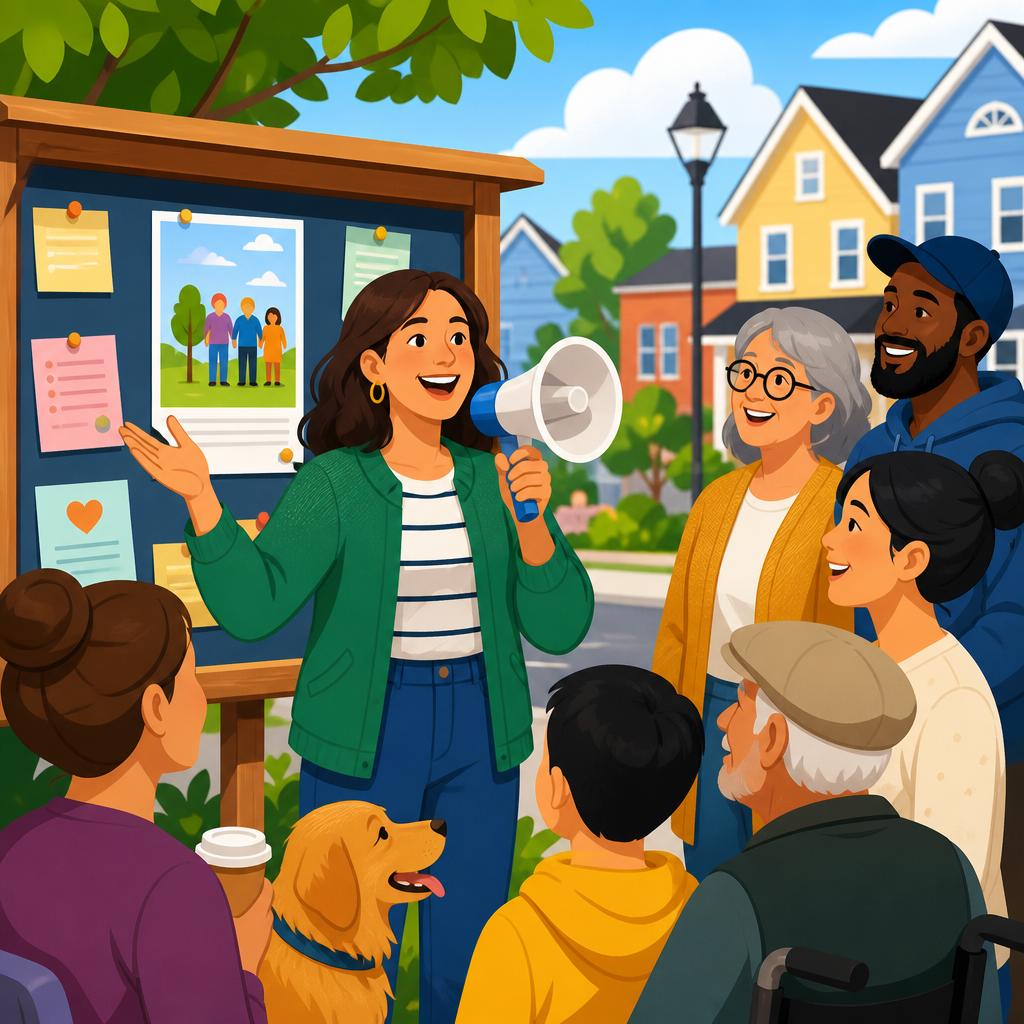
A strong community announcement tells people what is happening, why it matters, and what they need to do next without making them work for the meaning. In plain English, that means short sentences, familiar words, and a structure that helps busy readers scan for details. I have edited announcements for schools, housing associations, nonprofits, churches, and neighborhood groups, and the same pattern shows up every time: when a notice is vague, formal, or overloaded with jargon, people miss deadlines, ignore events, or flood staff with avoidable questions.
A community announcement is a public message sent to a defined group, usually to inform, invite, warn, or request action. It may appear in email, a printed flyer, a WhatsApp group, a Facebook post, a resident portal, or a bulletin board. Plain English is writing that readers can understand the first time they read it. The UK Plain English Campaign and the US federal plain language guidance both emphasize direct wording, logical order, and useful headings. Those principles matter because community audiences are mixed. Some readers are fluent, some are distracted, some read on phones, and some may have limited literacy or speak English as a second language.
Writing a community announcement well is not just a style preference. It affects turnout, compliance, trust, and inclusion. If residents do not understand a water shutdown notice, they cannot prepare. If parents misread a schedule change, children arrive at the wrong time. If volunteers cannot tell whether registration is required, they may stay home. Good announcements reduce confusion and support fairness because everyone gets the same clear information. The goal is simple: help people understand the message quickly enough to act on it with confidence.
Start with the purpose and the action
The fastest way to improve a community announcement is to decide its single purpose before drafting. Most weak notices try to do too much at once. They announce an event, explain background history, thank sponsors, remind people about past issues, and ask for feedback in one block of text. Readers then miss the main point. A better method is to identify the core action. Do you want people to attend, prepare, avoid an area, bring documents, pay by a deadline, or share the message with others? Put that action near the top.
In practice, I use a simple briefing line before writing: “This announcement is to tell [audience] about [subject] so they can [action] by [time].” For example: “This announcement is to tell residents about a parking lot closure so they can move their cars by 8 a.m. on Friday.” That sentence keeps the draft focused. It also helps you spot missing facts. If readers must move their cars, they need the exact lot name, date, time, reason for closure, and where to park instead. Without those details, the message fails even if the writing sounds polished.
Your opening should answer the first questions immediately: What is happening? Who does it affect? When does it happen? What should people do now? Think of the first two sentences as the summary a reader sees in a locked phone notification. For routine messages, direct wording works best: “The community center will close at 6 p.m. on Tuesday, 14 May, for electrical repairs. All evening classes are canceled.” That is clearer than “Please be advised that due to circumstances relating to scheduled maintenance activities, operations may be adjusted.” Readers should never need to decode your meaning.
Use plain English, not official-sounding language
Many writers mistake formality for professionalism, especially in community settings. In reality, long words often hide simple ideas. Plain English does not mean childish writing. It means choosing the clearest accurate term. Write “use” instead of “utilize,” “help” instead of “facilitate,” and “before” instead of “prior to.” Prefer active voice when possible: “Staff will inspect the playground on Monday” is stronger than “The playground will be inspected on Monday.” Active verbs show responsibility and make deadlines feel real.
Jargon is another common barrier. Every organization has internal terms that confuse outsiders: HOA, quorum, discretionary fund, safeguarding lead, right-of-entry notice, or Phase 2 traffic management. If a technical term is necessary, define it in plain words the first time. For example: “A boil water advisory means you should boil tap water for one minute before drinking, cooking, or brushing teeth.” That definition matters more than the label. The Centers for Disease Control and Prevention uses this approach in public health communication because naming the issue alone does not tell people how to stay safe.
Tone also matters. Community announcements work best when they sound respectful, calm, and direct. Avoid sounding threatening unless legal enforcement is truly involved. “Please clear the hall by 7 p.m. so cleaners can begin” usually works better than “Failure to vacate the premises may result in further action.” When the subject is sensitive, plain English can still be compassionate. A notice about a funeral, memorial, rent increase, or service reduction should acknowledge the human impact without becoming vague. Clarity and empathy are compatible; in fact, they strengthen each other.
Organize information in the order readers need it
Good structure is the hidden engine of a clear announcement. Put the most important information first, then add supporting detail in descending order of importance. This is the same inverted-pyramid approach used in journalism and emergency communication. Start with the key message, then include logistics, then background, and finally contact details. If readers stop halfway through, they should still leave with the essential facts. On mobile screens, this matters even more because long introductions push the usable information below the fold.
A practical sequence works across most community messages: headline, one-sentence summary, date and time, location, who is affected, what to do, what happens if no action is needed, and where to ask questions. If the announcement is complex, a table helps readers compare details quickly.
| Announcement type | Essential details to include | Common mistake |
|---|---|---|
| Event invitation | Date, start time, location, cost, registration method, who can attend | Leading with background instead of the invitation |
| Service disruption | What is affected, exact timing, reason, workaround, contact point | Leaving out the practical alternative |
| Policy change | What changes, when it starts, who it affects, what readers must do | Using legal language without examples |
| Safety notice | Risk, affected area, immediate action, duration, official updates | Burying urgent instructions in long paragraphs |
Paragraph length matters too. One idea per paragraph is a useful rule. Dense blocks make people give up, especially older readers and phone users. Headings help when the announcement is longer than a short email. So do labels such as “When,” “Where,” and “What you need to do.” If you want to improve consistency across a team, create a simple template. In organizations I have supported, templates cut editing time sharply because staff stop reinventing the order for every notice.
Include complete facts and remove predictable confusion
The most reliable test of a community announcement is whether it prevents obvious follow-up questions. After drafting, ask what a busy reader might still need to know. If the notice says “join us for a meeting,” is it online or in person? If it says “children are welcome,” is supervision required? If it says “register by Friday,” which Friday and in which time zone? Specificity beats elegance. Write “Friday, 18 October, by 5 p.m.” instead of “this Friday.” Relative dates create avoidable mistakes when messages are forwarded or read late.
Examples are powerful because they turn abstract instructions into concrete behavior. Compare “parking restrictions will apply” with “do not park on Oak Street between the library and the post office from 7 a.m. to 3 p.m.” The second version is harder to misread. Numbers also need care. Use numerals for dates, times, fees, addresses, and deadlines. Write times with a.m. and p.m. unless your audience uses the 24-hour clock. For accessibility, avoid relying on color alone in phrases like “see the rooms marked in red.” Some readers may print in black and white or have color-vision differences.
When the message asks for a response, make the next step easy. Give one clear contact route and state what readers should send. “Email Maria Lopez at mlopez@example.org with your child’s name and grade by 3 June” works better than “contact us if interested.” If the request is similar to a formal inquiry, it helps to study concise message patterns such as those in this polite email guide, then adapt the same clarity to public announcements. Clear requests produce faster, more accurate replies.
Review for accessibility, trust, and real-world use
Before sending an announcement, read it aloud once. In my experience, awkward phrases and missing steps become obvious when spoken. Then test it against real-world conditions. Will it make sense to someone seeing only the first line in an inbox? Can a non-native speaker follow it? Does it include all key facts if an image fails to load? If the notice concerns health, money, safety, or legal obligations, verify every detail with the responsible person before publishing. Accuracy protects credibility; one wrong date can make the next announcement easier to ignore.
Accessibility is not optional. Use standard capitalization, strong contrast, and meaningful link text. “Register for the clean-up day” is better than “click here.” If you share the announcement as an image on social media, repeat the text in the caption so screen readers can access it. For multilingual communities, translate professionally when possible and keep the source version simple so translators can preserve the meaning. Community trust grows when messages are readable, consistent, and honest about limits. If details may change, say so directly and promise the next update time.
Writing a community announcement in plain English comes down to discipline. Decide the purpose, lead with the action, use familiar words, organize details in the order readers need them, and check for unanswered questions. These habits make announcements easier to understand, easier to share, and more likely to produce the right response. Clear writing saves staff time, reduces confusion, and shows respect for the whole community, including readers who are tired, distracted, or new to the topic. The next time you draft a notice, cut the jargon, add the missing specifics, and test whether someone can act after one quick read.
Frequently Asked Questions
What makes a community announcement “plain English”?
A community announcement is written in plain English when people can understand it quickly the first time they read it. That means the message is direct, specific, and easy to scan. Instead of sounding formal or administrative, it sounds clear and helpful. Readers should be able to answer three questions right away: what is happening, why it matters, and what they need to do next.
In practice, plain English usually means using short sentences, common words, and a logical structure. Put the main point near the beginning instead of burying it in background information. Use headings, bullet points if appropriate, and clear dates, times, locations, deadlines, and contact details. Avoid long introductions, passive voice, and vague phrases like “relevant parties are advised” or “further action may be required.” A stronger version would say, “Parents must return the form by Friday” or “Residents should move cars off the street by 8 a.m.”
Plain English does not mean oversimplified or unprofessional. It means respectful of the reader’s time. Community announcements are often read by busy parents, residents, volunteers, staff members, or neighbors who may be skimming on a phone. If they have to read a sentence twice to understand it, the writing is not doing its job. A plain-English announcement helps people notice the message, trust it, and act on it.
What information should every community announcement include?
Most effective community announcements include a core set of details, even when the topic changes. At minimum, readers need to know what is happening, who it affects, when it will happen, where it applies, why it matters, and what action they should take. If even one of those pieces is missing, people often fill in the gaps incorrectly or ignore the notice altogether.
A useful way to structure an announcement is to open with the main message in one or two sentences. Then follow with the practical details. For example, if a neighborhood group is announcing a road closure, the first line might say that a specific street will be closed on a certain date for repairs. After that, explain the timing, the detour, who may be affected, and whether residents need to move vehicles or plan extra travel time. This order matters because readers want the key point first, not after a paragraph of context.
It also helps to include deadlines, exceptions, and contact information. If people need to register, reply, attend, sign, pay, or prepare something, say exactly how and by when. If the announcement only applies to certain members of the community, make that clear. End with the next step in plain language, such as “Please submit your RSVP by Tuesday at 5 p.m.” or “Call the office if you need help.” A complete announcement reduces confusion and cuts down on follow-up questions.
How do you make a community announcement easy for busy people to scan?
To make an announcement easy to scan, organize it so readers can pick out the important details in seconds. Start with the most important information first. Many people will only read the opening lines, especially on mobile devices, so those lines should state the event, update, or issue clearly. Do not make readers search for the point.
After the opening, break the information into short paragraphs or clearly labeled sections. Keep each paragraph focused on one idea. Use familiar wording, and avoid blocks of dense text. If the announcement includes logistics, present them in a predictable order: date, time, place, who is affected, what to bring, and what to do next. Repeating that structure across multiple announcements can also help readers know where to look each time.
Clarity also improves when you remove clutter. Cut unnecessary background, repeated phrases, and formal filler. For example, instead of saying, “This correspondence is intended to notify all relevant stakeholders of the upcoming scheduled adjustment,” say, “The meeting time has changed.” Readers do not need a performance of professionalism. They need useful information they can act on. When the writing is concise and well structured, people are much less likely to miss deadlines or misunderstand the message.
What are the most common mistakes people make when writing community announcements?
One of the most common mistakes is being too vague. Writers sometimes assume readers already know the context, so they leave out critical details such as the deadline, exact location, or who the notice applies to. That creates confusion and usually leads to missed actions. If someone has to ask, “What does this mean for me?” the announcement probably needs revision.
Another frequent problem is using formal, bureaucratic, or jargon-heavy language. This often happens in schools, housing groups, nonprofits, churches, and neighborhood organizations where people want to sound official. But language that sounds official is not always language that communicates well. Phrases like “in accordance with established procedures” or “stakeholders are encouraged to avail themselves” slow readers down and weaken the message. Clear language is not less credible. In many cases, it is more credible because it is easier to trust and understand.
Writers also make mistakes by burying the main point, overloading the notice with too much background, or failing to include a clear call to action. A strong announcement does not just inform people; it tells them what to do next. If you want residents to attend a meeting, return a form, avoid a parking area, or prepare for a schedule change, say so directly. Before sending any announcement, check whether a first-time reader can immediately identify the purpose, the key details, and the required next step.
How can you revise a community announcement to make it clearer and more effective?
The easiest way to revise an announcement is to look at it from the reader’s point of view. Ask whether the first sentence clearly states the main news. If not, rewrite the opening so the purpose is obvious right away. Then check whether the answer to each essential question is easy to find: what is happening, when, where, who is affected, why it matters, and what to do next. If any of that is hidden, move it higher.
Next, simplify the language. Replace long words with familiar ones, cut filler, and shorten sentences that try to do too much at once. Swap passive constructions for active ones when possible. For example, “The gym will be closed on Saturday” is usually stronger than “Closure of the gym will be in effect on Saturday.” Read the announcement out loud as part of the revision process. If a sentence sounds stiff, confusing, or overly formal, it will probably be harder to read than it needs to be.
Finally, test the announcement for action and usability. Make sure dates, times, names, and deadlines are accurate and easy to spot. Confirm that contact details are included if readers may need help. End with a direct next step so people know exactly what to do. A good final check is this: if a busy reader looked at the notice for 10 seconds, would they understand the message and know how to respond? If the answer is yes, the announcement is likely ready to send.





