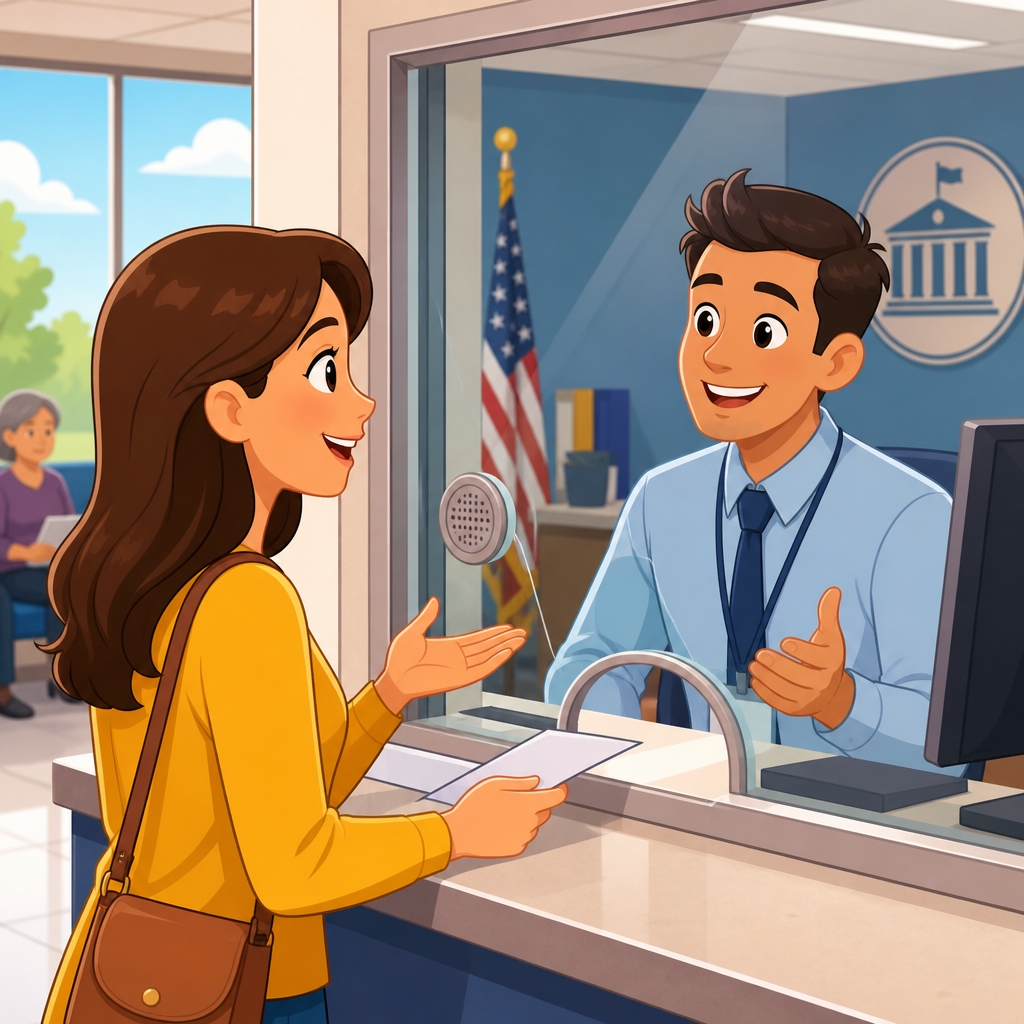
Walking up to a government office window can feel harder than the task itself, especially if English is not your first language. The setting is formal, the line is often long, and the clerk usually expects clear, efficient communication. Knowing what to say at a government office window means using short, polite, accurate phrases to explain your purpose, answer questions, and ask for the next step. In practical terms, that includes stating why you are there, showing identification, confirming documents, and checking deadlines, fees, or processing times.
I have helped adult English learners prepare for visits to passport offices, city halls, tax counters, immigration desks, and motor vehicle agencies, and the same pattern appears almost every time. People usually know the basic vocabulary, but they freeze when they must speak under pressure. The problem is rarely grammar alone. It is not knowing the standard phrases used at public service counters, not understanding what the clerk may ask next, and not having a simple script ready. A focused set of office-window phrases solves that problem quickly because most interactions follow a predictable order.
This matters because small communication errors at a government office can lead to missed appointments, rejected applications, repeated visits, or extra fees. If you say the wrong date, forget to ask whether copies are required, or misunderstand “original document” versus “photocopy,” the process can stop immediately. Clear language saves time and reduces stress for both you and the clerk. It also helps you sound respectful and organized, which often leads to smoother service. The goal is not to speak perfect English. The goal is to handle the exchange confidently, understand the instructions, and leave knowing exactly what happens next.
Start the conversation clearly and politely
The best opening at a government office window is direct and simple. Clerks handle many people every day, so they need your purpose first. A strong opening sounds like this: “Good morning. I’m here to renew my passport,” “Hello. I need to register this address change,” or “Good afternoon. I have an appointment for 10:30.” These openings work because they identify the service immediately. Avoid long explanations at the start. If you begin with your full story, the clerk may interrupt to ask the specific service you need.
Politeness matters, but efficiency matters too. Use “Good morning,” “hello,” “please,” and “thank you,” then move straight to the reason for your visit. If you are unsure which line or window is correct, say, “Is this the right window for birth certificate applications?” or “Could you please tell me where I should submit this form?” Those are standard, respectful questions that help you avoid waiting in the wrong place. If you have an appointment, say it early and include the time, because some offices separate walk-ins from scheduled visits.
If you need to identify yourself before speaking, use short factual sentences: “My name is Ana Silva,” “Here is my appointment confirmation,” or “I was told to bring these documents today.” These statements are especially useful when the office uses ticket numbers, barcodes, or appointment letters. Many learners practice only request phrases, but they also need transition phrases that keep the interaction moving. Good examples are “I filled out the form already,” “I’m not sure this section is correct,” and “This is my first time applying.” Those lines give useful context without becoming unfocused.
Explain your request and present documents correctly
Once the conversation begins, the clerk usually wants two things: a clear request and the required documents. State the request in one sentence. For example: “I’d like to apply for a replacement ID card,” “I need a copy of my marriage certificate,” or “I’m here to pay the vehicle registration fee.” Then be ready to hand over identification, application forms, proof of address, payment confirmation, photographs, or supporting records. Use exact vocabulary when possible. “Original” means the official document itself. “Copy” or “photocopy” means a reproduced version. Confusing those terms causes delays more often than pronunciation mistakes do.
When giving documents, say what each item is: “This is my passport,” “Here is proof of address,” “These are the bank statements you requested,” or “I also brought a translated copy.” That reduces back-and-forth and shows you understand the process. If you are missing something, say it honestly and directly: “I have the form, but I don’t have the original birth certificate with me,” or “I brought a digital copy on my phone. Is that acceptable?” Some offices accept printed copies only, while others allow digital confirmation for appointments but not for legal documents.
It helps to know common clerk questions in advance. You may hear: “What are you applying for?” “Do you have a valid ID?” “Do you have the original?” “Have you signed the form?” “Is this your current address?” or “Do you need standard or expedited processing?” Prepare short answers such as “Yes, this is my current address,” “No, I haven’t signed it yet,” or “I need standard processing, please.” If your broader goal is improving practical appointment English in formal settings, this companion guide on English for booking a doctor’s appointment by phone builds the same skill of stating a purpose clearly and answering follow-up questions without confusion.
| Situation | What to Say | Why It Works |
|---|---|---|
| Starting the visit | I’m here to renew my passport. | States the service immediately. |
| Checking location | Is this the right window for license applications? | Prevents waiting in the wrong line. |
| Giving documents | Here is my ID and proof of address. | Labels documents clearly. |
| Missing a document | I have a copy, but not the original. | Shows the exact limitation. |
| Clarifying next steps | What do I need to do next? | Gets actionable instructions. |
Ask the right follow-up questions
Many problems happen not during the request, but at the end, when people leave without confirming details. At a government office window, always ask follow-up questions about process, timing, and requirements. The most useful phrases are “Is there anything else you need from me?” “How long will processing take?” “Do I need to come back in person?” “Will I receive this by mail or email?” and “What is the deadline?” These questions are simple, but they prevent the most common misunderstandings.
In my experience, “What happens next?” is one of the best questions any learner can memorize. It invites the clerk to explain the sequence step by step. You may learn that you need to pay at another counter, submit fingerprints, book a second appointment, or wait for a text message. If a fee is involved, ask directly: “How much is the fee?” “Can I pay by card?” and “Do you issue a receipt?” Public offices vary widely. Some accept only local debit cards, some require exact cash, and some send applicants to a separate payment station before processing can continue.
You should also ask for confirmation when dates, names, or addresses matter. Try “Could you please check that the spelling is correct?” “Can you confirm the appointment date?” or “Is this the address you have on file?” Government records must match official documents precisely. One wrong letter in a surname or one incorrect apartment number can create later complications with benefits, taxes, licenses, or travel documents. Careful verification at the window is easier than fixing an official record afterward.
Handle confusion, delays, and problems professionally
Even when you prepare well, problems happen. A document may be missing, the system may be down, or the clerk may speak too quickly. The key is to stay calm and use clear repair phrases. Say, “I’m sorry, could you repeat that, please?” “Could you speak a little more slowly?” “I didn’t understand which document you need,” or “Can you write that down for me?” These are practical, professional phrases. They are better than pretending to understand, because false understanding leads to bigger delays later.
If something is missing, focus on solutions. Useful phrases include “Can I submit this later?” “Do I need to make another appointment?” “Is there a checklist I can take with me?” and “Can you tell me exactly which document is required?” Specific questions produce specific answers. If the office rejects a document, ask why: “Could you explain why this copy is not acceptable?” Sometimes the issue is not the document itself but the format, date, signature, translation, or certification. Understanding the exact reason helps you fix the problem in one trip instead of several.
There are also moments when you need to be politely firm. If you have followed instructions and something seems inconsistent, say, “I was told to submit this at this window,” or “My appointment email says these documents are sufficient.” Keep your tone neutral and respectful. Most clerks respond well to factual language, not emotional arguments. Government office communication works best when you are concise, organized, and calm. Bring papers in a folder, keep originals separate from copies, and have a pen ready. Good language helps, but good preparation makes that language effective.
What to say at a government office window is not complicated once you break the interaction into stages. First, greet the clerk and state your purpose in one clear sentence. Next, present documents using precise words such as ID, original, copy, proof of address, application, and receipt. Then ask follow-up questions about fees, timing, delivery, and next steps. If confusion appears, use repair phrases early instead of guessing. These patterns work at passport counters, immigration desks, city offices, tax windows, and vehicle agencies because the structure of the exchange is remarkably similar.
The main benefit of learning these phrases is control. You stop reacting nervously and start managing the conversation. That means fewer mistakes, fewer repeat visits, and a much better chance of finishing your task in one trip. Practice six or seven core sentences before your appointment, keep your documents organized, and listen for key questions from the clerk. If you want to feel more confident in formal English situations, start by memorizing the phrases in this guide and rehearse them out loud before your next visit.
Frequently Asked Questions
What should I say first when I get to a government office window?
Start with a short, polite greeting and immediately explain why you are there. In most government offices, the clerk is helping many people in a limited amount of time, so clear and direct communication is the best approach. A strong opening might be, “Good morning. I’m here to renew my ID,” or “Hello. I have an appointment for my passport application.” If you do not have an appointment, you can say, “Hi. I need help with my address change,” or “Good afternoon. I’m here to submit these documents.” This lets the clerk understand your purpose right away and guides the conversation in the correct direction.
It also helps to keep your first sentence simple. You do not need a long explanation unless the clerk asks for one. Government office communication usually works best when you state the task, provide the required item, and then wait for the next question. If you are nervous, prepare one sentence before you reach the window and say it slowly. A calm, direct opening creates a professional impression and often makes the rest of the interaction easier.
How do I explain my purpose clearly if English is not my first language?
The key is to use short, specific phrases instead of trying to explain everything at once. You do not need perfect grammar to be understood. What matters most is accuracy. For example, you can say, “I’m here to apply for a driver’s license,” “I need to replace my lost ID,” “I want to register this document,” or “I’m here for a benefits interview.” These types of sentences are effective because they focus on the main action you need the office to take.
If your situation is more complicated, break it into parts. First state the main reason for your visit, then add one detail if necessary. For example: “I’m here to renew my passport. My old one expired last month,” or “I need to update my information. I moved to a new address.” If you do not know the exact English word for the service, it is fine to describe it in plain language and show any relevant paperwork. You can also say, “I’m not sure of the name, but I need help with this form,” or “Can you tell me which service I need for this issue?” That shows initiative while still asking for guidance in a respectful way.
What are polite phrases to use when handing over documents or answering questions?
At a government office window, politeness matters, but efficiency matters too. When giving documents, use simple professional phrases such as, “Here is my ID,” “These are my documents,” “This is the completed form,” or “I brought the papers you requested.” If the clerk asks for something specific, answer directly: “Yes, I have it here,” “No, I don’t have that with me,” or “I only have a copy.” Clear answers help avoid confusion and save time for both you and the clerk.
When responding to questions, it is best to keep your answers factual and brief. If the clerk asks, “What is your current address?” you can simply give the address. If they ask whether you have an appointment, say, “Yes, my appointment is at 10:30,” or “No, I’m a walk-in today.” If you need a moment to understand, polite phrases like “Could you repeat that, please?” or “I’m sorry, can you speak a little more slowly?” are entirely appropriate. These expressions are respectful and practical. They show that you want to cooperate and provide the correct information.
How can I ask what to do next without sounding confused or unprepared?
It is completely normal to ask for the next step at a government office, especially when the process involves forms, fees, waiting areas, or multiple counters. A professional way to ask is, “What should I do next?” You can also say, “Where do I go after this?” “Do I need to wait here?” or “Is there anything else you need from me?” These questions are clear, respectful, and commonly used in formal service settings. They help you move through the process without guessing.
Asking for clarification does not make you seem unprepared. In fact, it often shows that you are paying attention and trying to follow instructions correctly. If the clerk gives several directions at once, you can confirm by saying, “So I need to pay the fee first and then come back here, correct?” or “Just to confirm, I should wait for my number to be called?” Repeating the instructions in your own words is one of the best ways to avoid mistakes. It also gives the clerk a chance to correct anything you may have misunderstood before you leave the window.
What should I say if I do not understand something or if there is a problem with my application?
If you do not understand the clerk, the best response is to say so politely and immediately. Useful phrases include, “I’m sorry, I didn’t understand,” “Could you explain that again, please?” and “Can you show me which part you mean?” If the issue involves a form, you can point to the section and ask, “What information goes here?” or “How should I complete this part?” In a government office, asking for clarification is better than guessing, because small mistakes can delay your application or require another visit.
If there is a problem, such as a missing document, incorrect form, or denied request, stay calm and ask focused questions. You might say, “What document am I missing?” “Can you tell me how to correct this?” “Do I need to make another appointment?” or “Is there another way to complete this process?” These questions shift the conversation toward a solution. Even if the answer is not what you hoped for, professional and composed language helps you get useful information. In many cases, the most important thing is not arguing at the window, but leaving with a clear understanding of what is required so you can return fully prepared.