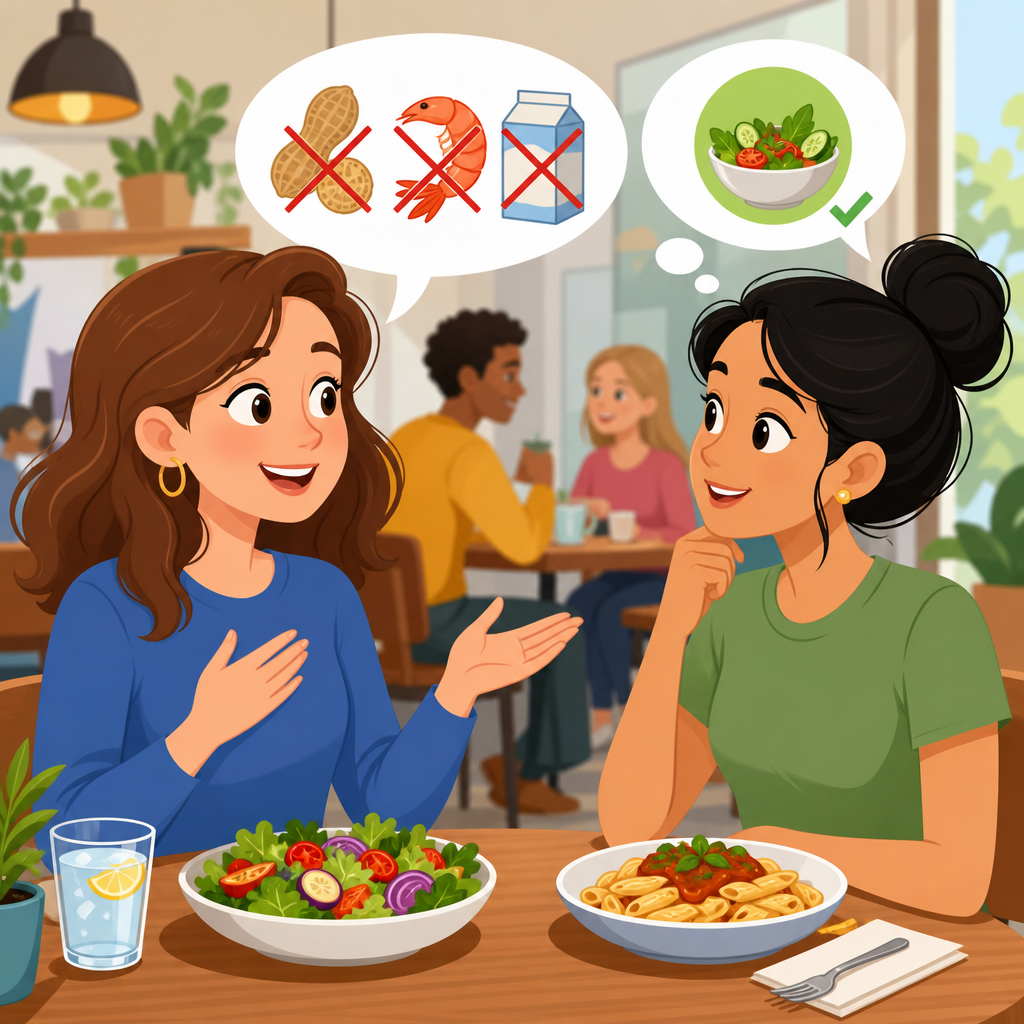
How to talk about allergies and food restrictions in English is an essential life skill for travel, school, work meals, and medical situations. If you cannot explain what you must avoid, a simple lunch order can turn into a health risk or an embarrassing misunderstanding. In English, the words you choose matter because “allergy,” “intolerance,” “dietary restriction,” and “preference” do not mean the same thing. I have helped English learners prepare for restaurant visits, workplace events, and doctor calls, and the biggest problem is usually not vocabulary alone. It is knowing how direct to be, what questions to ask, and how to confirm that another person truly understands.
An allergy is an immune-system reaction to a food or ingredient. Common examples include peanuts, tree nuts, shellfish, milk, eggs, soy, wheat, fish, and sesame. An intolerance is different. Lactose intolerance, for example, may cause stomach pain or bloating, but it is not usually the same kind of emergency as anaphylaxis. A food restriction can also come from religion, ethics, or medical advice, such as avoiding pork, eating halal or kosher food, following a gluten-free diet, or limiting sodium. In everyday English, native speakers often ask, “Do you have any allergies?” because allergies require extra caution.
This topic matters because people often assume more than they should. A server may hear “I don’t eat dairy” and think butter is acceptable. A friend may offer “just a little peanut sauce” without realizing trace amounts matter. In hospitals, schools, and airlines, staff members are trained to respond differently when they hear specific language such as “severe allergy,” “cross-contact,” or “I need you to check the ingredients.” Learning these phrases helps you protect your health, reduce confusion, and communicate calmly even under pressure. Strong English in this area is not about sounding advanced. It is about being clear, specific, and impossible to misunderstand.
Know the right words before you speak
The first step is choosing accurate vocabulary. If you have a true allergy, say “I’m allergic to peanuts” or “I have a severe shellfish allergy.” Do not soften the message with vague phrases like “peanuts aren’t good for me” or “I try to avoid shellfish.” Those expressions sound optional. If your condition is an intolerance, say “I’m lactose intolerant” or “I can’t digest dairy well.” If your restriction is not medical, say “I’m vegetarian,” “I don’t eat pork,” or “I avoid gluten for health reasons.” Clear labels help the listener understand the level of risk and respond properly.
It also helps to know the difference between “ingredient,” “contains,” and “may contain.” “Contains” means the food definitely has that item in it. “May contain” usually means there is a manufacturing risk or a risk of cross-contact. In restaurants, “cross-contact” means an allergen can get into your food from a shared grill, fryer, knife, cutting board, or spoon. This term is especially useful because many learners know to ask about ingredients but forget to ask how the food is prepared. If you have a serious allergy, preparation matters as much as the recipe.
Use short, strong sentences. “I’m allergic to nuts.” “Even a small amount is dangerous.” “Can you check with the kitchen?” “Was this cooked separately?” These are more effective than long explanations. In real life, restaurant staff, teachers, and receptionists are busy, and concise phrasing improves safety. If you need medical vocabulary for a phone call, it also helps to review phrases used in healthcare settings, especially when confirming symptoms, urgency, and history. A useful reference is this guide to booking a doctor’s appointment by phone, which supports the same kind of clear, practical communication.
Useful phrases for restaurants, cafés, and takeout
Restaurants are where many communication failures happen. The most effective approach is to say your restriction before you order, not after. Start with: “Before I order, I need to tell you that I have a severe allergy to sesame.” Then ask direct questions: “Does this dish contain sesame?” “Is the sauce made with nuts?” “Do you fry this in the same oil as shrimp?” If the staff member seems unsure, ask, “Could you please check with the kitchen?” In professional food service, checking is normal. Guessing is not acceptable.
You should also learn how dishes are described in menus. “Dressing” may contain dairy, egg, mustard, or anchovy. “Stock” and “broth” can include meat, shellfish, celery, or additives. “Glaze,” “marinade,” and “seasoning” may hide soy, wheat, or sesame. In bakeries, “plain” does not always mean safe, because display tongs, trays, and surfaces may be shared. I tell learners to assume nothing from menu names alone. English-speaking staff usually respond better when you ask about one issue at a time rather than listing six concerns in one long question.
| Situation | Best phrase in English | Why it works |
|---|---|---|
| Ordering at a restaurant | I have a severe peanut allergy. Does this dish contain peanuts or peanut oil? | States the risk level and asks about hidden forms |
| Checking preparation | Can this be prepared separately to avoid cross-contact? | Focuses on kitchen process, not only ingredients |
| Buffet or party food | Do you know which dishes are dairy-free and gluten-free? | Gets quick guidance when labels are limited |
| Correcting a misunderstanding | No, I can’t have even a small amount. | Clarifies that the restriction is strict |
For takeout and delivery, repeat the allergy in writing and by phone if possible. Many apps allow special instructions, but short notes work best: “Severe egg allergy. Please do not include mayo. Avoid cross-contact.” When picking up food, confirm again: “This is the order without dairy, correct?” Repetition may feel uncomfortable, but in safety communication, repetition is a strength. In English-speaking countries, it is generally seen as responsible, not rude.
How to explain restrictions at school, work, and social events
Not every food conversation happens in a restaurant. At school, a parent may need to tell a teacher, nurse, or cafeteria worker, “My child has a tree nut allergy and carries an epinephrine auto-injector.” At work, you may need to tell a manager, “I have celiac disease, so I cannot eat food with gluten or food contaminated by shared utensils.” At a friend’s house, you can say, “Thank you for inviting me. I need to let you know that I can’t eat shellfish.” This kind of advance notice is polite and practical.
Social situations require balance. You want to be clear without sounding apologetic for protecting yourself. A good model is simple and appreciative: “Thanks for offering, but I can’t eat anything with sesame.” “That looks great, but I have a dairy allergy.” “Could you tell me what’s in this?” If someone minimizes your concern by saying, “It only has a little,” respond firmly: “Even a small amount can be a problem for me.” This phrase is especially important because many misunderstandings come from other people thinking quantity changes the risk.
For potlucks, weddings, conferences, and airplane meals, ask early and ask specifically. “Will ingredient labels be available?” “Is there a vegetarian option without eggs?” “Can you note a shellfish allergy on the reservation?” Airlines differ widely. Some can record requests such as gluten-free or low-sodium meals, but special meals are not always safe for severe allergies because onboard environments involve shared surfaces and limited verification. Use English that reflects this reality: “I requested a special meal, but I still need to confirm the ingredients before I eat it.”
What to say in medical and emergency situations
Medical settings require exact language. If you are registering at a clinic, say, “I have a documented allergy to penicillin and a severe peanut allergy.” If the issue is food-related and urgent, state the symptoms clearly: “I ate something with nuts and now my lips are swelling.” “I’m having trouble breathing.” “I think I’m having an allergic reaction.” In emergency care, staff often prioritize breathing difficulty, swelling of the tongue or throat, widespread hives, vomiting after exposure, dizziness, and fainting. Use plain, direct English and do not wait for perfect grammar.
If you carry emergency medication, know how to say it. “I have an epinephrine auto-injector.” “I used my EpiPen five minutes ago.” “I need an ambulance.” In the United States, Food Allergy Research and Education emphasizes that epinephrine is the first-line treatment for anaphylaxis, and delayed treatment increases risk. That is why your English should focus on urgency, timing, and the trigger if known. A calm but firm sentence like “I was exposed to sesame and my throat feels tight” gives medical staff useful information fast.
If you are helping someone else, use closed questions and specific details. “What did you eat?” “Do you have an allergy?” “Do you have your auto-injector?” “Can you breathe?” When speaking to emergency services, include age, symptoms, location, and what treatment was already given. Good communication does not replace medical care, but it speeds up the right response. That is the real value of learning how to talk about allergies and food restrictions in English: it turns language into protection in the moments when clarity matters most.
Talking about allergies and food restrictions in English is not about memorizing long scripts. It is about using accurate terms, stating the risk clearly, asking direct questions, and confirming understanding. The most important distinction is whether the issue is an allergy, an intolerance, or another dietary restriction, because each one leads other people to act differently. In restaurants, ask about both ingredients and cross-contact. In social settings, tell people early and correct misunderstandings immediately. In medical situations, describe the trigger, the symptoms, and the urgency in plain English.
If you remember only a few phrases, make them these: “I’m allergic to ___.” “Even a small amount is dangerous.” “Can you check the ingredients?” “Was this prepared separately?” “I think I’m having an allergic reaction.” These sentences are short, natural, and effective across many situations. They also help you sound confident, which often leads to better support from staff, teachers, friends, and healthcare workers.
Practice these phrases before you need them. Say them aloud, save them in your phone, and use them consistently. Clear English can prevent mistakes, reduce stress, and protect your health. Start with the phrases most relevant to your own needs, and make them part of your everyday communication.
Frequently Asked Questions
What is the difference between an allergy, an intolerance, a dietary restriction, and a food preference in English?
These words are not interchangeable, and using the correct one can help people understand how serious your situation is. An allergy usually means your immune system reacts to a food, and even a small amount may cause symptoms that range from mild to severe. Because of that, saying “I have a peanut allergy” tells a restaurant, teacher, coworker, or host that the issue is medical and potentially urgent. An intolerance is different. It usually means your body has trouble digesting or processing a food, such as lactose, and the reaction is unpleasant but not usually the same as an immune-system allergy. A dietary restriction is a broader term that can include medical, religious, ethical, or personal reasons. For example, someone might say, “I have a dietary restriction. I can’t eat pork,” or “I’m on a gluten-free diet for medical reasons.” A food preference is the least serious category and means you simply like or dislike something, such as “I prefer not to eat mushrooms.” In real-life English, this distinction matters because people respond differently depending on the word you choose. If your health is at risk, avoid soft language like “I don’t really like nuts” when the truth is “I’m allergic to nuts.” Clear, accurate vocabulary protects you and reduces confusion.
How can I clearly explain a food allergy or restriction at a restaurant in English?
The best approach is to be direct, polite, and specific. Start with a clear sentence such as, “I have a serious allergy to shellfish,” “I’m allergic to peanuts,” or “I can’t eat dairy because I’m lactose intolerant.” After that, ask practical follow-up questions. For example, you can say, “Does this dish contain nuts?” “Is there any milk, butter, or cheese in this?” “Could you tell the kitchen that I have an allergy?” or “Is this cooked separately from seafood?” These follow-up questions are important because ingredients are not always obvious, and cross-contact can happen during preparation. If your restriction is not an allergy but is still important, you can say, “I have a dietary restriction and need to avoid gluten,” or “I don’t eat meat for religious reasons.” If you are not sure whether the other person understands, repeat the key point in simple words: “Even a small amount is a problem for me.” In English-speaking restaurants, short and clear communication is usually more effective than long explanations. It also helps to mention the ingredient itself, not just the category. For example, instead of only saying “I have an allergy,” say “I’m allergic to peanuts, peanut oil, and foods made with peanuts.” That gives the staff a better chance of helping you safely.
What are the most useful English phrases to use in urgent or important situations involving food allergies?
In important situations, you need language that is simple, strong, and easy to understand. Some of the most useful phrases are: “I have a severe allergy to nuts,” “I cannot eat any food with eggs,” “Please make sure this has no dairy,” “Even a small amount can make me sick,” and “This is a medical issue, not a preference.” These sentences help communicate seriousness immediately. If you are in a restaurant, you might add, “Please check with the chef,” or “Can you confirm that this is safe for me?” If you are at school or work, useful phrases include, “I need to know the ingredients before I eat this,” “I have to avoid foods that contain wheat,” and “If you’re unsure, I should not eat it.” In an emergency or medical context, even more direct language is appropriate: “I’m having an allergic reaction,” “I need medical help now,” or “I have an epinephrine auto-injector.” For English learners, it is helpful to memorize a few exact sentences instead of trying to invent them under stress. The goal is not perfect grammar. The goal is immediate understanding. A short sentence like “I’m allergic to sesame. Is there any sesame in this?” is far more useful than a complicated explanation that sounds uncertain. In urgent situations, confidence and clarity matter most.
How do I talk about food restrictions in social situations without sounding rude or uncomfortable?
You can be polite and firm at the same time. In English, many people worry that refusing food will sound impolite, but clear communication is usually appreciated, especially if health or religion is involved. A good strategy is to thank the person first and then explain your restriction briefly. For example: “Thank you, it looks great, but I can’t eat nuts,” “I really appreciate it, but I’m gluten-free for medical reasons,” or “Thanks for offering, but I don’t eat pork.” These responses sound respectful while still protecting your needs. If someone asks questions, you can decide how much to explain. You might say, “It’s an allergy,” “It’s a digestive issue,” or “It’s a religious dietary restriction.” If you want to reduce awkwardness, you can also offer a solution: “I’ll bring something I can eat,” “I’m happy with a simple salad,” or “Could you let me know what ingredients are in it?” In workplace meals, family gatherings, and school events, being proactive is especially useful. You can tell the organizer in advance: “I wanted to let you know that I have a dairy allergy,” or “Please note that I cannot eat foods with shellfish.” This sounds responsible, not rude. In conversational English, the key is to avoid apologizing too much for a legitimate need. You can be warm and gracious without minimizing the importance of your restriction.
What mistakes should English learners avoid when talking about allergies and food restrictions?
One common mistake is using weak or vague language for a serious medical issue. If you have an allergy, do not say only, “I don’t like peanuts,” because people may think it is optional. Say, “I’m allergic to peanuts.” Another mistake is confusing similar terms, such as saying “allergy” when you really mean “preference,” or saying “intolerance” when you are describing a severe immune reaction. Accuracy helps others respond correctly. A third mistake is forgetting to ask about ingredients in sauces, dressings, soups, marinades, or oils. Many hidden ingredients can cause problems, so it is wise to ask, “What is this made with?” or “Does it contain any sesame, nuts, dairy, or wheat?” English learners also sometimes use language that is too indirect, especially in cultures where direct refusal feels uncomfortable. But in English-speaking food and medical situations, direct language is often the safest choice. Another mistake is assuming that “vegetarian,” “vegan,” “gluten-free,” or “dairy-free” automatically means safe for your exact condition. Always confirm the specific ingredient you must avoid. Finally, do not be afraid to repeat yourself. Repetition is not rude when safety is involved. Saying, “Just to confirm, this has no shellfish, right?” is a smart communication habit. The best English in these situations is clear, specific, and practical.