
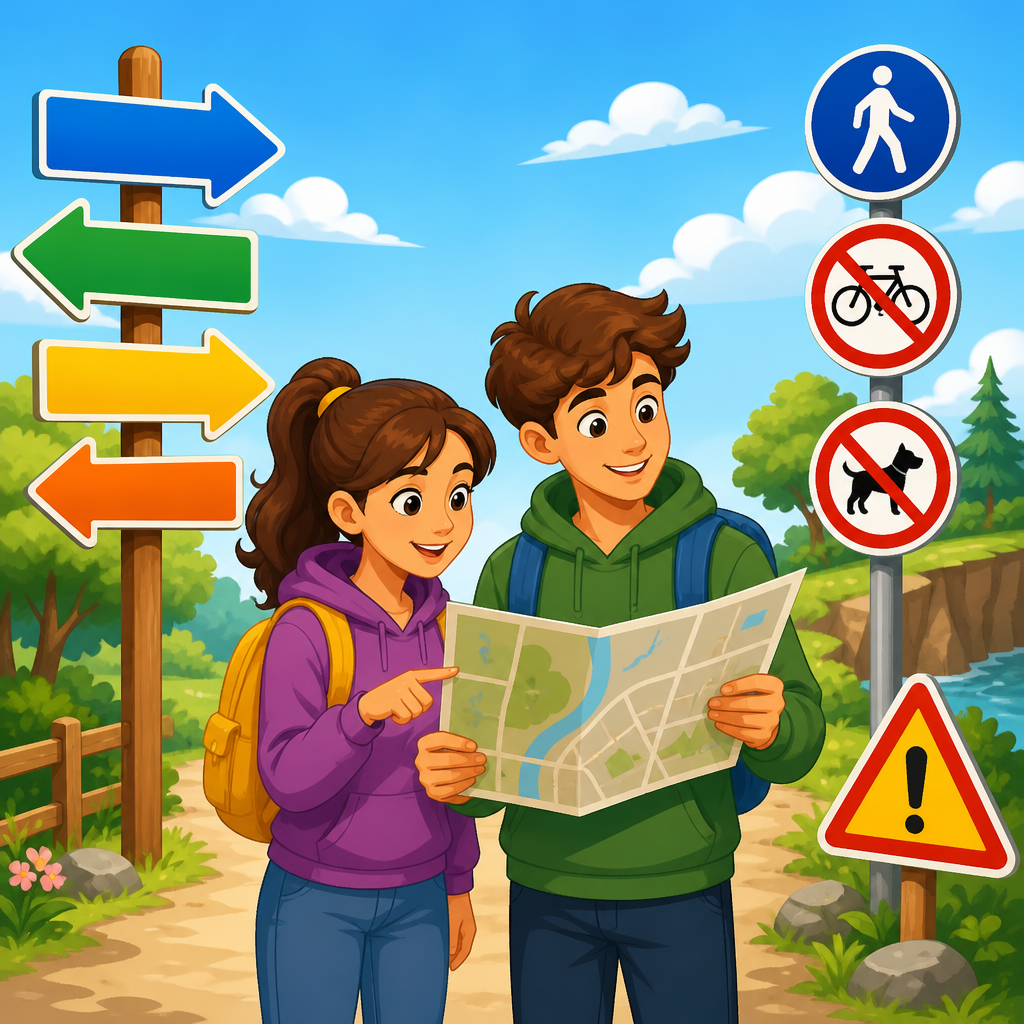
A2 reading practice with directions, rules, and warning signs helps learners move from decoding single words to understanding short, useful messages they meet every day. At A2 level, a reader should follow simple directions, recognize common rules, and understand warning signs in places such as stations, schools, parks, shops, offices, and apartment buildings. This matters because real-life reading rarely looks like a textbook paragraph. It appears on doors, tickets, maps, public notices, safety labels, and screens. In my classroom work, I have seen learners who can read a short story still miss “Mind the gap” on a train platform or misunderstand “No entry except staff.” That gap matters. Reading signs is a safety skill, a travel skill, and an independence skill.
Directions tell people where to go or what steps to follow. Rules state what is allowed, required, or forbidden. Warning signs alert people to danger or possible harm. A2 learners need more than vocabulary lists. They need pattern recognition: imperatives such as “Turn left,” modal meaning in “must” and “must not,” and reduced public language such as “Wet floor,” “Out of order,” or “Keep clear.” They also need to infer meaning from context, symbols, arrows, colors, and location. A yellow triangle suggests caution. A red circle often signals prohibition. An arrow plus a place name gives movement. When students learn these patterns directly, their reading becomes faster, more accurate, and more practical.
This article focuses only on A2 reading practice for directions, rules, and warning signs. The goal is not advanced grammar or long comprehension passages. The goal is confident understanding of short functional texts. You will see the key language patterns, the most useful sign types, common traps, and clear methods that help learners answer questions correctly and react appropriately in real situations.
What A2 learners must understand in everyday signs
At A2 level, learners should understand short texts that give immediate instructions. That includes basic movement language such as “Go straight ahead,” “Take the second turning on the right,” “Use the side entrance,” and “Platform 4 this way.” It also includes simple rule language: “Visitors must sign in,” “No food or drink,” “Dogs must be kept on a lead,” and “Please queue here.” Warning language is often shorter and less grammatical, so learners must get comfortable with compressed forms like “High voltage,” “Slippery surface,” “Deep water,” and “Caution: hot.”
The reading challenge is not usually one difficult word. It is the combination of short wording, unfamiliar layout, and zero extra explanation. For example, “Authorised personnel only” is harder than “Only workers can enter” even though the meaning is simple. “Give way” confuses many learners because the words are easy individually, but together they have a specific road meaning. “Keep off the grass” may be understood literally word by word, yet the learner must infer the rule: do not walk on the grass. Good A2 reading practice teaches these chunks as complete messages, not isolated vocabulary items.
In practical terms, learners should scan for four things: action, place, restriction, and danger. Ask: What must I do? Where does this apply? What is not allowed? Is there a risk? If a sign says “Emergency exit only,” the action is exit, the place is that door, the restriction is only in emergencies, and the hidden warning is that normal use is not allowed. This structured reading habit improves accuracy quickly.
Language patterns in directions, rules, and warnings
Most directions use the imperative because they tell the reader what to do. Common verbs include go, turn, cross, follow, take, enter, exit, keep, wait, and press. Typical examples are “Turn right at the bank,” “Cross at the lights,” and “Press button for assistance.” A2 learners should notice sequence markers too: first, then, next, after that, and finally. On signs and notices, sequence is often shown visually with numbers or arrows rather than full sentences.
Rules often depend on modal meaning, especially must, must not, can, cannot, and may. “You must wear eye protection” is stronger than “Please wear eye protection.” “You may use this entrance after 6 pm” shows permission linked to time. Public English also uses noun phrases instead of full sentences. “Staff only” means only staff may enter. “No smoking” means smoking is prohibited. “Seat belts must be worn” uses the passive, which appears frequently in transport and workplace signs.
Warnings usually remove unnecessary grammar. Designers want speed, not elegance. That is why people see “Beware of dog,” “Falling rocks,” “Road works ahead,” or “Contents under pressure.” In lessons, I train learners to identify the hazard first and the response second. If the sign says “Fragile,” the object can break, so handle it carefully. If it says “Do not lean out of the window,” the danger is falling. If it says “Keep away from children,” the risk concerns child safety, not general use.
| Sign text | Main function | What the reader should understand |
|---|---|---|
| No entry | Rule | Do not go in through this point |
| Turn left after the bridge | Direction | Follow the route and change direction at a specific place |
| Wet floor | Warning | The surface may be slippery; walk carefully |
| Keep gate closed | Rule/Instruction | Shut the gate after using it |
| Mind the step | Warning | There is a level change; do not trip |
How to practice reading signs effectively at A2
The best A2 reading practice uses authentic materials, not only workbook sentences. Collect photos of signs from supermarkets, buses, libraries, elevators, car parks, hospitals, and mobile apps. Ask learners to answer direct questions: Where are you? What should you do? What is forbidden? Why? This mirrors common exam tasks and real-world reading. A station sign saying “Delay expected due to signaling problem” can generate three A2-friendly questions without needing a long passage.
Another effective method is contrast practice. Put similar signs together and ask learners to explain the difference. Compare “No parking” with “No stopping.” Compare “Exit” with “Emergency exit.” Compare “Be careful” with “Do not touch.” These pairs teach nuance. In transport English, that nuance matters. A learner who understands “No unattended baggage” knows not to leave a suitcase alone, even if they return in one minute.
Cloze tasks also work well when they use realistic chunks. Example: “Please ___ in at reception,” “Keep ___ of reach of children,” or “Turn ___ at the roundabout.” Matching symbols to text is useful too, especially for learners who rely too heavily on single words. For extra support, connect this practice to the earlier foundation work in the main guide on signs and simple instructions: https://5minuteenglish.com/a1-reading-practice-signs-labels-and-simple-instructions/. That sequence works because learners first master short labels, then move into A2 interpretation and inference.
Timed scanning is important. In everyday life, nobody studies a warning sign for a minute. Give learners ten to fifteen seconds per item and train them to locate the key signal word. Over time, they stop translating every word and start reading for purpose. That is the shift from beginner decoding to functional comprehension.
Common problem areas and how to fix them
The most common problem is reading words literally but missing intended meaning. “Out of order” does not mean outside a sequence in most public places; it means a machine is not working. “Stand clear” does not ask whether the person is visible; it tells them to move away. “Give way” is not about generosity. These fixed expressions should be taught as units with context and pictures.
Negatives also cause mistakes. Learners may miss “not” in “Do not feed the animals” or interpret “unless” incorrectly in “No entry unless authorised.” I recommend highlighting the restricting word first, then paraphrasing the rule in simple English. “Unless authorised” becomes “Only people with permission can enter.” This method is especially helpful for workplace safety notices and apartment building rules.
A third issue is inference from layout and symbol systems. On roads, a red circular sign usually prohibits, while a triangular sign warns. In buildings, arrows indicate movement, and icons often replace nouns. A learner may know the word “stairs” but miss a staircase icon beside “Fire exit.” Teach text and visual signal together. International standards such as ISO safety symbols exist precisely because quick recognition saves time and reduces accidents.
Finally, some signs are polite but still strict. “Please keep this door locked” sounds soft, yet it is a real requirement. “We kindly ask customers not to open products before purchase” is still a prohibition. A2 learners benefit from practice that separates tone from force: polite wording does not always mean optional.
Using these skills in exams, travel, and daily life
In exams, questions on signs usually test gist, detail, and practical response. A notice reading “Library computers are for study purposes only. Maximum use: 30 minutes when others are waiting” may lead to questions about purpose, time, and conditions. Learners who identify the core rule first usually answer correctly. They do not get distracted by every small phrase.
In travel, sign reading prevents expensive or dangerous mistakes. “Validate ticket before boarding” matters on city transport systems in parts of Europe. “Passengers for domestic departures only” matters at airports. “Last entrance 5:30 pm” can determine whether you see a museum at all. In daily life, apartment notices, medicine labels, school rules, and delivery instructions all depend on the same A2 reading skills.
The main benefit of focused A2 reading practice is independence. When learners can understand directions, rules, and warning signs quickly, they move through public spaces with more confidence and fewer errors. Build practice around authentic signs, teach fixed expressions, and train scanning for action, restriction, place, and risk. Start small, review often, and use real examples from your environment. That is how short texts become reliable understanding.
Frequently Asked Questions
What does “A2 reading practice” mean for directions, rules, and warning signs?
A2 reading practice means learning to understand short, clear texts that appear in everyday life, especially in public places and shared spaces. For directions, this includes simple messages such as “Turn left,” “Go upstairs,” “Platform 3,” or “Take the second street on the right.” For rules, it includes notices like “No food in class,” “Visitors must sign in,” or “Keep the door closed.” For warning signs, it covers common alerts such as “Wet floor,” “Danger: High voltage,” or “Mind the gap.” At this level, learners are not expected to read long, complex explanations. Instead, they should be able to recognize familiar vocabulary, understand short sentences, and connect the message to the situation around them. This kind of reading is important because it reflects real communication outside the classroom. In daily life, people often need to read quick messages correctly and immediately, whether they are in a station, a school, a shop, an office, or an apartment building.
Why is reading directions, rules, and warning signs so important at A2 level?
It is important because these are some of the most practical reading tasks an A2 learner will face every day. Many real-life texts are not long articles or stories. They are short notices that give information, control behavior, or protect safety. A learner may need to understand where to go, what is allowed, and what is dangerous in a very short time. For example, reading “Emergency exit,” “Staff only,” “Please queue here,” or “No parking” correctly can help someone move through a place confidently and avoid mistakes. This type of reading also builds independence. When learners can understand signs and notices on their own, they do not need to ask for help as often. In addition, it improves overall reading ability by training students to notice keywords, symbols, and context. Even when the language is simple, the meaning can be very important. A missed warning or misunderstood rule can create confusion, inconvenience, or even a safety problem, so this skill has clear value in everyday life.
What kinds of texts and signs should A2 learners practice reading?
A2 learners should practice with a wide range of short, useful texts from common public and private places. Good examples include station signs such as “Tickets only,” “Way out,” and “Delayed train”; school notices such as “Library closes at 5,” “No running,” and “Exam room”; park signs such as “Keep off the grass,” “Dogs must be on a leash,” and “Do not feed the birds”; shop messages such as “Closed for lunch,” “Buy one get one free,” and “Please pay at the counter”; office notices such as “Meeting in progress,” “Reception this way,” and “Please switch off mobile phones”; and apartment building signs such as “Quiet after 10 p.m.,” “Lift out of order,” or “Fire door: keep shut.” Learners should also read simple maps, labels, door signs, schedules, public notices, and safety instructions. The goal is to become familiar with repeated patterns in everyday English. Many of these texts use short commands, common verbs, location words, and standard warning language. The more learners see these forms in context, the faster and more accurately they can understand them.
How can learners improve their understanding of rules and warning signs more effectively?
The most effective approach is to combine vocabulary study with context-based practice. Learners should begin by building a strong base of common words and phrases found in signs and notices, such as “entrance,” “exit,” “closed,” “allowed,” “forbidden,” “careful,” “danger,” “floor,” “stairs,” “queue,” and “emergency.” After that, they should practice reading complete signs in realistic situations instead of only memorizing single words. For example, it helps to ask simple questions while reading: Where is this sign? Who is it for? What action should a person take? Is it giving information, making a rule, or warning about danger? Learners can also improve by comparing similar signs, such as “Do not enter” and “No entry,” or “Be careful” and “Danger.” Visual clues are also useful, because many signs include symbols, colors, or placement that support meaning. Regular short practice works better than occasional long study. Reading signs in photos, worksheets, public transport apps, school buildings, or local streets can make learning more natural and memorable. Repetition in real contexts helps students move from slow word-by-word reading to quicker understanding.
What are the most common challenges A2 learners face with directions, rules, and warning signs?
One common challenge is that these messages are short, but they still require exact understanding. A learner may know most of the words but still misunderstand the full meaning. For example, “Staff only” is easy to read word by word, but the learner must understand that it means other people cannot enter. Another difficulty is that signs often use brief or formal language, commands, or fixed expressions instead of full conversational sentences. Phrases like “Keep clear,” “Out of service,” or “No unauthorized access” may be unfamiliar even if the grammar is simple. Learners can also struggle when there is little context or when similar signs have different meanings. “Watch your step” and “Mind the gap” are both warnings, but they appear in different situations. Direction signs can be confusing if learners do not know location vocabulary such as “opposite,” “next to,” “behind,” “downstairs,” or “at the corner.” In addition, some signs depend on quick recognition because people often read them while walking or traveling. The best way to overcome these challenges is through repeated exposure, focused vocabulary practice, and exercises that ask learners to explain the purpose of each message in simple words. With regular practice, these short texts become much easier to understand accurately and quickly.





