
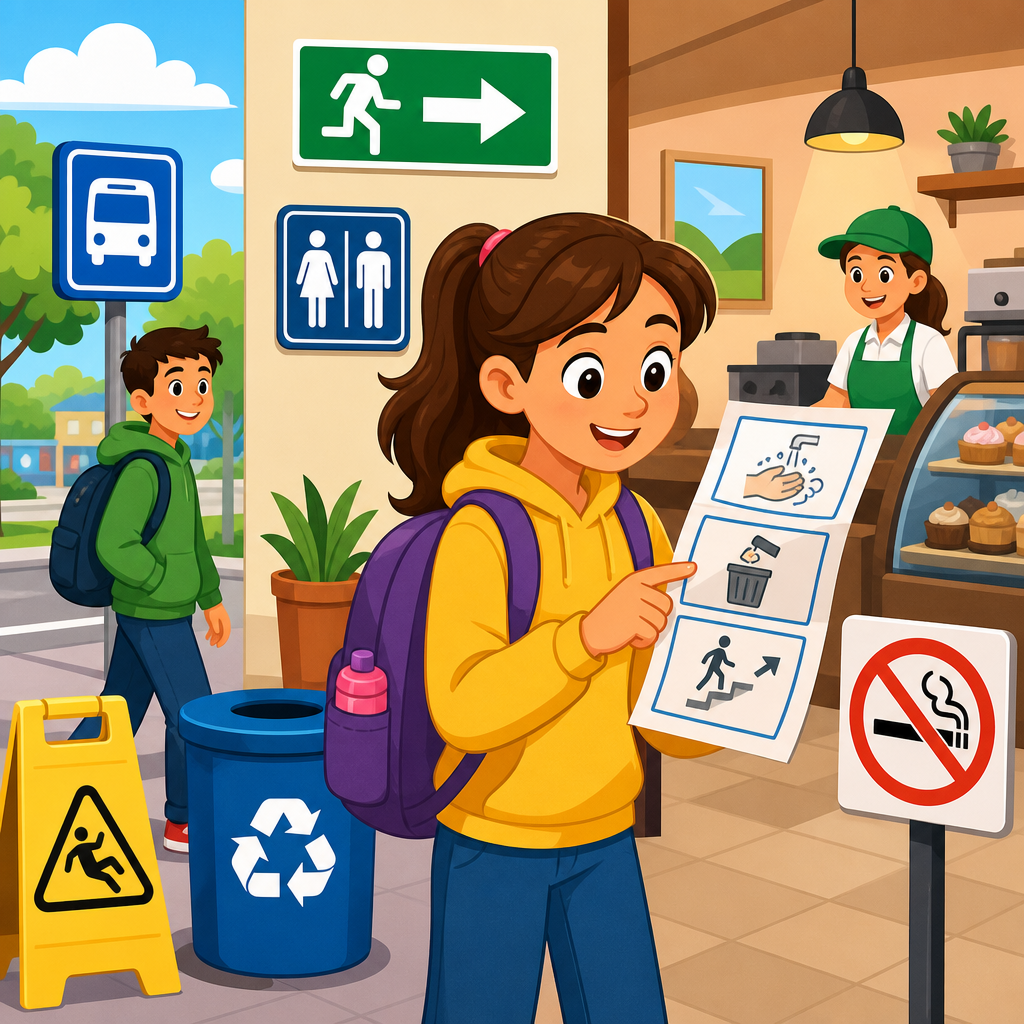
A1 reading practice starts with the shortest texts people meet every day: signs, labels, notices, menus, tickets, timetables, and simple instructions. At A1 level, reading means understanding basic written English that supports immediate needs, such as finding the exit, choosing the right bus, checking a price, or following a classroom task. Learners are not expected to interpret abstract arguments or long articles. They need to recognize common words, fixed phrases, numbers, dates, times, and familiar verbs in context. This practical focus matters because early reading success builds confidence fast. When students can understand “Push,” “Open,” “No parking,” “Use by 12 June,” or “Write your name here,” they see English as useful rather than distant.
In my own classes, the biggest improvement in beginner reading has rarely come from long passages. It comes from repeated work with real-world print. A pharmacy label, a supermarket sign, a hotel notice, or a school worksheet gives learners a clear purpose. They scan for one answer, confirm it, and move on. That is exactly how most daily reading works. Strong A1 reading practice also supports vocabulary growth, spelling recognition, and basic grammar awareness. Students begin to notice how imperatives give instructions, how prepositions show place, and how nouns appear in standard combinations such as “bus stop,” “staff room,” or “credit card.”
This guide explains how to practice A1 reading through signs, labels, and simple instructions in a broad, structured way. It defines the main text types, shows what learners should be able to understand, and gives concrete examples of how to teach and study them. It also addresses common problems, including confusing similar words, reading too slowly, depending too much on translation, and missing key details such as numbers or negatives. If you are building a foundation in reading, this is the right place to start because these short texts train the core skill behind all later progress: finding meaning quickly and accurately from clear written cues.
Table of contents
1. What A1 reading includes
2. Why signs, labels, and instructions matter
3. Reading signs in public places
4. Understanding labels and packaged information
5. Following simple instructions step by step
6. Core vocabulary and grammar patterns
7. Useful practice methods for learners and teachers
8. Common mistakes and how to fix them
9. Building toward stronger reading fluency
What A1 Reading Includes
A1 reading is the ability to understand very short, very clear texts about familiar topics. In the Common European Framework of Reference, A1 learners can recognize known names, words, and basic sentences in notices, posters, and catalogs. In practical terms, this includes classroom instructions, store signs, transport information, simple forms, calendars, messages, and product labels. The language is concrete, not figurative. The task is usually to identify one fact, one action, or one warning.
At this level, text difficulty depends less on length than on density and familiarity. A ten-word sign can be hard if it contains an unknown phrase like “Mind the gap,” while a twenty-word classroom notice can be easy if it uses familiar vocabulary. Effective A1 reading practice therefore teaches chunks, not isolated words alone. Learners should know that “Keep left,” “Wet floor,” “Out of order,” and “For sale” work as complete messages. They also need repeated exposure to visual context, because real reading often combines words with location, symbols, color, and layout.
Good beginner materials cover both recognition and action. Recognition means understanding what a text says. Action means knowing what to do next. If a learner reads “Do not enter,” the successful outcome is not only translation but correct behavior. That is why signs, labels, and simple instructions are ideal for a pillar page on reading: they connect language directly to use.
Why Signs, Labels, and Simple Instructions Matter
These text types matter because they are the first gatekeepers of independence in English. A learner who can read signs can move through stations, schools, offices, and shops with less help. A learner who can read labels can buy food, compare products, check size, see ingredients, and notice safety information. A learner who can read simple instructions can complete a task in class, use a machine, submit a form, or take medicine more safely. This is not small progress. It is functional literacy in action.
They also matter pedagogically because they train high-value reading behaviors. Students learn to scan for keywords, match text to purpose, notice negatives such as “don’t” and “no,” and use numbers accurately. They build orthographic familiarity with common words that later appear in longer texts. For example, repeated exposure to “closed,” “discount,” “entrance,” “available,” and “return” improves recognition speed across many contexts. Research on beginner literacy consistently supports frequency and meaningful repetition; common words learned in context are retained better than word lists studied without use.
From a teaching perspective, these texts are efficient. One short notice can generate vocabulary, grammar, pronunciation, speaking, and writing practice. “Please leave bags here” teaches politeness, plural nouns, place language, and classroom interaction. Because the input is short, students can succeed quickly, and success increases motivation.
Reading Signs in Public Places
Public signs are one of the best entry points for A1 reading because they are brief, frequent, and purpose-driven. Most signs fall into a few categories: direction, warning, prohibition, information, and service. Direction signs include “Exit,” “Way out,” “Platform 2,” and “Reception this way.” Warning signs include “Hot surface,” “Slippery floor,” and “Watch your step.” Prohibition signs include “No smoking,” “No photos,” and “Do not touch.” Information signs include “Tickets online only,” “Museum open daily,” and “Lift out of order.” Service signs include “Customer service,” “Self-checkout,” and “Cash only.”
For learners, the first goal is accurate identification of function. Ask not only “What does it say?” but “What kind of message is this?” That distinction improves comprehension. “No entry” and “Danger” are both negative, but one is a rule and the other is a warning. The response is different. In lessons, I have seen students read individual words correctly yet miss the practical meaning because they do not classify the sign type.
Context helps. “Please queue here” in a bank is easier to understand when students see floor markers or a service desk. “Staff only” near a back door becomes memorable when learners imagine where customers may and may not go. Real photographs, transit maps, shopping screenshots, and school notices are better than invented examples because layout and visual cues are part of authentic reading.
Time, numbers, and symbols are especially important in public reading. “Last train 22:45” is a different skill from reading a sentence. Students must decode the format and understand relevance. The same is true for dates, prices, and quantity limits such as “Maximum 12 items.” These details often carry the main meaning.
Understanding Labels and Packaged Information
Labels bring together vocabulary, formatting, and decision-making. A1 learners meet labels on food, drinks, medicine, clothing, cleaning products, and personal care items. Typical information includes product name, flavor or type, weight, ingredients, price, size, color, directions, warnings, storage, and expiry dates. The reading task is usually selective: learners do not need every word. They need the exact detail that answers a practical question.
For example, on a food package, a learner may need to find whether the product contains milk, nuts, or sugar; how much it weighs; when to use it by; or how to store it after opening. On a clothing label, they may need the size, fabric, or washing symbol. On a medicine label, the stakes are higher: dosage, frequency, age restrictions, and warnings must be understood precisely. Here teachers should be careful. Authentic medicine labels can be useful, but examples should stay simple and should always include the point that medical instructions require extra checking in real life.
Labels are also ideal for teaching predictable language patterns. “Keep refrigerated,” “Store in a cool, dry place,” “Shake well before use,” and “Best before” are recurring phrases. Once learned as chunks, they transfer widely. Students also benefit from understanding the difference between “best before” and “use by.” The first relates mainly to quality; the second relates more directly to safety on perishable foods in many systems. That distinction is practical and memorable.
| Text type | Typical example | Main reading task | Key detail to find |
|---|---|---|---|
| Public sign | No parking | Understand a rule | What is not allowed |
| Food label | Use by 12 June | Check safety or freshness | Date |
| Clothing label | Size M, 100% cotton | Choose the right item | Size and material |
| Classroom instruction | Write your name at the top | Complete a task | Action and place |
| Transport notice | Bus 14 departs at 09:20 | Travel correctly | Number and time |
Following Simple Instructions Step by Step
Simple instructions are central to A1 reading because they appear everywhere: classrooms, workplaces, websites, packaging, appliances, and public services. These texts commonly use the imperative form, as in “Open the book,” “Turn left,” “Press start,” “Add water,” or “Tick one box.” The grammar is simple, but the challenge is careful sequencing. Learners must understand what to do first, next, and last.
In class, instructions should begin with familiar routines. “Listen and repeat,” “Match the words and pictures,” “Circle the correct answer,” and “Put the cards in order” are standard examples. Once students can process these quickly, move to everyday tasks outside the classroom: “Enter your email,” “Choose a password,” “Wash hands before use,” or “Take one tablet after meals.” The best practice includes both text and outcome. If students read “Fold the paper in half,” they should actually fold it. Physical response confirms comprehension immediately.
Sequence markers are worth explicit teaching even at beginner level. Words like “first,” “next,” “then,” and “finally” reduce confusion. So do connectors such as “before” and “after.” A short set of instructions can also train caution with negatives: “Do not wash in hot water” or “Don’t open the door while the machine is running.” Missing one negative word can completely reverse meaning.
Digital life has made instruction reading more important, not less. Beginners now read app prompts, payment screens, delivery updates, and account verification messages. These are often short but dense. A phrase like “Tap to continue” is easy once known, yet unfamiliar the first time. A1 practice should include such modern microtexts because they are part of daily reading.
Core Vocabulary and Grammar Patterns
Strong A1 reading depends on high-frequency vocabulary organized by use, not alphabetically. Learners should know place words such as entrance, exit, upstairs, downstairs, left, right, inside, outside, floor, room, and desk. They need action verbs such as open, close, push, pull, wait, stop, pay, write, choose, wash, turn, keep, and check. They also need quantity and time language: one, two, half, liter, kilo, today, tomorrow, daily, Monday, a.m., p.m., now, and later. Without these basics, even very short texts become slow.
Grammar at this level is functional. Imperatives are essential because instructions and signs depend on them. Negative forms with “no,” “not,” and “don’t” are equally important. Articles and plurals matter in labels and notices, while prepositions such as in, on, at, under, next to, and between help learners follow directions. Modality appears in basic safety and rules through words like “must” and “can,” though many signs prefer shorter forms. Noun phrases also deserve attention because signs often omit full sentence structure. “Emergency exit” is not a sentence, but it communicates complete meaning.
One common teaching error is giving beginners too many single-word translations without collocations. In real reading, words travel together. Students should learn “cash only,” “out of order,” “keep clear,” “one way,” “seat belt,” and “queue here” as units. Recognition becomes faster, and misunderstanding drops sharply.
Useful Practice Methods for Learners and Teachers
The most effective A1 reading practice uses short cycles, high repetition, and authentic material. Start with noticing. Show a sign or label for five to ten seconds and ask one question: “Where is this?” “What can you do?” or “What time is it?” Then repeat with variation. This trains scanning instead of word-by-word decoding. In my experience, speed improves when tasks are narrow and success is immediate.
Matching is another strong method. Learners match signs to places, labels to products, or instructions to pictures. Information-gap tasks work well too. One student has a bus timetable; another has the questions. To answer, they must locate route numbers, destinations, and departure times accurately. For labels, a shopping task is useful: find a 500-gram product under a certain price, choose a shirt made of cotton, or identify which juice contains orange.
Teachers should also use local materials. Photos from nearby stations, cafés, schools, clinics, and supermarkets are memorable because learners may meet them again outside class. If privacy rules permit, classroom walls can display rotating collections of mini-texts. Spaced repetition helps: revisit common signs across several weeks until recognition is automatic.
For self-study, learners can build a simple reading notebook with four columns: text, place, meaning, and action. A phone camera makes this easy. Take a picture of a sign, write what it means, and note what a person should do. This method turns daily life into reading practice and creates personal relevance, which improves retention.
Common Mistakes and How to Fix Them
The first common mistake is reading every word slowly instead of searching for the key detail. Beginners often think good reading means full translation. At A1 level, it usually means targeted understanding. Fix this with purpose-based questions: “What time?” “Which door?” “How much?” “Can you enter?” This changes reading behavior.
The second mistake is ignoring small but critical words, especially negatives and prepositions. Students may read “No food or drink” as “food and drink,” or confuse “on the left” with “to the left of.” The fix is contrast practice with minimal pairs in meaning, not pronunciation only. Put “push/pull,” “open/closed,” “in/out,” and “before/after” side by side and ask students to act on them.
The third mistake is overreliance on translation apps. These tools can help, but they can also prevent visual memory and chunk recognition. Encourage learners to predict from context first. If they see a red sign on a door, they should ask whether it is likely a warning, a rule, or an instruction before checking a dictionary. That habit mirrors real reading.
Another problem is limited familiarity with standard formats. A learner may know the words but not the convention. For instance, 22:45, £3.99, 500 g, and “B1” on a building directory all require format knowledge. Practice should therefore include symbols, abbreviations, and layout patterns, not vocabulary alone.
Building Toward Stronger Reading Fluency
A1 reading practice with signs, labels, and simple instructions is the foundation of broader reading skill. It teaches learners to connect words with action, to scan for essential details, and to use context efficiently. Those are not small beginner habits. They are the same habits strong readers use later with emails, articles, forms, manuals, and websites. The difference is complexity, not the core process.
The clearest path forward is consistent contact with real, short texts. Read the sign on the bus, the label in the kitchen, the notice in the building, the prompt on the phone, and the instruction on the worksheet. Learn common chunks, notice numbers and negatives, and ask practical questions about every text. If you teach, prioritize authenticity, repetition, and task-based checking. If you study alone, collect examples from daily life and review them until recognition is quick and confident.
When learners master this level of reading, English becomes usable immediately. They can move more easily, choose more safely, and complete simple tasks with less hesitation. That visible progress builds motivation for longer texts later. Start with the words the world already puts in front of you, practice them carefully, and make everyday reading your first steady step toward fluency.
Frequently Asked Questions
What does A1 reading practice usually include?
A1 reading practice usually includes very short, practical texts that people see in everyday life. These often include signs, labels, notices, menus, tickets, timetables, maps, classroom instructions, and simple messages. At this level, the goal is not to understand long opinions, stories, or complicated articles. Instead, learners focus on reading English that helps with immediate, real-life needs. For example, they may read a sign that says “Exit,” a label with a price, a timetable with bus times, or a classroom notice that says “Open your book on page 10.”
These texts are useful because they contain common words and fixed phrases that appear again and again. Learners begin to recognize everyday vocabulary such as days of the week, months, times, numbers, food items, places, and basic verbs like “open,” “close,” “stop,” or “pay.” They also learn how English presents information in short formats, such as headings, symbols, and simple directions. This kind of reading builds confidence because students can quickly see a clear purpose for what they are reading and understand how written English works in common situations.
Why are signs, labels, and simple instructions important for A1 learners?
Signs, labels, and simple instructions are important because they are often the first written English that beginners need to understand in daily life. A learner may need to find the right room, read a store opening time, choose the correct bus, check the price of a product, or follow a short instruction in class. These tasks do not require advanced grammar, but they do require quick understanding of familiar words, numbers, and short phrases. That is exactly what A1 reading practice is designed to develop.
Another reason they matter is that they teach reading for a clear purpose. Instead of trying to understand every single word, learners practice finding the key information they need. For example, on a ticket they may look for the date, time, platform, or seat number. On a food label, they may look for the product name, quantity, or price. On a simple notice, they may need to identify whether something is allowed, forbidden, open, closed, free, or reserved. This practical approach helps learners become more independent and prepares them for real-world communication in English.
What reading skills should students develop at A1 level?
At A1 level, students should develop core reading skills that support basic understanding of short texts. One of the most important skills is recognizing high-frequency vocabulary, especially words connected to places, transport, food, shopping, time, dates, and daily routines. Students should also learn to identify fixed expressions such as “No entry,” “For sale,” “Turn left,” “Please wait,” or “Pay here.” These phrases appear often in real life, so learning them as complete chunks is very helpful.
Students should also practice reading numbers, prices, times, dates, and simple schedules accurately. For many A1 texts, this information is more important than full sentence meaning. A learner who can find “8:30,” “Monday,” “£5,” or “Platform 2” is already using an essential reading skill. In addition, students should develop the ability to scan for specific information, match words with symbols or pictures, and follow short instructions in the correct order. For example, they may read “Write your name,” “Tick one box,” or “Stand in line.” These skills create a strong foundation for later reading development because they train learners to understand meaning quickly and practically.
How can learners improve their A1 reading of short everyday texts?
Learners can improve by practicing with real or realistic materials that match their level. This means using short texts such as shop signs, bus timetables, restaurant menus, tickets, classroom notices, safety labels, and simple written instructions. Regular practice with these materials helps learners become familiar with common text formats and repeated vocabulary. It is especially useful to work with texts that have a clear goal, such as finding a departure time, choosing a meal, or understanding what to do next.
It also helps to focus on patterns instead of trying to translate everything. Learners should pay attention to repeated words, common commands, numbers, and visual clues like icons, bold text, headings, and layout. Reading aloud can support word recognition, and matching activities can help learners connect words with meanings. For example, students can match “Entrance” and “Exit” with pictures, or match a timetable to the correct departure time. Short, frequent practice is usually more effective than long, difficult reading tasks. When learners work with manageable texts and clear objectives, they build speed, confidence, and practical understanding step by step.
What kinds of questions are useful when practicing A1 reading?
The best questions for A1 reading are simple, direct, and based on clear information in the text. They should guide learners to find specific details rather than guess abstract meaning. Good examples include: “What time does the bus leave?”, “How much is the sandwich?”, “Is the museum open on Sunday?”, “Which platform is correct?”, or “What should you do first?” These questions help students practice reading for key facts and train them to notice the most important information in everyday texts.
It is also useful to include yes-or-no questions, multiple-choice tasks, matching exercises, and short answer questions. For signs and labels, learners can answer questions about meaning, such as whether something is allowed or not allowed. For instructions, they can put steps in the correct order. For menus or timetables, they can compare options and locate details. This kind of question design is effective because it reflects how people actually use reading in real life. At A1 level, success comes from understanding short, practical messages accurately, and well-chosen questions make that skill easier to practice and measure.





