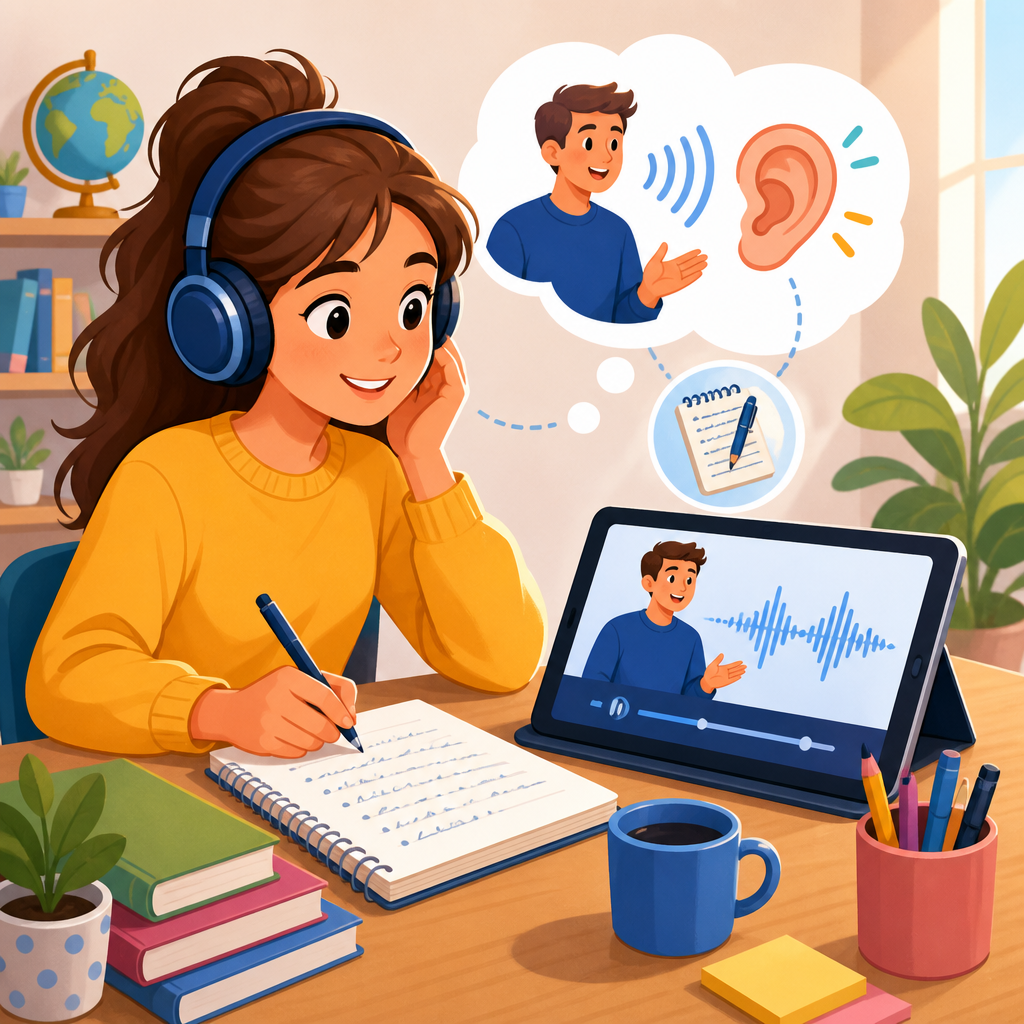
Dictation is one of the most efficient ways to improve English listening accuracy because it forces you to match real speech to exact words, sounds, and punctuation in real time. In language learning, dictation means listening to a recording or a live speaker and writing down precisely what you hear. Listening accuracy means more than understanding the general idea. It means correctly identifying individual words, weak forms, verb endings, function words, numbers, names, and boundaries between sounds. I have used dictation with beginner and intermediate learners for years, and it consistently exposes the gap between what students think they hear and what English actually sounds like at natural speed.
That gap matters. Many learners can follow a topic but still miss small details that change meaning: fifteen versus fifty, can versus can’t, or Tuesday versus Thursday. In practical situations such as phone calls, appointments, travel, and workplace instructions, those small misses create bigger problems than missing the main idea. Dictation trains bottom-up listening, the process of decoding sounds into words, while also strengthening spelling, grammar awareness, and short-term auditory memory. Research on second-language listening regularly shows that weaker listeners often struggle not because they lack vocabulary, but because they cannot recognize known words when connected speech reduces or blends them. Dictation addresses that exact weakness directly and measurably.
The method also works because it creates clear evidence. When you compare your transcript with the original, you can see exactly where your listening breaks down. Maybe you miss unstressed words like of, to, and have. Maybe you confuse linked sounds, or you stop listening after one unknown word. Instead of vague practice, you get a record of errors that can be corrected. Used properly, dictation is not a school punishment or a memory test. It is a diagnostic tool and a training method for hearing English more accurately.
Why dictation improves listening better than passive practice
Passive listening has value, but it often allows learners to guess meaning without truly hearing the language. Dictation removes that escape route. You cannot write “something about a meeting” if the line is “The meeting was moved to quarter past three on Thursday.” You must identify articles, tense markers, prepositions, time expressions, and consonant endings. That pressure makes you notice features of speech that casual listening misses.
In my experience, dictation improves accuracy for three main reasons. First, it slows your attention without necessarily slowing the audio. You listen with a concrete purpose: capture every word. Second, it reveals recurring error patterns. Third, it creates a feedback loop that is easy to repeat. If a learner misses final /s/ and /t/ sounds in every exercise, the problem becomes visible immediately. Then practice can target that feature instead of relying on more random exposure.
Dictation is especially useful for common listening trouble spots in English: reduced function words, contractions, linking, assimilation, and minimal pairs. A learner may know the words “going to” but hear “gonna” as a blur. They may know “next day” but not recognize how the /t/ can disappear in fast speech. Dictation forces these forms into conscious awareness. That is why teachers still use it in pronunciation-informed listening lessons, despite the growth of video-based practice and interactive apps.
How to do dictation correctly
The most effective dictation routine is short, structured, and repeatable. Choose audio between twenty and ninety seconds. Longer clips overwhelm attention and make correction messy. Start with material slightly below your reading level but close to your listening level. Clear conversational recordings, short news items, and graded listening texts work well. If you are a beginner, begin with names, numbers, dates, and short everyday sentences. A useful starting point is the main A1 listening practice guide for catching names, numbers, and dates, because those details are where accuracy often fails first.
Play the full audio once for gist. On the second listening, write what you hear. Pause if needed at first, but do not pause after every word; that turns listening into decoding isolated sounds rather than connected speech. On the third listening, fill gaps and check uncertain parts. Then compare your version with the transcript. Mark mistakes by category, not just by count. For example: missed article, wrong number, merged two words, missed negative form, spelling after correct hearing, or unknown vocabulary.
After correction, replay the sentence while reading the transcript aloud. This step matters. It links listening and pronunciation, which strengthens recognition the next time you hear similar sound patterns. If you only check answers and move on, improvement is slower. A complete cycle usually takes ten to fifteen minutes, which is enough for focused progress without fatigue.
What to listen for during dictation
Most learners think they are missing difficult vocabulary, but their biggest losses usually come from small high-frequency items. Focus first on function words: a, the, of, to, for, was, were, have, and had. These words are often reduced in natural speech, yet they carry grammar and relationships. Missing them leads to inaccurate transcripts and incomplete understanding.
Next, pay attention to sound boundaries. English speakers link words, so “pick it up” may sound like one unit, and “an apple” can seem to start with the /n/. Final consonants also disappear perceptually when the next word begins with a consonant. Learners often write “las year” for “last year” because the /t/ is not strongly released. Dictation trains you to expect these patterns rather than treating them as exceptions.
Negatives and numbers deserve special attention because they carry high communicative risk. Missing “not” reverses meaning. Confusing thirteen and thirty changes dates, prices, and addresses. I have seen learners understand an entire message and still fail the task because they wrote 16 instead of 60. Dictation is one of the fastest ways to reduce these errors because it isolates them in context and gives immediate correction.
| Problem area | Typical error in dictation | What to train |
|---|---|---|
| Reduced function words | Missing “to” in “want to go” | Listen for unstressed grammar words |
| Linking | Writing “turn itoff” as one unknown word | Mark word boundaries in connected speech |
| Final consonants | Hearing “old” as “ol” | Notice weakly released endings |
| Negatives | Missing “don’t” or “isn’t” | Check meaning-changing short words |
| Numbers | Confusing 14 and 40 | Compare stress and final sounds |
How to choose the best audio for accurate improvement
Not all dictation material is equally useful. The best audio is clear enough to be decoded but natural enough to reflect real speech. For beginners, scripted audio spoken at moderate speed is ideal. For lower intermediate learners, short unscripted clips with one or two speakers work well. Avoid long podcasts at first. They contain too much information, too many unfamiliar references, and too few clean stopping points for detailed correction.
Use recordings with transcripts whenever possible. Reliable sources include BBC Learning English, VOA Learning English, Elllo, TED-Ed transcripts for selected shorter segments, and coursebook audio from publishers such as Cambridge or Oxford. The transcript is not a crutch; it is the answer key that makes the exercise useful. Without it, you may reinforce wrong guesses.
Audio choice should also match the feature you want to train. If your main problem is catching dates and times, choose messages, announcements, and appointment dialogues. If you miss contractions and reduced speech, pick casual conversations. If you struggle with accent variation, start with one stable accent and then branch out. Accuracy grows fastest when practice is targeted rather than random.
How to measure progress and fix recurring mistakes
Improvement in dictation should be tracked with simple metrics. I recommend three: percentage of words correct, number of meaning-changing errors, and repeated error types. Percentage of words correct gives a broad view, but meaning-changing errors matter more. If you miss two articles and one negative, the negative is the priority because it changes the message.
Keep an error log after each session. Write the original phrase, your version, and the reason for the mistake. Over time, patterns become obvious. One learner I coached kept missing “he’s” and “his” because the final /z/ blended into the next word. Another consistently lost plural endings in fast speech. Once identified, those patterns can be drilled with short focused sets instead of more general listening.
Progress usually appears in stages. First, you notice more missing words. That feels worse but is actually improvement because awareness has increased. Second, your transcript becomes more complete, though still inaccurate in small forms. Third, you start correcting likely errors during the final replay because your expectations of English rhythm and grammar improve. That stage is where listening accuracy becomes portable to real conversations.
Common mistakes that make dictation less effective
The biggest mistake is choosing audio that is too difficult. If every line contains unknown vocabulary, dictation becomes a vocabulary test, not a listening exercise. Another common mistake is overusing the pause button. Pausing every second prevents you from learning how sounds flow across words. Use pauses strategically between chunks, then gradually reduce them.
Many learners also skip the correction stage or only look at the right answer briefly. That wastes most of the exercise. The learning happens when you compare, diagnose, and replay. A fourth mistake is focusing only on content words such as nouns and verbs. English listening accuracy often depends more on short grammar words, endings, and stress patterns than on big vocabulary items.
Finally, do not confuse dictation with transcription of everything you hear in a movie scene. For training accuracy, shorter is better. Precision beats volume. One carefully analyzed thirty-second clip will usually teach more than ten unchecked minutes of difficult audio.
Dictation improves English listening accuracy because it turns listening into observable, correctable practice. It teaches you to hear what is really there: weak forms, linked sounds, endings, negatives, and numbers that carry crucial meaning. Done well, it is brief, focused, and measurable. Choose short audio with a transcript, listen in cycles, categorize mistakes, and replay after correction. That process builds the decoding skills that many learners lack even when they know the vocabulary.
The main benefit is confidence based on evidence. Instead of hoping your listening is improving, you can see fewer errors, better word recognition, and stronger control over details. Start with three short dictation sessions a week, track your patterns, and target the errors that repeat. If you want sharper English listening, dictation is not old-fashioned; it is one of the most reliable methods available. Pick a short clip today and test what you actually hear.
Frequently Asked Questions
What is dictation in English learning, and why does it improve listening accuracy so effectively?
Dictation is the practice of listening to spoken English and writing down exactly what you hear, word for word. In language learning, that includes not only content words such as nouns and verbs, but also small grammatical words, contractions, verb endings, linking sounds, punctuation, and sentence boundaries. This matters because listening accuracy is not the same as understanding the general topic. A learner may understand the main idea of a sentence but still miss important details like is versus was, can versus can’t, singular versus plural endings, or a speaker’s use of articles, prepositions, and reduced forms.
Dictation improves listening accuracy so well because it forces active attention at the sound level. Instead of letting unclear parts pass by, you have to decide exactly what was said. That process trains your ear to notice word boundaries, stress patterns, weak forms, connected speech, and fast pronunciation that are easy to ignore in ordinary listening. Over time, learners begin to recognize common reductions such as gonna, wanna, or didja, as well as less obvious features like linking between words and disappearing sounds in rapid speech.
Another reason dictation works is that it gives immediate evidence of your listening gaps. When you compare your version with the transcript, you can see precisely where you misheard the audio. That feedback is much more useful than simply knowing you “didn’t understand.” It shows whether the problem came from vocabulary, pronunciation, grammar, speed, concentration, or unfamiliar accents. Because of that, dictation is one of the most efficient tools for turning vague listening practice into measurable improvement.
How do I do a dictation exercise correctly if I want to improve real English listening skills?
The best way to do dictation is to use short, manageable audio and follow a clear process. Start with a recording that is slightly challenging but not overwhelming, ideally 20 to 60 seconds long. Listen once all the way through for general meaning. Then listen again in short sections and write exactly what you hear. Pause as needed, but do not guess too quickly. If a word is unclear, mark the space, write your best attempt, and continue. After that, replay the same section several times to fill in missing details.
Once you have completed your first draft, compare it carefully with the correct transcript. This correction stage is where much of the learning happens. Do not just look at what was right or wrong. Analyze why you missed something. For example, maybe the speaker reduced to so much that you did not hear it, or maybe two words were linked together and sounded like one. Perhaps you knew the vocabulary in reading but did not recognize it in natural speech. That kind of analysis helps you improve faster than repeating the same activity mechanically.
After checking your errors, listen again while reading the transcript. Notice how the written sentence maps onto the actual sounds. Then try a final round of listening without looking, or read the text aloud to reinforce the connection between pronunciation and perception. This sequence—listen, transcribe, check, analyze, and repeat—builds real listening skill because it trains both recognition and self-correction. If you want even better results, keep a notebook of your repeated error patterns, such as missed endings, contractions, numbers, names, or function words. That turns each dictation exercise into targeted listening training rather than just a test.
What kinds of mistakes should I pay attention to during dictation practice?
Not all dictation mistakes are equally important, so it helps to categorize them. One major category is function words, including articles, prepositions, auxiliary verbs, pronouns, and conjunctions. These small words are often reduced in natural speech, which makes them easy to miss, yet they carry important grammatical meaning. Missing has, been, for, or the may seem minor, but repeated problems in this area usually indicate weak perception of connected speech and sentence structure.
Another key category is word endings and grammar markers. Many learners fail to hear final -s, -ed, or -ing, especially when speakers talk quickly or when final consonants blend into the next word. These small endings affect tense, number, and aspect, so hearing them accurately is essential. You should also watch for contraction errors such as confusing he’s with he was, or they’d with they had or they would. These are common listening problems because spoken English often compresses grammatical information.
A third category involves boundaries and sound recognition. This includes hearing where one word ends and the next begins, identifying linked or reduced sounds, and distinguishing similar words such as fifteen and fifty, ship and sheep, or can and can’t. Proper nouns, numbers, dates, and names are also worth special attention because they often carry crucial meaning in real-life listening. By tracking these types of errors, you can identify whether your main difficulty is grammar, pronunciation, vocabulary recognition, processing speed, or accent familiarity. That diagnosis makes your future practice much more effective.
How often should I practice dictation, and how long does it take to see results?
Consistency matters more than marathon sessions. For most learners, 10 to 20 minutes of focused dictation practice several times a week is far more effective than doing a long session once in a while. Because dictation requires intense concentration, shorter and more regular practice usually produces better results. A practical routine is three to five sessions per week using short audio clips, especially if you review your errors carefully instead of just writing what you hear and moving on.
Many learners begin to notice changes within a few weeks. Early improvements often include better attention to small words, increased awareness of reduced pronunciation, and less panic when speech feels fast. After a longer period of steady practice, learners typically report stronger recognition of common sentence patterns, improved decoding of connected speech, and greater confidence in understanding details such as times, verb forms, and speaker intent. The exact timeline depends on your level, the difficulty of the material, and how actively you analyze mistakes.
It is also important to understand that progress in dictation may appear before progress in general comprehension feels dramatic. That is normal. Dictation sharpens the fine-grained processing that supports accurate listening, so it often improves your ability to catch details first. Over time, that stronger sound-to-word recognition makes everyday listening easier and more automatic. If you want visible proof of progress, save your old dictations and compare them after a month. You will often find that you miss fewer function words, recognize more reduced forms, and need fewer replays to understand the same length of audio.
What are the best materials for dictation practice, and should beginners use transcripts?
The best materials are clear, level-appropriate recordings with accurate transcripts. Good choices include podcast excerpts, graded listening materials, news clips, interviews, short lectures, and dialogue-based lessons. Beginners usually benefit most from slower, clearly articulated audio, while intermediate and advanced learners should gradually add more natural and varied speech. It is especially useful to choose recordings that match your goals. If you need workplace listening, use professional conversations or presentations. If you want everyday listening improvement, use casual dialogues, interviews, or storytelling.
Yes, beginners should use transcripts—but at the right stage of the exercise. The transcript should not replace listening. Instead, it should be used after your independent attempt so you can check accuracy and study what you missed. For a beginner, transcripts are extremely valuable because they connect spoken forms to written language and reduce frustration. They also help build awareness of how English sounds differ from how it looks on the page. Many learners know a word in reading but fail to recognize it when spoken naturally; transcripts help close that gap.
As your skill grows, you can make the task more challenging by using faster speech, different accents, longer clips, or materials without immediate transcript support. However, even advanced learners benefit from transcript-based review when the goal is precise listening accuracy. The key is not to avoid support, but to use support strategically. A good dictation resource should let you listen multiple times, pause easily, and verify the exact wording afterward. When the material is well chosen and the review process is thorough, dictation becomes one of the most reliable ways to train accurate, detailed English listening.