
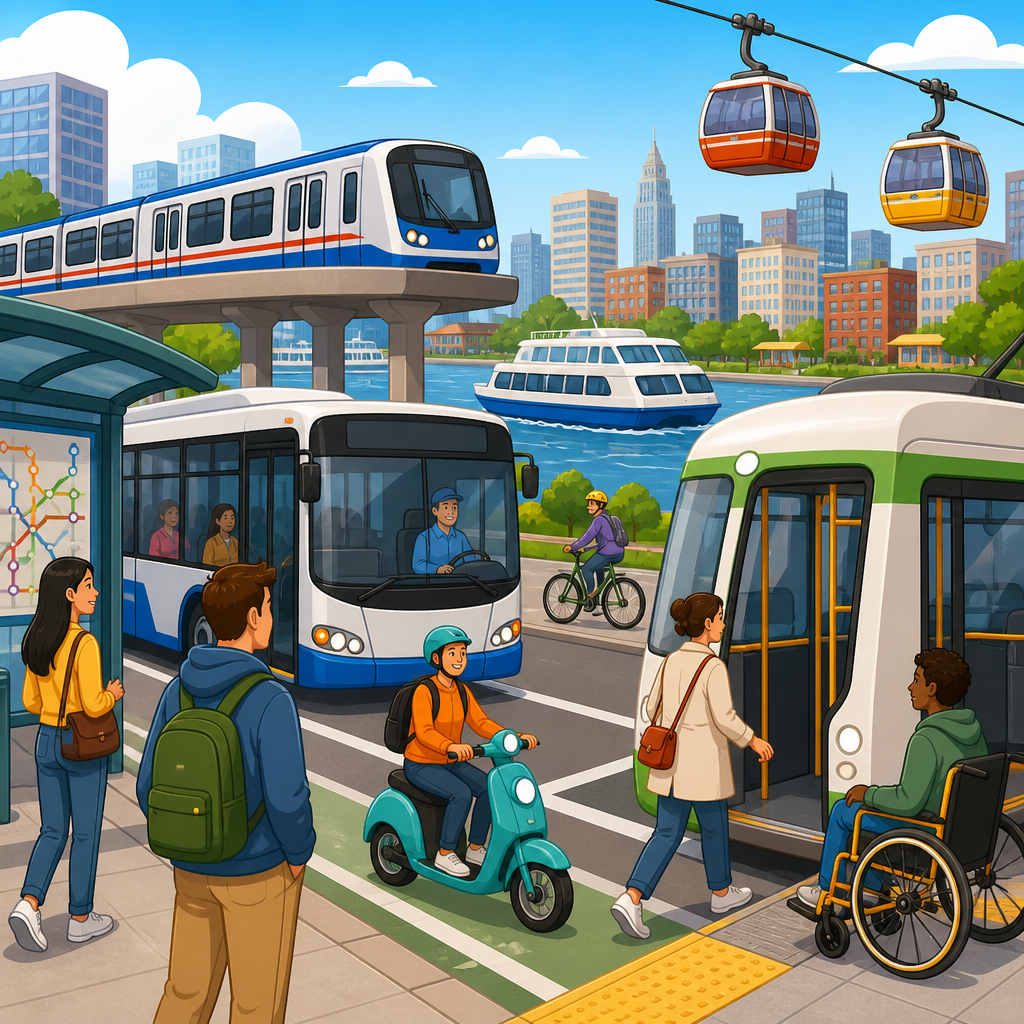
Public transportation vocabulary goes far beyond the basic words bus and train. If you want to ask for directions, read signs, buy tickets, or understand delays in English, you need the wider language system that transit agencies actually use every day. In practice, that means learning not only vehicle names, but also route terms, ticketing language, platform instructions, accessibility words, and the polite questions riders ask staff and other passengers. I have taught this vocabulary to adult learners preparing for travel, commuting, and relocation, and the biggest improvement usually comes when students stop memorizing isolated nouns and start noticing how transit words work together in real situations.
Public transportation refers to shared travel services available to the general public, usually operated by a city, regional authority, or licensed private company. Vocabulary is the set of words and phrases that helps you understand and participate in that system. A stop is where a bus picks up passengers. A station is a larger facility for rail, metro, or intercity services. A route is the path a vehicle follows, while a line is the named service, such as the Blue Line or Route 24. These distinctions matter because one wrong word can create confusion. Asking “Where is the train stop?” may be understood, but “Which platform does this line depart from?” is the language that signs and staff are more likely to use.
This topic matters because transportation language affects independence. If you misunderstand “outbound,” you may travel in the wrong direction. If you do not know the difference between “local” and “express,” you may miss your stop or pay a different fare. For new arrivals in an English-speaking city, transit vocabulary often becomes urgent before workplace vocabulary does. Even learners focused on housing benefit from it, because apartment searches depend on commute descriptions, neighborhood access, and station proximity. That is why understanding movement-related language pairs well with broader practical English resources, including the main guide at 5 Minute English.
Vehicle and service words you will actually hear
Beyond bus and train, common vehicle words include tram, streetcar, subway, metro, light rail, commuter rail, ferry, shuttle, coach, and paratransit. These are not perfect synonyms. In North America, subway usually means an underground urban rail system, while in many international contexts metro is more common. Light rail often runs on tracks like a train but behaves partly like a tram, with shorter vehicles and more frequent street-level stops. Commuter rail generally connects suburbs to a city center and runs less frequently than a metro. A shuttle is a short repeated service between key points such as an airport terminal and parking lot. Paratransit is a specialized shared transport service for eligible riders with disabilities who cannot use standard fixed-route transit.
Service patterns add another layer. A local service stops at every or most stations. An express service skips some stops to reduce travel time. Limited-stop means something similar, though agencies may define it differently. A direct service may have no transfers, but it does not always mean nonstop. Peak service refers to busy commuting periods, often morning and evening rush hour. Off-peak describes quieter times when frequency may drop. Headway is the scheduled time between vehicles, such as every 10 minutes. In my experience, students quickly understand schedules once they learn headway, inbound, outbound, terminus, and transfer, because these words explain the logic of the network rather than just naming objects.
Station, stop, and route vocabulary for reading signs
Transit systems communicate through signs, maps, and announcements, so location words are essential. On rail systems, platform is the area where passengers wait to board. Track refers to the rails themselves, though some stations label boarding areas by track number. Concourse is the central circulation area inside a station, often where ticket machines, gates, and shops are located. Exit, entrance, elevator, escalator, stairwell, and underpass appear constantly in stations. On buses, bay means a designated boarding area, especially at terminals. Stand is also used in some countries for an assigned coach or bus position.
Direction words cause many mistakes. Inbound usually means heading toward the city center or system hub. Outbound means moving away from it. Uptown and downtown are city-specific and should never be guessed without local context. Terminal or terminus means the end of the line. Last stop is the plain-English equivalent often heard in announcements. If a sign says “service terminates here,” everyone must leave the vehicle, even if the line continues later with another train. Route map, network map, and timetable are also worth separating. A route map shows one service in detail. A network map shows the wider system. A timetable lists planned departure and arrival times, while a live board shows real-time information that may differ from the printed schedule.
Fare, ticket, and payment language
Payment vocabulary often determines whether a journey goes smoothly. Fare is the price of travel. Ticket is the physical or digital proof you paid. Pass usually means unlimited travel for a period, such as a day pass, weekly pass, or monthly pass. Stored-value card refers to a reloadable transit card with money or balance on it. Tap in and tap out describe contactless validation at the start and end of a trip. Validation matters because some systems require you to activate a paper ticket in a machine before boarding. If you skip that step, you may still be fined even though you bought the ticket.
Zones, surcharges, concessions, and fare capping are especially useful terms. Zone-based fares depend on distance or boundaries crossed. A surcharge is an extra fee, common on airport services. Concession fares are discounted prices for children, students, seniors, or eligible riders. Fare capping means the system automatically stops charging once you reach the daily or weekly maximum, a model used by agencies such as Transport for London. The table below shows how these terms appear in real transit use.
| Term | Meaning | Example in context |
|---|---|---|
| Single fare | One trip | “A single fare covers one bus ride within 90 minutes.” |
| Transfer | Changing vehicles or lines | “You get one free transfer from the tram to the metro.” |
| Peak fare | Higher price at busy times | “Commuter rail charges a peak fare before 9 a.m.” |
| Contactless | Payment by bank card or device tap | “You can board faster by using contactless at the gate.” |
| Proof of payment | System checked by inspectors, not gates | “Keep your ticket ready on proof-of-payment services.” |
Delay, disruption, and announcement vocabulary
Real transit English becomes most important when something goes wrong. Delay means service is running later than scheduled. Disruption is a broader word covering delays, closures, diversions, and cancellations. Cancelled means a trip will not run at all. Suspended means a service has been temporarily stopped, often on part of a line. Diverted means a bus is using a different route because of roadworks, an accident, or an event. Replacement service usually means buses are operating instead of trains during maintenance. Signal failure, mechanical issue, staff shortage, and police activity are common reasons used in announcements.
Passengers also hear operational terms such as board, alight, stand clear, mind the gap, and priority seating. Board means get on; alight means get off, though it sounds formal and is more common in announcements than conversation. “Stand clear of the closing doors” is standard safety language on many rail systems. “Mind the gap” refers to the space between the train and platform edge. Priority seating means seats reserved for older adults, pregnant passengers, and riders with disabilities. If you understand these expressions instantly, you respond faster and travel more confidently.
Useful questions and natural rider phrases
Knowing the vocabulary is only half the task; you also need the phrases that make it usable. The most effective questions are specific. Instead of “Where bus?” ask “Does this bus go to Central Station?” Instead of “Ticket here?” ask “Where can I top up my card?” Strong transit English combines the key noun with the exact action: catch a bus, miss a stop, change lines, validate a ticket, request a stop, and report a lost item. These combinations sound natural because they reflect how agencies and riders actually speak.
Useful questions include: “Is this the right platform for the northbound train?” “Do I need to tap out at the end?” “Is there an accessible entrance?” “How often does the shuttle run?” and “Where do I transfer for the airport line?” When I coach learners, I also teach repair phrases for confusion: “Could you repeat that more slowly?” “Does express mean it skips Oak Street?” and “I need the local service because my stop is Elm Park.” Those sentences solve real problems quickly. Build your transit vocabulary by collecting language from maps, station posters, and official apps, then practice it on your next trip. The reward is simple: clearer travel, fewer mistakes, and more independence every time you ride.
Frequently Asked Questions
1. What public transportation words should I learn beyond “bus” and “train”?
To function confidently in English on public transportation, it helps to learn vocabulary in categories rather than memorizing only vehicle names. Start with transit types such as subway, metro, tram, streetcar, light rail, commuter rail, ferry, and shuttle. Then learn route and location terms such as line, route, station, stop, terminal, platform, track, bay, and transfer point. These are the words you will see on maps, signs, and announcements every day.
It is also essential to understand direction and schedule vocabulary. Common words include inbound, outbound, northbound, southbound, express, local, arrival, departure, delay, service change, and last train. For ticketing, learn terms such as fare, single ride, day pass, monthly pass, reload, tap in, tap out, and fare gate. Finally, practical rider language matters just as much as system vocabulary. Phrases like “Does this train stop at Central Station?” or “Where do I transfer for the airport?” are often more useful than isolated word lists because they reflect how people actually communicate while traveling.
2. What is the difference between common route and station terms like line, route, stop, station, platform, and terminal?
These words are related, but transit systems use them in specific ways. A line usually refers to a named or numbered rail service, such as the Red Line or Line 2. A route is often used more broadly and is especially common for buses, indicating the path a vehicle follows through the city. A stop is a place where a bus, tram, or sometimes train picks up and drops off passengers, while a station is typically a larger, more permanent facility, often with multiple platforms, entrances, signs, and ticket machines. If you mix up stop and station, people will usually still understand you, but knowing the distinction helps you read transit information more accurately.
A platform is the area where passengers wait to board a train or metro, and in some systems, certain bus terminals also use platform numbers or bay numbers. A terminal is usually the final stop or endpoint of a route, though the word can also refer to a large transit building where several services connect. Understanding these distinctions makes directions much easier to follow. For example, “Take the Green Line to Park Street, transfer at the station, and wait on Platform 3 for the outbound train” contains several different transit concepts in one sentence. When learners understand how these words fit together, maps, signs, and staff instructions become much less intimidating.
3. How can I understand ticketing and fare vocabulary when using public transportation in English?
Ticketing language can be confusing because different cities use different systems, but the core vocabulary is surprisingly consistent. The word fare means the price of your trip. You may buy a single ticket, one-way ticket, round-trip ticket, day pass, weekly pass, or monthly pass. Some systems use a paper ticket, while others use a rechargeable transit card, smart card, or mobile app. Important action words include buy, reload, validate, scan, tap, and activate. If you hear “tap in” and “tap out,” that means you must touch your card or phone to the reader when entering and leaving the system.
It is also helpful to understand how fare rules are explained. Terms like zone, peak hours, off-peak, reduced fare, transfer included, and proof of payment often appear on signs and websites. Reduced fare may apply to seniors, students, or riders with disabilities. Proof of payment means you may not pass through gates, but you still need a valid ticket in case an inspector asks to see it. If you need help, practical questions include “How much is the fare to downtown?” “Can I use this card on the bus and subway?” and “Do I need to tap out at the end?” Learning this vocabulary saves time, prevents mistakes, and makes you more independent when traveling in English-speaking environments.
4. What words and phrases are useful for asking for directions, understanding announcements, and dealing with delays?
When asking for directions, the most useful language is clear, direct, and polite. Strong everyday questions include “How do I get to City Hall by public transportation?” “Which line goes to the airport?” “Do I need to transfer?” “Is this the right platform for the downtown train?” and “Where is the next stop after this one?” These questions combine key transit vocabulary with natural spoken English. You should also know directional words such as uptown, downtown, inbound, outbound, eastbound, and westbound, because staff and signage often use them instead of neighborhood names.
For announcements and delays, listen for words such as service disruption, delay, track maintenance, signal problem, shuttle bus, detour, expected arrival, and final destination. An announcement like “Due to a signal problem, inbound service is delayed by 15 minutes” contains exactly the type of language riders need to recognize quickly. If there is a problem, useful follow-up questions include “Is there an alternate route?” “Will this affect transfers?” and “Where do I catch the replacement bus?” The goal is not only to know the dictionary meaning of these words, but also to understand them in real transit situations, where speed, noise, and stress can make communication harder. That is why learning whole phrases is often more effective than studying isolated vocabulary.
5. What accessibility and courtesy vocabulary should riders know on public transportation?
Accessibility vocabulary is an important part of real-world transit English because it appears on signs, maps, announcements, and official websites. Common words include elevator, escalator, ramp, step-free access, accessible entrance, priority seating, wheelchair space, audio announcement, and service animal. You may also see notices such as “elevator out of service” or “this station is not fully accessible.” Understanding these terms helps riders plan routes more effectively and avoid unnecessary difficulty, especially in large or older transit systems where not every station has the same facilities.
Courtesy language matters just as much. Riders often need polite expressions such as “Excuse me, is this seat taken?” “Could you tell me when we reach Main Street?” “May I get past, please?” and “Is this area reserved for priority seating?” Transit systems also use behavior-related signs with words like yield your seat, stand clear of the doors, queue here, and mind the gap. These phrases are part of the social language of transportation, not just the technical language. For learners, mastering both accessibility and courtesy vocabulary builds confidence, improves safety, and makes interactions with staff and fellow passengers smoother and more respectful. In everyday travel, that wider vocabulary is what turns basic English knowledge into practical communication.





