
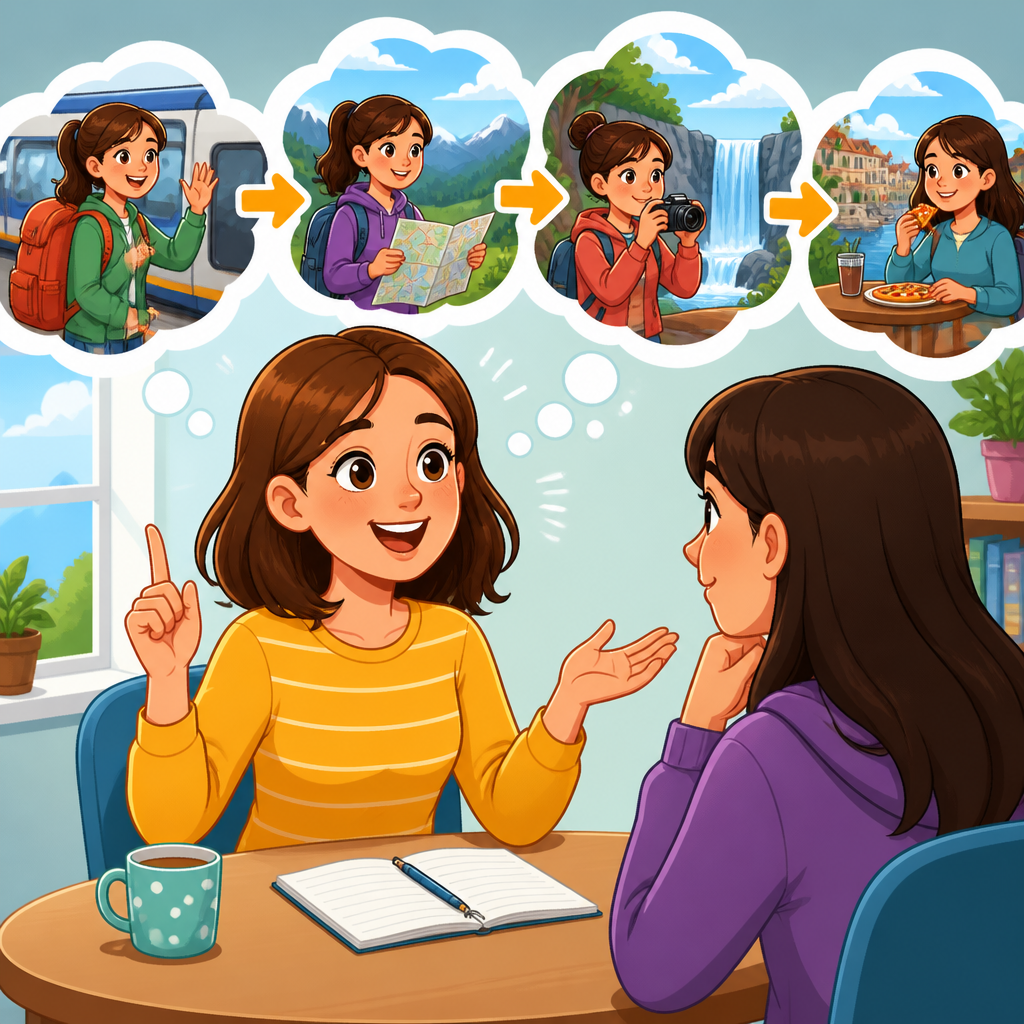
A2 speaking practice about past experiences helps learners move from isolated present-tense sentences to short, connected stories. At this level, clear sequencing matters more than perfect complexity because listeners need to follow what happened first, next, and last. When students can say, “Last weekend I visited my cousin. First we had lunch, then we walked by the river, and after that we watched a film,” they are doing an essential A2 task: describing past events in a simple, logical order.
In practical teaching terms, “past experiences” means familiar real-life events such as a trip, a family celebration, a school day, a shopping problem, or a memorable meal. “Clear sequencing” means using time markers and connectors to organize those events: yesterday, last week, first, then, after that, later, finally, and in the end. I have coached many beginner learners through this stage, and the biggest improvement rarely comes from adding difficult vocabulary. It comes from learning a reliable speaking pattern that reduces hesitation and makes the message easy to understand.
This skill matters because most everyday conversations include simple retelling. A classmate asks what you did on Sunday. A colleague asks how your journey went. A teacher asks about your last holiday. In each case, the listener expects a chronological answer. Without sequencing, learners often produce disconnected statements like “I went to Madrid. My sister. Good hotel. We eat paella.” The information is there, but the story is hard to follow. With sequencing, the same speaker can say, “Last month I went to Madrid with my sister. First we checked into our hotel, then we walked around the center. In the evening we ate paella, and the next day we visited a museum.” That is clearer, more confident, and more useful.
The core language for sequencing past experiences
At A2, learners do not need every past narrative structure. They need a compact toolkit they can use accurately under pressure. The first part is the past simple, especially high-frequency regular and irregular verbs: went, saw, ate, had, bought, took, came, met, and left. The second part is time reference: yesterday, last night, last weekend, two days ago, on Saturday, in the morning, and later that day. The third part is sequencing language: first, then, next, after that, later, finally. When these three parts work together, short stories become coherent.
A strong formula is time + subject + past verb + detail. For example: “Last Friday I met my friend after work.” Then add the next step: “First we went to a café.” Continue the chain: “Then we talked about our jobs. After that we walked to the station. Finally I took the bus home.” This pattern is teachable, memorable, and effective. It also prevents one common A2 problem: overusing “and” for every link. “And” is useful, but if every sentence starts with it, the sequence sounds flat and sometimes confusing.
Another useful distinction is between event markers and time markers. Event markers organize order: first, next, finally. Time markers place actions on the clock or calendar: at 8 p.m., on Sunday morning, last summer. Good A2 speaking combines both. “Last summer we went to Izmir” sets the context. “First we visited my aunt, then we went to the beach” gives order. “In the evening we ate at a small restaurant” adds timing. That combination creates a complete answer without making the speaker memorize a long script.
A simple speaking framework that reduces hesitation
The most reliable framework I use for A2 speaking practice has four moves: set the time, name the people and place, list two to four actions in order, and end with a result or feeling. This mirrors how real conversations work. For example: “Last weekend I went to the park with my brother. First we rented bicycles, then we rode around the lake. After that we bought ice cream. Finally we went home because it started to rain. It was a fun day.” Learners who follow this structure usually speak more smoothly because they always know what comes next.
One reason this framework works is cognitive load. Beginners often freeze because they are choosing grammar, vocabulary, and content at the same time. A fixed sequence lowers that load. Instead of inventing everything from zero, the learner fills slots: when, who, where, what happened first, what happened next, how it ended. In classroom recordings, I have seen students increase speaking length from ten seconds to thirty or forty seconds just by rehearsing this pattern with familiar topics.
It also helps to prepare “safe verbs” that fit many experiences. Go, meet, have, eat, watch, buy, take, visit, arrive, and leave cover a large share of A2 stories. A learner may not know “strolled,” “purchased,” or “departed,” but does not need them. Clear sequencing with common verbs is better than ambitious vocabulary with broken structure. For broader fluency foundations, learners can also review introductory speaking routines in the main guide at 5 Minute English, then return to past-experience practice with stronger confidence.
Useful sequencing phrases and when to use them
Learners often ask which connectors are best for A2 speaking. The answer is simple: use a small set repeatedly and accurately. “First” starts the story steps. “Then” and “next” move it forward. “After that” signals another action and sounds slightly more natural in longer answers. “Later” is useful when there is a time gap. “Finally” marks the last main event. “In the end” works well for a result, especially if something changed. These phrases are common in coursebooks aligned with CEFR A2 because they directly support understandable speech.
Choice matters because each phrase has a job. “First” is not usually repeated for every sentence. “Then” is flexible and frequent. “After” needs an object or clause, as in “After lunch” or “After we finished.” “After that” can stand alone, which makes it easier for A2 learners. “Finally” introduces the last stage, not a random extra idea. When students learn those functions, their speech becomes noticeably more organized.
| Phrase | Best use | Example |
|---|---|---|
| First | Start the sequence | First, we checked into the hotel. |
| Then | Continue with the next event | Then, we went out for dinner. |
| After that | Add another step clearly | After that, we took some photos. |
| Later | Show a gap in time | Later, I called my parents. |
| Finally | Introduce the last event | Finally, we returned home. |
Pronunciation practice should happen with these connectors, not only grammar drills. If a learner pauses for two seconds before “after that,” the story loses momentum. Short repetition exercises help: “First we arrived. Then we sat down. After that we ordered food. Finally we paid.” Spoken rhythm is important. Sequencing phrases act like road signs for the listener, so they should come out quickly and confidently.
Common mistakes that make past stories confusing
The most frequent problem is tense switching. A learner starts in the past—“Yesterday I went to the market”—and suddenly changes to the present: “Then I buy fruit and see my neighbor.” This usually happens because the speaker is concentrating on meaning, not form. The fix is not a long grammar lecture. It is targeted repetition of short past-time stories where every main verb stays in the past simple. Drilling mini-sequences works better than isolated verb lists.
Another common issue is missing sequence markers. Students may say, “Last Sunday I visited my grandmother. We had tea. I helped her. I went home.” The meaning is possible, but adding connectors immediately improves fluency: “Last Sunday I visited my grandmother. First we had tea, then I helped her in the kitchen, and finally I went home.” The grammar barely changes, yet the answer sounds more complete.
A third issue is too much detail in the wrong place. At A2, a speaker may stop the story to search for a specific adjective, food name, or transport term. This interrupts flow. I tell learners to protect the sequence first and simplify details if needed. “We went to a small restaurant” is enough if “seafood restaurant near the old harbor” causes a long silence. Communication at this level depends on continuity.
Word order also causes trouble, especially with time phrases. “I last weekend went to my uncle’s house” is understandable but unnatural. A safer model is “Last weekend I went to my uncle’s house.” Similarly, “Then we by bus went home” should become “Then we went home by bus.” Practicing whole sentence patterns helps learners internalize these chunks faster than correcting one word at a time.
Practice activities that build real speaking ability
Effective A2 speaking practice should move from controlled to personal. Start with picture sequences showing three or four events, such as arriving at a station, boarding a train, meeting a friend, and eating lunch. Learners describe the pictures in order using set connectors. Next, give prompt cards with familiar topics: “your last birthday,” “a day trip,” or “a meal with family.” Finally, shift to real personal answers with one minute of preparation and thirty to sixty seconds of speaking.
One excellent activity is the timeline retell. Students draw four boxes and label them first, then, after that, finally. In each box they write only one or two words, not full sentences: “bus,” “museum,” “lunch,” “home.” Then they speak from those notes. This prevents reading and encourages natural production. In my experience, learners who use keyword notes improve faster than those who memorize full paragraphs, because they stay flexible when a teacher asks a follow-up question.
Pair work is especially valuable when the listener has a task. For example, Student A tells a story about last weekend, and Student B must ask one follow-up question such as “Who did you go with?” or “What did you do after that?” This creates a realistic conversation instead of a monologue. It also trains the speaker to maintain sequence under mild pressure, which is exactly what happens in everyday English.
Recording is another high-value method. A learner records a forty-second answer on a phone, listens back, and checks three points: Did I say when it happened? Did I use at least three sequence markers? Did my verbs stay in the past? This self-check is simple, objective, and more effective than vague advice like “speak more naturally.”
Clear sequencing turns A2 speaking about past experiences into a skill learners can use immediately in class, at work, and in daily conversation. The goal is not a dramatic story or advanced grammar. The goal is a short, logical account that another person can follow easily. When learners control a few common past verbs, a handful of time expressions, and reliable connectors such as first, then, after that, and finally, their speech becomes more organized and more confident.
The most effective approach is narrow and practical: use a four-part framework, practice high-frequency verbs, avoid unnecessary detail, and repeat short personal stories until the sequence feels automatic. This is how hesitant speakers start sounding clear. Choose one real experience from yesterday or last week and practice telling it in four steps today.
Frequently Asked Questions
What does “talking about past experiences with clear sequencing” mean at A2 level?
At A2 level, talking about past experiences with clear sequencing means describing something that happened in the past in a simple order that listeners can easily follow. The main goal is not to tell a very long or complex story. Instead, it is to connect a few past actions using basic time markers and sequencing words such as “first,” “then,” “after that,” “later,” and “finally.” This helps the speaker move beyond single sentences and create a short, logical description of an experience.
For example, an A2 learner might say, “Last Saturday I went to the park. First I met my friend. Then we drank coffee. After that we walked around the lake. Finally I went home.” This is a strong A2 answer because the events are clear and easy to understand. Even if the grammar is not perfect in every sentence, the listener can still understand what happened and in what order.
This skill is important because everyday conversations often include simple stories about weekends, holidays, family visits, school events, or special days. At A2, learners build confidence by organizing these events step by step. Clear sequencing makes communication smoother, and it shows that the learner can speak in connected ideas rather than isolated present-tense statements.
Why is sequencing more important than using complicated grammar when speaking about past experiences?
For A2 learners, sequencing is often more important than complicated grammar because communication comes first. If a speaker uses very advanced grammar but the order of events is confusing, the listener may not understand the story. However, if the learner uses simple language with a clear structure, the message is usually successful. At this level, being understood is the key goal.
When learners talk about past experiences, the listener needs to know what happened first, what happened next, and how the experience ended. Words like “first,” “then,” “after that,” and “finally” give the story shape. These words guide the listener through the events. Without them, the speaker may produce correct sentences, but the story can feel disconnected or difficult to follow.
For instance, compare these two answers: “I visited my grandmother. We ate lunch. I took the bus. We watched TV.” and “Yesterday I visited my grandmother. First I took the bus. Then we ate lunch. After that we watched TV. Finally I went home.” The second answer is better for A2 speaking practice because it gives a clear timeline. That is why teachers often encourage students to focus on simple past forms and logical sequencing before trying more advanced structures.
What words and phrases should A2 students use to describe past events in order?
A2 students should use a small but useful group of sequencing words and time expressions that make past events easy to follow. The most common sequencing words are “first,” “then,” “next,” “after that,” “later,” and “finally.” These words help connect actions in a natural way. They are easy to remember, practical for speaking tasks, and extremely effective in short stories.
Students should also use simple time expressions to show when the experience happened. Good examples include “yesterday,” “last weekend,” “last night,” “last month,” “two days ago,” and “when I was on holiday.” These phrases help set the scene before the speaker starts describing the sequence of events. A strong A2 response often begins with a time expression and then continues with the order of actions.
Here is a useful model: “Last weekend I went to the beach. First I met my friends at the bus station. Then we traveled to the beach. After that we swam in the sea. Later we ate sandwiches. Finally we came home in the evening.” This kind of answer is ideal for A2 speaking because it is simple, organized, and clear. Students do not need many linking expressions at first. A few basic ones, used correctly and consistently, can make a big difference.
How can learners practice speaking about past experiences more confidently?
Learners can build confidence by practicing short, personal stories with a clear beginning, middle, and end. A very effective method is to choose familiar topics such as a weekend activity, a birthday, a school day, a family visit, or a trip to a shop or park. These topics are easier because the learner already knows the vocabulary and can focus on sequencing the events instead of inventing complicated ideas.
One helpful strategy is to prepare a simple speaking frame. For example: “Last ____, I _____. First, I _____. Then, I _____. After that, I _____. Finally, I _____.” Repeating this structure with different topics gives learners a safe pattern to follow. Over time, they begin to speak more naturally and need fewer prompts. This kind of repetition is especially useful at A2 because it develops fluency and reduces hesitation.
It also helps to practice aloud, not only silently. Students can record themselves, speak to a partner, or answer simple speaking questions in front of a mirror. After speaking, they should check two things: Did I use past forms? Did I put the events in a clear order? That is often more useful than trying to correct every small mistake. Confidence grows when learners see that they can tell a short story and be understood. Clear communication is a strong success at A2 level.
What are the most common mistakes A2 learners make when describing past experiences?
One common mistake is using only separate sentences without clear links. For example, a learner may say, “I went to my uncle’s house. We ate. We talked. I came home.” While this is understandable, it sounds basic and disconnected. Adding sequencing words makes the answer much stronger: “Last Sunday I went to my uncle’s house. First we ate lunch. Then we talked in the garden. Finally I came home.” The second version is clearer and more natural.
Another frequent mistake is mixing present tense and past tense in the same story. A learner might say, “Yesterday I go to the market and buy fruit.” This is very common at A2. The learner should aim for simple past forms such as “went” and “bought.” Perfect accuracy is not always necessary, but the speaker should try to stay in the past when describing past experiences. Consistency helps the listener understand the timeline better.
A third mistake is trying to say too much with language that is too difficult. Some learners want to tell a long, detailed story, but then they lose control of the grammar and organization. At A2, a shorter and clearer answer is usually better than a long and confusing one. It is more effective to describe three or four actions in the correct order than to attempt a very advanced story. Teachers and examiners usually respond well when the learner speaks simply, logically, and clearly. That is exactly what strong A2 past experience speaking should sound like.





