
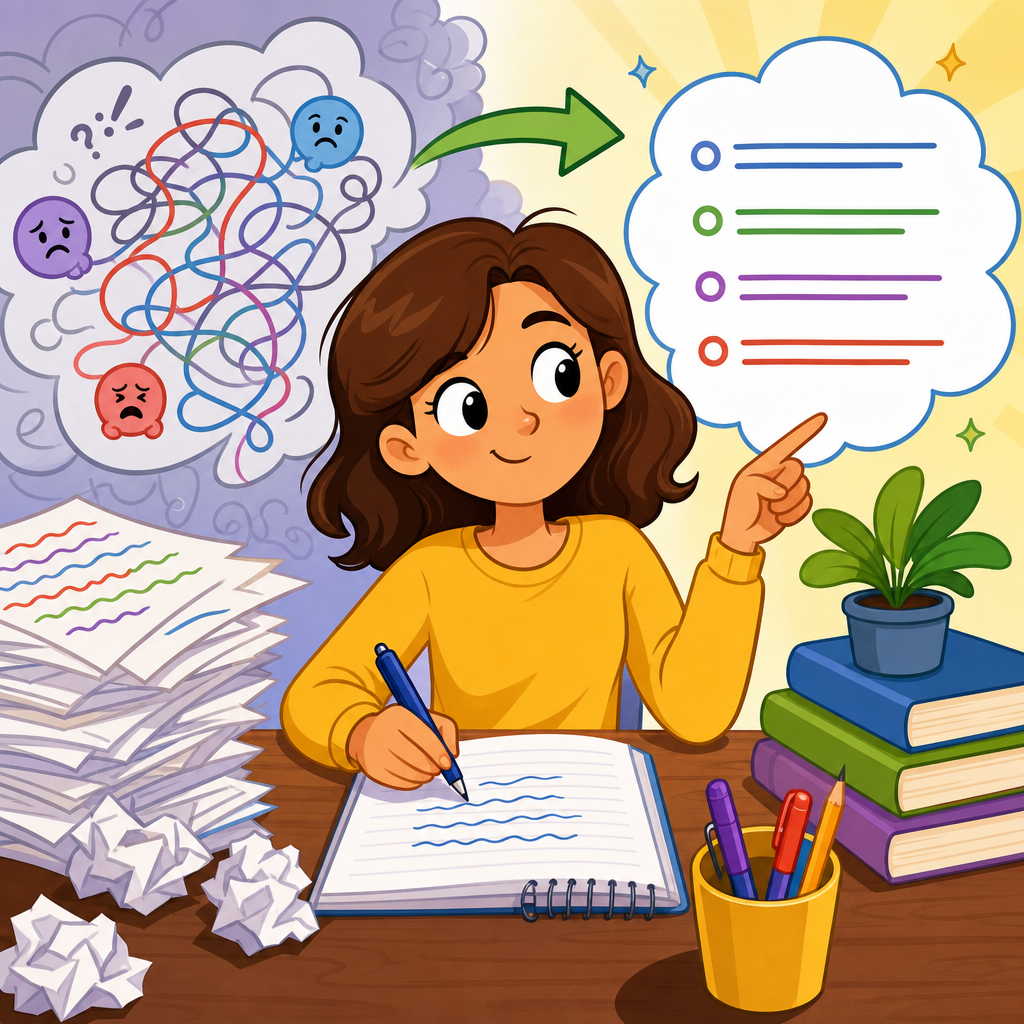
Run-on sentences weaken academic writing by cramming multiple complete thoughts into one unstable line, forcing readers to guess where ideas begin, pause, and end. In writing practice, a run-on sentence happens when independent clauses are joined incorrectly or not separated at all. The two main forms are the fused sentence, where clauses are pushed together with no punctuation, and the comma splice, where a comma tries to do the work of a period, semicolon, or coordinating conjunction. I have corrected thousands of student drafts, and run-ons remain one of the most common sentence-level problems because they often sound acceptable when spoken aloud. On the page, however, they create confusion, lower clarity, and can reduce grades in academic English, standardized tests, and professional communication. Learning to identify and rewrite them is not just a grammar exercise; it is a practical skill that improves argument structure, reading flow, and credibility. This hub article explains how to avoid run-on sentences in writing practice, shows ten sentence rewrites, and connects the issue to broader miscellaneous concerns such as pacing, cohesion, punctuation choice, and sentence variety across academic English.
What a Run-On Sentence Really Is
A run-on sentence is not simply a long sentence. Length alone is not the issue. A sentence can be forty words long and still be correct if the clauses are properly connected. A sentence can also be only twelve words long and still be a run-on if two independent clauses collide without the right structure. An independent clause contains a subject and a finite verb and can stand alone as a complete sentence. When writers place two of these clauses together, they must use one of four standard repairs: a period, a semicolon, a comma plus a coordinating conjunction, or subordination with words such as because, although, while, or since. Anything else usually creates an error.
Students often confuse run-ons with sentence fragments, but they are opposite problems. A fragment lacks a complete thought. A run-on contains too many complete thoughts without proper control. In real academic writing, run-ons usually appear during drafting when the writer is thinking faster than the punctuation system allows. I see this often in timed essays: a student has a strong idea, adds another related idea, then another, and never signals the relationship clearly. The result is not just a grammar mistake; it is a breakdown in logic presentation.
Why Run-On Sentences Hurt Academic English
In academic English, punctuation is a meaning system, not decoration. Readers rely on sentence boundaries to process claims, evidence, concessions, and transitions. If boundaries are weak, the argument feels less rigorous even when the ideas are good. Teachers may mark run-ons because they interfere with clarity, but the deeper issue is that they blur relationships between ideas. Is the second clause explaining the first, contrasting with it, or adding a consequence? Correct punctuation makes that relationship explicit.
Run-on sentences also affect style. They flatten emphasis because every idea appears to have the same weight. In research summaries, literature reviews, reflective writing, and exam responses, that can make your prose feel immature. Clear sentence control, by contrast, signals competence. It helps with cohesion, supports paragraph development, and improves readability metrics used by many editing tools, including Grammarly, ProWritingAid, Microsoft Editor, and the Hemingway Editor. Those tools are useful, but none of them replaces understanding the grammar behind the correction. If you know why a sentence is a run-on, you can fix it quickly in any setting, including handwritten exams where software cannot help.
How to Fix Run-On Sentences: Four Reliable Methods
The safest way to correct a run-on is to decide how closely the clauses should be connected. If the ideas are separate and deserve full emphasis, split them into two sentences. If they are closely linked and balanced, use a semicolon. If the relationship is additive, adversative, causal, or contrasting in a straightforward way, use a comma with a coordinating conjunction such as for, and, nor, but, or, yet, or so. If one idea depends on the other, make one clause subordinate.
In my editing work, I recommend this decision process: first identify both independent clauses, then ask what logical relationship you want the reader to notice. For example, “The sample size was small the findings were still useful” can become “The sample size was small, but the findings were still useful.” The conjunction but does more than fix punctuation; it announces contrast. Likewise, “Students revised the essay they improved their citations” may be better as “After students revised the essay, they improved their citations,” if the first action provides context for the second. Correcting run-ons is therefore a revision skill tied directly to meaning.
Rewrite These 10 Sentences
The examples below show common patterns found in academic English. Each original sentence is a run-on. Each rewrite demonstrates a different repair choice based on meaning, rhythm, and emphasis.
| Run-on sentence | Effective rewrite | Why it works |
|---|---|---|
| The lecture ended late many students missed the bus. | The lecture ended late, so many students missed the bus. | The conjunction shows cause and effect. |
| I finished the first draft it still needed evidence. | I finished the first draft, but it still needed evidence. | The second clause contrasts with the first. |
| The data looked inconsistent we checked the spreadsheet again. | The data looked inconsistent; we checked the spreadsheet again. | A semicolon links two closely related complete ideas. |
| She cited three sources the argument remained weak. | Although she cited three sources, the argument remained weak. | Subordination highlights concession. |
| The library was crowded I studied at home. | The library was crowded. I studied at home. | Two sentences create clean separation. |
| We analyzed the poem the symbolism was difficult to explain. | We analyzed the poem, and the symbolism was difficult to explain. | The conjunction joins related actions and commentary. |
| The professor posted feedback students revised immediately. | When the professor posted feedback, students revised immediately. | The dependent clause clarifies timing. |
| The method was inexpensive the results were unreliable. | The method was inexpensive; however, the results were unreliable. | The transition marks contrast, and the semicolon controls the link. |
| He wanted to sound formal he used overly complex sentences. | Because he wanted to sound formal, he used overly complex sentences. | The causal relationship becomes explicit. |
| The paragraph had a clear topic sentence the supporting details were out of order. | The paragraph had a clear topic sentence, yet the supporting details were out of order. | Yet signals an unexpected contrast. |
Notice that the best correction is not always the shortest one. The right choice depends on the intended relationship between clauses. That is why memorizing rules without analyzing meaning produces awkward revisions. A semicolon, for instance, is grammatically correct in many cases, but if the relationship is strongly causal, a conjunction or subordinate clause usually serves the reader better.
Common Causes in Writing Practice
Most run-ons come from predictable habits. First, many writers imitate speech, where pauses and intonation can carry meaning without punctuation. Second, learners may overuse commas because they recognize the need for a pause but do not know which mark is required. Third, drafting pressure encourages sentence accumulation: one idea triggers another, and the writer keeps typing. Fourth, some students are told to avoid short sentences, so they assume combining clauses always sounds more academic. In practice, mature writing uses a mix of short, medium, and long sentences, each controlled carefully.
Another frequent cause is weak clause identification. If you cannot quickly spot subjects and verbs, you will struggle to see where one complete thought ends. I often ask students to underline each independent clause before revising. This simple step makes hidden run-ons obvious. Reading the sentence aloud can help, but it is not enough, because spoken rhythm may disguise structural errors. Clause analysis is more reliable than listening alone.
Practical Editing Strategies That Work
To avoid run-on sentences consistently, build a revision routine. After drafting, scan each paragraph for places where two complete thoughts sit side by side. Check every comma between clauses and ask whether a coordinating conjunction follows it. Review transitional adverbs such as however, therefore, moreover, and consequently; these do not join independent clauses by themselves and usually need a period or semicolon before them. This is a classic source of comma splices in student essays.
A second strategy is sentence combining in reverse. Teachers often use sentence combining to build fluency, but sentence splitting is just as valuable. Take one long sentence and test whether two shorter sentences improve the logic. A third strategy is pattern practice. Rewrite the same run-on using a period, semicolon, conjunction, and subordinate clause. Comparing versions develops control. Corpus-based resources and style guides, including Purdue OWL, the Chicago Manual of Style, and Cambridge Grammar materials, all reinforce the same principle: punctuation should reflect the relationship between ideas, not just the sound of a pause.
Using This Hub to Improve Miscellaneous Writing Skills
Because this page serves as a miscellaneous hub within writing and academic English, treat run-on sentence practice as part of a larger editing system. Sentence boundaries connect directly to paragraph unity, transitions, concision, tone, and coherence. If your writing often contains run-ons, you may also need help with comma splices, fragments, overuse of conjunctive adverbs, and coordination versus subordination. These topics belong together because they all shape how readers process meaning line by line.
The most effective practice is targeted and repeated. Keep a personal error log, collect sentences from your own assignments, and rewrite them in multiple ways. Over time, you will start noticing clause patterns before the mistakes reach the final draft. That awareness is the real goal.
Avoiding run-on sentences in writing practice is one of the fastest ways to make academic English clearer, more persuasive, and easier to read. A run-on is not a sentence that is merely long; it is a sentence that mishandles independent clauses. Once you understand that definition, the fixes become practical: use a period for separation, a semicolon for a close link, a comma with a coordinating conjunction for direct connection, or subordination to show dependence. The ten rewrites in this article demonstrate how punctuation choices shape meaning, emphasis, and flow. They also show that grammar correction is not mechanical. Good writers select the structure that best expresses the relationship between ideas. If you want stronger essays, cleaner exam responses, and more confident editing habits, start by reviewing your own drafts for clause control and rewriting one run-on sentence today.
Frequently Asked Questions
What is a run-on sentence, and why does it hurt academic writing?
A run-on sentence happens when two or more complete thoughts, also called independent clauses, are joined incorrectly or not separated at all. This creates a sentence that feels unstable because the reader is not given clear signals about where one idea ends and the next begins. In academic writing, that lack of structure can make even a strong point seem confusing, careless, or underdeveloped. Readers may have to stop and reread the line just to figure out the writer’s meaning, which interrupts flow and weakens the authority of the work.
Run-on sentences are not simply “long sentences.” A sentence can be long and still be perfectly correct if its clauses are connected properly. The real problem is faulty clause connection. When complete thoughts are mashed together without the right punctuation or conjunctions, the sentence loses control. In formal writing, that can reduce clarity, damage coherence, and distract from the argument. Learning to recognize and revise run-ons is one of the most practical ways to improve sentence-level precision.
What are the main types of run-on sentences students should know?
The two main types are fused sentences and comma splices. A fused sentence occurs when two independent clauses are placed side by side with no punctuation at all. For example, a sentence such as “The study was persuasive it lacked recent data” contains two complete thoughts, but nothing properly separates them. The reader can usually guess the intended meaning, but the structure is still grammatically incorrect because the clauses have been fused together.
A comma splice happens when a writer uses only a comma to join two independent clauses. For example, “The study was persuasive, it lacked recent data” is also incorrect because a comma alone cannot carry the weight of separating two complete sentences. To fix either type of run-on, the writer needs a stronger connection strategy, such as a period, semicolon, coordinating conjunction, or a restructuring of the sentence. Understanding these two error patterns makes proofreading much easier, especially during revision exercises built around rewriting faulty examples.
How can I fix a run-on sentence correctly?
There are several reliable ways to correct a run-on sentence, and the best choice depends on the relationship between the ideas. The simplest method is to split the clauses into separate sentences with a period. This works especially well when each thought deserves equal emphasis. Another option is to use a semicolon if the two independent clauses are closely related and you want a smooth, formal connection. You can also join them with a comma plus a coordinating conjunction such as “and,” “but,” “or,” “so,” “for,” “yet,” or “nor.”
A fourth strategy is to turn one clause into a dependent clause by adding a subordinating word like “because,” “although,” “when,” or “while.” This helps show a clearer logical relationship between the ideas. In some cases, the best revision is to rewrite the sentence entirely so that the meaning becomes tighter and more direct. When practicing with sentence rewrites, it helps to ask two questions: does each part contain a complete thought, and have those thoughts been connected with the right structure? If the answer to either question is no, the sentence likely needs revision.
How can I tell the difference between a run-on sentence and a long but correct sentence?
This is a common point of confusion. Length alone does not make a sentence a run-on. A sentence may include multiple clauses, descriptive phrases, and transitions and still be grammatically correct if the parts are connected properly. The key issue is whether the sentence gives each independent clause the punctuation or conjunction it requires. If every complete thought is linked in a controlled way, the sentence may be long, but it is not a run-on.
One useful proofreading method is to identify the subject and verb in each clause and then check whether that clause could stand alone as a full sentence. If two complete sentences are sitting next to each other without proper separation, you likely have a run-on. If they are joined by a semicolon, a period, or a comma with a coordinating conjunction, the structure may be correct. This distinction matters because many writers shorten sentences unnecessarily when the real goal should be control, not brevity. Effective academic writing often includes complex sentences, but complexity must be managed with clear grammar.
What is the best way to practice avoiding run-on sentences when rewriting examples?
The best practice method is to slow down and examine each sentence one clause at a time. Start by locating every independent clause, then decide how the ideas are related. Are they equal in importance? Does one explain, contrast with, or cause the other? Once that relationship is clear, choose the revision strategy that fits best. This makes sentence correction more purposeful than simply inserting punctuation at random. In an exercise built around rewriting 10 sentences, the goal is not just to “fix errors,” but to understand why one correction works better than another.
It also helps to revise each example in more than one valid way. A run-on can often be corrected with a period, a semicolon, or a subordinating conjunction, and each option creates a slightly different rhythm and emphasis. Reading the revised versions aloud can help you hear where a natural stop or connection belongs. Over time, this kind of repeated practice builds sentence awareness, making it easier to catch run-ons in your own drafts before they weaken your writing. The more consistently you train yourself to recognize clause boundaries, the more confident and precise your academic style becomes.





