
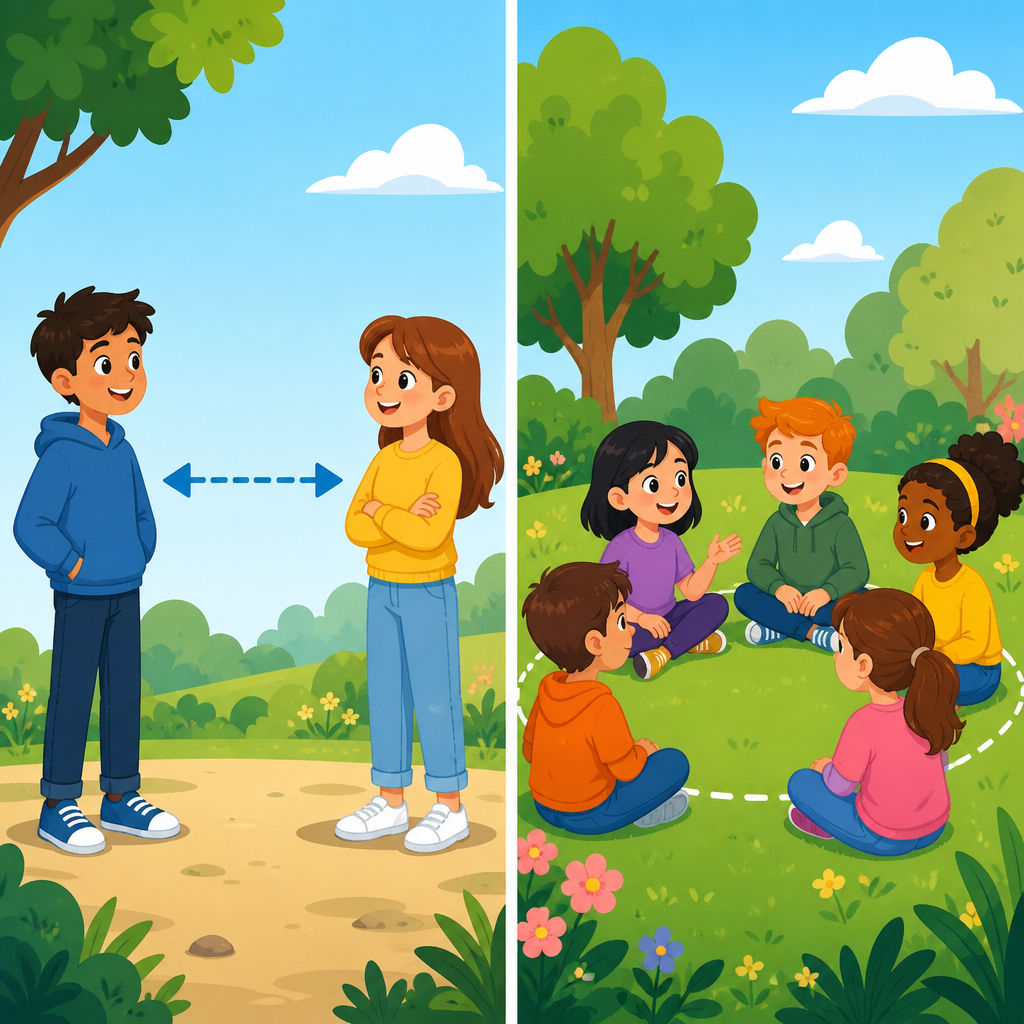
Writers stumble over “between” and “among” because the old classroom rule sounds simple—use “between” for two and “among” for more than two—yet real English is more precise. In professional editing, I regularly see sentences with three contracts negotiated between companies, choices divided among departments, and subtle errors that change tone more than meaning. This article explains how to choose prepositions for two entities versus groups, why the distinction matters in grammar and style, and how this hub connects the broader family of confusing words that cause similar problems. If you want cleaner sentences, stronger exam answers, and more credible business writing, mastering between vs among is a high-value skill.
Both words are prepositions that describe relationships. “Between” usually points to distinct, separate entities considered individually, while “among” usually points to a group, mass, or collective relationship where individual boundaries are less important. That is the real rule. The number of entities can matter, but the more reliable test is whether you are naming one-to-one relationships or treating several items as a group. Standard references such as Merriam-Webster and major style guides reflect this usage. Once you understand that distinction, many apparently tricky sentences become straightforward, and related confusing words become easier to sort as well.
This matters because grammar choices signal precision. In legal writing, “agreement between the five partners” is correct because each partner is a distinct party to the agreement. In everyday speech, “she felt comfortable among friends” is better because the point is belonging within a group, not a separate relationship with each friend one by one. Searchers looking up confusing words often need direct answers, but they also need context: rules, exceptions, examples, and editing strategies. As the hub page for the confusing words area within grammar, this article gives you the core decision rule, common pitfalls, and links in principle to related distinctions such as fewer vs less, affect vs effect, and who vs whom.
The Core Rule: Distinct Relationships vs Group Membership
The clearest way to decide between vs among is to ask what kind of relationship the sentence expresses. Use “between” when the relationship is individual and separable. Use “among” when the relationship is collective and blended into a group. This explains why “negotiations between France, Germany, and Italy” is correct: there are more than two countries, but the negotiations involve distinct parties. It also explains why “the secret spread among the staff” is correct: the staff is functioning as a group, not as individually contrasted members.
Here is the concise answer most learners need: “between” is for one-to-one or clearly distinct relationships, even if more than two items are involved; “among” is for belonging, distribution, or interaction within a group. Consider these examples. “The treaty between the three nations ended the conflict” is right because each nation is separately identified. “There was mutual respect among the villagers” is right because the sentence describes a collective atmosphere. In my editing work, this distinction resolves most errors immediately, especially in reports, essays, and email drafts where writers rely too heavily on the simplistic number rule.
When to Use “Between” with More Than Two Items
Many writers are surprised to learn that “between” often works with three or more nouns. In fact, it is the preferred choice when the sentence names distinct participants or specific comparisons. You would say “the differences between revenue, profit, and cash flow” because each financial concept is contrasted individually. You would also write “the conversation between the CEO, the union representative, and the mediator” because each participant has a separate role. The sentence would sound less precise with “among.”
This use is not a modern shortcut; it has long been standard English. Grammar authorities have accepted “between” for multiple distinct entities for centuries. Practical examples appear in diplomacy, law, and science. An agreement can exist between several companies. A boundary can be drawn between three states at a single point. Tension can arise between siblings, parents, and grandparents within one family. In all those cases, the relationships are not vague group associations. They are structured, identifiable connections.
| Situation | Best Choice | Example | Why |
|---|---|---|---|
| Two distinct entities | Between | between Alice and Ben | Direct one-to-one relationship |
| Three or more distinct parties | Between | between the manager, HR, and legal | Each party is separately identified |
| Within a collective group | Among | among the employees | Focus is on group membership |
| Distribution through a group | Among | shared among neighbors | Items spread across a collective |
When “Among” Is the Better Choice
Use “among” when the group matters more than the individuals. The most common contexts are inclusion, distribution, mingling, and general association. “She walked among the trees” works because the trees form a surrounding group. “The prize money was divided among the winners” works because the money is distributed throughout the group. “He felt respected among his peers” works because the sentence describes his standing within a collective circle.
“Among” often pairs naturally with plural nouns that imply an environment rather than separate participants: among friends, among voters, among researchers, among the audience. It also appears in expressions of prevalence, such as “a common belief among economists” or “high burnout rates among nurses.” In these cases, the sentence does not map a separate connection from one member to another; it describes something existing within a population. If you replaced “among” with “between,” the result would sound strained or technically wrong because the collective sense disappears.
Common Mistakes, Edge Cases, and Style Decisions
The biggest mistake is applying the two-versus-more-than-two rule mechanically. “The rivalry among the two teams” is usually wrong; “between the two teams” is the natural form because two distinct sides are involved. But the reverse mistake is also common. Writers sometimes produce “a sense of trust between the community” when “among the community” or, more idiomatically, “within the community” is better. The key is not counting nouns first. Identify the type of relationship first.
Distribution creates another edge case. “Divide the candy among the children” is standard because the candy is spread throughout a group. However, “choose between the red, blue, and green folders” is also standard because you are selecting from distinct options. Similar logic applies to location. “A path between the houses” suggests the space separating distinct buildings. “A cottage hidden among the hills” suggests enclosure within a landscape. Context decides meaning.
There are also idiomatic phrases you simply need to recognize. English strongly favors “between you and me,” not “among you and me,” because the phrase concerns two individuals. It favors “among other things” because the expression means “as one item in a larger set.” Formal prose sometimes allows either preposition with a slight shift in meaning. “An argument between the scholars” highlights the parties as separate thinkers; “agreement among the scholars” highlights shared consensus within the field. Good editing means choosing the word that matches the intended perspective, not forcing one option everywhere.
How This Fits the Wider “Confusing Words” Grammar Hub
Between vs among belongs to a larger category of confusing words that trip up students, professionals, and fluent speakers alike. The pattern is familiar: two forms seem interchangeable, but usage depends on structure, meaning, and register. In the broader grammar hub, this article sits beside distinctions like affect vs effect, farther vs further, compliment vs complement, and fewer vs less. These pairs matter for the same reason this one matters: small word choices shape accuracy, authority, and reader trust.
The smartest way to study confusing words is by contrast, not memorization alone. Ask what grammatical role each word plays, what meaning it signals, and what contexts native usage prefers. With between and among, that means distinguishing separate entities from groups. With who and whom, it means subject versus object function. With insure, ensure, and assure, it means financial protection, guaranteeing an outcome, and giving confidence. Building this comparison habit turns grammar from a list of traps into a usable editing system. If you manage content teams, teach writing, or prepare for exams such as the SAT, ACT, IELTS, or TOEFL, that system saves time and reduces repeated errors.
Practical Editing Tips for Getting It Right Every Time
When you revise a sentence, use a three-step test. First, underline the nouns after the preposition. Second, ask whether they are acting as distinct individuals or as a collective group. Third, substitute a quick paraphrase. If you can say “one-to-one relationship with each,” choose “between.” If you can say “within or throughout the group,” choose “among.” For example, “cooperation between marketing, sales, and product” passes the one-to-one test. “Trust among employees” passes the group test.
Read the sentence aloud as a final check. Awkwardness often reveals a mismatch. Business writing especially benefits from this habit because prepositions affect clarity in contracts, policy documents, and project updates. I have corrected phrases like “alignment among leadership, finance, and operations” to “alignment between leadership, finance, and operations” when the sentence named separate departments coordinating directly. Conversely, I have changed “engagement between staff” to “engagement among staff” when the writer meant general participation across the workforce. Precision here is not pedantic; it helps readers understand relationships immediately. Review a few examples from your own writing today, and you will start noticing the pattern everywhere.
Choosing between “between” and “among” becomes easy once you stop counting items and start analyzing relationships. Use “between” for distinct, separate entities, even when there are three or more. Use “among” for group membership, distribution, or general association within a collective. That single principle explains the vast majority of correct usage and helps you avoid the most common grammar mistake tied to these prepositions.
As a hub within the confusing words section of grammar, this topic teaches more than one pair of prepositions. It trains you to read for function, meaning, and context, which is the same skill behind mastering many other word-choice problems. Strong writers do not rely on oversimplified rules; they choose the form that communicates the exact relationship intended. Apply the three-step editing test, compare your own sentences, and keep building your confusing words reference set. The payoff is immediate: cleaner prose, stronger credibility, and fewer avoidable corrections.
Frequently Asked Questions
Is it always correct to use “between” for two and “among” for more than two?
No. That classroom shortcut is helpful as a starting point, but it is not a complete rule. In careful English, “between” is often used when you are talking about distinct, individual relationships, even if more than two people, items, or groups are involved. For example, you can say there was an agreement “between the three partners” because the sentence focuses on a relationship linking clearly separate parties. In contrast, “among” is usually the better choice when the idea is collective, distributed, or less individualized, as in dividing resources “among the departments” or finding consensus “among the committee members.”
The real difference is not simply number. It is whether the sentence highlights one-to-one or clearly defined connections, or whether it treats the set as a group. That is why phrases such as “negotiations between five countries” sound natural: each country is a distinct participant in a structured relationship. Meanwhile, “trust among coworkers” works because the feeling exists within the group as a whole rather than along separately named lines. If you rely only on the two-versus-more-than-two rule, your writing may still be understandable, but it can sound less precise and less polished.
When should I use “between” with more than two entities?
Use “between” when the sentence emphasizes separate, identifiable parties and the relationship connecting them. This commonly happens with words like “agreement,” “contract,” “difference,” “choice,” “negotiation,” “rivalry,” and “relationship.” You might write about a contract “between the supplier, the distributor, and the retailer,” or a discussion “between management, legal counsel, and the client.” Even though more than two entities are involved, each one is individually recognized in the connection.
A good test is to ask whether the people or things could be listed as distinct participants in a structured interaction. If the answer is yes, “between” is often the stronger choice. For instance, “The treaty was signed between France, Germany, and Italy” sounds natural because the countries are named as separate parties. “Among” would make the sentence feel looser and less exact. This is especially important in formal, academic, legal, and business writing, where relationships between clearly defined entities need to be stated accurately.
When is “among” the better choice?
“Among” is usually best when something is shared, spread, felt, discussed, or distributed within a group rather than traced through individually defined links. Examples include “The bonus was divided among the staff,” “There was confusion among the guests,” and “The rumor spread among students.” In these cases, the sentence does not focus on separate pairings or explicit party-to-party relationships. Instead, it treats the people involved as members of a collective whole.
This is why “among” often appears with ideas of inclusion, distribution, atmosphere, and general interaction within a set. If you are talking about belonging, participation, influence, or movement through a group, “among” is usually the more natural and idiomatic option. It creates a sense of being inside the group rather than standing at defined points of connection. In style terms, choosing “among” in these contexts helps your sentence sound smoother and more native, while choosing “between” might make it sound too segmented or overly technical.
Does choosing “between” or “among” ever change the meaning of a sentence?
Sometimes the difference is subtle, but yes, it can affect meaning, emphasis, and tone. “Between” tends to make relationships sound more specific, deliberate, and structured. “Among” tends to make them sound more collective, general, or diffuse. Compare “an agreement between the departments” with “cooperation among the departments.” The first points to a formal arrangement linking distinct units; the second suggests a broader pattern of working together within the group.
In many everyday sentences, readers will still understand what you mean even if the less precise preposition is used. However, the effect on tone matters, especially in edited prose. A legal document, policy memo, academic paper, or polished article benefits from these distinctions because they help readers see whether the focus is on individual parties or group dynamics. In other words, the choice may not always create a dramatic grammatical error, but it often shapes how refined, accurate, and intentional the writing feels.
What is the easiest way to decide which preposition to use while writing or editing?
The simplest editing strategy is to look at the kind of relationship your sentence describes. If the connection is direct, structured, or involves distinct parties, lean toward “between.” If the idea is collective, shared, or distributed through a group, lean toward “among.” Ask yourself whether the sentence is pointing to separate entities in relation to one another, or to a general condition existing within a larger set.
It also helps to check the noun or verb around the preposition. Words such as “agreement,” “difference,” “choice,” “comparison,” and “negotiation” often pair naturally with “between,” even when more than two entities are involved. Words such as “sharing,” “distribution,” “discussion,” “harmony,” and “confusion” often fit better with “among.” When editing, read the sentence aloud and listen for whether the thought feels individualized or collective. That quick habit usually leads you to the more precise preposition and gives your writing a more confident, professional finish.





