
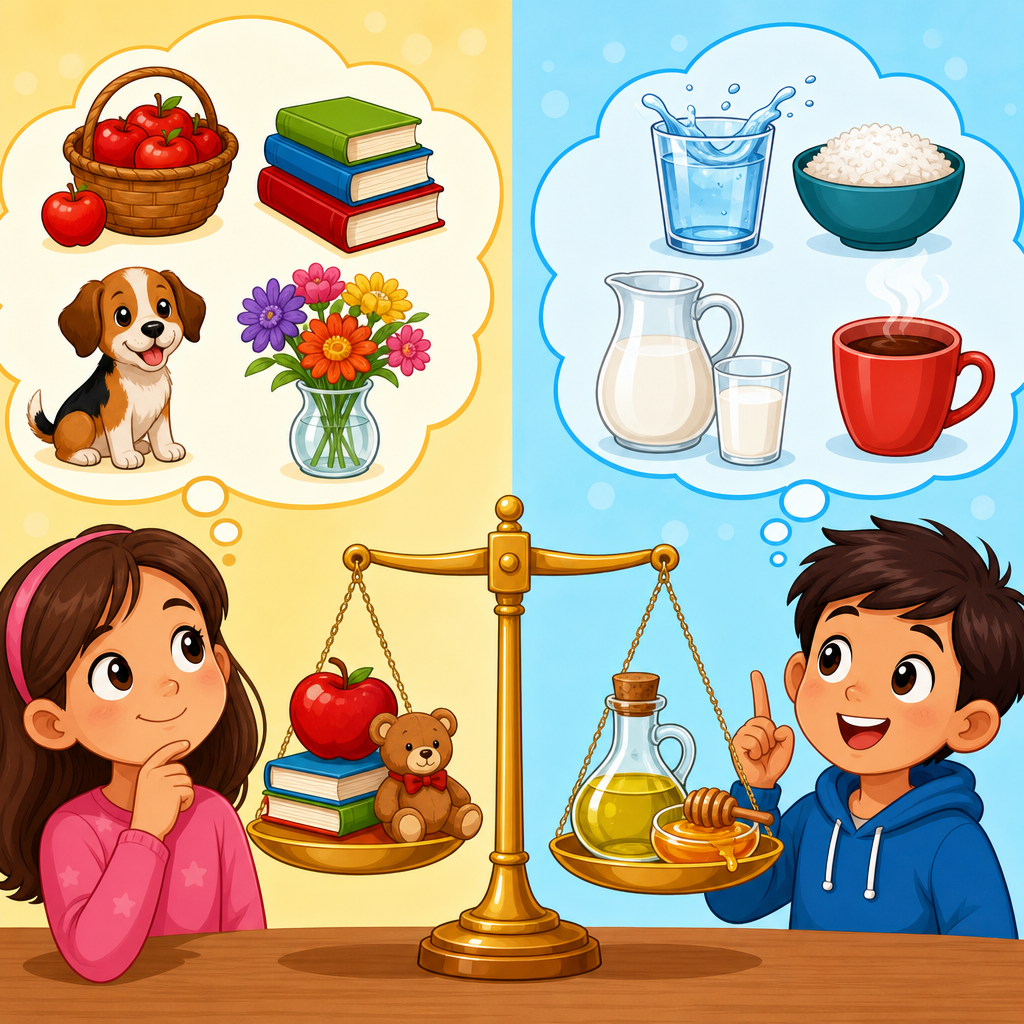
Countable and uncountable nouns seem straightforward until the same word appears in both forms and the meaning changes. This is one of the most important patterns in English grammar because it affects articles, verb agreement, quantity words, and everyday interpretation. In practical teaching and editing work, I see learners understand countable nouns as things you can number, like book or chair, and uncountable nouns as masses or abstract ideas, like water or advice. The problem starts when one noun belongs to both categories. Then grammar is not just about form; it is about meaning.
A countable noun can usually take a, an, or a plural form. An uncountable noun usually does not. But English uses many nouns flexibly. Chicken can mean the animal, a type of food, or an individual bird. Paper can mean the material or a newspaper or academic article. Experience can mean accumulated knowledge or a specific event. These shifts are not random. They follow recognizable semantic patterns that advanced learners can learn and apply.
This topic matters because meaning errors often survive even when sentence structure looks correct. A learner may say, “I had an experience in marketing” when they mean general professional background, or “There are too many traffics” when they mean traffic as a mass condition. Native speakers understand some mistakes from context, but the wrong countability can sound unnatural, imprecise, or misleading. In exams, business writing, and conversation, choosing the correct form signals control of grammar and vocabulary at the same time.
How meaning changes when countability changes
When a noun shifts from uncountable to countable, it often moves from a general substance, field, or abstract concept to a specific instance, unit, or type. That is the core rule. In lessons, I teach learners to ask one question first: am I talking about something in general, or one example of it? If the noun names material or an abstract quality, uncountable use is common. If it names a particular item, occasion, variety, or result, countable use often appears.
Take coffee. In “Coffee contains caffeine,” the word is uncountable because it means the substance in general. In “We ordered two coffees,” it becomes countable because it means two cups or servings. The grammar changes because the speaker is no longer talking about the substance broadly. The same pattern appears with tea, beer, and juice. Restaurant English uses countable forms constantly because ordering usually means units, not materials.
This distinction also explains nouns like beauty. “Beauty matters in design” uses the abstract idea, so it is uncountable. “She is a beauty” uses a specific example of a beautiful person, so it is countable. The countable form often adds a figurative or evaluative meaning. Learners who notice this pattern start recognizing it across many nouns, not as separate vocabulary problems but as one grammatical system.
Common noun pairs that learners confuse
Some nouns change meaning so frequently that they deserve close study. Paper as an uncountable noun means the material used for writing or printing: “The printer is out of paper.” As a countable noun, it means a newspaper, an exam paper, or a scholarly article: “I submitted three papers last term.” In academic English, this distinction matters because “research” is uncountable, but “a paper” is one written product.
Work is another major source of mistakes. Uncountable work means labor, employment activity, or tasks in general: “I have too much work.” Countable a work usually means a created piece, especially in literature or art: “The museum bought two works by the artist.” This is why “I have many works to do” sounds wrong in ordinary English, while “the complete works of Shakespeare” is correct. If you need the countable everyday meaning, use tasks, jobs, or assignments.
Experience is equally important. Uncountable experience means knowledge or skill gained over time: “She has extensive experience in sales.” Countable an experience means a specific event: “Working abroad was an unforgettable experience.” Job interviews often expose this difference. Candidates should say “I have five years of experience,” not “five years of experiences,” unless they mean several distinct events or kinds, which is much rarer.
| Noun | Uncountable meaning | Countable meaning | Example |
|---|---|---|---|
| chicken | meat as food | a bird | We ate chicken / There are three chickens. |
| glass | material | drinking container | Glass breaks easily / He dropped a glass. |
| hair | hair in general | individual strand | Her hair is long / I found a hair in the soup. |
| room | space | separate area in a building | There is no room / We booked a room. |
| time | time in general | occasion | Time passes quickly / I called three times. |
Patterns behind food, material, and abstract nouns
Food nouns commonly shift from uncountable to countable when the speaker means an animal, a portion, or a variety. Lamb can be meat or an animal. Fish is often uncountable as food, but countable as individual creatures; in scientific contexts, fishes can refer to species. Cheese is usually uncountable, yet specialists may say “French cheeses” to mean types. This countable use of varieties is standard in menus, retail, and food journalism.
Material nouns follow a similar logic. Glass, iron, and wood are uncountable when they name substances. They become countable when they name objects, types, or sometimes institutions and tools. “The greenhouse is made of glass” refers to the material. “Please bring me a glass” means a container. “The woods” does not mean pieces of wood but a forested area, which shows that some countable meanings become separate lexical items that must simply be learned.
Abstract nouns often become countable when they refer to individual manifestations. Kindness is generally uncountable, but “many kindnesses” can mean several acts of kindness. Pleasure means enjoyment in general when uncountable, but “a pleasure” means a specific delightful experience or polite social formula. These uses appear often in formal writing and conversation. Learners who master them sound more natural because they can express nuance instead of relying on one fixed meaning per word.
High-value examples for speaking, writing, and exams
Several noun shifts appear repeatedly in IELTS, TOEFL, Cambridge exams, and workplace English. Business as an uncountable noun means commercial activity in general: “Business is slow this month.” As a countable noun, it means a company or sometimes a matter: “She started three businesses” or “That is not your business.” Light is uncountable when it means illumination, countable when it means a lamp or signal. Noise is usually uncountable in general complaints, but countable in “I heard a strange noise.”
Education is normally uncountable when discussing the system or process: “Education should be accessible.” In specialized contexts, however, an education means a received course of learning: “He got a good education.” Failure is uncountable when meaning lack of success, but countable when referring to a person or thing that fails: “The plan ended in failure” versus “The product was a commercial failure.” These distinctions are especially useful in analytical essays, where precision affects both style and score.
For learners also reviewing agreement and paired structures, countability choices connect with broader sentence accuracy. A noun’s form influences determiners, pronouns, and verbs around it. That is one reason I recommend studying it alongside related grammar points in a focused guide such as this explanation of either, neither, and both, where number and reference also change meaning. Grammar works best when learners see these systems interacting, not as isolated rules.
How to choose the correct form in real situations
The most reliable method is to identify the speaker’s intended meaning before choosing the article or plural. Ask whether the noun refers to substance, concept, activity, or field; if yes, uncountable is likely. Ask whether it refers to one item, one episode, one variety, or one result; if yes, countable is likely. Corpus tools such as the Cambridge Dictionary, Longman Dictionary of Contemporary English, and the Corpus of Contemporary American English are useful because they show the noun in authentic contexts, not just definitions.
It also helps to learn frequent collocations instead of single words. We say make progress, not usually make a progress. We say a good knowledge of Spanish only in limited set phrases, while general knowledge is uncountable. We say a help only in certain contexts, but help is usually uncountable. After years of correcting essays, I have found that collocation awareness reduces countability errors faster than memorizing long lists, because it trains the ear for what English actually does.
Countable versus uncountable nouns that change meaning are not exceptions at the edges of English; they are a central feature of how English packages ideas. The key insight is simple: when countability changes, meaning usually shifts from general to specific, from substance to unit, or from abstract idea to individual instance. Learn the pattern through common nouns like paper, work, experience, chicken, and glass, then confirm it with real examples in dictionaries and corpora.
Mastering this area makes your English more accurate, more natural, and more precise. You will choose articles more confidently, avoid common learner errors, and understand subtle differences that native speakers use automatically. Most importantly, you will stop treating each noun as an isolated rule and start seeing the logic behind the system. Review the examples in this article, test yourself with your own sentences, and notice these shifts the next time you read or listen to English.
Frequently Asked Questions
What does it mean when a noun is both countable and uncountable, and why does the meaning change?
Some English nouns can function as both countable and uncountable, but they do not always mean exactly the same thing in each form. This happens because English often uses the uncountable form to refer to a substance, activity, abstract idea, or general category, while the countable form refers to a specific item, instance, type, serving, or unit. For example, chicken as an uncountable noun can mean the meat: “We had chicken for dinner.” As a countable noun, it usually means the animal: “There are three chickens in the yard.” The grammar changes with the meaning. Uncountable nouns do not normally take a or an and are not usually made plural, while countable nouns can be singular or plural and can be used with numbers and articles.
This pattern matters because it affects much more than vocabulary. It changes article choice, verb agreement, and the quantity words you can use. You say “much experience” but “many experiences” if you mean separate events. You say “some paper” for the material, but “a paper” can mean an article, essay, or newspaper depending on context. In other words, the shift is not random. The noun moves from a mass or general idea to a countable unit with a more specific meaning. Once learners recognize that these nouns change meaning according to how the speaker is framing them, the system becomes much easier to understand and use accurately.
What are some common examples of nouns that change meaning when they become countable or uncountable?
Several high-frequency English nouns behave this way, and they are worth learning as patterns rather than isolated exceptions. Hair is a classic example. Uncountable hair refers to the substance or the mass of hair in general: “Her hair is very long.” Countable a hair means a single strand: “There’s a hair in my soup.” Work as an uncountable noun refers to labor or employment in general: “I have too much work.” Countable a work or works can refer to a creation such as a painting, book, or piece of art: “The museum owns several works by the artist.”
Light is another useful example. Uncountable light refers to illumination in general: “We need more light in this room.” Countable a light often means a lamp or light source: “Turn on the kitchen light.” Time uncountably can refer to time as a general concept: “Time passes quickly.” Countably, times refers to occasions: “I’ve visited London three times.” Room uncountably can mean space: “There isn’t much room in the car.” Countably, it means an enclosed part of a building: “The house has six rooms.” Learning these pairs helps learners see that the countable form often narrows the meaning into a unit, occurrence, object, or category, while the uncountable form keeps the meaning broad, general, or material.
How do articles and quantity words change with nouns that can be both countable and uncountable?
This is one of the most important practical points, because grammar choices immediately reveal whether a noun is being treated as countable or uncountable. If the noun is uncountable, you generally do not use a or an, and you do not usually make it plural. Instead, you use expressions such as some, much, a little, a bit of, or a measurement phrase. For example: “We need some paper,” “She gave me useful advice,” and “There isn’t much room.” If the noun is countable, you can use a, an, numbers, and plural forms, along with quantity words such as many, few, and several: “I wrote a paper,” “She offered several suggestions,” and “There are many rooms in the hotel.”
The challenge is that the same word may allow both systems, but with a different meaning each time. Compare “I need paper” with “I need a paper.” The first refers to the material; the second usually refers to a written assignment, academic article, or newspaper, depending on context. Compare “He has experience” with “He had several strange experiences.” The first describes general knowledge or skill gained over time; the second refers to individual events. A good rule is to ask what exactly is being counted. If you can count separate items, occasions, or units, the noun is being used countably. If you are talking about a mass, quality, or general concept, the noun is likely uncountable. That question often leads directly to the correct article and quantity word.
How can I tell from context whether the noun means a substance, a general idea, or a specific item?
Context usually gives strong clues, especially the words around the noun and the kind of sentence it appears in. If the noun appears with a number, a/an, or a plural ending, it is almost certainly being used countably: “two coffees,” “a cheese,” “three experiences.” In these cases, the meaning is often a serving, a type, or an individual event. For example, “two coffees” usually means two cups of coffee, not two separate kinds of the substance in a scientific sense. If the noun appears without an article and refers to a material, activity, or broad concept, it is often uncountable: “Coffee keeps me awake,” “Cheese is expensive here,” “Experience matters in this job.”
There are also semantic clues. Ask whether the speaker means the substance itself, the idea in general, or a distinct unit. Glass uncountably means the material: “The table is made of glass.” Countably, a glass usually means a drinking container: “Can I have a glass of water?” Iron uncountably can mean the metal: “Iron is strong.” Countably, an iron means the household device for clothes. Business uncountably can refer to commerce in general: “Business is slow this month.” Countably, a business means a company: “She started a business.” Over time, learners get faster at noticing these signals, but the best method is to read the whole sentence and identify whether the noun refers to mass, concept, type, serving, event, or object.
What is the best way to learn and remember nouns whose meanings change between countable and uncountable use?
The most effective approach is to learn these nouns in meaning pairs with example sentences, not as isolated dictionary labels. Instead of memorizing “paper = countable/uncountable,” learn “paper = material” and “a paper = article/essay/newspaper.” Do the same with chicken, coffee, experience, room, light, hair, and work. This helps you connect grammar to meaning, which is exactly how fluent speakers use the language. It is also useful to group nouns by common shifts in meaning. Some change from substance to object, like glass and iron. Some change from general concept to specific event, like time and experience. Some change from food substance to animal, like chicken or fish in certain contexts.
Another strong strategy is to notice collocations and typical sentence patterns. For instance, uncountable uses often appear with some, much, a little, and singular verbs, while countable uses appear with a, numbers, plurals, many, and few. Keep a personal list of examples such as “There is hair on the floor” versus “I found a hair on the floor,” or “We drank coffee after dinner” versus “We ordered two coffees.” If you are writing or editing, pause whenever a noun can potentially shift meaning and ask what the sentence is really trying to say. That habit builds accuracy quickly. In the long run, mastery comes from repeated exposure, comparison, and active use, because these nouns are not just grammar facts; they are meaning choices that shape how readers and listeners understand the sentence.





