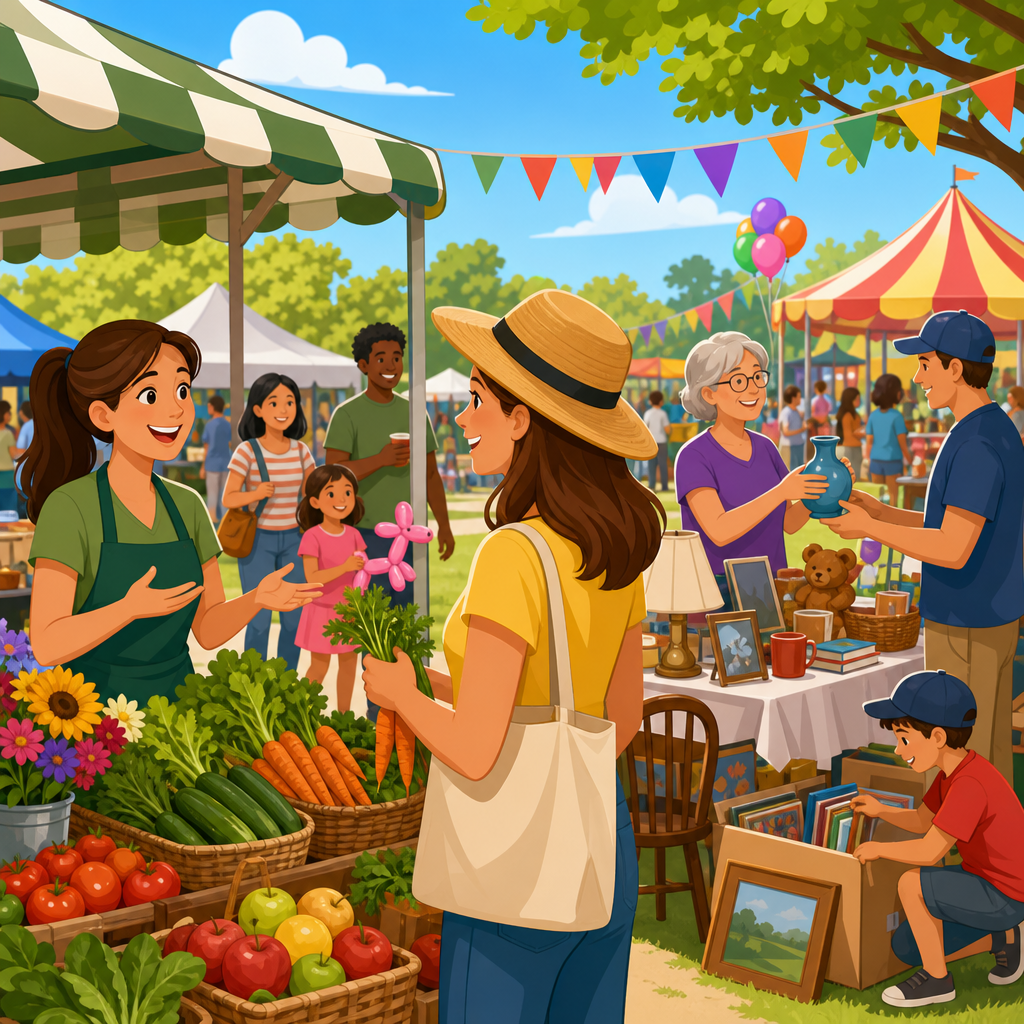
English for farmers markets, yard sales, and community fairs is a practical set of speaking skills that helps learners handle short conversations, ask clear questions, understand prices, and connect politely with neighbors in informal public spaces. These events are different from classrooms, offices, and customer service counters because the language is quick, local, and highly social. People bargain gently at a yard sale, discuss produce quality at a farmers market, and make friendly small talk at a community fair while standing in line, browsing tables, or tasting samples. I have coached adult learners through these settings in real neighborhoods, and the same pattern appears every time: students usually know the vocabulary for food, money, and directions, but they struggle with the casual phrases native speakers use automatically.
Understanding this kind of English matters because these events are often entry points into local culture. A farmers market can teach regional food words, seasonal habits, and polite ways to ask where something was grown. A yard sale can reveal how Americans discuss used items, negotiate prices, and signal friendliness without sounding pushy. A community fair adds tickets, booths, games, live music, volunteer tables, and fast introductions. In all three places, success depends less on perfect grammar than on listening for common patterns, using direct but polite questions, and knowing when to continue a conversation or end it gracefully. For learners who want real participation rather than textbook practice, this is one of the most useful forms of everyday English.
Key terms help clarify the topic. A farmers market is a local event where growers and food vendors sell produce, baked goods, meat, flowers, or handmade products. A yard sale, also called a garage sale in many areas, is a casual sale of used household items by private individuals. A community fair is a broader public event that may include food stands, crafts, performances, information booths, and family activities. The English used in these places overlaps, but each one has its own rhythm, expectations, and vocabulary. Learning those differences makes conversations smoother and reduces the hesitation many learners feel when they must react in real time.
Core phrases you will hear and use
The most useful English in these settings is short, functional, and repetitive. At a farmers market, common questions include “How much is this?” “Is this local?” “What do you recommend?” “Is it ripe?” and “Can I pay by card?” At a yard sale, people often say “Does it work?” “Are you flexible on the price?” “Would you take ten dollars?” or “Can I bundle these?” At a community fair, practical phrases include “Where do I buy tickets?” “What time does it start?” “Which line is this?” and “Is this booth cash only?” These questions are effective because they are direct, easy to understand, and socially normal. Learners do not need complicated sentences to sound capable.
Listening matters just as much as speaking. Sellers often answer quickly with reduced forms such as “It’s five,” “Cash only,” “Fresh this morning,” “You can try one,” or “I can do fifteen.” In speech, “going to” becomes “gonna,” “want to” becomes “wanna,” and “let me see” may sound like one fast unit. I tell learners to focus on meaning blocks rather than every word. If a vendor says, “These came in today, super sweet, two for five,” the key ideas are freshness, taste, and price. Training your ear for these compressed patterns makes a huge difference in confidence.
Politeness also has a local style. Americans in these spaces usually appreciate brief warmth: “Hi,” “How’s it going?” “Thanks,” and “Have a good one.” That does not require a long conversation, but ignoring it can sound abrupt. If you need help with that social layer, this guide on American small talk rules that surprise ESL learners explains why tiny exchanges matter. In practice, a simple opener like “Hi, these tomatoes look great” often leads to easier communication than starting immediately with a price question.
Farmers market English: produce, quality, and payment
Farmers markets rely on descriptive language. Buyers ask about freshness, flavor, origin, and cooking use. Good questions include “What’s in season right now?” “Which peaches are sweetest?” “How should I cook this?” and “Was this grown nearby?” Vendors usually expect these questions and often enjoy answering them. In many markets, sellers take pride in terms like heirloom, organic, pesticide-free, pasture-raised, and small-batch. Learners do not need to master agricultural science, but they should recognize that these words affect price and buyer interest. “Heirloom tomatoes” usually means older named varieties grown for flavor, while “pasture-raised eggs” refers to hens with outdoor access under a recognized husbandry claim.
Payment language has become more varied. Many market stalls now accept tap-to-pay systems through Square, Clover, or smartphone readers, but some still prefer cash. You will hear “card minimum,” “exact change helps,” “EBT accepted,” or “scan the QR code.” The United States Department of Agriculture has supported nutrition benefit use at many farmers markets, so learners may also hear SNAP-related language. Knowing these terms prevents confusion and helps shoppers move quickly in line. If you are unsure, ask early: “Do you take cash, card, or both?” That sounds more natural than waiting until checkout and creating a delay.
Samples create another common interaction. A vendor may say, “Would you like to try one?” The expected answer can be as simple as “Yes, thank you” or “No thanks, maybe later.” After tasting, useful responses are “That’s really good,” “It’s sweeter than I expected,” or “I’ll take a basket.” These are small moments, but they build real conversational ability because they combine description, decision-making, and politeness in a live setting.
Yard sale English: used goods and gentle bargaining
Yard sales use a different register because the items are secondhand and prices are flexible. The most important skill is asking about condition without sounding negative. Instead of saying “This is old,” say “Does this still work?” or “Has this been used much?” If you notice a flaw, “I see a small crack here” is better than “This is damaged.” These softer phrases keep the conversation cooperative. In my experience, learners who speak too bluntly are not being rude intentionally; they are translating directly from another language. At a yard sale, softer wording gets better results.
Bargaining is usually acceptable, but style matters. In many American yard sales, sellers expect modest negotiation, not aggressive haggling. “Would you take eight?” works well. “What’s your best price?” is common too, though some sellers dislike it because it shifts all the work to them. “Could you do ten for both?” is often the strongest phrase because it is clear and specific. If the seller says no, a polite response is “No problem, thanks anyway.” That keeps the interaction comfortable, especially in residential neighborhoods where the social relationship matters.
| Situation | Natural phrase | Why it works |
|---|---|---|
| Ask price | How much are you asking for this? | Common, polite, direct |
| Check condition | Does it still work? | Neutral wording |
| Negotiate | Would you take fifteen? | Specific and respectful |
| Bundle items | Could you do twenty for all three? | Efficient for multiple purchases |
| Decline politely | I’ll think about it, thanks. | Ends conversation smoothly |
Another useful point is cultural expectation around honesty. Sellers often use phrases like “as is,” “needs a little work,” or “missing one piece.” “As is” means the item is sold in its current condition with no promise of repair or refund. Learners should understand that private sales usually do not offer the protections of retail stores. Asking “Can I test it?” for electronics or “Do you know if all the parts are here?” for furniture is reasonable and often necessary.
Community fair English: lines, booths, and quick social exchanges
Community fairs combine transactional English with event language. You may need to ask where to park, where a line begins, whether tickets are sold at the gate, or what time a performance starts. Because these events are noisy, concise questions work best: “Is this the line for tickets?” “Where’s the main stage?” “When does the band start?” “Are wristbands required for rides?” Native speakers often answer with landmarks instead of full directions, such as “Past the food trucks, on your left.” Learners should practice following those short directional cues.
Booths also create opportunities for social contact. Volunteers may ask, “Are you from around here?” “Do you want to sign up?” or “Have you tried our raffle yet?” A simple answer is enough. You can say, “I’m new to the area,” “Just looking, thanks,” or “Not yet, how does it work?” These replies are effective because they sound open without creating pressure. At family-oriented fairs, you may also hear child-related language such as “face painting,” “bounce house,” “waiver,” and “height requirement.” Understanding these terms helps parents and caregivers move efficiently through the event.
Food stands add another layer. Menus may use local shorthand like combo, side, topping, refill, lemonade stand, funnel cake, corn dog, or kettle corn. If the menu is unclear, ask “What comes with that?” or “Is it spicy?” These short clarifying questions prevent ordering mistakes and sound completely natural. In crowded spaces, successful English is not elegant English; it is clear, timely, and easy to answer.
How to practice before you go
The fastest way to improve is targeted rehearsal. Build a phrase bank of ten questions, ten answers, and ten price expressions. Practice numbers aloud, especially amounts like $3.50, $12, and “two for five.” Listen to local vendor videos on Instagram, YouTube, or market websites to get used to regional accents and speaking speed. Then do role-plays with realistic constraints: background noise, a short time limit, and the need to make a decision. I have seen learners improve dramatically after practicing just three scenarios repeatedly: buying fruit, negotiating for used items, and asking for fair tickets.
It also helps to prepare fallback language. If you miss something, say “Sorry, could you say that again?” “Did you mean five-zero or one-five?” or “I’m still learning English, so a little slower helps.” Most vendors respond well to direct clarity. Bring a notes app for vocabulary and use your phone calculator during negotiations if needed. The goal is not perfect performance. The goal is confident participation in real local life. Pick one event this month, use five prepared phrases, and start talking.
Frequently Asked Questions
Why is English for farmers markets, yard sales, and community fairs different from everyday classroom English?
English in farmers markets, yard sales, and community fairs is more casual, faster, and more relationship-based than the English many learners first study in class. In a classroom, conversations are often structured, complete, and predictable. In these public community spaces, people speak more naturally, use shorter sentences, switch topics quickly, and expect friendly interaction. A seller may say, “These were picked this morning,” “I can do ten dollars for both,” or “Let me know if you have questions,” and the listener needs to understand the meaning right away, even if the grammar is informal.
Another important difference is that these places are highly social. People are not only buying and selling. They are greeting neighbors, making small talk, commenting on the weather, asking where something came from, or chatting about value and quality. At a farmers market, a customer may ask, “Are these tomatoes sweet?” or “How do you cook this?” At a yard sale, someone might say, “Would you take five for it?” At a community fair, a visitor may ask, “What time does the music start?” or “Is this booth cash only?” These are practical, everyday exchanges that require confidence with short, useful phrases.
For that reason, learners benefit from studying real spoken patterns instead of only formal sentence models. It helps to practice greetings, polite questions, numbers, prices, directions, and simple follow-up responses. The goal is not perfect textbook English. The goal is clear, respectful communication that feels natural in a local community setting.
What are the most useful English phrases to learn for shopping and speaking politely at these events?
The most useful phrases are the ones that help learners begin a conversation, ask about items, understand cost, and respond politely. Simple greetings are essential because they make interactions smoother and more friendly. Phrases like “Hi,” “Good morning,” “How are you?” and “Hello, I’m just looking” are very useful. If a seller approaches, “I’m just looking, thank you” is a polite way to say you are not ready to buy yet.
Questions about price are especially important. Learners should be comfortable with “How much is this?” “How much are these?” “Is there a discount if I buy more than one?” and “Do you take cash, card, or both?” At a farmers market, it also helps to ask about freshness and quality with phrases such as “Are these fresh?” “Which one do you recommend?” “Was this grown locally?” and “What does this taste like?” At community fairs, practical questions include “Where is the restroom?” “What time does the event end?” “Where do I buy tickets?” and “Is there a line for this booth?”
Polite response phrases matter just as much as questions. Learners should practice “That sounds good,” “I’ll take it,” “Thank you,” “Maybe I’ll come back later,” and “I appreciate it.” If they do not understand, they can say, “Could you say that again?” “Can you speak a little more slowly?” or “Did you mean ten or fifteen?” These phrases are powerful because they help keep the conversation positive even when communication is difficult. In these informal public spaces, being polite and friendly often matters as much as being grammatically perfect.
How can English learners ask about prices, bargains, and value without sounding rude?
The key is to use soft, respectful language. In many yard sales and some community sales, light bargaining is normal, but the tone should stay friendly. Instead of saying, “This is too expensive,” a better approach is, “Would you take eight dollars?” or “Could you do ten for both?” These phrases sound cooperative rather than demanding. Adding polite words such as “would,” “could,” “maybe,” and “if possible” makes a big difference. For example, “Would you be willing to lower the price a little?” is much better than “Lower the price.”
At farmers markets, bargaining is usually less direct than at yard sales, but customers may still ask about value. They might say, “Do you have a price if I buy several?” “Is there a deal on two baskets?” or “Which option is the best value?” These questions show interest without disrespecting the seller’s work. In many cases, sellers are happy to explain quantity pricing, seasonal discounts, or what makes one item more expensive than another.
It is also important for learners to understand that tone of voice and facial expression affect meaning. A smile, a greeting, and a thank-you can make a price question feel completely normal. If the seller says no, a polite response is “No problem, thank you,” or “Thanks anyway.” That keeps the interaction positive. Learning how to discuss price politely helps learners participate more confidently in local buying and selling culture, where friendliness and respect are often part of the experience.
What listening skills are most important in busy, informal places like markets and fairs?
In busy public settings, learners need strong listening skills for short, fast exchanges rather than long conversations. Background noise, multiple speakers, music, traffic, and crowd movement can make even simple English harder to understand. Because of this, learners should focus on recognizing key information quickly: prices, quantities, times, locations, and common phrases. For example, understanding “three for five,” “cash only,” “right around the corner,” or “we close at two” can be more useful than understanding every single word in a sentence.
It also helps to listen for patterns instead of isolated vocabulary. A seller saying, “These just came in,” probably means the produce is fresh. “Last one” suggests limited quantity. “I can bundle these together” means the speaker may offer a combined price. Community events often include announcements and directions, so learners should practice understanding phrases like “next booth,” “across from the stage,” “sign-up table,” and “starting in ten minutes.” These repeated expressions appear often in real-life settings.
Good listeners also know how to repair communication when they miss something. Useful strategies include asking for repetition, confirming numbers, and repeating key information back to the speaker. For example, “Sorry, did you say fifteen?” or “So it’s two dollars each?” This reduces mistakes and shows active engagement. In practice, the best listening goal is not total comprehension. It is successful comprehension of the most important details needed to respond correctly and confidently.
How can someone practice English for farmers markets, yard sales, and community fairs before going to one in real life?
The best preparation is practical, spoken practice based on realistic situations. Learners should rehearse short dialogues they are likely to use: greeting a seller, asking a price, requesting clarification, making small talk, and saying thank you. Role-play is especially effective. One person can act as a vendor and another as a shopper. Practice exchanges such as “How much is this?” “Would you take ten?” “Which apples are best for baking?” or “Where is the ticket booth?” Repeating these patterns builds confidence and speed.
It is also useful to practice with real-world vocabulary. Learners can study words connected to produce, household items, handmade goods, food stands, local events, and money. They should become comfortable with numbers, especially fast price expressions like “five each,” “two for six,” and “twenty altogether.” Listening practice can include short videos, local event clips, or recordings of informal conversations to get used to natural rhythm and casual pronunciation.
Another strong strategy is to prepare conversation tools in advance. Learners can make a short list of go-to phrases, such as “Could you repeat that?” “I’m interested in this,” “Do you have a smaller one?” “What do you recommend?” and “I’ll think about it.” Practicing small talk also helps because these community spaces are socially warm and local. Comments like “It’s a beautiful day,” “This looks great,” or “You have a nice selection” can make interactions easier. The more learners prepare for short, authentic exchanges, the more comfortable they will feel when they arrive and start speaking in real time.