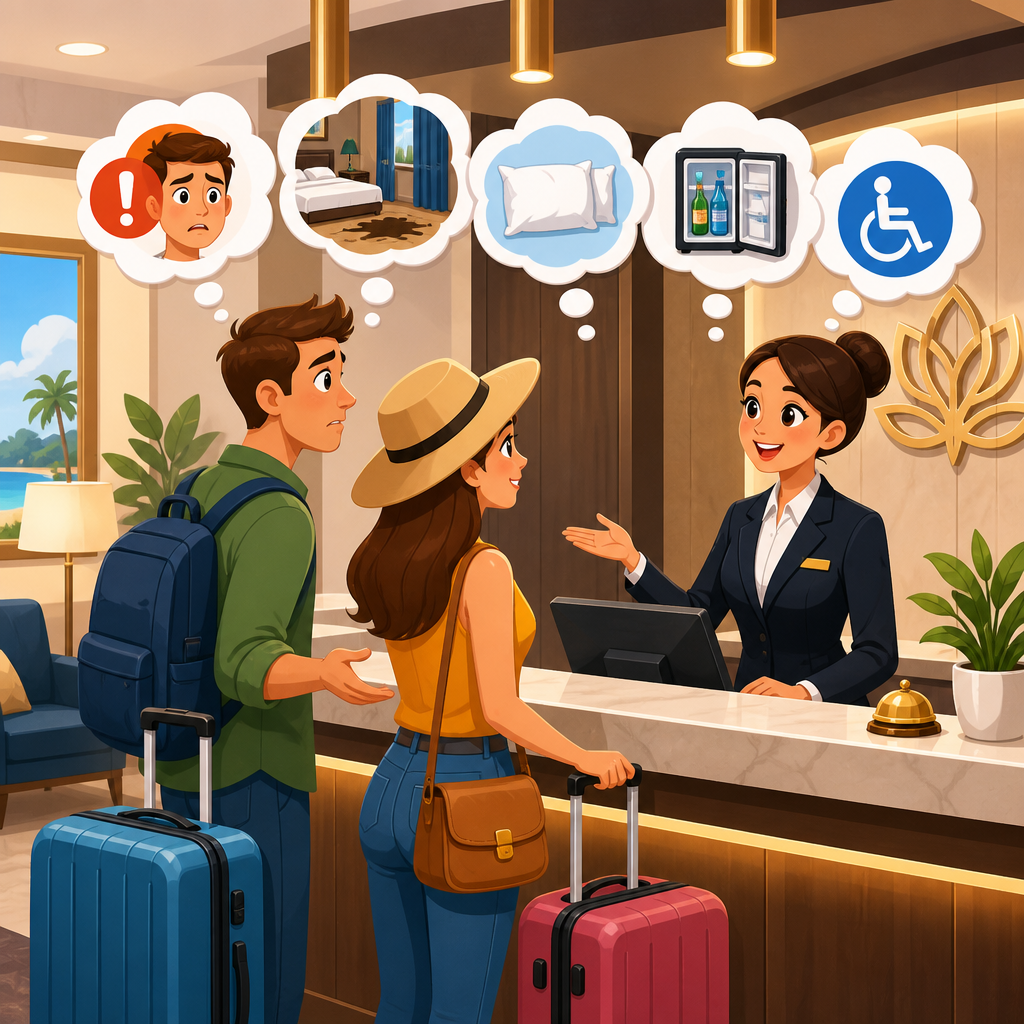
English for hotel check-in problems and special requests is a practical set of phrases, questions, and listening skills that helps travelers solve issues at the front desk quickly and politely. At check-in, even simple mistakes can create stress: a missing reservation, the wrong room type, an early arrival, a credit card problem, or a request for a quiet room, late checkout, or extra bedding. I have worked with adult English learners preparing for real trips, and the same pattern appears every time: students often know travel vocabulary, but they struggle when the conversation changes unexpectedly. That is why this topic matters. Hotel staff usually speak fast, use standard service language, and expect short, clear answers. Guests need English that is direct enough to fix the problem, but polite enough to keep the interaction cooperative.
In this context, check-in means the process of arriving at a hotel, confirming a booking, showing identification, providing payment, and receiving a room key. A special request is any reasonable preference beyond the basic reservation, such as a high floor, twin beds, an accessible room, a crib, or a room away from the elevator. A check-in problem is any mismatch between what was booked and what is available or recorded in the system. Common examples include “I booked a double room, but this says single,” “The reservation is under a different name,” or “I requested non-smoking, but this room smells like smoke.” Good English for hotel check-in problems and special requests focuses on four things: explaining the issue, giving proof, asking for a solution, and confirming the result. When travelers can do those four things well, they save time, avoid misunderstanding, and protect their comfort and budget.
Core English for front desk conversations
The most useful hotel English is not complicated grammar. It is predictable, functional language used in a specific order. First, state your purpose: “Hi, I have a reservation under Chen,” or “I’m checking in. The booking should be under Maria Gomez.” Second, identify the problem clearly: “I think there may be a mistake with my booking,” “I reserved a king room, but this shows two twins,” or “I requested early check-in when I booked.” Third, ask for action: “Could you please check again?” “Is there any way to change the room?” “Would it be possible to store my luggage until the room is ready?” Finally, confirm the solution: “So the breakfast is included, correct?” “Just to confirm, checkout is at noon?” “You’ll send housekeeping with extra towels?”
Politeness matters because hotel staff often have discretion. In my experience, learners who sound calm and precise get better results than those who use long explanations or emotional language. Useful softening phrases include “I’m sorry, but…,” “I think there’s been a misunderstanding,” “Would it be possible…,” and “Could you help me with this?” These phrases reduce tension without weakening your message. At the same time, guests should avoid vague language. Instead of saying “There’s something wrong,” say “The rate is different from my confirmation email,” or “The room is next to the elevator, and I requested a quiet room.” Specific language gives the receptionist a clear path to solve the issue.
Travelers also need to understand common front desk questions. Staff may ask, “May I see your passport?” “Can I have the card used for booking?” “Was breakfast included in your rate?” “Would you like one key or two?” or “Could you spell your last name?” If you do not understand, the best response is simple: “Could you say that again, please?” “Could you speak a little more slowly?” or “Do you mean the card I used online?” Asking for repetition is better than pretending to understand and accepting the wrong room or rate. For broader appointment and service-call language practice, the main guide at 5 Minute English teaches the same clear habits: identify yourself, state the issue, ask direct questions, and confirm details.
Common check-in problems and the exact phrases to use
Most hotel check-in problems fall into a small number of categories, and each one has standard English. If the hotel cannot find your reservation, say, “I have a confirmation email here. The reservation number is 458216,” or “It may be under my first name, not my family name.” If the dates are wrong, say, “I booked from June 14 to June 17, but this shows only two nights.” If the room type is wrong, use the exact booking term: “I reserved a double room with two beds,” “I booked a king room,” or “I paid for a sea-view room.” Exact room vocabulary matters because words like double, twin, queen, king, adjoining, and accessible have operational meanings in hotel systems.
Payment issues are also common. Sometimes the room is prepaid, but the desk still requests payment for the stay. In that case, say, “My booking was prepaid. This charge should be only for incidentals, correct?” If the hotel needs a security deposit, ask, “How much is the hold, and when is it released?” That distinction is important. A hold is not the same as a final charge, and many travelers confuse the two. Another frequent issue is tax and fee confusion. Say, “Could you break down the total for me?” or “Are city tax and service fee included in this amount?” Those questions are practical because rates shown on booking platforms may exclude local taxes or destination fees depending on the country and platform policy.
When a room is not ready, a strong response is polite but specific: “I understand check-in starts at 3 p.m. Is there any room available now?” “If not, could you store my bags?” or “Could you let me know as soon as the room is ready?” If the assigned room has a problem after you receive the key, return to the desk and describe facts, not feelings: “The air conditioning isn’t working,” “The room hasn’t been cleaned yet,” “There is too much noise from the street,” or “The smoke detector is beeping.” Hotels respond faster when the issue is concrete and verifiable. In large chains, front desk agents often log maintenance tickets, room moves, and compensation in a property-management system, so precision helps both sides.
How to make special requests that actually work
Special requests are more successful when travelers understand the difference between a request and a guarantee. In most hotels, items like a high floor, a room away from the elevator, connecting rooms, or early check-in are preferences, not promises, unless the rate or room category specifically guarantees them. Good English reflects that reality. Say, “I requested a quiet room when I booked. If possible, could I have a room away from the elevator?” or “I know early check-in depends on availability, but is anything ready now?” This wording shows you understand the limit while still making the request clearly.
Timing is important. The best moment to repeat a request is at check-in, when the receptionist can still see available rooms. I advise learners to use a three-part structure: reminder, reason, and flexibility. For example: “I noted a feather-free room on my booking because I have an allergy. Is that available?” or “I requested a crib because we’re traveling with a baby. If a crib isn’t available, do you have any alternative?” Giving a brief reason can help staff prioritize the request, especially for accessibility, allergies, or family needs. You do not need a long story; one sentence is enough.
| Situation | Useful phrase | Why it works |
|---|---|---|
| Quiet room | “If possible, could I have a room away from the elevator?” | Specific and realistic |
| Late checkout | “Would it be possible to check out at 1 p.m. instead of noon?” | Names the exact time |
| Bed type change | “Do you have any rooms with one king bed instead of two twins?” | Uses standard room terms |
| Accessibility | “I need an accessible room with a roll-in shower.” | States a non-negotiable requirement |
| Extra items | “Could someone bring two extra pillows and one blanket?” | Clear quantity and item names |
Some requests are best made with follow-up questions. If you need late checkout, ask whether there is a fee. If you need parking, ask whether it is self-parking or valet. If breakfast matters, ask for hours, location, and whether it is included for every guest in the room. Precision prevents disappointment later. Travelers should also know that “subject to availability” is service-industry shorthand for “possible, but not certain.” When you hear it, respond with, “I understand. Could you please note the request again?” That keeps the conversation professional and increases the chance of a positive result.
Listening for key details and confirming the solution
The final skill is confirmation. Many check-in problems are solved, then recreated by poor listening. Before leaving the desk, confirm the essentials: room number, floor, breakfast, Wi-Fi, deposit, checkout time, and any promised follow-up. Say, “Just to confirm, the late checkout is approved for 1 p.m.?” “The total charge today is only the deposit?” or “Housekeeping will bring the crib within 20 minutes?” These questions may feel repetitive, but they prevent disputes. In training sessions, I have seen even advanced learners misunderstand “complimentary” as “included in the room rate” in one moment and “free only for one guest” in another. Confirmation removes ambiguity.
If the answer is no, ask about alternatives rather than ending the conversation. “If a room change isn’t possible tonight, could someone check tomorrow?” “If breakfast isn’t included, is there a discounted rate for guests?” “If there’s no late checkout, could you hold my luggage after noon?” This approach keeps the interaction productive. Good English for hotel check-in problems and special requests is not about sounding perfect. It is about getting a usable result through clear, polite, exact communication. Practice the phrases before your trip, keep your confirmation email accessible, and use specific words at the front desk. That small preparation makes travel smoother, cheaper, and far less stressful. On your next stay, learn five key phrases, rehearse them aloud, and use them with confidence.
Frequently Asked Questions
What should I say in English if the hotel cannot find my reservation at check-in?
If the front desk cannot find your reservation, stay calm and speak clearly. A useful first sentence is: “Hi, I have a reservation under the name [your name].” If they still cannot locate it, you can say: “Could you please check again?” or “It might be under a different spelling.” Many check-in problems happen because of small spelling differences, booking through a third-party website, or confusion about the check-in date. It also helps to say: “I booked it for [date] for [number] nights,” and “I have my confirmation email here if that helps.”
In a real travel situation, the most effective English is polite, direct, and specific. You do not need advanced grammar. What matters is giving the receptionist the exact details they need: your full name, arrival date, number of nights, and booking reference number. If you booked through a travel app or agency, say: “I booked through [website/app],” because the hotel may need to search a different system. If the problem continues, ask: “Could you tell me what the issue is?” or “Is the reservation in the system under another name?”
It is also smart to prepare for the next step. If the hotel truly cannot find the booking, ask practical questions such as: “Do you have any rooms available tonight?” “Can you contact the booking company?” or “What can we do to solve this now?” These phrases show that you want a solution, not an argument. For English learners, this is an important travel skill: describe the problem briefly, provide evidence, and ask focused follow-up questions. That approach reduces stress and helps the conversation move toward a quick resolution.
How can I explain that I received the wrong room type and ask for a change?
If your room does not match what you booked, the best approach is to explain the difference clearly and politely. You can say: “I’m sorry, but I booked a double room, and this looks like a single,” or “I reserved a non-smoking room, but this room smells like smoke.” Other common examples include bed type, view, accessibility features, or room size. A direct but respectful sentence works well: “I think there may be a mistake with my room assignment.”
When speaking to the front desk, be specific about what you expected and what you actually received. This makes your English more effective than simply saying, “This room is wrong.” For example, say: “I booked a room with two beds, but this room only has one bed,” or “I requested a quiet room, but this room is next to the elevator.” If possible, mention your confirmation: “My confirmation says a king room with a city view,” or “I requested an accessible room when I booked.” Specific language helps staff understand whether the issue is a simple room mix-up or a request based on a medical, family, or comfort need.
Then move to the request itself. Good phrases include: “Would it be possible to change rooms?” “Do you have the room type I originally booked?” and “Could you help me find a better option?” If the hotel is full, you can ask: “Is there another room available later today?” or “Can you put me on a waiting list for a room change?” In travel English, being polite does not mean being weak. It means making your request in a professional way that front desk staff can respond to quickly. Clear comparisons, calm tone, and practical questions usually lead to the best outcome.
What are the most useful English phrases for arriving early and requesting early check-in?
Early arrival is one of the most common check-in situations travelers face. If you arrive before the official check-in time, begin with a simple request: “Hi, I know I’m early, but is it possible to check in now?” This sentence is polite because it shows you understand the hotel’s normal policy. You can also say: “I realize check-in is at 3:00, but I wanted to ask whether my room might be ready earlier.” This sounds natural, respectful, and confident.
If your room is not ready, do not stop the conversation there. Ask useful follow-up questions such as: “What time do you expect the room to be ready?” “Could you store my luggage until then?” or “Is there a place where I can wait?” These questions are extremely practical and often more important than the early check-in request itself. In many hotels, staff may not be able to guarantee immediate access to the room, but they can still help by holding your bags, giving you access to the lobby, or notifying you when the room is ready.
If early check-in is especially important because of a long flight, a child, jet lag, or a work meeting, you can explain that briefly: “I just arrived from an overnight flight, so I’d really appreciate any early check-in if possible.” The key phrase here is “if possible,” which keeps the request polite. You should also be prepared to hear common staff responses such as “We’ll do our best,” “Housekeeping is still cleaning the room,” or “There may be an extra fee.” Understanding these phrases is part of strong travel listening skills. Good travel English is not only about what to say, but also about recognizing hotel policies and responding calmly when the answer is not immediate.
How do I talk about a credit card problem or payment issue at the front desk?
Payment issues can feel stressful, especially after a long trip, but clear English can make them easier to solve. If your card does not work, you can say: “It looks like there’s a problem with my card,” or “My card should be valid. Could you tell me why it was declined?” These phrases are useful because they focus on the situation without sounding defensive. Sometimes the issue is not the card itself, but the type of card, a bank security block, an authorization hold, or a mismatch between the cardholder name and the reservation name.
Ask direct questions to understand the exact problem. For example: “Do you need the same card I used for the booking?” “Is this for payment or just for a security deposit?” “Can I use a different card?” and “Do you accept debit cards or cash?” These questions are especially important because hotels often use specific payment procedures at check-in. Some travelers expect to pay only at checkout, while others do not realize the hotel may place a temporary hold on the card. Knowing how to ask about these details can prevent confusion and extra stress.
If you need time to fix the issue, stay solution-focused. You can say: “Let me contact my bank,” “I have another card I can try,” or “Could you explain the amount being charged?” If your booking was prepaid through a third-party site, mention that clearly: “This reservation was already paid online. Could you check whether this card is only needed for incidentals?” That sentence is particularly useful because prepaid bookings often still require a card for security. In practical travel English, the goal is not to sound formal; it is to ask the right questions, understand the hotel’s process, and keep the conversation moving toward a workable solution.
How can I make special requests like a quiet room, late checkout, or extra bedding in polite English?
Special requests are very common, and polite English makes them much easier to handle. A strong general phrase is: “Would it be possible to request…?” For example, “Would it be possible to request a quiet room?” “Would it be possible to get late checkout?” or “Could we have an extra blanket and an extra pillow?” These forms are useful because they sound respectful and natural at hotels in English-speaking environments. They also work well whether you are asking before check-in, during check-in, or after you enter the room.
When making special requests, be specific and realistic. If you want a quiet room, say: “If possible, could I have a room away from the elevator?” or “Do you have a room on a higher floor?” If you need late checkout, ask: “What time is standard checkout, and would late checkout be available tomorrow?” If you need extra bedding, be exact: “Could we have an extra duvet?” “Is it possible to get a rollaway bed?” or “Could you send up bedding for the sofa bed?” This kind of practical vocabulary matters because “extra bedding” can mean different things in different hotels.
It is also helpful to know that special requests are often subject to availability, so you may hear phrases like “We can’t guarantee that,” “There may be an additional charge,” or “We’ll note the request.” If that happens, ask a follow-up question: “When will you know if it’s available?” “Could you let me know later today?” or “Is there an alternative option?” This keeps the conversation productive. For adult English learners preparing for real trips, this is exactly the kind of language that builds confidence: short, polite requests; clear details; and good listening for the hotel’s response. In real hotel situations, that combination helps you solve problems quickly while sounding calm, courteous, and capable.