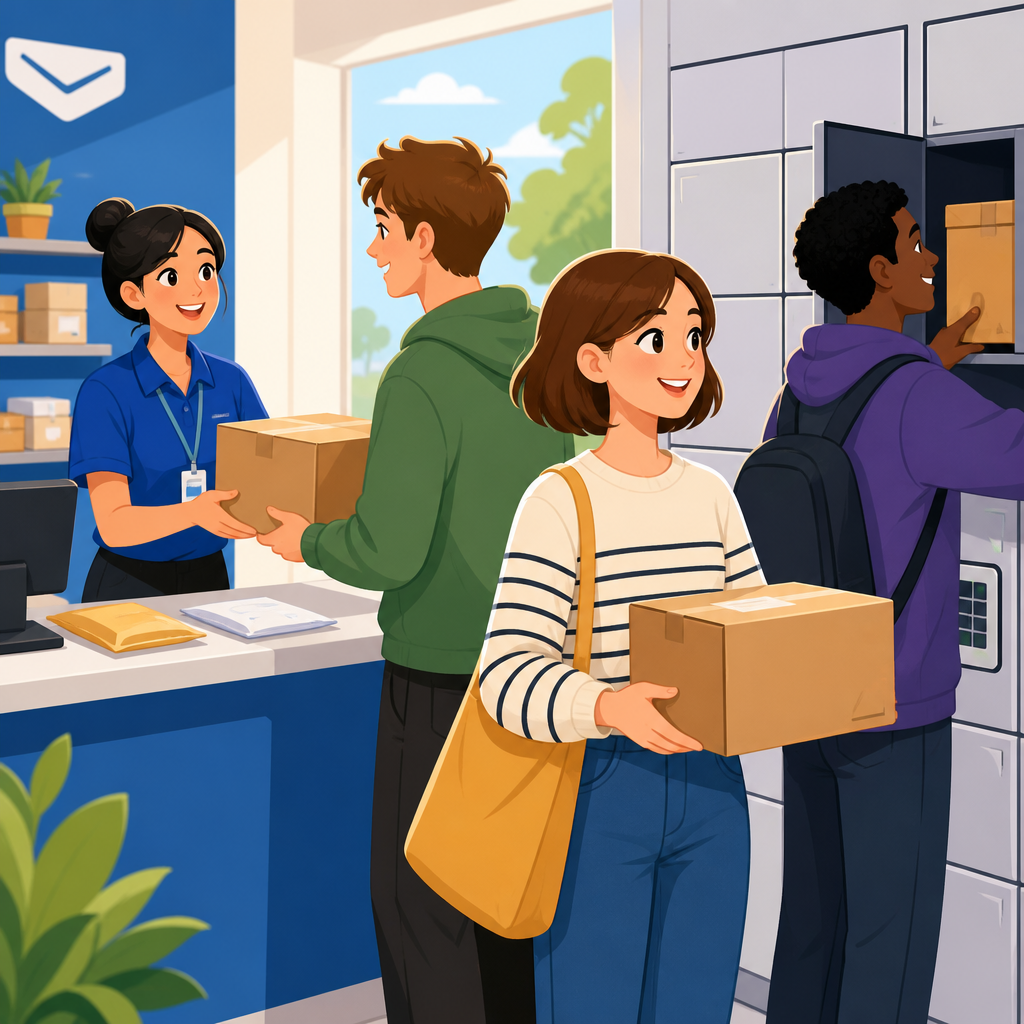
English for package pickup, drop-off, and locker help matters because shipping is now part of ordinary life, yet many English learners still feel stuck when a clerk asks a fast question, a locker screen gives unclear instructions, or a courier leaves a missed-delivery notice. In this context, package pickup means collecting a parcel from a counter, store, post office, or secure locker; drop-off means handing over a prepaid return or outgoing shipment; locker help refers to the language needed when a code fails, a compartment will not open, or identification is required. I have coached adults through these exact moments, and the problems are usually not grammar mistakes. The real issue is knowing the standard phrases, documents, and short responses that shipping staff use every day.
This topic matters for three practical reasons. First, package problems are time-sensitive. A parcel may be held for only seven days, a locker code may expire, or a return label may need same-day scanning. Second, the language is compressed. Staff often say, “ID and tracking, please,” “Is this QR or label-based?” or “The item is oversize for the locker.” Third, there are consequences for misunderstanding. If you answer “yes” when the clerk asks whether the parcel contains lithium batteries, liquids, or fragile items, you may trigger extra rules or refusal. Clear English helps you avoid delay, extra fees, and repeated trips.
To succeed, you need more than isolated vocabulary. You need usable scripts, awareness of shipping procedures, and confidence with common tools such as tracking numbers, QR codes, barcodes, return merchandise authorization numbers, and government-issued identification. Major carriers and retail pickup points follow similar patterns even when brand names differ. Whether you are dealing with Royal Mail, USPS, UPS, FedEx, DHL, Amazon lockers, InPost, Evri, or a local convenience store counter, the conversation usually follows a predictable sequence: identify the package, verify the recipient, scan a code, confirm the service, and resolve any exception. Once you know the sequence, the English becomes manageable.
Core English for package pickup at counters and collection points
At a staffed pickup location, the first goal is to state what you need in one sentence. The clearest opening lines are: “I’m here to pick up a package,” “I’m collecting a parcel for this address,” or “I got a delivery notice and I’m here to collect the item.” If you have a message on your phone, add: “I have the pickup code and tracking number.” Staff then usually ask for identification, the recipient’s name, or the delivery notice. A strong response is: “The package is under Maria Gomez,” “Here’s my photo ID,” or “The notice says the parcel was redirected here.” Short, direct language works better than long explanations at a busy counter.
You should also recognize the exact questions clerks ask. Common ones include: “Can I see your ID?” “Is the parcel in your name?” “Do you have the tracking number?” “Was this sent to a pickup point?” and “Are you authorized to collect it for someone else?” The best strategy is to answer with both the information and the next useful detail. For example: “Yes, it’s in my name. The tracking number ends in 4821.” Or: “I’m picking it up for my husband. I have his authorization email and both IDs.” In practice, this reduces back-and-forth and speeds up service.
Problems at pickup are also predictable. Sometimes the parcel is scanned into the wrong shelf, not yet processed, or held because the name does not exactly match the label. In that case, use problem-solving phrases: “The app says it’s ready for pickup, but I may be early,” “Could you check under a shortened first name?” “The address matches, but the surname is missing a letter,” or “Can you tell me what document you need from me?” That final question is especially useful because it moves the conversation from confusion to a specific requirement.
Useful English for drop-off, returns, labels, and special shipment questions
Drop-off language is different because you are starting the transaction, not finishing it. Say, “I need to drop off this prepaid return,” “This package already has a label,” or “I need to send this item and buy postage.” Those three sentences cover most situations. The clerk will then ask whether the item is prepaid, domestic or international, boxed or unboxed, and whether a QR code can be scanned to print the label. If you are not sure, say, “The seller emailed me this QR code for the return,” or “I printed the label at home, but I still need a receipt.” Always ask for a receipt, because the acceptance scan is your proof that the carrier took possession of the package.
When sending a package, staff may ask content and safety questions. These are not casual. Carriers follow rules on hazardous materials, restricted items, customs declarations, and packaging standards. You may hear: “Does it contain batteries, liquids, perfume, or anything fragile?” “What is the value of the contents?” or “Do you need signature confirmation?” Answer factually. A good model is: “It contains clothing only, no batteries or liquids,” “The declared value is sixty dollars,” or “Yes, I’d like tracking and signature confirmation.” If you do not understand a term, ask directly: “What does signature confirmation include?” That is better than guessing.
Returns create their own vocabulary. Learn these terms: return label, merchant barcode, drop-off receipt, refund processing, original packaging, and inspection. In many shops, the refund is not immediate; the seller issues it after the package is scanned at a warehouse. Explain your goal clearly: “I’m returning this because it arrived damaged,” “The seller said no box is required,” or “Can you confirm this scan will start the refund process?” For broader appointment and phone language used in service situations, a helpful companion guide is this practical English resource, especially if you are also building confidence asking questions under time pressure.
Locker help: screens, codes, failed doors, and support requests
Lockers are convenient, but they create a different kind of English challenge because the first interaction is often with a screen, not a person. Typical instructions include “Enter pickup code,” “Scan QR code,” “Collect all items before closing the door,” “Oversize item redirected,” and “Compartment empty? Report an issue.” Read every line before tapping. Many users press too quickly and miss a warning that the package was placed in multiple compartments or moved to a service counter. If the code fails, use exact language when calling or chatting with support: “The pickup code is being rejected,” “The locker door opened, but the compartment was empty,” or “The screen says the parcel has already been collected, but I did not pick it up.”
Support teams usually need four pieces of information: tracking number, locker location, time of attempted pickup, and the phone number or email linked to the order. Give them in that order. For example: “My tracking number is 1Z45…, the locker is at Central Station, I tried at 6:20 p.m., and the order is linked to this email.” Precise details matter because locker systems log every door opening, scan event, and code attempt. In my experience, customers who provide exact times get faster help because agents can match the event in the system instead of starting with general troubleshooting.
| Situation | Best English phrase | Why it works |
|---|---|---|
| Code does not work | “The pickup code is invalid even though the app says ready for collection.” | States the contradiction clearly. |
| Door opened to wrong box | “The compartment opened, but my package was not inside.” | Describes the exact failure. |
| Need more time | “Can you extend the pickup window by one day?” | Makes a specific request. |
| Item too large | “Was the parcel redirected to a staffed pickup point because it was oversize?” | Shows you understand common locker exceptions. |
Another common problem is authorization. Some lockers allow only the original phone number to retrieve the parcel, while others permit forwarding the code. If you are collecting for someone else, ask before traveling: “Can this code be shared, or does the system require the named recipient’s phone?” If support moves the package, confirm the next step: “Will I receive a new code, or should I bring ID to the counter location?” This kind of confirmation prevents the most frustrating outcome: arriving with the wrong document for the new pickup method.
Polite repair strategies when you do not understand the clerk or the system
The most useful skill is not perfect pronunciation; it is repair language. Repair language helps you recover when you miss a word, hear a fast question, or need the speaker to repeat a detail. Use these lines naturally: “Could you say that again more slowly?” “Did you say tracking number or pickup number?” “Can you point to the option on the screen?” “I want to make sure I understood: you need my ID and the QR code, right?” and “What is the next step after this scan?” These phrases are efficient and respectful, which is exactly what busy shipping environments require.
Pronunciation matters most with letters, numbers, and names. Read tracking details in chunks, not as one long string. Say, “It’s ABT, seven four nine, six one,” then pause. If a clerk mishears a letter, use the phonetic alphabet when necessary: “B as in Bravo, D as in Delta.” Many frontline staff already use this system because it reduces errors in alphanumeric references. For names and addresses, spell proactively if the environment is noisy. I have seen simple spelling save several minutes when the package is filed under a slightly different version of a surname.
Finally, remember the practical habits that support clear English. Keep your ID, pickup email, code, and tracking number open before you reach the counter. Screenshot locker codes in case mobile service is weak. Check whether the label is attached flat and fully visible. Bring any required authorization if collecting for another person. Most important, ask for confirmation at the end: “So the package has been accepted and scanned, correct?” or “Just to confirm, I need to return tomorrow with this notice and photo ID.” Clear closing questions prevent repeat visits.
English for package pickup, drop-off, and locker help becomes easier when you treat each interaction as a predictable sequence: identify the item, verify the person, complete the scan, and solve exceptions with direct language. The key phrases in this article are practical because they match real shipping workflows used by carriers, retailers, and locker providers. When you can state the problem clearly, answer safety and identity questions accurately, and ask for the next step, you save time and avoid costly misunderstandings.
The main benefit is confidence in a routine task that often feels stressful only because it moves quickly. Learn a small set of standard expressions, keep your documents ready, and use repair phrases whenever something is unclear. Review these scripts before your next pickup or return, and practice saying them aloud so they feel natural when you need them most.
Frequently Asked Questions
1. What English phrases should I know for package pickup at a post office, store counter, or pickup point?
If you are picking up a package, the most useful English is simple, direct, and polite. In most situations, you can start with: “Hi, I’m here to pick up a package,” or “I’m here to collect a parcel.” The clerk may then ask for your name, tracking number, pickup code, or photo ID. Common questions include: “What’s the name on the package?”, “Do you have your ID?”, “Can I see the pickup notice?”, and “Do you have the tracking number?” It helps to be ready with short answers such as: “Yes, here’s my ID,” “The package is under Maria Gomez,” or “I have the code on my phone.” If you did not understand what the employee said, a useful response is: “Sorry, could you repeat that more slowly?” or “Can you please show me where I need to sign?”
You should also recognize common pickup-related vocabulary. “Pickup location” means the place where your parcel is being held. “Counter” is the service desk. “Signature required” means you must sign before receiving the package. “Held for pickup” means the item is waiting for you. “Missed delivery” means the courier tried to deliver it but could not complete the delivery. If there is a problem, you may hear: “We can’t release the package without ID,” “The package hasn’t arrived yet,” or “It was transferred to another location.” In those moments, calm, practical English is best: “Could you tell me which location has it now?”, “When will it be available?”, or “What document do I need to bring?” Knowing these phrases can make package pickup much less stressful and helps English learners handle real-world shipping situations with more confidence.
2. How can I speak clearly and confidently when dropping off a prepaid return or outgoing package?
For drop-off, you usually do not need complicated English, but you do need the right key phrases. If the label is already attached, you can say: “Hi, I’d like to drop off this package,” or “This is a prepaid return.” If you are sending a package that is not fully prepared, you may need to ask: “Can you help me mail this package?”, “Do I need to fill out a form?”, or “Can I buy packaging here?” A clerk may ask whether the item is prepaid, where it is going, or whether it contains anything fragile, valuable, liquid, or hazardous. Useful answers include: “Yes, the shipping label is already printed,” “It’s a return for an online order,” and “No, it doesn’t contain anything dangerous.”
It is also important to understand the language of confirmation. If you want proof that you dropped off the package, ask: “Can I get a receipt for the drop-off?” or “Could you scan it and give me a confirmation?” That receipt is important because it shows the time, date, and acceptance scan. If you are returning an item, you may also hear “merchant return,” “prepaid label,” “drop-off receipt,” and “acceptance scan.” If the worker says, “This location doesn’t accept that carrier,” they mean the company at that counter cannot process your shipment. In that case, you can ask: “Where is the nearest location that accepts this label?” Good drop-off English is not about sounding advanced. It is about being able to confirm what is happening, make sure your package was accepted properly, and leave with the information you need for tracking and peace of mind.
3. What should I do if a package locker screen is confusing or I do not understand the instructions?
Package lockers are convenient, but they can be difficult for English learners because the instructions are often short, fast, and full of technical terms. The first thing to do is look for familiar words such as “pickup,” “scan code,” “enter PIN,” “open door,” “close compartment,” and “confirm.” These are the most common actions. If the locker says “Enter access code,” it wants the pickup code sent by text or email. If it says “Scan barcode,” hold your phone or printed code under the scanner. If the message says “Compartment timed out,” it usually means the locker door was open too long and you need to restart the process. Understanding these small phrases can prevent a lot of confusion.
If you still do not understand, use practical help language. If a store employee is nearby, say: “Could you help me use this locker?”, “I’m not sure what this message means,” or “The screen says my code is invalid.” If there is a support button or phone number, explain the issue clearly: “I’m at the locker, but it won’t open,” “I entered my code, but nothing happened,” or “The package may be in the wrong compartment.” It is also useful to know that “invalid code” means the code was not accepted, “expired pickup window” means you waited too long, and “out of service” means the locker is temporarily unavailable. In many cases, the problem is not your English at all. It may be a technical error, a delayed scan, or a locker malfunction. The best approach is to describe exactly what you see on the screen and ask for the next step.
4. How do I understand a missed-delivery notice or a message saying my package could not be delivered?
A missed-delivery notice usually means the courier attempted delivery but could not complete it. This may happen because nobody was home, a signature was required, the address was incomplete, access to the building was not possible, or the driver considered the location unsafe or inaccessible. Common English on these notices includes “Delivery attempted,” “No authorized recipient available,” “Signature required,” “Final notice,” “Held at pickup location,” and “Redelivery available.” If you receive one of these messages, the most important thing is to identify what action is required. You may need to pick up the parcel, schedule another delivery, call customer service, or update the delivery instructions.
When speaking to a clerk or support agent, use direct questions: “Can you tell me why delivery was missed?”, “Is the package being held for pickup?”, “Can I schedule redelivery?”, and “What identification do I need?” If the notice says “held at local depot” or “available at pickup point,” that means the package is waiting at another location. If it says “return to sender,” the package may be sent back to the shipper if you do not act in time. You should also pay attention to deadlines such as “pickup by Friday” or “will be returned after 5 days.” A missed-delivery message can sound frustrating or formal, but the English needed to solve it is usually very practical: confirm where the package is, what caused the failed delivery, and what your next available option is. That is the fastest way to turn a confusing notice into a clear plan.
5. What are the most important shipping and locker vocabulary words English learners should memorize?
The best vocabulary to memorize is the kind you will actually see and hear again and again. Start with core nouns: “package,” “parcel,” “shipment,” “label,” “tracking number,” “receipt,” “pickup code,” “counter,” “locker,” “compartment,” “courier,” “carrier,” and “delivery notice.” Then learn key verbs: “pick up,” “drop off,” “ship,” “mail,” “scan,” “sign,” “track,” “return,” “deliver,” “hold,” and “release.” These words appear in nearly every package-related situation, whether you are talking to a clerk, reading an email, or following a locker screen. Once you know them, even short instructions become much easier to understand.
It is also smart to memorize problem-solving terms because those are the words people often panic over. Important examples include “prepaid,” “signature required,” “invalid code,” “delayed,” “attempted delivery,” “out for delivery,” “held for pickup,” “return to sender,” “lost package,” “damaged,” and “proof of drop-off.” Try not just to memorize each word alone, but to learn it inside a useful sentence. For example: “This is a prepaid return,” “I need proof of drop-off,” “The tracking number isn’t updating,” or “My package is being held for pickup.” This method helps you move from passive understanding to active communication. For English learners dealing with package pickup, drop-off, and locker help, strong vocabulary is not just academic. It is a practical tool that helps you ask better questions, understand instructions faster, and solve shipping problems with less stress.