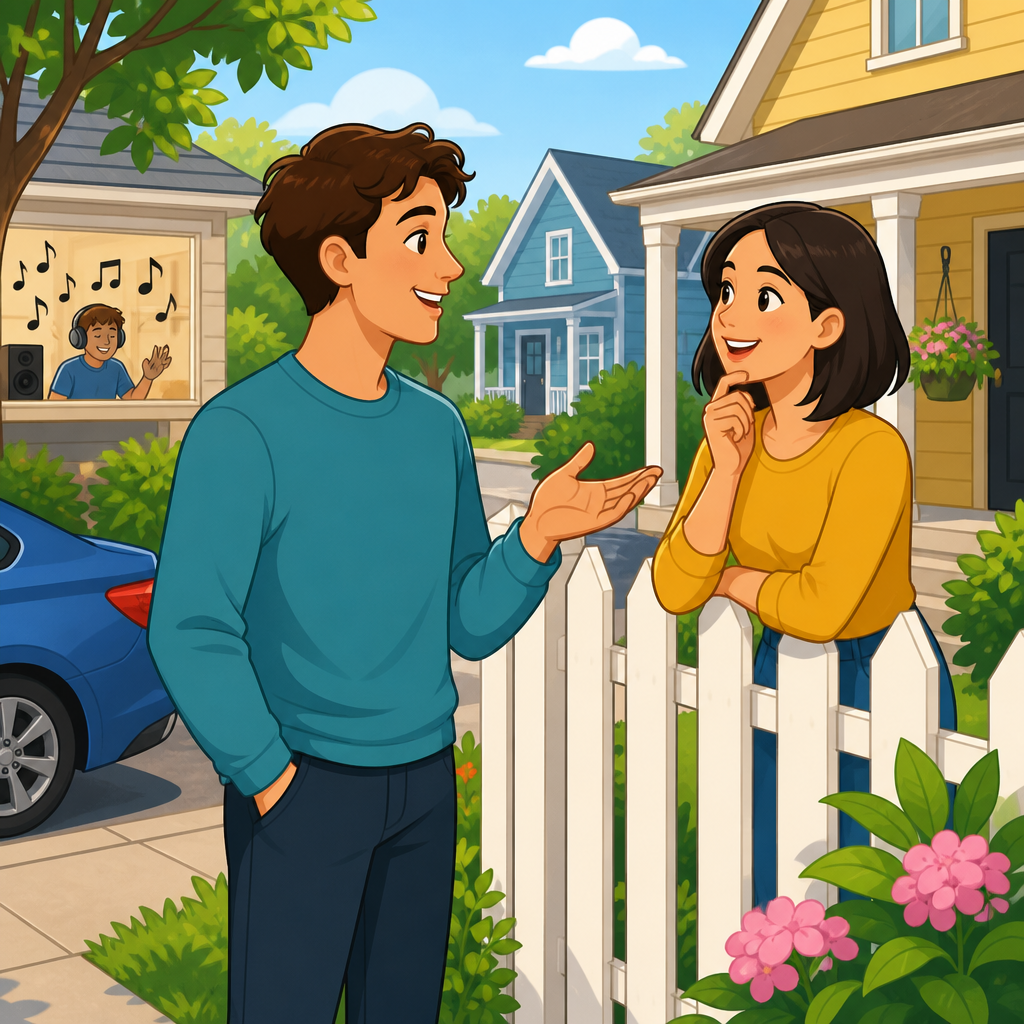
English for talking to neighbors about noise or parking is a practical communication skill that helps prevent small frustrations from turning into lasting conflict. In everyday life, noise complaints and parking misunderstandings are among the most common sources of tension between people who otherwise want to get along. The right words matter because they shape whether a conversation feels respectful, aggressive, apologetic, or cooperative. When I have helped adult English learners prepare for real housing conversations, these two topics come up repeatedly because they involve emotions, rules, and shared space all at once. A calm sentence can solve a problem in five minutes; a careless one can damage trust for months.
In this context, noise usually means loud music, television, parties, footsteps, barking dogs, construction, or late-night visitors. Parking can mean blocking a driveway, using someone else’s assigned space, parking too close, leaving a car in a guest area too long, or misunderstanding street rules. Talking to neighbors about noise or parking requires more than vocabulary. You need softening phrases, clear requests, time references, and language that separates the problem from the person. Instead of sounding accusatory, effective English focuses on facts: what happened, when it happened, how it affected you, and what change you are asking for.
This matters for renters, homeowners, roommates, and anyone living in an apartment building, townhouse complex, or crowded street. It also matters because many housing systems have formal escalation paths, from homeowners associations to landlords and city parking enforcement, and those systems work better when you first communicate clearly. Good spoken English can protect relationships and create a record of reasonable behavior if the issue continues. The goal is not to “win” an argument. The goal is to solve the problem while staying polite, direct, and confident.
Core phrases for starting the conversation politely
The best opening is short, neutral, and specific. Start with a greeting, then mention the issue without blame. Useful openers include: “Hi, do you have a minute?” “I wanted to talk to you about something small.” “I’m sorry to bother you, but I wanted to mention the noise last night.” “I think there may have been a mix-up with the parking space.” These sentences work because they reduce defensiveness. In my experience, learners often begin too strongly with “You are always…” or “You need to stop…,” which almost guarantees resistance.
Softening language is especially important. Phrases like “a bit,” “kind of,” “it seems,” and “I was wondering if” make requests sound more cooperative. For example, “Your music was too loud” is understandable, but “I was wondering if you could turn the music down a bit after 10 p.m.” is more likely to get a good response. For parking, compare “Don’t park there again” with “I think that spot is assigned to my apartment, so could you please use the guest area instead?” The second version is direct but respectful.
You also need clear time and place language. Say “around midnight,” “this morning,” “for about an hour,” “in front of my driveway,” or “in space 14 by Building C.” Precise language prevents arguments about what actually happened. If your neighbor says, “What noise?” you can answer, “The TV was quite loud between 11:30 and 12:15.” If the issue is parking, “Your car was blocking the left side of my driveway” is much stronger than “You parked badly.” Specific details help keep the conversation practical rather than personal.
Useful English for noise complaints that stays calm
When discussing noise, explain the impact on you without exaggeration. Good models are: “I had trouble sleeping because the music was loud after 11.” “I’m working from home today, and the drilling is making it hard to take calls.” “Your dog has been barking for a long time this morning, and I wanted to let you know.” These statements use what communication trainers often call “I” framing. You describe your experience instead of attacking character. That approach lowers conflict and keeps the focus on a fix.
If the issue is recurring, acknowledge the pattern carefully. You can say, “This has happened a few times over the past two weeks,” or “I’ve noticed the parties have been going later recently.” Avoid absolute language such as “always” and “never” unless it is literally true. Absolutes sound emotional and are easy to challenge. A better request is, “Could you keep it down after 10 p.m. on weekdays?” That gives your neighbor a practical action. In many cities, local quiet hours begin around 10 or 11 p.m., though exact rules vary, so mentioning the time is both polite and reasonable.
If your neighbor responds defensively, stay with facts. Say, “I understand, and I’m not asking for total silence. I’m just asking for less noise late at night.” This sentence is effective because it sounds balanced. It recognizes normal living sounds while setting a boundary. For learners who want more practice with everyday problem-solving English, a useful reference point is the broader communication guide at 5 Minute English, which also shows how polite, structured requests work in stressful situations.
Useful English for parking problems and shared-space misunderstandings
Parking disputes often involve rules, signage, and assumptions. The most effective English names the location and the rule as you understand it. Try: “I think that parking space is assigned to my unit.” “Could you move your car a little? It’s hard for me to get out.” “I wanted to mention that the guest parking area has a two-hour limit.” “Your car was blocking my driveway this morning.” These phrases avoid insults and point directly to the practical issue.
It is helpful to distinguish between a one-time mistake and repeated behavior. For a first incident, use language that leaves room for misunderstanding: “I’m not sure if you knew, but that space belongs to Apartment 6.” “There may have been some confusion about visitor parking.” This wording preserves goodwill. If the problem repeats, become firmer: “This has happened three times this month, and I need the space kept clear.” Firm does not mean rude. It means unambiguous.
Parking conversations also benefit from solution language. Instead of stopping at the complaint, add an alternative: “If your guests need a place to park, the open street spaces on Oak Avenue are usually available after 6 p.m.” Offering a realistic option shows that you want a fix, not a confrontation. In residential communities, this matters because relationships continue long after the immediate inconvenience is over.
What to say, what to avoid, and when to escalate
Most neighbor conversations go better when you follow a simple structure: greeting, issue, impact, request, and next step. The table below shows effective examples.
| Situation | Say this | Avoid this |
|---|---|---|
| Loud music at night | “Hi, could you turn the music down a bit after 10? I’m having trouble sleeping.” | “You’re so inconsiderate.” |
| Blocked driveway | “Your car is blocking my driveway. Could you please move it now?” | “Move your car or else.” |
| Assigned parking space | “I think that spot is assigned to me. Please use the guest area.” | “That’s my spot. Don’t do that again.” |
| Repeated noise issue | “This has happened several times this week. I need it to be quieter after 11.” | “You always ruin everything.” |
There are moments when direct conversation is not enough. If the issue continues, document dates, times, and what was said. Keep notes factual. For noise, record patterns such as “loud bass from 11:45 p.m. to 1:10 a.m.” For parking, note license plate details, location, and duration where lawful and safe to do so. Then follow the proper channel: landlord, building manager, homeowners association, or local authority. Many leases and community rules require residents to attempt informal resolution first, which makes polite initial communication especially valuable.
Safety is the clear limitation. If a neighbor is intoxicated, threatening, or already aggressive, do not continue the conversation in person. Use management, non-emergency municipal reporting, or emergency services when appropriate. Good English helps, but personal safety comes first. In my work with learners, I emphasize that confidence does not mean arguing longer. It means knowing when to stop, when to document, and when to escalate through official systems.
How to practice these conversations until they feel natural
The fastest way to improve is to rehearse complete mini-dialogues aloud. Practice with a friend or record yourself saying three versions: very polite, neutral, and firm. For example: “Hi, sorry to bother you, but the TV was loud last night.” Then: “The TV was loud after 11, and I couldn’t sleep.” Then: “This has happened several times, and I need it to stop after 11.” This progression teaches control. You choose the level that fits the situation instead of reacting emotionally in the moment.
Focus on pronunciation for key courtesy phrases such as “Could you please…,” “Would you mind…,” and “I was wondering if….” Also practice stress on the important facts: time, place, and request. Native speakers often judge tone as much as grammar. A grammatically perfect sentence can still sound angry if spoken too sharply. Slower speed, lower volume, and a neutral facial expression usually improve the outcome.
Learning English for talking to neighbors about noise or parking gives you a practical tool for everyday peace. The essentials are simple: start politely, describe the specific problem, explain the effect, ask for a clear change, and escalate only when necessary. This approach protects relationships while making your message easy to understand. Practice a few key sentences now, so you can use them calmly when a real issue happens. The more prepared you are, the easier it becomes to solve the problem before it grows.
Frequently Asked Questions
1. What are polite English phrases I can use to talk to a neighbor about noise?
Polite language is the best place to start because it lowers tension and shows that you are trying to solve a problem, not start an argument. In English, softening phrases are especially useful when discussing noise. For example, you might say, “Hi, I just wanted to mention something,” “I hope you don’t mind me asking,” or “I’m sorry to bother you, but the music has been pretty loud tonight.” These expressions make your request sound respectful and cooperative. You can also be specific without sounding aggressive by saying, “Would you mind turning it down a little?” or “Could you please keep it a bit quieter after 10 p.m.?”
It also helps to focus on the situation rather than attacking the person. Instead of saying, “You are always too loud,” try, “I’ve been having trouble sleeping because of the noise.” This kind of statement explains the impact on you without blaming your neighbor’s character. If you want to sound even more neighborly, you can add a positive tone, such as, “I understand everyone has guests sometimes,” or “I know it may not have seemed that loud from your side.” These phrases show empathy and often make the other person more willing to listen and cooperate.
2. How can I talk to a neighbor about a parking problem without sounding rude?
Parking can be a sensitive issue because people often feel protective about convenience, personal space, and fairness. A good approach is to describe the problem clearly and calmly while avoiding accusations. For example, you could say, “Hi, I wanted to ask about the parking situation,” followed by, “When that car is parked there, it blocks part of my driveway,” or “It’s hard for me to get out in the morning.” This keeps the focus on the practical issue instead of making the conversation personal. Questions often sound less confrontational than commands, so phrases like “Would it be possible to leave a little more space?” or “Could we figure out a better way to park here?” are useful.
It is also helpful to sound solution-oriented. Instead of only pointing out what is wrong, suggest a workable option: “If you park a little closer to the curb, it would really help,” or “Maybe we can agree to keep this area clear.” This makes the conversation feel like a shared problem-solving moment rather than a complaint. In English, tone matters as much as vocabulary, so even a simple sentence can sound very different depending on how it is delivered. Speaking slowly, using “please” and “thank you,” and avoiding emotionally charged words like “ridiculous,” “selfish,” or “always” can make a big difference in how your message is received.
3. What should I say if I need to complain but want to keep a good relationship with my neighbor?
If your goal is to protect the relationship, the most effective strategy is to be direct but respectful. Many English learners worry that being too direct will sound rude, but being too indirect can also create confusion. A balanced approach works best. You can begin with a friendly opening such as, “Hi, I wanted to talk to you about something small,” or “I hope we can work something out.” Then explain the issue in a neutral way: “The late-night noise has been difficult for me,” or “I noticed the car was blocking the shared space yesterday.” These statements are clear, but they do not immediately put the other person on the defensive.
To maintain goodwill, include language that shows flexibility and understanding. For example, “I know these things happen,” “I’m sure it wasn’t intentional,” or “I just wanted to mention it before it becomes a bigger issue.” This signals that you are trying to prevent conflict, not create it. You can then end with a cooperative request such as, “Do you think we could find a solution?” or “I’d really appreciate your help with this.” This combination of clarity, calmness, and respect is often the key to preserving a positive relationship while still communicating an important concern.
4. How do I respond in English if a neighbor complains to me about noise or parking?
When a neighbor brings up a complaint, your response can either calm the situation or make it worse. A strong first response is to acknowledge the concern, even if you do not fully agree. In English, useful phrases include, “Thanks for letting me know,” “I’m sorry about that,” or “I didn’t realize it was causing a problem.” These responses show maturity and respect. They do not necessarily mean you are accepting all blame, but they help keep the conversation constructive. If the issue was accidental, you can say, “That wasn’t my intention,” or “I’ll be more careful going forward.”
If you need to explain your side, do so without sounding defensive. For instance, “I had guests over last night, but I understand it was late,” or “I thought there was enough space, but I see what you mean.” This type of response combines explanation with acknowledgment. If appropriate, offer a clear next step: “I’ll move the car,” “I’ll turn the volume down,” or “I’ll make sure it doesn’t happen again.” In situations where you cannot fix everything immediately, a phrase like “Let’s try to find a solution that works for both of us” is especially helpful. Good English for these moments is not only about vocabulary; it is about showing that you are listening and willing to cooperate.
5. What common English mistakes should learners avoid when discussing noise or parking issues?
One common mistake is using language that sounds stronger or harsher than intended. For example, saying “You must stop this now” may sound like a threat in everyday neighbor conversation, even if the speaker simply wants the problem to end. Softer alternatives such as “Could you please keep it down?” or “Would you mind moving your car?” are usually more appropriate. Another frequent mistake is overusing words like “always” and “never,” as in “You always make noise” or “You never park properly.” These expressions often make people feel attacked and can quickly escalate a disagreement. More accurate and less emotional language, such as “It has happened a few times” or “This has been a problem recently,” is much more effective.
Another issue is translating directly from one’s first language without considering English tone and social expectations. In many cases, a sentence may be grammatically correct but socially too blunt. For example, “Move your car” is understandable, but “Could you move your car when you have a chance?” sounds much more natural and polite in most neighbor situations. Learners should also avoid vague complaints that do not explain the real problem. Saying “Your parking is bad” is less useful than saying, “When your car is parked there, I can’t open my gate fully.” Clear, specific, polite language leads to better outcomes. In conversations about everyday tension, the goal is not only to be understood, but also to sound calm, respectful, and reasonable.