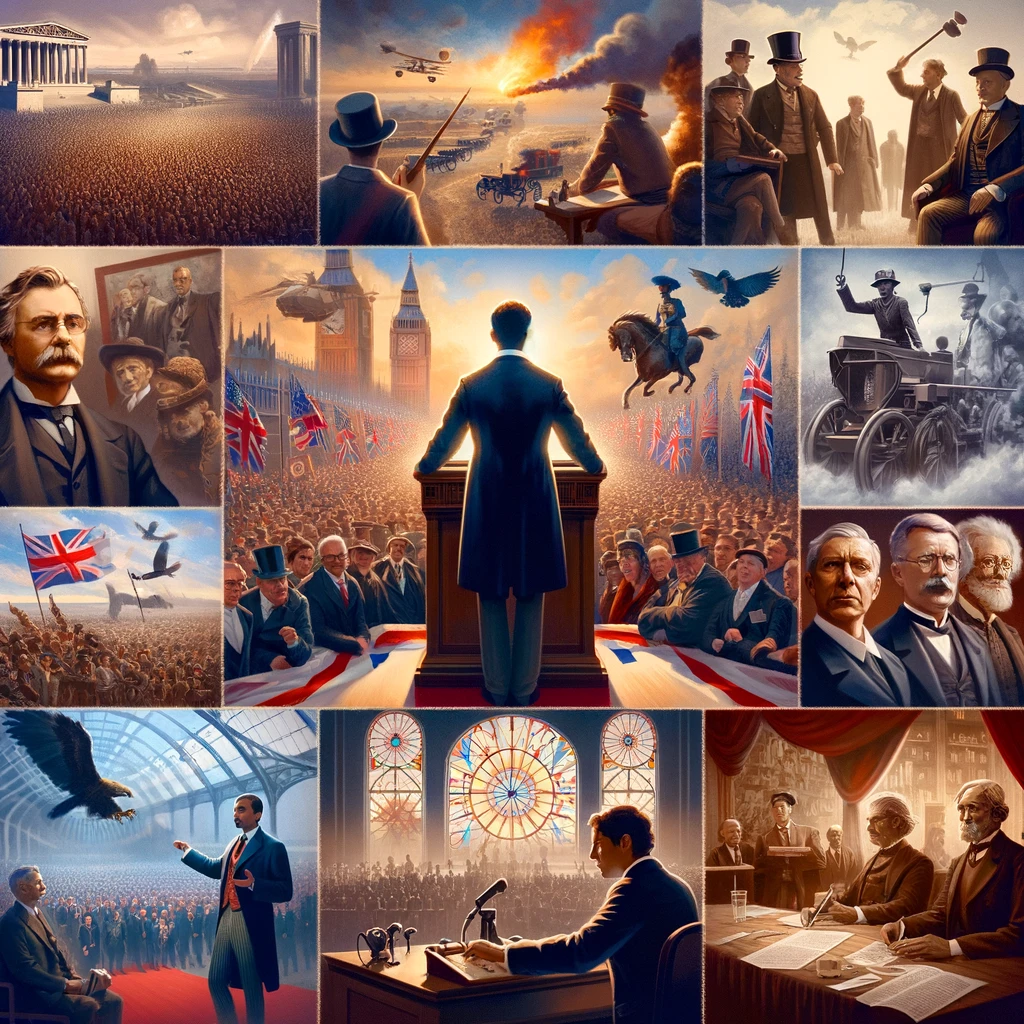
Learning focus: identify repetition, contrast and audience in speeches delivered in English. Choose a short passage, explain one technique in your own words, then try it in an original sentence. These are historical and political examples for language analysis; persuasive language is not itself proof that a claim is true.
The power of words has shaped history, influenced societies, and inspired generations. Throughout history, numerous English speeches have resonated beyond their immediate audience, leaving an indelible mark on the fabric of society. This article explores some of the most iconic English speeches, delving into their context, content, and the impact they have had both at the time and in the years that followed.
The Timeless Influence of Oratory
Oratory, the art of effective public speaking, has been a critical tool for leaders and visionaries to convey their ideas, rally support, and make lasting changes. The English language, with its rich vocabulary and expressive potential, has been the medium for many significant speeches. These oratories not only reflect the times in which they were given but also continue to influence contemporary thought and discourse.
The Power of Churchill’s Words
“We Shall Fight on the Beaches”
Winston Churchill, the British Prime Minister during World War II, was known for his stirring oratory, which played a vital role in bolstering British morale during the war’s darkest hours. Among his many speeches, “We Shall Fight on the Beaches,” delivered to the House of Commons on June 4, 1940, stands out. This speech was given after the British Expeditionary Force’s evacuation from Dunkirk, a moment that was both a retreat and a miraculous escape.
Context and Content
Churchill’s speech was a masterful blend of realism and defiance. He did not shy away from acknowledging the dire situation Britain faced but simultaneously infused a spirit of unyielding resilience. The speech’s most famous line, “We shall fight on the beaches… we shall never surrender,” encapsulated the British resolve to stand against Nazi Germany, regardless of the odds.
Impact and Legacy
This speech is not just remembered for its immediate effect on British morale but also for how it has come to symbolize steadfast resistance in the face of adversity. Churchill’s words continue to be referenced and quoted, showcasing the enduring power of well-crafted rhetoric.
Recording check: Churchill delivered this speech in the House of Commons, but the familiar recording was made in 1949. It is not a live recording from 4 June 1940. The UK government history account explains the distinction. Check whether an audio source is an original recording, a later re-recording or an actor’s performance before treating it as evidence of the original delivery.
Martin Luther King Jr.’s Dream
“I Have a Dream”
On August 28, 1963, Martin Luther King Jr. delivered his iconic “I Have a Dream” speech, a defining moment in the American Civil Rights Movement. Standing on the steps of the Lincoln Memorial in Washington D.C., King shared his vision of a future where people would be judged not by the color of their skin but by the content of their character.
Context and Content
King’s speech was a poignant and poetic call for equality and freedom. Its power lay not just in the words but in the emotion and conviction with which they were delivered. The refrain “I have a dream” became a rallying cry for change and has since become synonymous with the fight against racial injustice.
Impact and Legacy
The speech is an important text in the history of the civil rights movement. Its relationship to later legislation should be considered alongside organising, protest, legal action and political decisions. The speech alone does not establish why a law passed. For language practice, identify the repeated phrase, explain the future it describes, and distinguish that analysis from a claim about its political effects.
The Eloquence of Elizabeth I
“The Tilbury Speech”
Elizabeth I addressed troops at Tilbury on 9 August 1588 during the Spanish invasion threat. Different versions of the speech survive; the familiar wording should be studied as a transmitted historical text, rather than a recording or a guaranteed word-for-word transcript. Royal Museums Greenwich gives the setting, and the Newberry Library notes the different versions. The text offers examples of contrast and appeals to shared responsibility.
Context and Content
Facing the threat of invasion, Elizabeth’s speech was a powerful assertion of her leadership and a demonstration of unity and strength. Her declaration, “I know I have the body of a weak, feeble woman; but I have the heart and stomach of a king,” was a remarkable statement of her resolve and capability as a leader.
Impact and Legacy
Elizabeth’s speech is remembered as a symbol of strong leadership and national unity. It is often cited in discussions about gender and leadership, highlighting how Elizabeth used her position to challenge contemporary notions of gender roles.

John F. Kennedy’s Call to Action
“Ask Not What Your Country Can Do For You”
John F. Kennedy’s inaugural address on January 20, 1961, is remembered for its stirring call to action and its challenge to the American public. The speech’s most famous line, “Ask not what your country can do for you – ask what you can do for your country,” has become a timeless call to civic responsibility and public service.
Context and Content
Kennedy’s speech came at a crucial time in American history, with the Cold War in full swing and a burgeoning civil rights movement. His words were aimed at inspiring a sense of collective responsibility and urging Americans to contribute to the greater good of the nation and the world. The speech was notable for its forward-looking optimism and its appeal to unity and shared purpose.
Impact and Legacy
Kennedy’s inaugural address helped to inspire a generation to public service and played a significant role in shaping the national and international policies of the 1960s. The phrase “Ask not what your country can do for you” continues to resonate as a symbol of selfless service and is often referenced in political discourse, emphasizing the importance of individual contribution to societal progress.
Nelson Mandela’s Defiant Stand
“I Am Prepared to Die”
Nelson Mandela delivered his statement from the dock at the Rivonia Trial on 20 April 1964. The Nelson Mandela Foundation records the date and setting. Unlike an election rally or inaugural address, this was a courtroom statement. That audience and purpose matter when analysing its argument against apartheid.
Context and Content
In facing the possibility of the death penalty, Mandela used the courtroom as a platform to justify the necessity of armed struggle against an oppressive regime. He articulated his vision for a democratic and free society, where all South Africans, regardless of race, could live together in harmony and with equal opportunities. The most poignant part of the speech, where Mandela declared he was prepared to die for his ideals, underscored his unwavering commitment to justice.
Impact and Legacy
Mandela’s speech became a manifesto for the anti-apartheid movement and played a significant role in drawing international attention to the plight of South Africans under apartheid. His words and his subsequent long imprisonment became central symbols of the struggle against racial oppression. The speech remains a powerful example of the use of oratory to advance human rights and social justice.
Barack Obama’s Message of Hope
“Yes We Can”
Barack Obama used the “Yes We Can” refrain in remarks following the New Hampshire primary on 8 January 2008. The American Presidency Project transcript begins with his congratulations to Hillary Clinton on her victory. This was a campaign address after a primary defeat, not his presidential victory speech. Notice how the repeated refrain presents a shared possibility despite that immediate result.
Context and Content
The speech was notable for its inclusive language and its appeal to a sense of shared destiny. Obama used simple yet powerful rhetoric to inspire a sense of possibility and to rally support for his vision of a more united and equitable America. The refrain “Yes We Can” was both a statement of collective ability and a call to action.
Impact and Legacy
The refrain became associated with Obama’s campaign. Analysing its repetition can show how a speaker builds a message around a short phrase; it cannot measure how many votes that speech produced. Keep an interpretation of language separate from an unverified claim about election outcomes.
Each of these speeches, in their own way, has contributed to the shaping of history and the English language. They have demonstrated the power of words to inspire, to challenge, and to bring about change. From Churchill’s unwavering defiance to Obama’s optimistic vision, these speeches continue to resonate because they speak to universal truths and aspirations. They remind us of the power of speech not just to reflect reality but to shape it, and of the ongoing importance of eloquent and effective communication in our world.
Rhetorical Mastery in Famous Speeches
English speeches of great historical significance are not only remembered for their content but also for their masterful use of rhetorical techniques. These techniques, which include the use of repetition, metaphor, and emotional appeal, have played a crucial role in making these speeches memorable and impactful.
Techniques That Resonate
Churchill’s use of repetition in “We Shall Fight on the Beaches,” Mandela’s poignant use of antithesis in “I Am Prepared to Die,” and King’s vivid metaphors in “I Have a Dream” are prime examples of how language can be artfully employed to persuade, motivate, and inspire. These techniques not only enhance the emotional impact of the speeches but also contribute to their lasting memorability.
The Art of Persuasion
Understanding these rhetorical strategies provides insight into how speakers have historically persuaded and influenced their audiences. It reveals the art behind the oratory, highlighting how strategic language choices can significantly impact the effectiveness of a message.
The Linguistic Legacy
The influence of these famous speeches extends beyond their immediate political or social contexts, leaving a lasting imprint on the English language and literature. Phrases like “I have a dream” and “Yes We Can” have entered common parlance, illustrating how powerful speech can transcend its original setting to become part of everyday language.
Language and Literature
These speeches have also found their way into educational curricula, serving as exemplary texts for studying language, rhetoric, and history. They offer rich material for linguistic analysis and are often used to teach persuasive writing and speaking skills.
Speeches in Education and Public Speaking
The study of these famous speeches is integral to education, particularly in the fields of English, history, and political science. They serve as powerful tools for teaching students about the impact of effective communication and the importance of public speaking.
Training the Next Generation of Orators
By analyzing these speeches, students learn not only about historical events and figures but also about the art of crafting and delivering a message. These speeches are used in public speaking courses to teach techniques such as voice modulation, pacing, and audience engagement.
Inspiration for Aspiring Speakers
For those learning English as a second language (ESL), these speeches offer rich examples of the language’s expressive potential. They provide inspiration and models for aspiring speakers to develop their own style and voice.
Famous English speeches have played an instrumental role in shaping history, influencing language, and inspiring generations. Their enduring importance lies not just in their historical significance but also in their continued relevance and ability to resonate across time and cultures. As we continue to study and draw inspiration from these speeches, we are reminded of the enduring power of words to effect change and the vital role of effective communication in our society.
Contemporary Relevance of Iconic Speeches
The impact of these historic speeches extends into the contemporary era, influencing modern politics, media, and public discourse. Their enduring relevance highlights the timeless nature of effective communication and the universal appeal of messages rooted in fundamental human values and aspirations.
Influence on Modern Politics
Politicians and public figures continue to draw inspiration from these speeches. The rhetorical devices, persuasive techniques, and emotional appeals used in iconic speeches like those by Churchill, King, and Obama serve as a blueprint for crafting compelling political messages today. Their speeches are often referenced or echoed in contemporary political discourse, underlining the timeless principles they represent.
Media and Popular Culture
In popular culture, these speeches have been immortalized through various mediums, including films, documentaries, and books. Their dramatization in movies and documentaries has helped bring their context and significance to a broader audience, thereby educating and inspiring future generations.
A Tool for Social Change
Furthermore, the messages conveyed in these speeches continue to resonate in modern social movements. Phrases like “I have a dream” or “Yes We Can” are often invoked in campaigns for equality, justice, and social change, demonstrating the enduring power of these words to mobilize and unite people for a common cause.
Celebrating and Remembering the Speeches
The legacy of these speeches is preserved and celebrated through various means. Memorials, museums, and educational programs are dedicated to the figures behind these speeches, ensuring that their messages and the values they stood for are not forgotten.
Educational Programs and Memorials
Educational institutions often include these speeches in their curriculum, recognizing their value not only as historical documents but also as tools for teaching rhetoric, communication, and history. Memorials and museums dedicated to figures like Martin Luther King Jr. and Nelson Mandela offer interactive experiences that bring their speeches and their historical contexts to life.
Annual Commemorations and Events
Annual commemorations and events are held in honor of these speeches and their speakers, often coinciding with significant historical dates related to them. These events serve as reminders of the progress made since these speeches were delivered, as well as the ongoing challenges in fulfilling the visions they articulated.
Conclusion
The famous English speeches explored in this article are more than just words from the past; they are living documents that continue to influence and shape our present and future. Their study offers invaluable lessons in the power of language, the art of persuasion, and the role of leadership in effecting change. As we reflect on these speeches, we are reminded of the potential each of us has to use our voice to make a difference, to inspire change, and to contribute to the betterment of our world.
Practise identifying rhetorical techniques
Read this short example written for this lesson: “We can listen with care. We can ask clear questions. We can disagree respectfully. A stronger discussion needs more than a louder voice.”
- Which two words repeat at the start of three sentences?
- What does “we” suggest about who can take part?
- Does repetition prove that the speaker’s argument is correct? Explain.
- Does a recording of a historical speech necessarily come from the day it was first delivered?
- Why should you check the source before quoting the Tilbury speech word for word?
- Write a two-sentence invitation to a study group using repetition. Check that the invitation makes a clear request.
Show answers and explanations
- “We can” repeats at the start. Repetition at the beginning of successive clauses or sentences is called anaphora; here it gives the three actions a shared pattern.
- Shared participation. “We” can include speaker and audience, although the context determines exactly whom it includes.
- No. Repetition can make a point easier to notice or remember. Evidence and reasoning are still needed to support it.
- No. A later recording can reproduce an earlier speech. Check the recording date and the original delivery date separately.
- Different versions survive. Name the edition or source you use rather than treating the familiar text as an exact recording.
- One possible answer: “Join us to practise speaking. Join us to share one useful expression.” Other answers work if they repeat a structure and clearly invite participation.