
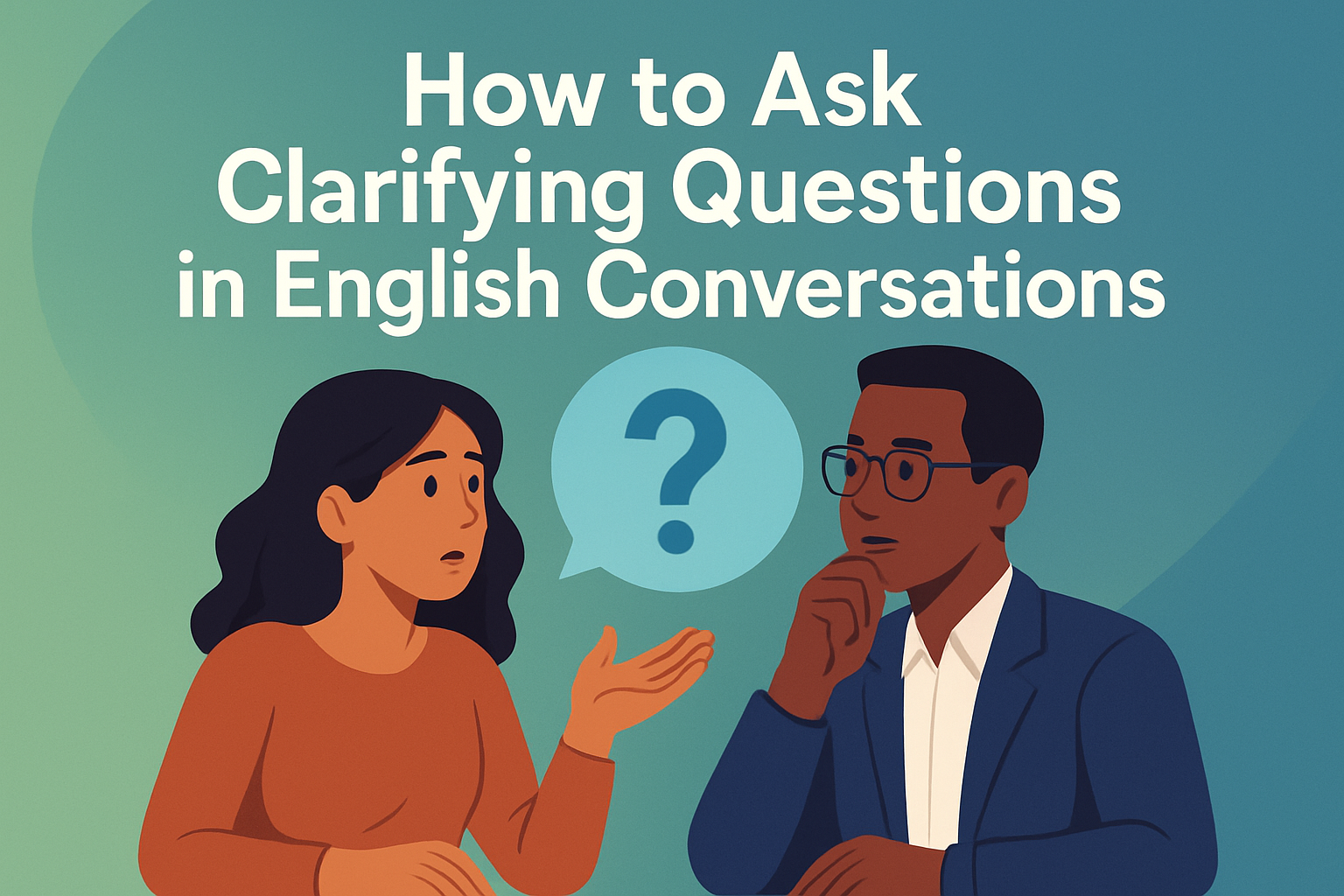
In English conversations, often things aren’t as clear as we’d like them to be. Misunderstandings and misinterpretations can occur, leading to confusion and, at times, miscommunication. To bridge this gap, asking clarifying questions is crucial. These are questions aimed at ensuring understanding and gaining more precise information when something is not entirely clear. Mastering the art of clarification in conversations can enhance communication skills, deepen relationships, and ensure smoother interactions in both personal and professional settings.
Understanding and properly utilizing clarifying questions can empower individuals to communicate more effectively. Whether in a casual chat or a business meeting, the ability to pause and seek clarity not only facilitates better dialogue but also demonstrates active listening and engagement. Clarifying questions vary in form and can be tailored to fit different types of content and contexts. By learning how to ask these questions effectively, we enhance our communication toolkit, leading to more productive and insightful interactions.
Why Are Clarifying Questions Important?
Clarifying questions hold substantial significance in daily communication. They act as a tool to resolve ambiguities and ensure that the speaker and listener are on the same page. To highlight their importance, consider a workplace scenario. Imagine attending a meeting where the objective is to discuss project deadlines. As the manager outlines the timelines, an employee may be unsure about specific milestones. By asking clarifying questions such as, “Do you mean we need to complete this phase by the end of the month?” the doubt is addressed immediately, preventing future misunderstandings.
Effective clarification doesn’t just benefit the immediate conversation; it also strengthens long-term communication patterns. Participants who incorporate clarifying questions reveal themselves as attentive and invested listeners, fostering a more open dialogue environment. Consequently, their ongoing interactions are likely to be more coherent and cooperative. Mastering this skill can aid in navigating complex discussions, ensuring that all parties involved reach a mutual understanding more efficiently.
Types of Clarifying Questions
Clarifying questions can be categorized into different types, each serving a particular function. The five main types of clarifying questions include:
- Open-ended Questions: These questions prompt the speaker to elaborate further. An example would be, “Can you tell me more about why this approach was chosen?”
- Closed-ended Questions: Designed to receive a concise answer, often yes or no. An example is, “Did you mean the red folder needs scanning?”
- Probing Questions: These encourage more in-depth exploration of a topic. A probing question might be, “What factors led you to make that decision?”
- Reflective Questions: Paraphrasing what the speaker said, prompting confirmation of accuracy. For instance, “So you’re saying the report is due next week, correct?”
- Hypothetical Questions: These questions explore possible scenarios and outcomes, such as, “What would happen if the shipment were delayed?”
Each type of question is used depending on the information required and the context of the conversation. Understanding when and how to apply each type can notably enhance the depth and effectiveness of the conversation.
Techniques for Asking Effective Clarifying Questions
Asking effective clarifying questions requires certain techniques to ensure the questions are both appropriate and productive. Here is a practical approach to this:
- Active Listening: Pay close attention to what is being said. Ensure that you understand the initial statement before asking any questions.
- Be Polite and Respectful: Frame your questions in a manner that is considerate. Use polite language such as “Could you please explain…” or “I’m sorry, could you clarify your point on…”
- Stay Relevant: Ensure that your questions are pertinent to the topic at hand to maintain focused and productive dialogue.
- Simplify Your Questions: Avoid complex language or multiple questions in one. Ask one question at a time for clarity.
Imagine a situation during a marketing strategy meeting. An employee, not entirely clear on the new objectives, might say, “Could you clarify how this campaign will differ from the previous ones?” Such framing opens the floor for detailed explanations, ensuring everyone is aligned with the new strategy.
Practical Examples of Clarifying Questions
The practical application of clarifying questions can be seen across various scenarios. Here’s a table illustrating some real-world examples:
| Scenario | Clarifying Question Example |
|---|---|
| Team Meeting | “Are we focusing on increasing customer satisfaction or sales volume this quarter?” |
| Healthcare Appointment | “Could you elaborate on the potential side effects of the medication?” |
| Classroom Setting | “Did I understand correctly that the assignment is due by Friday midnight?” |
| Client Discussion | “When you mentioned delivery times, did you imply there could be potential delays?” |
These examples demonstrate how asking the right questions can lead to better understanding in various contexts, enhancing overall communication efficiency and relationship dynamics.
Overcoming Challenges in Asking Questions
In certain situations, individuals may hesitate to ask clarifying questions due to perceived challenges. Overcoming these challenges involves recognizing and addressing the underlying concerns. Common challenges include the fear of seeming uninformed, disrupting the flow of conversation, or possibly offending the speaker.
To overcome these challenges, it is helpful to adopt a mindset of learning and engagement. Reminding oneself that seeking clarity is a sign of professionalism and eagerness can alleviate the fear of judgment. For instance, during a technical presentation, one might wonder about a specific process. By respectfully asking, “Could you clarify how this step integrates with the previous system?” it shows a proactive attitude towards understanding and learning.
Additionally, it is valuable to practice asking questions in smaller meetings or informal settings if one feels uncomfortable in larger groups. This approach gradually builds confidence in formulating and articulating clarifying questions in any setting.
Conclusion: Mastering Clarifying Questions
In conclusion, the ability to ask clarifying questions is an essential skill that can dramatically improve communication efficacy. By allowing individuals to resolve uncertainties and bridge knowledge gaps, clarifying questions ensure mutual understanding and enable more effective dialogues. This skill is invaluable in fostering stronger relationships, clearer interactions, and more collaborative environments.
The key takeaways for mastering clarifying questions include understanding the different types, knowing when and how to utilize them, and overcoming any associated challenges. Ultimately, the goal is to engage in meaningful conversations where information is clearly exchanged and understood. As a simple next step, begin incorporating these questioning techniques into your daily interactions. By doing so, you’ll likely notice a significant improvement in how conversations unfold and achieve a higher level of clarity in both personal and professional settings.
Frequently Asked Questions
1. What are clarifying questions and why are they important in English conversations?
Clarifying questions are inquiries made to obtain a deeper understanding of what someone else is saying. In English conversations, or any language for that matter, things aren’t always as clear as we’d hope. Sometimes the speaker might assume that you understand all the nuances, or maybe their explanation isn’t as detailed as it could be. Clarifying questions serve as a tool to fill in those gaps. They help in ensuring that the listener gets precise information and fully understands the message intended by the speaker, reducing the chances of misunderstandings. For instance, if someone says, “We should meet sometime soon,” a clarifying question could be, “When would be a good time for you?” This not only prompts a more specific response but also paves the way for effective communication. Understanding and asking these questions skillfully can enhance your interpersonal communication by fostering deeper connections and minimizing confusion.
2. How can I identify when a clarifying question is necessary during a conversation?
Identifying the need for a clarifying question takes a bit of practice and attentiveness. There are some tell-tale signs you can watch out for. First, recognize if you’re feeling confused or uncertain about what the other person means. This feeling is a clear indicator that a clarifying question might be necessary. Additionally, be aware of vague or ambiguous statements. If someone uses broad terms, like “later,” “soon,” or “thing,” it might be worth asking for more precision, such as “What time specifically do you have in mind?” or “Could you elaborate on ‘thing’?” Furthermore, look for inconsistencies in the conversation; if something doesn’t make sense, it’s essential to address it promptly. Noticing the body language and tone of the speaker can also guide you. Sometimes if someone seems hesitant, it might hint that they aren’t conveying the full message, encouraging a question for more clarity.
3. What are some examples of effective clarifying questions I can use?
Using effective clarifying questions can significantly impact a conversation’s flow and comprehension. Here are some examples:
- “Can you elaborate on that?” – This question invites the speaker to provide more detail, ensuring you grasp all necessary information.
- “What do you mean by…?” – Perfect for when a specific word or phrase is unclear, asking for clarification helps anchor the context.
- “So, what you’re saying is…?” – This is a paraphrasing technique to confirm that your understanding is aligned with the speaker’s intent.
- “Could you give me an example?” – Illustrations often illuminate abstract points, making them concrete and comprehensible.
- “How does that relate to…?” – This question helps tie together different pieces of information, creating a cohesive understanding.
4. How can I practice asking clarifying questions to improve my English communication skills?
Improving your ability to ask clarifying questions is like sharpening any other skill—it requires practice, observation, and sometimes trial and error. You can start small by engaging in everyday conversations with friends, family, or colleagues and consciously incorporating clarifying questions. Make a conscious effort to pause and reflect on what you don’t understand; then tactfully ask a clarifying question. Another effective method is role-playing scenarios that might require clarification with someone who is also interested in improving communication skills. You could also benefit from language exchange meetups either in-person or online, where non-native speakers practice English. These settings often provide ample opportunities for misunderstanding, hence rich grounds for asking clarifying questions. Additionally, reading or listening to complicated English materials and trying to identify which parts would benefit from clarification can be an excellent solo exercise. The more diverse the scenarios you expose yourself to, the more adept you’ll become in using clarifying questions instinctively.
5. How do I ensure my clarifying questions do not come across as rude or repetitive?
When asking clarifying questions, it’s crucial to be sensitive to the speaker’s feelings to maintain a respectful and congenial communication atmosphere. To do this, frame your questions politely and empathetically. Start by expressing an understanding or acknowledgment of what they’ve said, using phrases like, “I see where you’re coming from,” or “I understand what you’re saying up to this point,” before seguing into your clarifying question. Moreover, be mindful of your tone and body language, as these non-verbal cues often carry as much, if not more, weight than words themselves. Avoid an accusatory or dismissive tone. Lastly, ensure that your questions vary in structure to avoid sounding like a broken record. Instead of repeating, “Can you explain that?” each time, mix it up with alternatives like, “I’m not quite clear on that part, could you say more?” or “How does that work in this situation?” By approaching clarifications in a courteous and imaginative way, you can foster an environment where productive and understanding dialogue flourishes.





