
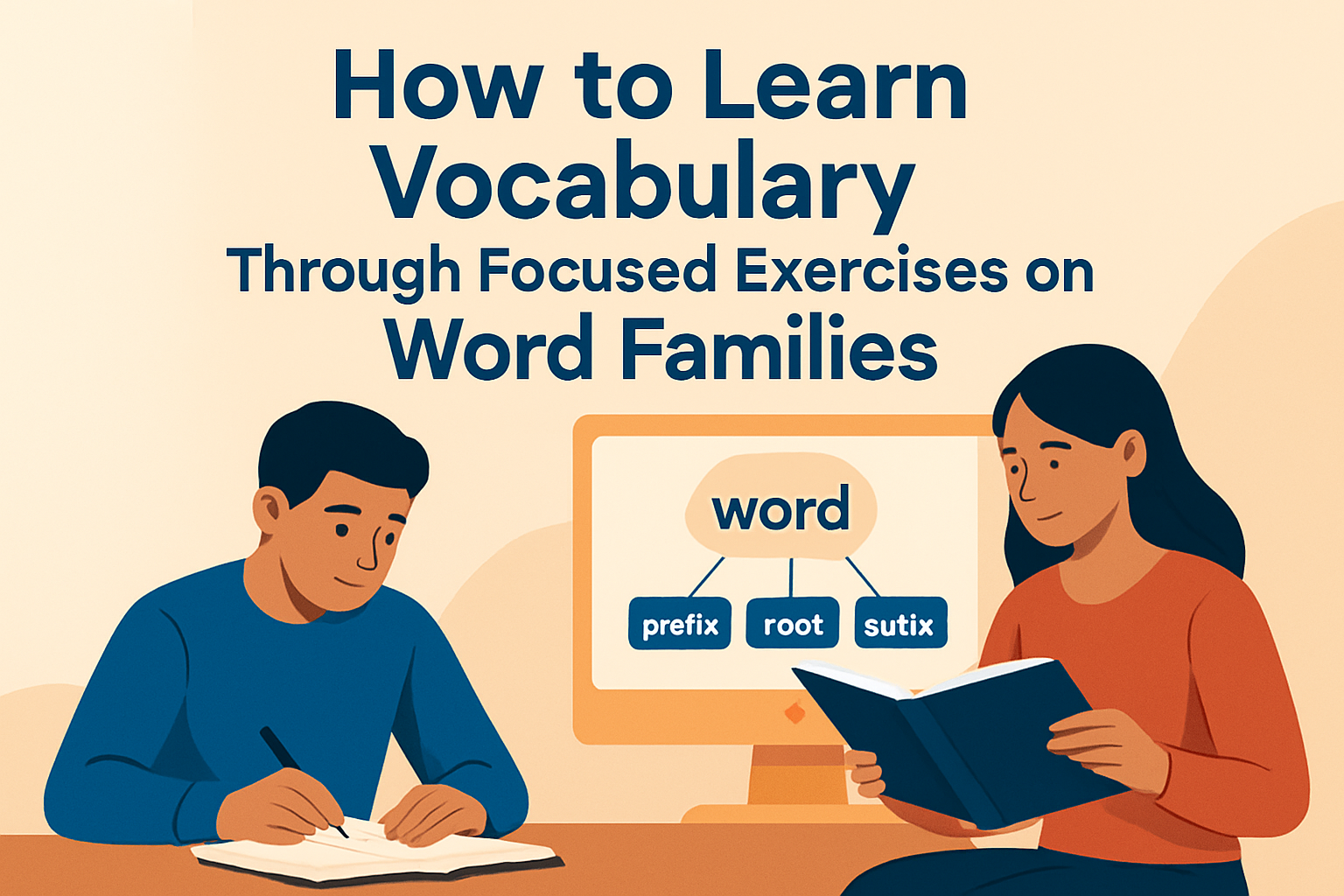
Learning vocabulary is not just about memorizing random words; it is a fundamental part of mastering a language, enhancing communication skills, and improving literacy. With a greater vocabulary, you can express ideas more accurately and engagingly. A strategic way to expand your vocabulary repertoire is by focusing on word families. In linguistic terms, a word family is a group of related words that share a common base or root. Understanding and utilizing word families can be an incredibly effective method for vocabulary acquisition due to the contextual understanding of words. This article will delve into how you can learn vocabulary through focused exercises centered around word families, explain why this approach matters, and how it can lead to more effective learning outcomes.
Understanding Word Families: Definition, Importance, and Examples
To effectively learn vocabulary through word families, it’s essential to first understand what a word family is. A word family comprises a base word or root and all its derivations across different parts of speech. For example, the word family for “act” includes words like “actor”, “action”, “active”, “react”, and “inactive.” Recognizing these derivations helps learners form connections between words, aiding in retention and recall.
The importance of word families lies in their ability to provide contextual learning, which is more effective than rote memorization. This approach allows learners to see words in different forms and functions, helping them understand subtle nuances and uses. For example, learning the word family of “generate” might include words like “generous”, “generation”, and “generator.” This approach exposes learners to a richer vocabulary by learning one root word’s various siblings, turning it into a family unit of multiple related words.
Real-world applications are plentiful. For instance, when reading a scientific article, understanding a word family can help demystify complex terminologies. If someone is familiar with the word family surrounding “biology” (such as “biological”, “biologist”, or “biomes”), they are more prepared to interpret new vocabulary in context.
Applying Word Families to Vocabulary Exercises
One effective exercise to practice using word families is creating word maps. A word map visually organizes words in a family, highlighting their relationships. This can be done on paper or using digital tools. Begin with a base word and draw branches to list derivations. For example, start with “photograph” and branch out to “photography”, “photographic”, and “photographer”. This visual representation aids memory and makes connections clearer.
Another practical exercise involves sentence creation. Taking each word from a family, learners can create sentences that illustrate proper usage. For instance, with the family of “construct”: Learner might draft sentences like “The engineer constructed the bridge”, “The construction of the building took years”, and “She is a very constructive critic”. By forming sentences, learners see the word in action, solidifying its meaning and contextual use.
Real-World Examples of Word Families in Education
Educational environments often employ word families in language classes. English as a Second Language (ESL) teachers use word family exercises to help students make connections between words, speeding up the learning process. Suppose a class is learning the word family revolving around “teach” and “learn”. The students will encounter words like “teacher”, “learning”, “learner”, and “teachable”. Through exercises where they match words with definitions, fill in the word gaps in sentences, or create word trees, learners grow a robust vocabulary base.
Utilizing Digital Tools for Learning Word Families
The digital age offers numerous tools for learning vocabulary through word families. Applications and software enable interactive learning by providing dynamic exercises that encourage engagement. Apps like Quizlet or Anki offer flashcards for word family practice. These digital flashcards often include visual aids and auditory components to cater to different learning styles, helping learners grasp pronunciation alongside spelling and word use.
Additionally, language learning platforms like Duolingo introduce similar exercises, prompting learners to use related words in various sentences, thus reinforcing the word family concept. These tools track progress and adapt to individual pacing, offering tailored feedback that assists learners in focusing on areas needing improvement.
| Tool | Features | Benefits |
|---|---|---|
| Quizlet | Flashcards, Games | Visual and auditory aids |
| Anki | Spaced Repetition | Customizable learning speed |
| Duolingo | Immersive Exercises | Active recall and application |
Challenges and Considerations in Learning Word Families
One of the more complex challenges when working with word families is the varying number of derivations for each root word. English is a language rich with exceptions and unique derivations, and learners may encounter common pitfalls. For instance, irregular verbs or anomalous adjectives that don’t follow typical patterns can confuse learners who are strictly following the rules.
To mitigate these challenges, it’s important for learners to engage with varied examples and exercises. Reading is a powerful tool here. By encountering words in context within different written formats — books, articles, and essays — learners start to intuitively understand word use. Creating varied exercises that explore irregular forms or exceptions also prepares learners for inevitable anomalies.
Practical Steps for Implementing Word Family Exercises
- Start with a comprehensive root word list: Choose roots that are frequently used in both spoken and written forms.
- Create a schedule for regular practice: Consistency is key to long-term retention.
- Combine visual, auditory, and written exercises: This multi-sensory approach caters to various learning preferences.
- Engage in interactive activities with peers: Discuss word families in groups to enhance understanding through conversation.
- Evaluate progress periodically: Assess understanding through quizzes or language proficiency tests.
Realizing these steps through practical application means you’re not only learning in isolation but also interacting with others, solidifying your understanding through teaching and testing your knowledge cooperatively.
The Role of Contextual Learning in Word Families
Contextual learning stands as a cornerstone of understanding word families, as it situates vocabulary within everyday dialogues or academic texts. By practicing vocabulary in real-world contexts, either through immersive environments or constructed scenarios, learners mount upon their word knowledge by understanding situational word use.
For instance, suppose a learner recognizes that “innovation” and “innovative” stem from the root “innovate.” Once they encounter the term in business articles or tech conferences, linking these words to familiar contexts enhances memory recall. This static map closed during paralysis intensify potent venues and fitting initiatives cement a greater impetus where learners can metabolize vocabular emblems into an enriched personal network.
Conclusion: Harnessing the Power of Word Families
In conclusion, taking a focused approach to learning vocabulary through word families provides learners with a dynamic and interconnected look at language. By emphasizing contextual understanding and offering a systematic exploration of words and their related forms, word families enhance both comprehension and usage significantly. As the learner connects words to their roots and branches of derivations, vocabulary proficiency increases. Establishing a routine for frequent practice of these exercises through integrating digital tools, educational resources, or personal commitments offers an enduring way to expand vocabulary. By consistently engaging with word families, learners unlock linguistic doors to effective communication.
The main benefit to adopting this methodology lies in its ability to equip learners with a strong vocabulary foundation that extends beyond memorization. It fosters a depth of understanding and an ability to navigate the nuances of language effectively. Your next step is to dive into a specific word family and explore its topography through varied exercises, gradually rounding out your vocabulary. With commitment plus the structured exercises outlined above, uncovering the power of word families is well within reach.
Frequently Asked Questions
1. What is a word family and why is it important for learning vocabulary?
Let’s break down the concept of word families. In essence, a word family consists of words that are connected through a common root or base word. For example, the word family for “act” includes “action,” “active,” “react,” “inactive,” and many more. The significance of word families lies in how they help language learners understand and acquire languages more efficiently. By recognizing the root word, you can predict the meaning of other words within the same family. This approach not only expands your vocabulary but also enhances your comprehension because you’re learning groups of words simultaneously. This systematic method is crucial because language is much more about connections than isolated terms. Knowing 10 word families could likely help you know over 50 new words, all while increasing the depth and understanding of each. Plus, it supports literacy development by making you more agile in using words in different contexts.
2. How can I incorporate focused exercises on word families into my vocabulary learning practice?
Incorporating focused exercises on word families into your routine can be a game-changer for your language learning journey. Here’s a step-by-step guide to getting started. First, create a list of common root words. This could easily be derived from words you encounter in day-to-day life or ones appearing frequently in the language you’re studying. Second, research to identify words belonging to each word family from the list. Categorize them and make a separate list for each family. For instance, if the root word is “connect,” the word family would include “connection,” “connected,” “disconnect,” etc. Use flashcards to quiz yourself, remembering to mark those that you find challenging, for additional revisits. Incorporating workbooks or digital apps that offer word family exercises can be incredibly helpful too. Regular practice with these exercises, such as quizzes or crosswords that focus on word families, solidifies your understanding and recall. Lastly, try integrating these words into your own sentences to practice them in context. This can particularly enhance retention and fluency.
3. How do word families enhance my spelling and pronunciation skills?
Working with word families can significantly refine both your spelling and pronunciation abilities. When you learn a word family, you’re not just learning single words, but understanding how they morph with prefixes, suffixes, and other modifications. This consistency in structure aids retention, which naturally leads to better spelling over time. For example, knowing the root “play,” you can easily spell “player,” “playing,” “playful,” etc. The repeated exposure to similar letter patterns dramatically improves memorization without rote learning. On the pronunciation front, focusing on word families enables you to understand patterns in stress and intonation, which are crucial for sounding fluent. Consider the root word “photograph” – noticing the stress shift in “photography” versus “photographer” showcases how word families tie into mastering language subtleties. Additionally, learning to correctly pronounce one word in a family boosts your confidence and equips you with a comprehension tool that is applicable as you expand to more complex words.
4. Are there any tools or resources that can help me practice word families more effectively?
Absolutely, there are plenty of resources available to help deepen your understanding of word families. Online platforms such as Quizlet offer a plethora of flashcards dedicated to word families, allowing you to customize and personalize your learning experience. Apps like Anki use spaced repetition to help cement the knowledge of word groups into your long-term memory. Some online dictionaries and thesauruses also have features that allow you to explore word families. Workbooks or language guides, particularly those focusing on themes like academic vocabulary or test preparation, frequently include exercises based on word families. Websites that offer worksheets and PDF printables could be a fantastic supplement as well. Each of these tools is designed to hone in on the repetitive practice of identifying, using, and recalling different members of a word family – all essential parts of efficient language acquisition.
5. How can I measure my progress when using word families to learn vocabulary?
Tracking your progress is essential to understanding how well you’re absorbing the material associated with word families. Begin by assessing your baseline – how well do you know the words in a specific word family before starting focused exercises? Use tests or quizzes created from your word lists to gauge your initial proficiency level. As you continue, set regular check-ins where you challenge yourself with those same quizzes or create scenarios where you have to write or speak using words from those families. Utilize apps that track your scores over time so you can visibly see improvement. Another effective approach is keeping a journal where you write down sentences or small paragraphs using the words in question; revisit earlier entries to see how your proficiency has evolved. Obtaining feedback from peers, teachers, or language exchange partners can also provide insightful progress markers. This ongoing self-assessment ensures that you’re not just memorizing but truly acquiring and applying new vocabulary.





