
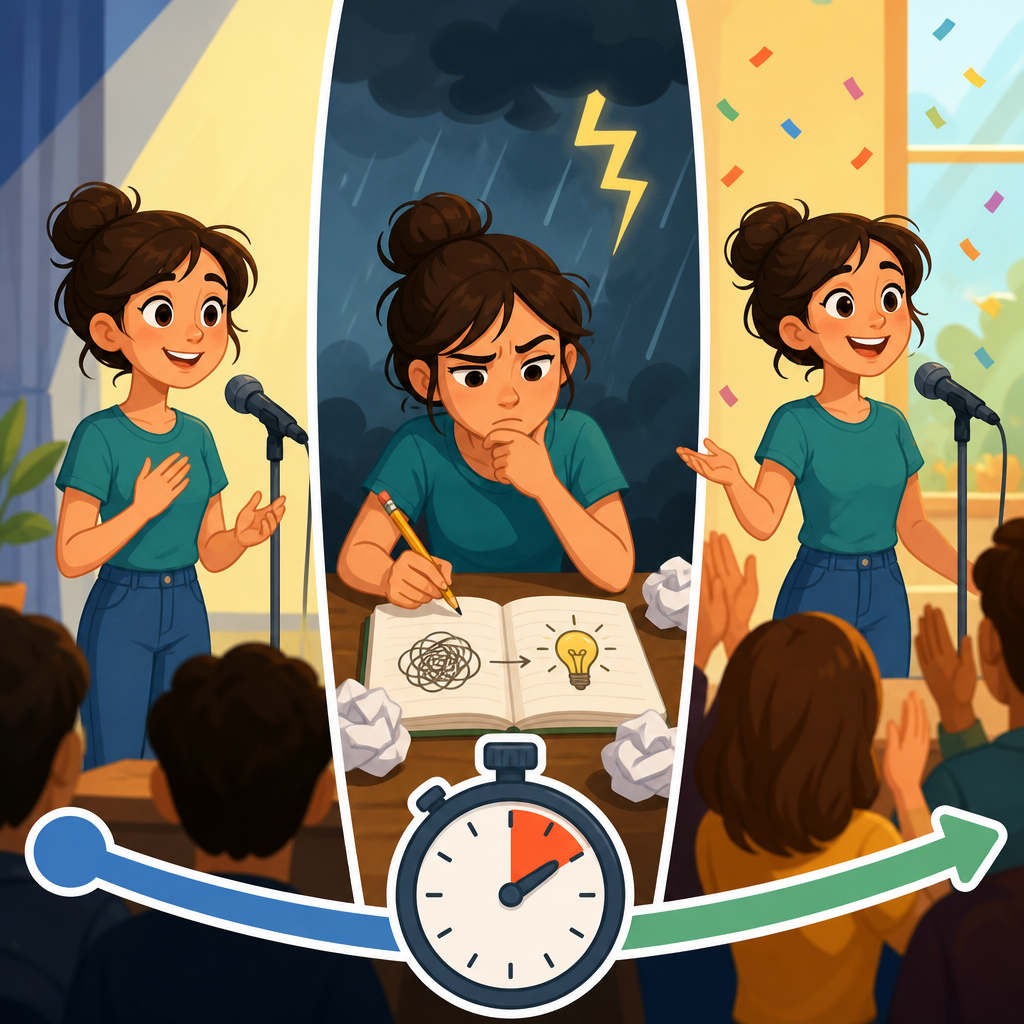
A 30-second story is a short spoken narrative with one simple setup, one clear change, and one memorable takeaway. In speaking practice, it matters because real conversations rarely give you three minutes to explain an experience. You often have half a minute to answer a teacher, introduce an example in class, respond during an interview, or keep a conversation moving. If your story has a beginning, middle, and end, listeners can follow it instantly. If it wanders, they get lost before your point arrives.
When I coach beginner and lower-intermediate speakers, this is one of the first speaking patterns I teach because it solves several problems at once. It improves fluency, helps pronunciation by reducing hesitation, and makes ideas easier to organize under pressure. A 30-second story is not a summary of your whole life. It is one tiny moment told in sequence. The beginning gives context: who, where, and what was happening. The middle introduces action or change. The end shows the result, feeling, or lesson. That structure is simple, but it is powerful because human listeners expect events to unfold in order.
Key terms are straightforward. The beginning is the setup. The middle is the turning point or main action. The end is the outcome. In practical speaking, thirty seconds usually means about 60 to 75 words for a careful learner, or 75 to 90 words for a more confident speaker. That limit forces clarity. You cannot include every detail, so you choose only the details that support the main point. This is exactly why short storytelling is such effective speaking practice.
Start with one moment, not a whole history
The biggest mistake I hear is choosing a topic that is too large. Learners say, “I want to tell about my vacation,” then they try to include the flight, hotel, weather, food, shopping, and the trip home. In thirty seconds, that collapses. A good 30-second story focuses on one moment: missing the train, finding a lost wallet, meeting a friendly stranger, burning dinner, or giving a first presentation. One moment gives the story shape.
A useful test is this question: can the story be described in one sentence? For example, “I was late for class, but a bus driver helped me arrive on time.” That sentence already contains the structure. Beginning: I was late for class. Middle: a bus driver helped me. End: I arrived on time. If you cannot reduce your story to one sentence, the scope is probably too broad.
This narrow focus also helps language learners choose vocabulary. Instead of searching for ten different words from ten different situations, you need only the words for one event. That lowers cognitive load and makes speech more natural. For learners building basic confidence, this method pairs well with guided self-introduction practice in the main speaking guide at https://5minuteenglish.com/a1-speaking-practice-introducing-yourself-clearly-and-naturally/, because both skills rely on sequencing simple ideas clearly.
Build the beginning in one sentence
The beginning should answer three listener questions as fast as possible: Who is involved? Where are you? What is happening? You do not need all possible background. You need just enough context so the middle makes sense. In strong short stories, the opening sentence often contains time and place markers because they orient the listener immediately. Examples include, “Last Monday, I was on my way to work,” or “When I was in the supermarket yesterday, I realized I forgot my wallet.”
Notice what these examples do well. They avoid abstract openings like “I want to tell you something interesting.” That kind of sentence uses time but gives no information. Direct context is better. In teaching sessions, I often tell speakers to imagine a camera turning on. What would the listener see first? A bus stop in the rain, a classroom before a presentation, a kitchen with smoke, or a phone with one percent battery. Concrete openings create instant understanding.
The beginning should also hint at motion. Even if nothing dramatic has happened yet, the listener should feel that something is about to change. “I was carrying a birthday cake on a crowded train” is stronger than “I had a cake.” The first opening creates expectation. The second merely names an object.
Use the middle to show the change
The middle is the engine of a 30-second story. It answers the question, “What happened?” In narrative terms, this is the disruption, problem, surprise, or decision that moves the story forward. Without a middle, you have description, not story. In spoken English, this part should usually contain one major action, not three or four smaller ones.
For beginners, the simplest formula is subject plus action plus consequence: “The box broke, and the books fell on the floor.” That is enough. More advanced speakers can add a reaction: “The box broke, the books fell everywhere, and everyone turned to look at me.” What matters is that the middle changes the situation created in the beginning.
Transitions are especially useful here because they signal movement clearly. Words like “but,” “then,” “suddenly,” “so,” and “because” do heavy lifting in short stories. They are basic words, but they are structurally important. “I was walking to the station, but I saw my train leaving.” In one line, the listener understands expectation and reversal. I encourage learners to practice these connectors until they become automatic, because fluency often depends less on rare vocabulary and more on control of simple linking words.
End with a result listeners can remember
The ending should answer one final question: what was the result? In short speaking tasks, the result can be practical, emotional, or reflective. Practical endings state what happened: “I caught the next bus and arrived ten minutes late.” Emotional endings show feeling: “I was embarrassed, but later I laughed about it.” Reflective endings add a lesson: “Since then, I always check my bag before I leave home.”
Not every story needs a moral. In fact, forcing a lesson can make a short story sound unnatural. But the story does need closure. Many learners stop too early after describing the problem. They say, “My phone died in the airport,” and then pause. The listener still expects resolution. Even a simple last line completes the arc: “So I borrowed a charger from a stranger and made my call.”
A good ending often echoes the beginning. If the beginning shows a goal, the ending shows whether that goal was reached. If the beginning shows calm, the ending may show surprise. This contrast makes the story feel complete and helps listeners remember it after only thirty seconds.
A simple framework for planning and timing
When I time students, the most reliable breakdown is 8 to 10 seconds for the beginning, 12 to 15 seconds for the middle, and 8 to 10 seconds for the end. The middle gets slightly more time because action needs space. If the beginning is too long, the speaker uses half the story on background. If the ending is missing, the story feels unfinished.
| Story part | Goal | Time guide | Example line |
|---|---|---|---|
| Beginning | Set context fast | 8–10 seconds | “Yesterday, I was hurrying to my English class.” |
| Middle | Show one change or problem | 12–15 seconds | “But I got on the wrong bus and ended up across town.” |
| End | Give the result | 8–10 seconds | “I arrived late, but I learned to check the bus number first.” |
This structure works because it matches how listeners process speech in real time. Research in discourse comprehension consistently shows that clear event order reduces effort for the audience. In plain terms, if events come in sequence, people understand them faster. That matters even more when the speaker is still developing fluency.
Practice with spoken language, not written language
Another common problem is sounding like you are reading an essay out loud. Spoken stories should use short clauses, familiar verbs, and natural rhythm. Written language often packs too much information into one sentence. Speech needs breathing room. Compare these two versions. Written style: “Having discovered that I had inadvertently boarded the incorrect bus, I experienced considerable frustration.” Spoken style: “Then I realized I was on the wrong bus, and I got really frustrated.” The second version is clearer, easier to pronounce, and more natural in conversation.
Record yourself on a phone and listen for three things: pauses, sentence length, and ending clarity. If you pause because you are choosing details, your story may still be too big. If one sentence runs for fifteen seconds, break it into two. If the final line sounds weak, rewrite the ending so it gives a result. In my experience, two or three focused recordings improve a short story more than twenty silent rewrites.
It also helps to rehearse with fixed patterns. Try “Last week…, but…, so…” or “I was…, then…, in the end….” These frames are not childish. They are efficient. Even experienced speakers use internal templates when they need to be concise under time pressure.
Examples that show the difference between weak and strong
Consider a weak version: “I had a bad day yesterday. Many things happened. First I woke up late, and then I missed breakfast, and then the bus was crowded, and then at work I had too much to do.” This is understandable, but it is not a 30-second story. It is a list of problems. There is no single central event, so the listener has nothing to hold onto.
Now consider a stronger version: “Yesterday morning, I was running late for work and carrying my coffee to the bus stop. Then I slipped, dropped the cup, and spilled coffee all over my white shirt. I had to go back home and change, so I arrived late, but my coworkers laughed and helped me relax.” This version works because it selects one moment, shows a change, and ends with a result. The details support the same event instead of competing with one another.
If you want to improve quickly, collect five personal stories from daily life and compress each one to thirty seconds. Use ordinary events, not dramatic ones. Everyday stories are easier to retell naturally, and natural retelling is the goal. Start today by choosing one small moment and shaping it into a clear beginning, middle, and end.
Frequently Asked Questions
1. What is a 30-second story, and why does it need a clear beginning, middle, and end?
A 30-second story is a very short spoken narrative designed to communicate one experience, one example, or one insight quickly and clearly. In most real-life speaking situations, you do not have several minutes to build background, add side details, and slowly reach your main point. You may be answering a teacher in class, giving a brief example during a presentation, responding to an interview question, or keeping a casual conversation moving. In those moments, a short story works best when it has an obvious structure listeners can understand immediately.
The beginning gives the setup. It tells listeners where you were, what was happening, or what the situation was before anything changed. The middle introduces the key action, problem, or turning point. This is the moment that creates movement in the story. The end delivers the result, lesson, or memorable takeaway. That simple structure matters because listeners process spoken information fast. If your story wanders through too many details, they lose track of the point before you finish speaking.
A clear beginning, middle, and end also make you sound more confident and organized. Instead of searching for words while telling the story, you follow a mental path. That helps your speaking feel more natural, even when you are nervous. A strong 30-second story is not about saying everything. It is about saying the right things in the right order so the listener can follow you instantly and remember your point.
2. How can I structure a 30-second story so it feels complete without sounding rushed?
The easiest way to structure a 30-second story is to think in three small parts: setup, change, and takeaway. The setup is your beginning. In one sentence, explain the basic situation. For example: “Last week in class, I had to present without my notes.” The change is your middle. In one or two sentences, explain what happened that made the story interesting or important: “At first I panicked, but then I focused on just explaining the main idea in simple words.” The takeaway is your end. In one sentence, show the result or lesson: “That experience taught me I speak more clearly when I stop trying to memorize every line.”
This structure feels complete because it gives listeners all three things they need: context, action, and meaning. It does not sound rushed when you keep each part focused on only one idea. Many speakers sound rushed not because they speak too fast, but because they try to include too much information. Names, timelines, extra explanations, and background details often weaken a short story instead of strengthening it.
A useful rule is this: if a detail does not help the listener understand the situation, the change, or the result, leave it out. Your goal is not to compress a long story into 30 seconds word for word. Your goal is to build a smaller story that still feels finished. If you pause briefly between parts and emphasize the turning point, your story will sound controlled, natural, and easy to follow rather than hurried.
3. What kinds of details should I include in a short spoken story, and what should I leave out?
In a 30-second story, include only details that make the story clearer, more vivid, or more meaningful. The strongest details usually answer simple questions: Where were you? What was happening? What changed? What was the result? For example, saying “During my first job interview, I forgot the prepared answer and had to speak honestly” gives a clear setting and a clear turning point. That is enough for listeners to understand the situation without needing a long explanation.
What you should leave out are side details that slow the story down. These might include long descriptions, unrelated background, too many names, exact times, or repeated explanations. For instance, if you spend half your story explaining who everyone in the room was, what day it happened, what you wore, and what happened before the important moment, the listener may never reach the point with you. In short stories, extra detail often creates confusion rather than richness.
A good test is to ask whether each detail supports one of the three core parts. Does it help set up the beginning? Does it make the middle more understandable? Does it strengthen the ending or lesson? If not, remove it. You should also prioritize details that create emotional or practical clarity. Words like “nervous,” “surprised,” “relieved,” or “proud” can add impact quickly because they help the listener connect to the experience without requiring a lot of explanation. In a 30-second story, one strong detail is usually more powerful than five weak ones.
4. How do I make a 30-second story memorable and engaging when I have so little time?
To make a short story memorable, focus on one clear change and one clear point. People remember movement. They remember that something was one way at the beginning and different by the end. That change can be small, but it should be easy to hear. For example, “I was afraid to speak up in group discussions, but after sharing one idea and getting a positive reaction, I became much more confident” is memorable because the listener can clearly hear the before and after.
Word choice also matters. You do not need dramatic language, but you do need precise language. Strong verbs and simple emotional cues help your story stand out. Compare “Something happened and it was interesting” with “My slides failed, so I had to explain the project without visuals.” The second version is more specific, and specificity makes a story easier to picture and remember.
Delivery plays an important role as well. If you speak too quickly, your story may sound compressed and unclear. If you pause briefly before the turning point or before the final takeaway, you help the listener notice the structure. That makes the story feel more polished. Finally, end with a point that matters. A memorable ending often answers the listener’s silent question: Why are you telling me this? It could be a lesson, a result, or a personal realization. When the ending gives meaning to the experience, even a 30-second story can leave a strong impression.
5. What are the most common mistakes people make with 30-second stories, and how can they fix them?
One of the most common mistakes is trying to tell too much. Speakers often treat a 30-second story like a shortened version of a longer story, so they pack in background, multiple events, and extra explanation. The result is usually unclear. The fix is to choose just one moment, one change, and one takeaway. Think small and focused rather than broad and complete.
Another common mistake is having no real ending. Some people describe what happened but never explain why it mattered. That leaves the listener with information but no conclusion. To fix this, always finish with a result, reaction, lesson, or next step. Even a simple line such as “That taught me to prepare less and speak more naturally” gives the story a proper ending and makes it feel purposeful.
A third mistake is starting too far away from the main moment. Long openings weaken short stories. If it takes 15 seconds just to reach the important part, there is no room left for development or conclusion. Start closer to the action. Instead of explaining all the background, begin with the situation that directly leads to the change. Another issue is speaking in a flat, list-like way. A story should sound like movement, not a report. Use natural emphasis to show what changed and why it mattered.
The best way to fix all of these problems is practice with a simple formula. First, write your story in three lines: beginning, middle, end. Then say it aloud and time it. Remove anything that does not support the main point. Practice until the story sounds conversational rather than memorized. Over time, you will develop a strong instinct for selecting the right details, moving quickly to the turning point, and ending with impact. That is what makes a 30-second story clear, effective, and easy for listeners to follow.





