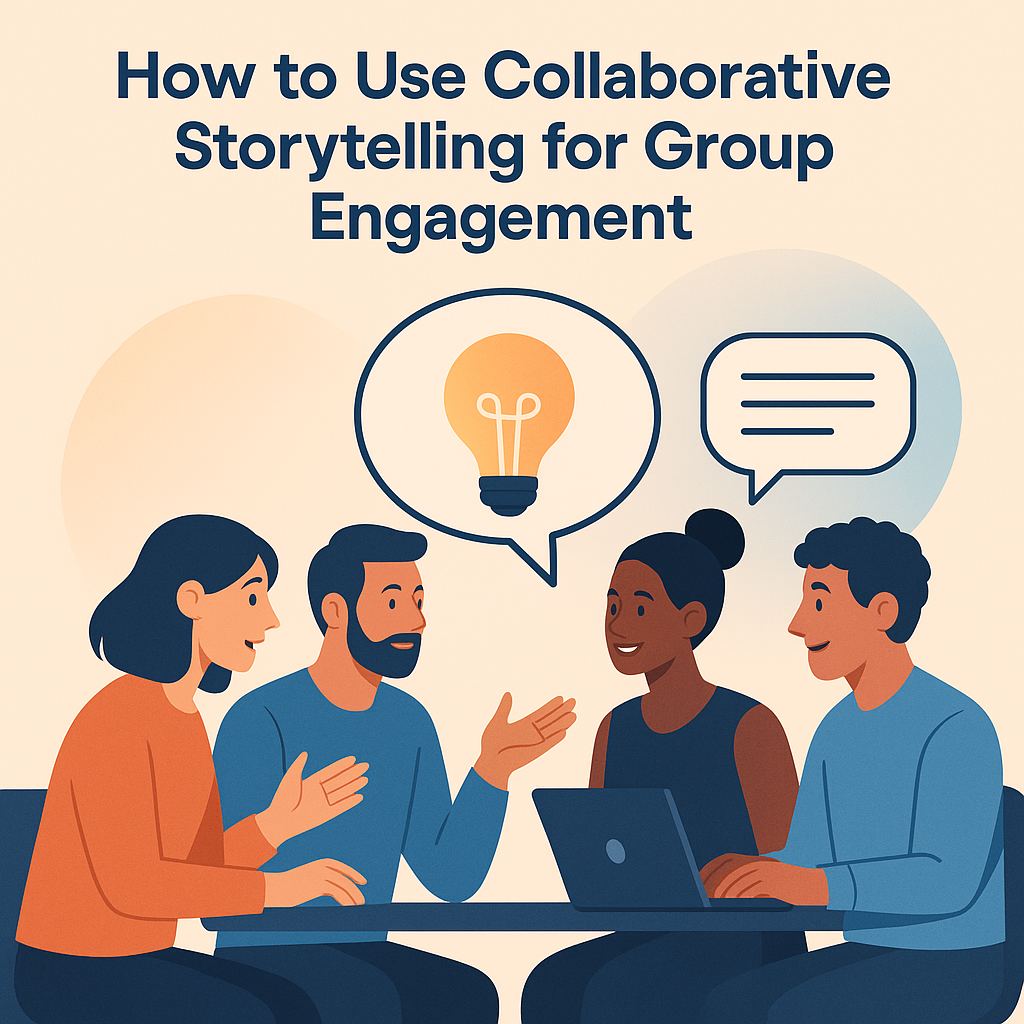
Collaborative storytelling is an innovative approach where multiple individuals come together to create and build a narrative. This technique involves group interaction that fosters creativity, teamwork, and communication among participants. By collaborating on a story, participants not only contribute their ideas but also build upon others’, leading to a cohesive and enriched narrative. This process is rooted in creativity and teamwork, engaging people at different levels and abilities. The concept has gained prominence not just in creative industries but also in educational settings, business workshops, and team-building events. Collaborative storytelling is impactful because it combines individual creativity with the collective intelligence of a group, leading to enhanced group dynamics and fostering a sense of community.
Especially in today’s world, where remote collaboration is becoming commonplace, understanding how to effectively use collaborative storytelling for group engagement is crucial. This technique aids in building a connection between individuals, offering a shared sense of achievement. It encourages inclusive participation and helps break down barriers, making it exceptionally valuable for personal development as well as organizational growth. By weaving together the threads of diverse perspectives, collaborative storytelling results in rich, multi-layered narratives.
The Mechanics of Collaborative Storytelling
Collaborative storytelling relies on a systematic yet flexible approach. The process usually starts with a central theme or a prompt that guides the participants. This can be anything from a simple sentence to a complex scenario that outlines the setting, characters, and a basic conflict. Participants take turns adding to the story, weaving their ideas with what has already been presented. The key is that every contribution builds on the last, maintaining coherence and continuity.
For instance, in a workshop setting, the facilitator might initiate the narrative with “Once upon a time in a land far away, a young adventurer set out to discover an ancient secret.” Participants then contribute by adding sentences or paragraphs, introducing new characters or plot twists, and taking the narrative forward. This not only involves creativity from each participant but also encourages attentive listening, as one needs to understand what has been contributed before adding their part.
Benefits of Collaborative Storytelling
Collaborative storytelling offers several benefits. Most importantly, it enhances creativity and imagination. By working in a team, individuals are exposed to different perspectives and ideas, expanding their creative horizons. Participants learn to think outside the box and often find themselves exploring ideas they might not have considered on their own.
Moreover, this approach improves communication skills within the group. As individuals share their thoughts and ideas, they practice articulating them clearly and concisely. Through feedback and constructive criticism, participants also learn to listen actively and respond appropriately, developing essential interpersonal skills.
Another significant benefit is the strengthening of team dynamics. Collaborative storytelling necessitates cooperation and compromise, teaching participants to work harmoniously towards a common goal. A real-world example of this is seen in writers’ rooms for television shows, where a team of writers collaborates daily to build and refine scripts.
Implementing Collaborative Storytelling in Educational Settings
In educational contexts, collaborative storytelling can be an effective tool to foster learning. Teachers can use this method to encourage students to engage with subject matter creatively. For instance, during a history lesson, students might be tasked with creating a story based on historical events. They would collaborate to ensure historical accuracy while creatively exploring the motivations and experiences of historical figures.
A practical example could involve a class divided into several groups, each assigned a different historical period. Students within a group create characters typical of the era, discussing scenarios and conflicts relevant to the time. This not only deepens their understanding of the historical context but also improves group cooperation and critical thinking skills.
- Improves creative thinking and problem-solving skills
- Develops empathy through role-play and understanding diverse perspectives
- Enhances engagement and motivation among students
Using Collaborative Storytelling in Business Environments
In business settings, collaborative storytelling can be a powerful tool for team-building and problem-solving. By encouraging employees to work together on narrative projects, companies can foster a sense of community and improve team dynamics. Collaborative storytelling pushes employees to think creatively about workplace challenges, exploring novel solutions in a supportive environment.
Consider a scenario where a marketing team is tasked with creating a campaign for a new product. By using collaborative storytelling, they start with a central message and work together to develop an engaging narrative that captures the brand’s essence. As each team member contributes, they refine the story, ensuring it resonates with the target audience. This collective approach can lead to more cohesive and innovative marketing strategies.
Collaborative storytelling in business also serves as a platform for sharing diverse viewpoints, which is crucial for innovative problem-solving. It harnesses the collective intelligence of the team, promoting a culture of inclusivity and mutual respect.
Challenges and Solutions in Collaborative Storytelling
Despite the benefits, collaborative storytelling can present challenges, such as potential conflicts within the group and difficulties in maintaining a coherent story. These challenges often arise from differing opinions and clashing ideas.
To mitigate these issues, it’s essential to establish clear guidelines and roles at the beginning of the storytelling process. Having a facilitator or moderator to manage the flow and mediate conflicts can help maintain harmony. Encouraging respect for each participant’s contribution and fostering an open-minded environment are crucial.
Consider a community theater group working on a play. Each member brings their unique vision, which may sometimes conflict with others’ ideas. By periodically reviewing everyone’s contributions and ensuring alignment with the group’s overall vision, they can navigate disagreements effectively, resulting in a well-developed final product.
| Challenge | Solution |
|---|---|
| Conflicting Ideas | Assign a moderator to mediate and encourage respect |
| Coherence Issues | Set clear guidelines and review contributions regularly |
Technological Tools for Collaborative Storytelling
In the digital age, various technological tools can facilitate collaborative storytelling, making it accessible to remote teams. Several platforms offer shared documents and online whiteboards, where participants can contribute and edit the story in real time. These tools are particularly useful for remote teams or individuals who cannot meet physically but wish to engage in collaborative storytelling activities.
Platforms like Google Docs allow multiple users to edit a document simultaneously, making it easy to see the story unfold and quickly incorporate changes. Trello, another useful tool, provides a visual method of organizing story elements and tracking progress. These tools support a seamless flow of ideas and ensure that all team members are on the same page, regardless of their physical location.
Businesses and educators leveraging these tools find that they can maintain high levels of collaboration and engagement, even in virtual settings. By integrating technology with traditional storytelling methods, they can enhance interaction and creativity among participants.
Conclusion and Next Steps
In summary, collaborative storytelling is a dynamic and versatile method for fostering group engagement across various settings. By encouraging collective creativity and effective communication, it enhances not only the quality of the final narrative but also the skills and relationships of the participants involved. Whether in educational environments, business workshops, or community groups, the benefits of this approach are clear.
The key takeaways from utilizing collaborative storytelling include improving creativity, strengthening communication, and reinforcing teamwork. By drawing on the collective intelligence and diverse perspectives of the group, richer, more compelling narratives can be constructed, benefiting both the individual and the organization.
For those interested in implementing collaborative storytelling, consider starting with small groups and clear guidelines to facilitate the process. Experiment with different settings, whether physical or virtual, and use modern technology to support collaboration. By embracing this method, you can unlock new levels of engagement and innovation within your team. Take the first step today and see the transformative power of collaborative storytelling for yourself.
Frequently Asked Questions
1. What is collaborative storytelling and how does it work in a group setting?
Collaborative storytelling is an engaging and interactive technique that brings multiple individuals together to create a shared narrative. In a group setting, participants contribute their ideas, weave together their thoughts, and build upon one another’s inputs to create a unified story. This activity is rooted in creativity and requires teamwork and communication, often leading to a cohesive and enriched story that surpasses what any single participant could create alone. Each participant plays a role, whether in generating plot twists, developing characters, or envisioning the setting, resulting in a collective creative experience. The process involves listening, respecting different perspectives, and being open to unexpected twists that others might introduce. By working together, participants learn to collaborate effectively and push their creative boundaries, making storytelling a vibrant group engagement tool.
2. Why is collaborative storytelling beneficial for group engagement?
Collaborative storytelling is a powerful tool for group engagement due to its ability to foster a variety of essential skills and dynamics. Firstly, it enhances creativity, as individuals are encouraged to think outside the box and build upon others’ ideas. This nurtures a creative synergy within the group. Secondly, it promotes teamwork and improves communication skills, as participants must listen to one another, negotiate narrative direction, and work towards a common goal. Additionally, it strengthens the group’s social bonds, as working together on a creative project can lead to stronger connections and mutual respect among participants. Collaborative storytelling also offers the opportunity for individuals to express themselves in a supportive environment, boosting confidence and encouraging participation from everyone, including those who might be more reserved. Ultimately, it’s a fun and engaging way to bring people together, making it invaluable for team-building and educational settings.
3. What are some effective strategies to facilitate collaborative storytelling within a group?
Facilitating collaborative storytelling requires intentional strategies to ensure everyone is engaged and the process is seamless. Start by clearly defining the purpose and guidelines of the storytelling session so that participants understand the objectives and limits of their creativity. Set the scene by introducing a basic story framework or theme to spark inspiration, but leave enough room for participants to introduce their ideas. Encourage every participant to contribute by fostering an inclusive environment where all voices are heard—this might involve setting rules such as everyone adds one sentence or idea at a time. Use creative prompts or question cards if the storytelling stalls, which can help reignite imagination and keep the flow going. It can also be helpful to record or document the story as it unfolds, preserving the collaborative creation for reflection or future reference. Most importantly, create a supportive atmosphere that values all contributions, and remind participants that the journey of storytelling is more important than the final product.
4. How can technology enhance collaborative storytelling for group engagement?
Technology can significantly enhance collaborative storytelling by providing tools and platforms that accommodate various creative inputs, even if participants are not physically in the same location. Online collaborative tools like Google Docs or dedicated storytelling apps such as Storybird or Plotagon allow groups to work together in real-time, share ideas, and develop narratives collectively. Virtual whiteboards and mind-mapping software, like Miro or MindMeister, can be used to brainstorm story elements or visualize complex plot structures. For groups interested in interactive and multimedia storytelling, platforms like Twine or Inklet can facilitate interactive story creation with multiple endings or branching paths. Furthermore, social media or dedicated community platforms can serve as spaces for sharing feedback and expanding the storytelling beyond the initial group. By leveraging these technological resources, the scope and reach of collaborative storytelling are broadened, making it accessible and engaging for diverse groups.
5. What common challenges might occur in collaborative storytelling, and how can they be addressed?
While collaborative storytelling is a rewarding process, it can present several challenges that need addressing to ensure a successful experience. One common issue is uneven participation, where some voices dominate while others are overshadowed. This can be mitigated by setting clear ground rules for turn-taking and encouraging equal contribution from all members. Another challenge is differing creative visions among participants, which may lead to conflicts or storytelling gridlock. Facilitators can handle this by emphasizing the collaborative nature of the activity and promoting compromise and flexibility. Group members can also be encouraged to discuss their visions openly before starting or use voting to decide on major story directions. Additionally, participants might suffer from creative block or lack of inspiration. To address this, use creative prompts or breaks to refresh their minds. Creating a safe and supportive environment is also crucial to allowing participants to express their ideas freely without fear of judgement. By being proactive and responsive to these challenges, collaborative storytelling can proceed smoothly and remain enjoyable for all involved.