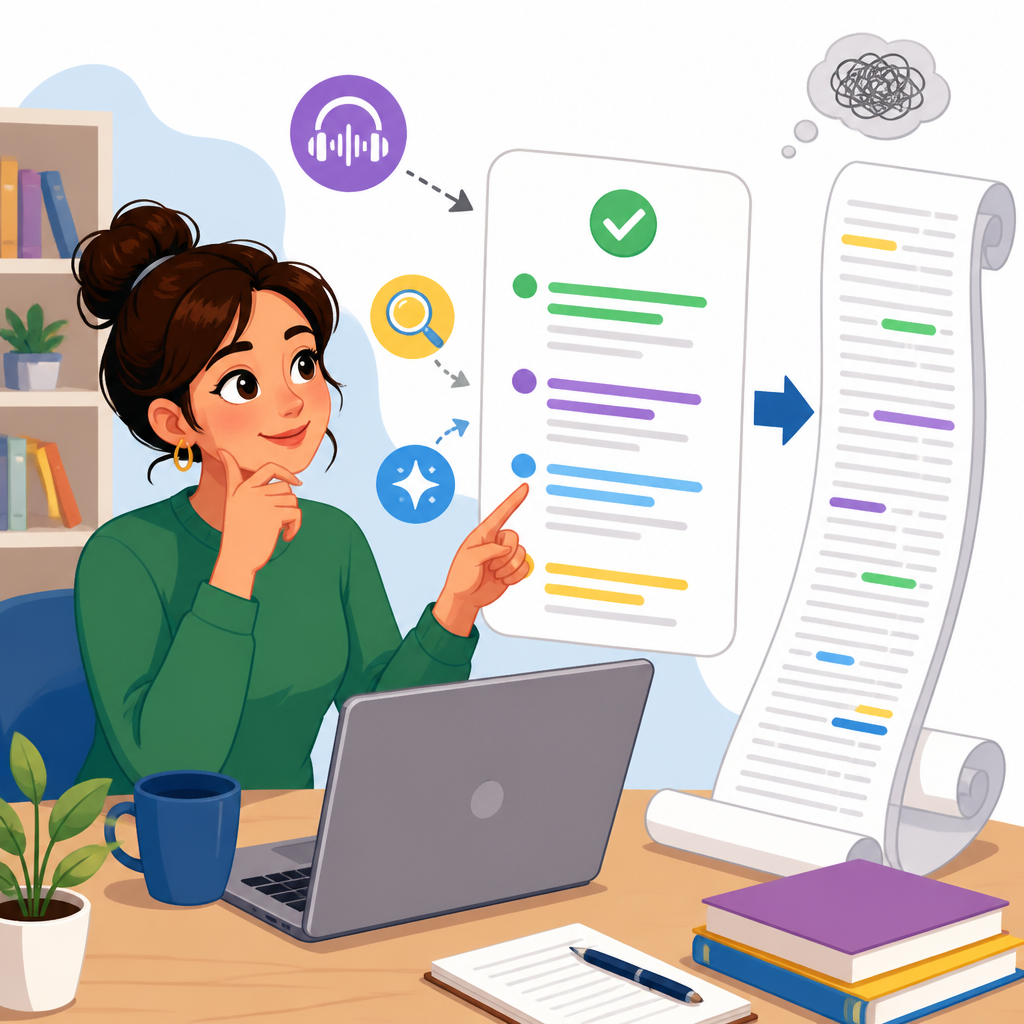
Transcripts are one of the most useful tools in listening practice, but many learners waste them by treating them like reading exercises. A transcript is simply the written record of what speakers say in an audio or video lesson. Used well, it helps you notice missed words, test what you actually heard, and confirm details such as names, numbers, dates, times, and short function words. Used badly, it becomes a crutch that pulls attention away from listening. The goal is not to read every line from start to finish. The goal is to use transcripts strategically so they solve specific listening problems quickly and train your ear instead of replacing it.
I have worked with beginner and lower-intermediate learners who thought transcripts were either cheating or mandatory. In practice, neither view is helpful. Most learners improve faster when they listen first, identify exactly where comprehension breaks down, and then consult only the part of the transcript that explains the gap. This matters because spoken English is dense with reductions, linking, weak forms, and fast information clusters. A learner may understand individual words on paper and still miss them in speech. Strategic transcript use closes that gap efficiently, especially in short listening drills where the objective is accurate recognition rather than extensive reading.
There is also a practical reason to avoid reading every line. Full reading shifts your brain into visual processing, which feels productive but often produces weak transfer back to audio. You remember the text, not the sound. For focused listening work, transcripts should function like a diagnostic tool: brief, targeted, and connected to replay. If your purpose is to catch a phone number, hear a date clearly, or distinguish fifteen from fifty, you need a method that keeps sound at the center. That method starts with a simple rule: listen, predict, check only the necessary lines, then listen again.
Start with a listening-first workflow
The most effective way to use transcripts without reading every line is to delay them. First, play the audio once for the main task only. If the exercise asks for a name, appointment time, price, room number, or date, write your best answer even if you are unsure. Second, replay the same clip and mark the exact second where your understanding breaks. Do not say “I did not understand the whole thing.” Be precise: “I missed the surname after Ms.” or “I heard thirteen, but I am not sure.” Third, open the transcript and check only that phrase or sentence. Then close it and replay immediately.
This workflow works because it preserves the mental sequence used in real listening. In real conversations, there is no written support arriving before the speech. Your ear has to process stress, rhythm, and context in real time. When learners read first, they often create a false sense of comprehension. I have seen students score well on transcript-supported exercises and then miss the same information in a fresh recording. By listening first, you create a genuine test. By checking only the problem area, you convert the transcript from a script into feedback.
A practical version is the three-pass method. Pass one: get the gist and write the key item. Pass two: verify by replaying and pausing only at the target moment. Pass three: use the transcript for a micro-check, then replay once more without looking. This takes less time than full reading and produces stronger gains in sound recognition. It is especially useful for beginner lessons built around short informational details, including the type of exercises collected in the main guide at https://5minuteenglish.com/a1-listening-practice-catching-names-numbers-and-dates/.
Use transcripts as a diagnostic tool, not a script
When a transcript helps, it usually answers one of four questions: What word was said? Where does one word end and the next begin? Which sounds changed in connected speech? Which detail carried the meaning? This diagnostic use is far more valuable than reading from line one to line twenty. Spoken English compresses information. “At eight o’clock on Thursday” may sound to a learner like a single sound block. The transcript lets you unpack that block, but only after you have identified it as the problem.
The best learners annotate transcripts selectively. They circle contractions such as “I’ll” and “we’re,” underline reduced forms such as “to” becoming /tə/, and mark linked phrases such as “next week” or “an email.” They do not highlight entire paragraphs. Selective marks train attention. If you missed “fifteen” because the final /n/ was weak, note that. If you confused “nineteen” and “ninety,” mark the stress pattern. English often signals these contrasts through stress and vowel length more than through perfect consonant clarity. A transcript helps you see the contrast, but replay teaches you to hear it.
Another useful habit is to compare what you thought you heard with what was actually said. Write your guess first, then check the transcript. This reveals patterns in your listening errors. For example, one student consistently wrote “seventy” when the speaker said “seventeen.” The transcript showed the correct word, but the real lesson came from comparing multiple mistakes and noticing that stress on the final syllable often signaled the teen numbers. Once that pattern was clear, targeted replay fixed the issue much faster than reading whole pages ever would.
Target the lines that carry listening value
Not every line in a transcript deserves equal attention. The most valuable lines are the ones that contain the exact information you are training to catch or the pronunciation feature that blocked you. In beginner listening, that usually means short transactional phrases: introductions, spellings, addresses, times, prices, dates, and confirmation questions. If the recording says, “That’s Tuesday the fourteenth at 3:30,” the useful line is the one with the date and time, not the entire conversation about why the appointment changed.
This is where timestamping helps. Many platforms, including YouTube captions, podcast players, and transcript tools like Otter or Trint, allow quick jumps to a specific moment. Use those tools to isolate a five- to ten-second segment. Loop it, check the corresponding transcript line, and replay until the sound matches the text in your mind. In my own teaching, this micro-looping approach regularly outperforms full transcript study because it concentrates effort on the exact place where comprehension failed.
| Listening problem | What to check in the transcript | What to do next |
|---|---|---|
| Missed a name | Spelling, stress, surrounding title words | Replay the introduction line three times and repeat aloud |
| Confused a number | Teen vs tens pattern, stress position | Loop the number phrase and compare pairs like 15/50 |
| Lost the date or time | Prepositions, ordinal numbers, clock format | Replay only the scheduling sentence and write it from memory |
| Could not separate words | Linked sounds, contractions, weak forms | Mark word boundaries, then shadow the sentence once |
This targeted method keeps you focused on sound-to-meaning mapping. It also prevents overload. Beginners who read whole transcripts often try to solve vocabulary, grammar, and pronunciation at the same time. That usually slows progress. Instead, decide the job of the transcript before you open it. If the job is checking a number, ignore other unfamiliar words unless they block that number. Narrow attention produces better listening gains than broad, unfocused study.
Turn transcript checks into ear training
A transcript becomes powerful only when it leads back to the audio. After checking the line, replay and say what you hear with the speaker. This technique, often called shadowing, does not need to be long. One sentence is enough if it contains the feature you missed. The point is not accent perfection. The point is to connect the written words to actual timing, stress, and sound reduction. If the transcript says, “It’s on the twenty-second,” shadow that exact phrase until the rhythm feels familiar.
Another effective technique is partial dictation. Cover the line, replay the segment, and write only the target item: the surname, date, floor number, or price. Then uncover the transcript and compare. Because the task is small, it stays manageable for beginners, but it still forces accurate listening. I have found this especially useful with voicemail-style recordings, where important details arrive quickly and are easy to miss on a first pass.
You can also build a personal error bank. Save short transcript lines that exposed recurring weaknesses: linked numbers, polite confirmations, month names, or letters spelled over the phone. Review those lines as audio-first drills, not as reading material. Over time, patterns emerge. Many learners discover that they do not actually have a vocabulary problem; they have a recognition problem caused by weak forms and fast transitions. Once you know the pattern, your transcript use becomes much smarter and much shorter.
Common mistakes and a better routine
The biggest mistake is opening the transcript too early. The second is reading along while the audio plays from the beginning. That can be useful for advanced pronunciation analysis, but for focused listening practice it usually lowers the challenge too much. A third mistake is using the transcript to translate every unknown word. If the listening goal is to catch operational details, translation can distract from the core skill. Finally, many learners never return to the audio after checking the text, which means the learning remains visual.
A better routine is simple. Listen once with a clear question. Replay and mark the exact trouble spot. Check only that line. Replay without looking. If necessary, shadow once and test again. Keep sessions short and frequent: ten minutes of focused transcript work is more effective than forty minutes of passive reading. The transcript should save time, not consume it. When you use it selectively, it becomes one of the fastest ways to improve accuracy in everyday listening.
Use transcripts with discipline and they will sharpen your ear instead of replacing it. Listen first, check narrowly, and return to the audio immediately. Focus on the lines that carry names, numbers, dates, and other critical details, because that is where transcript feedback pays off fastest. The benefit is simple: you spend less time reading and more time hearing English as it is actually spoken. Try this method in your next short listening exercise, and you will notice clearer results within a few practice sessions.
Frequently Asked Questions
What is the best way to use a transcript without turning listening practice into reading practice?
The most effective approach is to treat the transcript as a checking tool, not the main activity. Start by listening once or twice without looking at any text. Your first goal is to catch the main idea, the speaker’s tone, and the general flow of the message. On the next listen, focus on specific details such as key words, numbers, dates, names, short connecting words, or the exact phrasing that you missed. Only after you have made a real effort to understand by ear should you open the transcript.
When you do use it, avoid reading from the beginning to the end automatically. Instead, compare what you thought you heard with what was actually said. Look for gaps. Did you miss a reduced sound? Did two words connect so smoothly that they sounded like one? Did a familiar word sound unfamiliar because of speed, stress, or accent? This is where the transcript becomes powerful. It shows you exactly where listening broke down.
A practical method is to listen first, write down a few words or phrases you caught, and then use the transcript only to confirm or correct those sections. After that, go back to the audio and listen again without reading. This final step matters because it trains your ear to recognize the language in real time. If the transcript stays on the screen too long, your brain may switch from listening to reading, which weakens the exercise. In short, listen first, check selectively, then listen again. That sequence helps the transcript support listening instead of replacing it.
Should I ever read the full transcript, or is that a bad habit?
Reading the full transcript is not automatically a bad habit, but timing and purpose matter. If you read everything too early, especially before making any listening effort, you remove the productive struggle that helps your listening improve. In that case, the transcript becomes a shortcut. You may feel as if you understood the audio, but in reality you understood the written version, not the spoken one.
That said, there are times when reading the full transcript is useful. After several listening attempts, a complete read-through can help you understand the structure of the message, confirm meaning, and notice why certain parts were difficult. For example, you may discover that your problem was not vocabulary at all. It may have been fast speech, weak forms, linking, unfamiliar pronunciation, or function words such as “of,” “to,” “was,” or “have” disappearing in connected speech. A full transcript can reveal patterns that partial checking might miss.
The key is to use full reading as a later stage, not the starting point. Think of it as analysis after listening, not preparation before listening. Even then, stay active. Mark expressions that were hard to hear. Underline numbers, dates, names, and short phrases you missed. Notice where your mental version of the audio was wrong. Then close the transcript and replay the audio to reconnect the written form with the spoken form. So yes, you can read the full transcript, but it should serve listening practice, not replace it.
What parts of a transcript are most useful to check if I do not want to read every line?
If your goal is efficient listening practice, the most useful parts to check are the places where spoken English often becomes difficult to catch clearly. These usually include names, numbers, dates, times, addresses, prices, short answers, and function words. These details are easy to miss because they may be said quickly, reduced, or blended into surrounding speech. A transcript helps confirm them with precision.
You should also check the exact sections where your understanding broke down. If you understood the overall topic but lost the speaker during one sentence, go directly to that sentence instead of reading everything around it. If you heard “gonna,” “wanna,” or a string of connected words and could not separate them, the transcript can show you the standard written form. That helps you build the connection between natural speech and printed language.
Another high-value use is checking short function words and grammatical markers. Many learners focus only on content words such as nouns and verbs, but listening often fails because of small words: articles, prepositions, auxiliaries, negatives, and endings. Missing “didn’t” instead of “did,” or “can” instead of “can’t,” can completely change meaning. The transcript lets you verify these small but important features.
In practice, it helps to listen with a question in mind: What exactly did I miss? Was it a detail, a sound, a short word, or the speaker’s intention? Then use the transcript to answer that question only. This targeted method saves time and keeps your attention on the listening skill you are trying to build.
How many times should I listen before checking the transcript?
There is no single perfect number, but for most learners, two or three listens before checking the transcript is a strong starting point. The first listen should be for general meaning. Try to understand the topic, the situation, and the speaker’s main point without worrying about every word. The second listen can focus on details, especially the parts you missed the first time. If needed, a third listen can be used to test your guesses and see whether repeated exposure helps you catch more naturally.
After that, checking the transcript is usually more productive than continuing to guess. If you keep listening many times without understanding why you are missing something, you may reinforce confusion instead of improving. The transcript gives you feedback. It shows whether the issue was vocabulary, pronunciation, speed, connected speech, or simply a lapse in attention.
Your level also matters. Beginners may need the transcript sooner because too much uncertainty can become frustrating and unhelpful. More advanced learners can often wait longer and try to reconstruct missing parts before checking. The important thing is not to use the transcript immediately out of habit. Give your ears a real chance first.
A useful rhythm is this: listen once for gist, listen again for detail, check only the difficult parts, then listen again without reading. If the material is especially important or challenging, you can do one final listen after reviewing the full transcript. This creates a complete cycle of prediction, verification, and recognition. Over time, that cycle trains you to depend less on text and more on actual listening.
How can I tell whether I am using transcripts as a helpful tool or as a crutch?
The easiest test is to ask yourself what happens when the text disappears. If you understand well while reading but lose track when the transcript is removed, then the transcript is acting as a crutch. In that situation, your brain may be processing written language far more than spoken language. You are not really strengthening the skill that the activity is supposed to train.
By contrast, you are using transcripts well if they help you notice mistakes, confirm what you heard, and improve your performance on the next listen. A healthy pattern looks like this: first you listen and make an effort, then you check the transcript to identify specific problems, and then you listen again with better recognition. If the second or third listen feels clearer because of what you learned from the transcript, that is good use.
Warning signs of overdependence are easy to spot. You open the transcript before every audio. You keep your eyes on the text the whole time. You feel uncomfortable listening without subtitles or written support. You remember the written sentences, but you still cannot catch them when spoken naturally. Those are strong clues that reading has taken over.
To correct that habit, limit transcript use on purpose. Hide the text during first listens. Check only selected sections instead of the whole page. Use the transcript for short analysis, then close it quickly and return to the audio. You can also set a goal such as “I will only use the transcript after two listens” or “I will only check lines that include details I missed.” These small rules keep the transcript in its proper role: a precise support tool for listening growth, not a substitute for listening itself.