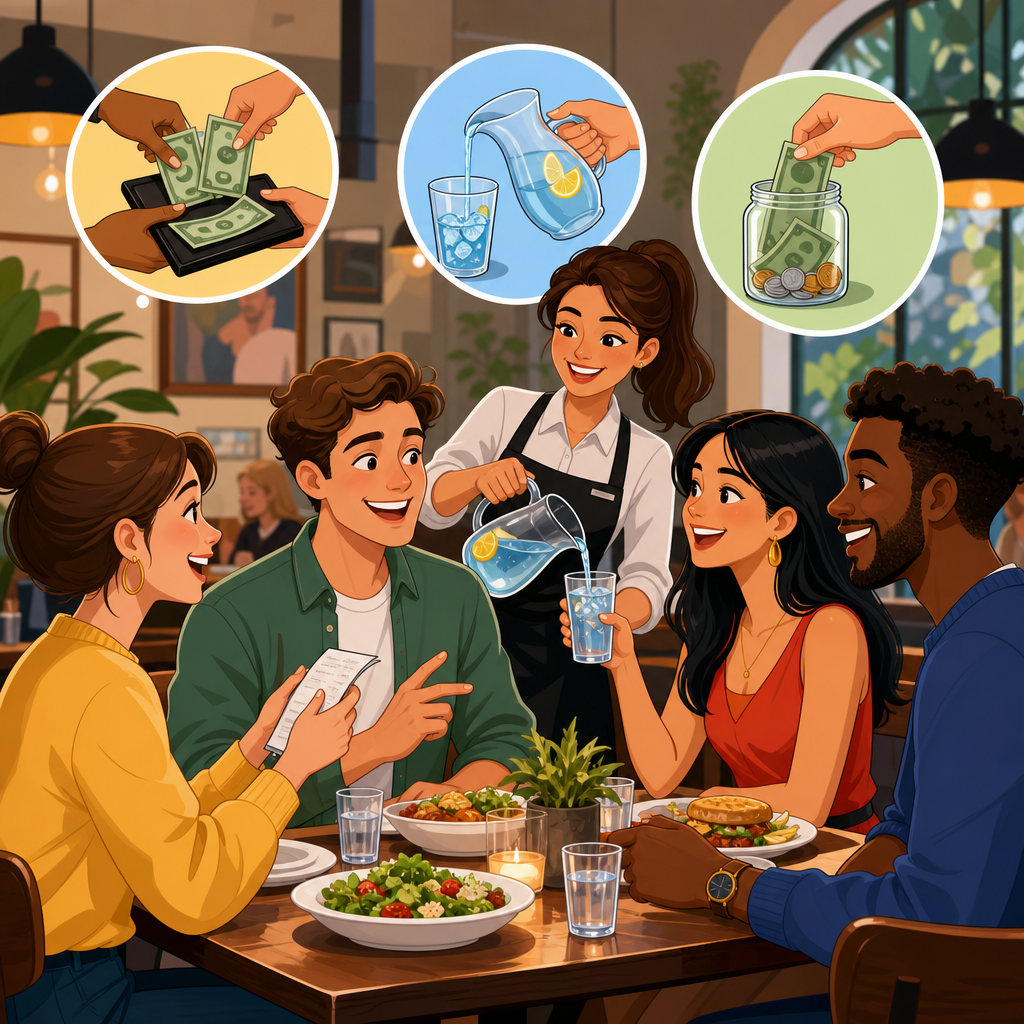
Restaurant culture in English-speaking countries can feel deceptively simple until the check arrives, someone asks for a refill, or the server mentions gratuity. For English learners, these moments are not just about vocabulary; they involve social rules, regional habits, and expectations that shape how polite, confident, and informed you sound. I have coached many learners through restaurant role-plays, and the same questions appear every time: Do people really split the bill? Are refills free? How much should you tip? The answers depend on context, but there are reliable patterns.
In this article, restaurant culture refers to the common customs around paying, ordering drinks, and rewarding service in restaurants in the United States and, to a lesser extent, other English-speaking settings. Splitting the bill means dividing the total cost among diners rather than having one person pay everything. A refill is an additional serving of a drink after the first one, sometimes free and sometimes charged. Tipping is the practice of leaving extra money for service, usually calculated as a percentage of the pre-tax or post-tax total, depending on local habit. These customs matter because mistakes can create awkwardness quickly, especially in business meals, dates, group dinners, and casual outings with native speakers.
What makes this topic important is that restaurant interactions are fast. You often have only a few seconds to understand a question like “Together or separate?” or “Would you like another Coke?” If you misread the situation, you may look rude when you intended to be respectful. Knowing the language and the logic behind the culture helps you respond naturally. It also reduces anxiety, because you understand not only what people say, but what they expect you to do next. That is the difference between memorizing phrases and navigating real life smoothly.
Splitting the bill: what people mean and what usually happens
In everyday American restaurant culture, splitting the bill is common, especially among friends, coworkers, and classmates. The most direct question from a server is usually “Is this together or separate?” Together means one check for the table. Separate means the server creates individual checks, often based on what each person ordered. In many casual restaurants, this request is normal and easy. In very busy places, large groups, or some finer restaurants, separate checks may be discouraged because they slow service and increase the chance of errors.
English learners often assume the bill should always be divided equally, but that is only one method. In practice, there are three common approaches: one person pays everything, each person pays for their own items, or the group divides the total evenly. The right choice depends on the occasion. On a first date, one person may offer to pay, though this is not automatic. At a business lunch, the inviter usually pays. Among friends, “We can just split it” may mean equal shares, even if one person ordered a salad and another ordered steak and wine. If the difference is large, people often clarify: “Do you want to split it evenly, or pay for what we ordered?”
Because this custom involves both money and relationships, the wording matters. “Can we get separate checks?” is standard and polite. “I’ll get this one” means you will pay the full amount. “Let’s split it” can be ambiguous, so in real situations I advise learners to be precise. Say “Let’s divide it evenly” or “Let’s each pay for our own meal.” That single extra phrase prevents confusion. For more social language that helps in everyday interactions beyond restaurants, see the main guide at https://5minuteenglish.com/american-small-talk-rules-that-surprise-esl-learners/.
Timing also matters. If you want separate checks, tell the server early, ideally when ordering. Many point-of-sale systems, including Toast and Square for Restaurants, allow checks to be split later, but early notice makes the process easier. If several people share appetizers or bottles of wine, the split can become messy. In those cases, one person often pays and others reimburse through Venmo, Zelle, or Cash App. That digital payment habit has changed group dining in the United States; many people no longer expect the restaurant to calculate every detail.
Refills: when they are free, when they are not, and how to ask
Refills are one of the most confusing parts of American restaurant culture because they are generous in some settings and limited in others. In many casual restaurants in the United States, refills on fountain soft drinks, brewed coffee, and iced tea are free. That means if you order a cola and finish it, the server may offer another at no additional charge. This practice is far less common in many other countries, where every new drink is billed separately. English learners are often surprised that the glass keeps coming back full.
Free refills usually apply to low-cost beverages with high profit margins. They rarely apply to bottled drinks, specialty coffee, fresh juice, smoothies, mocktails, milkshakes, beer, wine, or cocktails. Even water has context. Tap water is typically free in American restaurants unless you specifically order bottled still or sparkling water. In fast-food restaurants, self-service soda stations often make unlimited refills obvious. In table-service restaurants, the server controls refills, and policies vary by chain and by location. A diner like Denny’s may advertise free coffee refills, while an independent café may charge for every cup after the first.
| Item | Usually Free Refill? | Typical Context |
|---|---|---|
| Fountain soda | Often yes | Casual restaurants, diners, fast food |
| Brewed coffee | Often yes | Diners, breakfast spots |
| Iced tea | Often yes | Casual table service |
| Hot tea | Sometimes | Depends on tea bag or pot policy |
| Juice | Usually no | Breakfast places, cafés |
| Bottled soda | No | Restaurants without fountain machines |
| Alcoholic drinks | No | Bars and restaurants |
The language around refills is straightforward. Servers may ask, “Can I top that off?” “Need a refill?” or simply hold up a coffee pot and gesture. You can reply, “Yes, please,” “I’m good, thanks,” or “Just water for me now.” If you are unsure whether there is a charge, ask directly: “Are refills free on this?” That question is normal, not rude. I recommend it whenever the drink is not a standard fountain soda or regular coffee. Directness here saves money and embarrassment.
There is also a subtle etiquette point. If free refills are available, taking one is acceptable, but repeatedly requesting refills while staying for hours can test patience, especially during busy periods. In the United States, restaurants make money by turning tables, meaning seating new customers after one party leaves. Lingering with endless free soda during a lunch rush may be tolerated, but it is not invisible. Good judgment matters as much as vocabulary.
Tipping: the rule, the math, and the exceptions
Tipping in the United States is not a bonus for extraordinary service; in full-service restaurants, it is a standard part of the transaction. The conventional tip is 15 to 20 percent, with 20 percent now widely treated as the norm for competent service in many cities. This expectation exists partly because federal law allows a lower cash wage for tipped employees, although state laws vary. According to the U.S. Department of Labor, employers may take a tip credit under federal rules, but several states require higher direct wages. The practical result is clear: servers often depend on tips as core income, not extra income.
For learners, the easiest method is simple math. Move the decimal one place left to get 10 percent, double it for 20 percent, then adjust if needed. On a $50 bill, 10 percent is $5, so 20 percent is $10. If service was acceptable, leaving $9 to $10 is common. Some people calculate the tip on the pre-tax subtotal, others on the final total; both happen in real life, and the difference on a modest meal is usually small. What matters more is staying within the expected range unless there is a real service problem.
Not every dining situation uses the same tipping standard. At counter-service cafés, bakeries, or takeout counters, tip screens may suggest 18, 20, or 25 percent, but tipping is more optional there. Many people leave a dollar or two, choose a small percentage, or skip it. At bars, a common rule is $1 to $2 per beer or simple drink, and more for cocktails that require time and skill. For food delivery, weather, distance, and complexity matter; larger tips are common during rain, snow, or late-night service. Automatic gratuity, often 18 percent or 20 percent, may be added for large parties, so always read the receipt before tipping again.
There are exceptions and tradeoffs worth understanding. If service is seriously poor because the server is rude, forgetful, or absent, some diners reduce the tip. If delays come from the kitchen, not the server, many still tip normally. That distinction is important and fair. In my experience, learners feel pressure to choose between full generosity and complete refusal. Real restaurant culture is more nuanced. You can tip below 20 percent without breaking a rule, but leaving nothing at a sit-down restaurant sends a strong message and is generally reserved for extreme cases.
How to handle awkward moments with confidence
The most useful skill is not memorizing one perfect rule; it is recognizing the situation and responding clearly. If the server asks about the check and your group has not discussed it, say, “Give us one second.” If someone offers to pay and you want to contribute, say, “Are you sure? I’m happy to pay my part.” If you need clarification, ask. Native speakers do this constantly. Restaurant culture rewards calm, direct communication more than flawless etiquette.
Watch for regional and situational variation. In Canada, tipping practices resemble the United States, though taxes and terminal prompts may differ. In the United Kingdom, free refills are less universal, and service charges may already appear on the bill. In tourist-heavy American cities, payment tablets, QR-code menus, and suggested tips are now common. The underlying principle remains the same: read the bill carefully, ask early about separate checks, confirm refill policies when unsure, and calculate the tip before you pay.
Restaurant culture in English becomes much easier when you understand the unwritten rules behind splitting the bill, refills, and tipping. Splitting the bill is common, but you should specify whether you mean equal shares or individual items. Refills are often free for fountain soda, coffee, and iced tea in casual American restaurants, but many other drinks are charged again. Tipping at full-service restaurants is expected, with 15 to 20 percent as the standard range and 20 percent as the safest default in many places.
These habits matter because they affect how comfortable and respectful you appear during everyday social moments. A few clear phrases, basic percentage math, and the confidence to ask direct questions will prevent most problems. The next time you eat out in English, listen for the key cues, check the bill carefully, and respond plainly. That practical awareness will help you sound natural and avoid expensive misunderstandings.
Frequently Asked Questions
1. Do people really split the bill in English-speaking countries?
Yes, splitting the bill is very common in many English-speaking countries, especially when friends, coworkers, or classmates eat together. In the United States and Canada, it is normal for each person to pay for what they ordered, or for the group to divide the total evenly if the amounts are similar. In the UK, Australia, and other English-speaking places, practices can vary by age group, setting, and social situation, but the idea of “splitting the bill” is widely understood. What matters most is not just the payment itself, but how clearly and politely it is discussed. In casual groups, someone may say, “Shall we split it?” or “Do you want to do separate checks?” In some restaurants, especially in North America, servers are used to separate bills, but in others it may be more complicated, particularly if a large group waited until the very end to ask.
For English learners, the useful lesson is that splitting the bill is both a language skill and a social skill. If you want to avoid awkwardness, mention it early. You can say, “We’ll be paying separately,” or “Could we have separate checks, please?” If one person pays first and the others send money later, that is also common, especially among younger diners using payment apps. In more formal situations, such as a business meal or when someone invited you clearly as a guest, splitting may be less expected. In those cases, one person may insist on paying. Listening for expressions like “It’s on me,” “I’ve got this,” or “Let me treat you” helps you understand the social meaning of the moment. So yes, people do really split the bill, but the polite approach depends on timing, tone, and the relationship between the diners.
2. Are refills free, and what does “free refills” usually mean?
“Free refills” usually means you can have another serving of the same drink without paying extra, but this depends heavily on the country, the restaurant, and the drink itself. In the United States, free refills are especially common for soft drinks, drip coffee, iced tea, and sometimes fountain lemonade in casual restaurants, diners, and fast-food places. In Canada, similar practices exist, though not everywhere. By contrast, in the UK and many other places, unlimited free refills are less automatic and may be limited to specific self-serve soft drink stations or promotional offers. So while the phrase is common in restaurant English, you should never assume every drink comes with unlimited refills.
It is also important to understand that “refill” does not apply equally to all beverages. Alcoholic drinks, specialty coffees, bottled drinks, fresh juices, and premium beverages are almost never refilled for free. Even when refills are free, they usually mean the same beverage category, not switching from one expensive drink to another. If you are unsure, a polite question works well: “Do these come with free refills?” or “Can I get a refill on this?” In many restaurants, asking directly is completely acceptable and sounds natural. For English learners, this is a great example of practical language tied to culture: the vocabulary is simple, but the expectation is local. Knowing when to ask and not assume helps you sound more confident and avoids surprise charges on the final bill.
3. How much should you tip, and is tipping always expected?
Tipping rules vary a lot across English-speaking countries, and this is one of the most important parts of restaurant culture to learn. In the United States, tipping is generally expected in sit-down restaurants, and it is usually a significant part of a server’s income. A common tip is 15% to 20% of the bill before or after tax depending on local habit, though many people simply calculate from the total for convenience. In Canada, the expectation is very similar. If service was good, 18% to 20% is common in many cities. In these countries, leaving no tip at a full-service restaurant can be seen as a strong sign of dissatisfaction or as not understanding the system.
In the UK, tipping exists but is often less rigid. Some restaurants add a service charge automatically, especially in cities and for larger groups. If service charge is included, you usually do not need to add more unless you want to. In Australia and New Zealand, tipping is much less expected than in the US, though people may leave a little extra for excellent service. This means English learners should not treat “tipping culture” as one single rule. The best habit is to check the bill carefully for phrases such as “service included,” “gratuity added,” or “optional service charge.” If you are unsure, you can ask discreetly, “Is service included?” That simple question can save confusion and help you respond appropriately. Tipping is not just about money; it reflects local norms, and understanding those norms helps you behave naturally and respectfully.
4. What is the difference between “tip,” “gratuity,” and “service charge”?
These terms are related, but they are not always identical. A “tip” is the most common everyday word for extra money left for service. “Gratuity” is a more formal term and often appears on the bill, especially in the United States. For example, a restaurant may automatically add gratuity for a large party, such as six or more people. A “service charge” is a fee added by the restaurant itself, and depending on the country, it may or may not function exactly like a tip. In some places, service charge goes to staff; in others, it is handled differently by the business. That is why reading the bill matters more than relying only on one familiar word.
For practical restaurant English, the key is to know what to look for and what to say. If you see “18% gratuity included,” that usually means the tip has already been added, so leaving another full tip may be unnecessary unless you want to give extra. If you see “service charge,” it is wise to check whether it is optional or already part of the total. Useful questions include, “Has the tip already been added?” or “Does this include service?” These are polite, clear, and common. For English learners, this vocabulary matters because the wrong assumption can lead either to underpaying or accidentally paying twice. Learning the difference between these terms helps you read bills confidently and participate in restaurant situations with much less stress.
5. What are the most polite phrases to use when paying, asking for refills, or discussing the check?
Polite restaurant English is often built from simple phrases said with calm, respectful tone. To ask for the check, people commonly say, “Could we get the bill, please?” In the United States, “check” is more common, while “bill” is widely used in British English, though both are understood in many places. If you want to pay separately, you can say, “Could we have separate checks, please?” or “We’re paying separately.” If you want to divide one total evenly, “Can we split the bill?” sounds natural and direct. These phrases are not overly formal, but they are polite and widely used in real restaurants.
For refills, natural phrases include, “Could I get a refill, please?” “May I have some more coffee?” or “Do you do free refills on this?” If you are worried about sounding too direct, adding “could” or “please” helps immediately. When tipping or checking charges, you might ask, “Is service included?” or “Has gratuity already been added?” These are especially useful if you are traveling between countries with different customs. The larger lesson is that confidence in restaurant English does not come from advanced grammar; it comes from knowing the standard expressions people actually use. If you learn a few key phrases for the check, refills, and tipping, you will sound more natural, avoid uncomfortable misunderstandings, and handle restaurant interactions much more smoothly.