
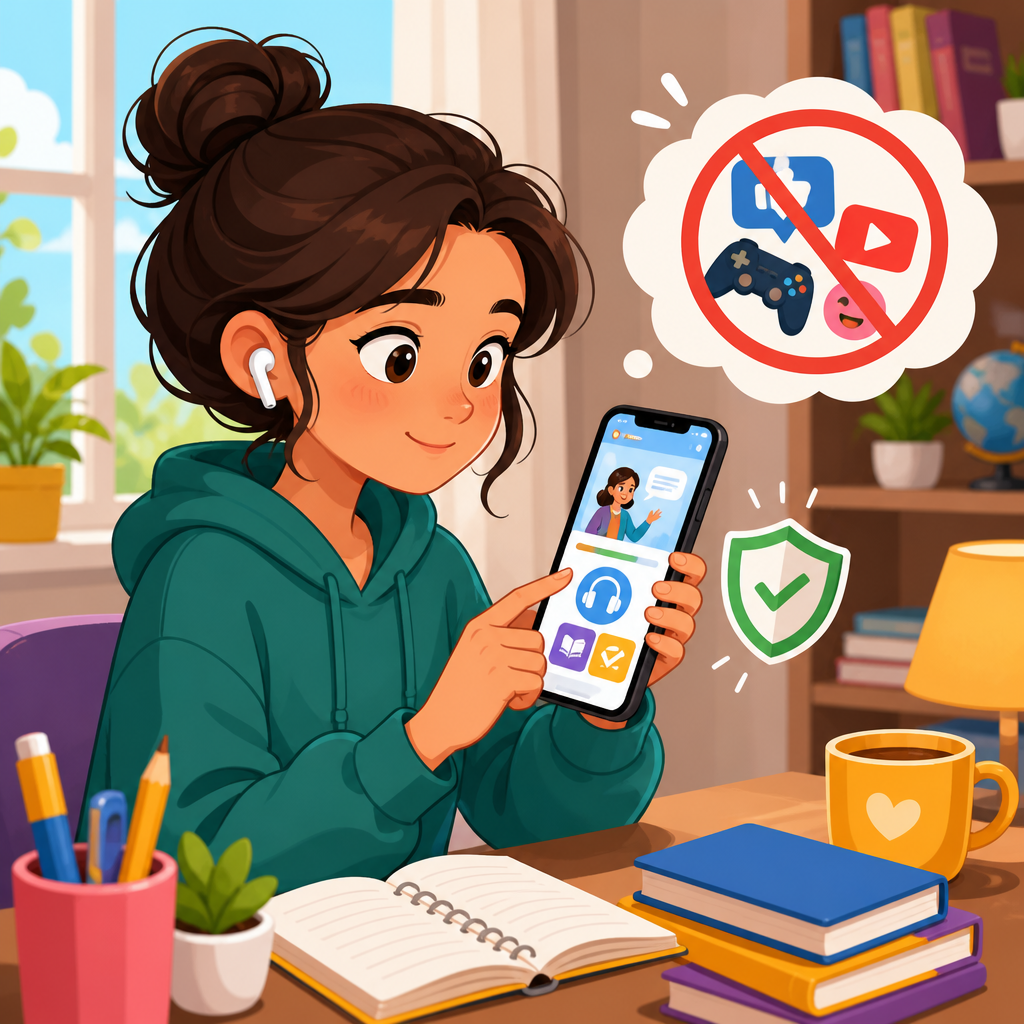
Studying English on your phone without getting distracted is possible, but it only works when the phone stops being an entertainment device first and becomes a controlled learning tool. For busy adults, mobile study is attractive because it fits into commutes, lunch breaks, waiting rooms, and the ten spare minutes before bed. The problem is obvious: the same device that delivers flashcards, podcasts, and reading practice also delivers notifications, social feeds, games, and endless scrolling. In my experience coaching adult learners, the issue is rarely motivation alone. It is usually friction, attention residue, and poor phone setup.
To study effectively, you need a system that reduces switching costs and protects focus. “Switching costs” are the mental penalties you pay every time you jump from one task to another. “Attention residue” is the leftover mental pull from the last app or message you checked. Both reduce comprehension, memory formation, and consistency. If you want your English study routine to stick, your phone environment matters almost as much as the lesson itself. This matters because short, focused mobile sessions can improve vocabulary retention, listening fluency, and reading speed, but fragmented sessions filled with interruptions often feel busy without producing real progress.
The goal is not to avoid your phone. The goal is to redesign how you use it so English study becomes the easiest thing to start and the hardest thing to interrupt. That means choosing the right apps, changing notification settings, building short study blocks, and deciding in advance what you will do during each session. When those decisions are made beforehand, your brain spends less energy resisting distractions and more energy learning.
Why phones distract you during English study
Phone distraction is not a personal weakness. It is a product design issue. Most apps compete for attention through alerts, badges, autoplay, infinite feeds, and variable rewards. Those features trigger habitual checking loops. During English study, even a two-second glance at a message can break working memory. If you were trying to understand a podcast sentence, recall a phrasal verb, or notice verb tense in a reading passage, that interruption can erase the context you were holding in mind.
Language learning is especially vulnerable because it depends on repetition and active recall. You need enough uninterrupted time to hear patterns, compare meanings, and produce language from memory. A learner who spends fifteen clean minutes shadowing audio often improves more than a learner who spends thirty interrupted minutes switching between study and social media. I have seen this repeatedly with adults who believed they lacked discipline, when the real problem was that they were studying in the same digital space where they relaxed and procrastinated.
Another reason phones distract learners is decision overload. If you unlock your screen and then choose between YouTube, Anki, a dictionary app, notes, or a chat tool, you create unnecessary resistance. The more decisions required, the easier it is to abandon the task. Effective mobile study removes choices at the moment of action.
How to turn your phone into a focused English study device
The fastest improvement comes from changing the phone before changing the learner. Start with notifications. Turn off all nonessential alerts, especially social media, shopping, news, and promotional notifications. Keep only calls or messages that matter for safety or work. On iPhone, use Focus modes; on Android, use Do Not Disturb or app-specific notification controls. Create a dedicated “English Study” focus setting that silences interruptions and allows only a small whitelist if necessary.
Next, change the home screen. Put your English tools on the first screen and remove distracting apps from immediate view. You do not need to delete every entertainment app, but you should make them harder to reach. Move them into folders, log out, or place them on the last screen. I also recommend removing badges, because red notification dots pull attention even when you intend to ignore them. Use grayscale during study sessions if you are highly reactive to colorful apps; many learners find that it lowers impulsive checking.
Then reduce app sprawl. Most people study better with three or four core tools than with ten mediocre ones. A practical setup might include one flashcard app such as Anki, one listening source such as Spotify or a podcast app, one reading source such as Kindle or a browser reading list, and one dictionary such as Cambridge, Longman, or Merriam-Webster. If every session begins in a different app, consistency drops.
| Problem | Phone adjustment | Why it works |
|---|---|---|
| Constant interruptions | Use Focus mode or Do Not Disturb | Protects working memory during listening, reading, and recall |
| Mindless app switching | Keep only 3–4 study apps on the first screen | Reduces decision fatigue and startup friction |
| Social media temptation | Hide, log out of, or time-limit distracting apps | Adds friction to impulsive checking |
| Unclear study goal | Predefine one task for each session | Makes starting automatic and measurable |
What an effective phone-based English session looks like
A good mobile study session is short, specific, and single-purpose. Instead of saying, “I will study English for twenty minutes,” say, “I will review twenty flashcards,” or “I will listen to one five-minute podcast twice and shadow three sentences.” Clear tasks are easier to begin and easier to complete. They also create a visible record of progress, which helps motivation.
The most reliable session length on a phone is often ten to twenty minutes. That is long enough for meaningful practice and short enough to defend from distractions. For vocabulary, use active recall, not passive rereading. Cover the meaning and force yourself to retrieve it. For listening, replay short segments and repeat them aloud. For reading, highlight useful phrases and save only a few, then review them later. For speaking, record a one-minute response to a prompt instead of waiting for a perfect study environment.
I often advise learners to assign one skill to one context. For example, use your commute for listening, your lunch break for flashcards, and your evening for short reading. Context-based routines reduce planning and make the habit more automatic. If you want a broader structure for busy schedules, this daily system fits well with mobile study: The 3-2-1 Daily English Routine for Busy Adults. The key is that each phone session should have a finish line.
Best methods for avoiding distraction while you study
Several methods work consistently because they address behavior, not just intention. First, use app blockers during study time. Tools such as Freedom, Opal, Forest, Screen Time, Digital Wellbeing, and One Sec can block or delay access to distracting apps. A delay of even five seconds is powerful because it interrupts automatic behavior. Second, study in airplane mode when your task does not require internet access. Download podcasts, articles, or flashcards beforehand and remove the temptation entirely.
Third, use timers. A visible ten- or fifteen-minute timer creates urgency and reduces the feeling that you can check one other app “for a second.” Fourth, keep a capture note. If a non-urgent thought appears, such as a work reminder or something you need to buy, write it in a simple note and return to the lesson. This prevents mental wandering from turning into app switching.
Fifth, match the task to your energy level. Low-energy moments are good for review, not for difficult grammar analysis. If you are tired, do listening repetition or flashcard review. If you are alert, do reading with note-taking or speaking practice. This matters because many learners blame distraction when the real issue is that the task is too demanding for the moment. Good mobile study is adaptive, not rigid.
Common mistakes that make mobile English study ineffective
The biggest mistake is confusing exposure with study. Watching random English videos while also reading comments is not focused practice. It may help familiarity, but it rarely produces strong retention. Another mistake is opening too many resources in one session. One article, one audio clip, or one flashcard deck is enough. Depth beats novelty on a phone.
A third mistake is using long sessions as the standard. When learners think they need forty-five quiet minutes, they skip the many short windows that could add up to real progress. Mobile learning succeeds through frequency. Four ten-minute sessions across a day can outperform one tired evening session because retrieval is spaced. Spaced repetition is well supported in cognitive science and is one reason flashcard systems like Anki are effective for vocabulary.
Finally, many learners fail to review what they save. They highlight dozens of phrases, bookmark articles, and collect screenshots, but never revisit them. A phone should not become a storage unit for good intentions. Save less, review more, and convert passive material into active practice by making cards, repeating sentences aloud, or writing one original example.
Studying English on your phone without getting distracted is less about willpower than about design. When you silence notifications, simplify your app choices, define one task per session, and use short protected study blocks, your phone becomes genuinely useful for language learning. The most effective learners do not try to be stronger than distraction every day; they make distraction less available. That is why a small number of practical changes often leads to immediate improvement in consistency and retention.
Remember the core principle: friction should be low for studying and high for everything that interrupts studying. Build your screen around that rule. Keep one vocabulary tool, one listening tool, one reading tool, and one dictionary. Decide in advance what each spare pocket of time is for. Use blockers, timers, and offline mode when needed. Then measure success by completed sessions, not by how motivated you felt.
If your English study on the phone has felt scattered, do not add more resources. Tighten the system you already have. Reorganize your device today, protect one ten-minute session, and repeat it tomorrow. Consistent focused practice on the phone is not a compromise. For many busy adults, it is the most realistic path to steady English progress.
Frequently Asked Questions
Can I really improve my English on my phone, or is it too distracting to be effective?
Yes, you can absolutely improve your English on your phone, but only if you treat the phone as a study tool instead of a general entertainment device. The biggest mistake most learners make is assuming that good intentions are enough. They open an English app, study for three minutes, see a notification, and then end up on social media or watching unrelated videos. The issue is not the phone itself. The issue is whether the learning environment on that phone has been controlled.
Mobile learning works especially well for busy adults because it turns small blocks of unused time into productive English practice. A ten-minute commute, a lunch break, or a few minutes in a waiting room can become useful study sessions when your materials are ready and distractions are reduced. Listening practice, vocabulary review, reading short texts, shadowing audio, and quick writing tasks are all realistic on a phone. In fact, short, repeated exposure often helps more than one long study session that only happens once a week.
What makes phone study effective is structure. If your apps are organized, notifications are limited, and you know exactly what you will do during each session, your phone can become one of the most practical language-learning tools you own. If you open your device without a clear plan, however, distraction usually wins. The goal is not to have more willpower. The goal is to remove as many temptations as possible before you begin.
What are the best ways to stop notifications and apps from interrupting my English study time?
The most effective approach is to reduce interruption before the study session starts. Put your phone in Do Not Disturb mode, silence nonessential alerts, and disable notifications from social media, shopping, news, and games. If an app does not need to interrupt you, it should not have permission to do so. This one change alone can dramatically improve concentration because it removes the constant visual and mental pull of incoming messages and updates.
It also helps to create a separate study environment on your phone. Move your English apps to the home screen and place distracting apps in folders, on later screens, or remove them entirely during intensive study periods. Some learners use app blockers or focus modes to limit access to entertainment apps for 15, 20, or 30 minutes at a time. That can be extremely useful because it replaces willpower with a system. If your most distracting app is literally unavailable during study time, you are much more likely to stay on task.
Another smart method is to study in airplane mode when your task allows it. If you are reviewing saved vocabulary, reading downloaded material, or listening to preloaded audio, you may not need an internet connection at all. This instantly cuts off many common distractions. The key idea is simple: do not rely on self-control in a high-distraction environment when you can redesign the environment itself. Serious learners make it easier to focus by making distraction less accessible.
What should a short but productive English study session on my phone look like?
A productive mobile study session should be small, specific, and easy to begin. One of the best formats is a focused 10- to 15-minute routine with one clear objective. For example, you might spend five minutes reviewing vocabulary, five minutes listening to a short English audio clip, and five minutes repeating useful phrases aloud. That is enough to build consistency without creating friction. If the session feels too long or complicated, you are less likely to start.
The most important principle is to avoid random study. Instead of unlocking your phone and deciding what to do in the moment, prepare a simple sequence in advance. You might have a “commute routine,” a “lunch break routine,” and a “before bed routine.” On the commute, you listen to a podcast and repeat key sentences. At lunch, you review flashcards and read a short article. Before bed, you write three sentences using new vocabulary. This reduces decision fatigue and helps your brain associate certain times of day with certain English tasks.
Short sessions become powerful when they are repeated consistently. Many adults underestimate how much progress comes from daily contact with the language. Fifteen focused minutes every day often leads to better retention than occasional hour-long sessions interrupted by fatigue and distractions. On a phone, success usually comes from keeping the task narrow: one article, one audio clip, one vocabulary set, one pronunciation drill. Small wins done regularly create measurable progress.
Which English activities are best for studying on a phone without losing focus?
The best mobile activities are the ones that match the strengths of the device while keeping the task simple. Vocabulary review is one of the strongest options because it fits naturally into short sessions. Flashcards, spaced repetition apps, saved word lists, and sentence review all work well on a small screen. Listening is another excellent choice. Podcasts, short dialogues, pronunciation clips, and audiobooks allow you to study while commuting, walking, or doing routine tasks, especially if you already know what you plan to listen to.
Reading can also be effective if you choose material that fits the context. Short news summaries, graded readers, mini dialogues, or saved articles are often better than long, dense texts on a phone. The smaller screen encourages shorter reading bursts, so it helps to work with content that can be completed in one sitting. Writing is possible too, especially for brief exercises such as sentence creation, note-taking, summarizing a short audio clip, or answering a daily prompt. Even one or two original sentences using new words can strengthen memory and active use.
To avoid distraction, choose activities that begin immediately and do not require too many app switches. For example, opening one app for flashcards is usually better than jumping between a dictionary, a video platform, a note app, and a translation tool all at once. The more fragmented the process becomes, the easier it is to drift away from studying. Efficient mobile learning is usually built around low-friction tasks: listen, repeat, review, read, and write briefly. The simpler the workflow, the easier it is to stay focused.
How can I turn my phone into a real English learning tool instead of an entertainment device?
Start by changing how the phone is set up. If your lock screen, home screen, and app layout are designed to pull you toward entertainment, that is where your attention will go. Move English learning apps, dictionaries, note apps, and audio resources to the most visible positions. Remove or hide the apps that waste your time most often. Unfollow accounts that trigger endless scrolling, and consider deleting entertainment apps during periods when you want to build stronger study habits. Environment design matters more than motivation in the long term.
Next, prepare your content in advance so the phone is ready for immediate use. Download podcasts, save articles, build vocabulary decks, bookmark pronunciation exercises, and keep a note open for useful phrases. The easier it is to begin, the more likely you are to use spare moments well. Many learners fail not because they lack discipline, but because every study session starts with searching, choosing, and organizing. By the time they are ready, they are already distracted. A well-prepared phone removes that barrier.
Finally, give your mobile learning a clear purpose. Decide what your phone is for in your English routine. Maybe it is your listening device, your vocabulary review tool, or your place for short daily reading. When the role is defined, your sessions become more intentional and less random. You do not need your phone to do everything. You need it to do a few useful things consistently. Once the device has rules, structure, and a focused role, it stops being just a source of interruption and becomes a practical, reliable part of your English progress.





