
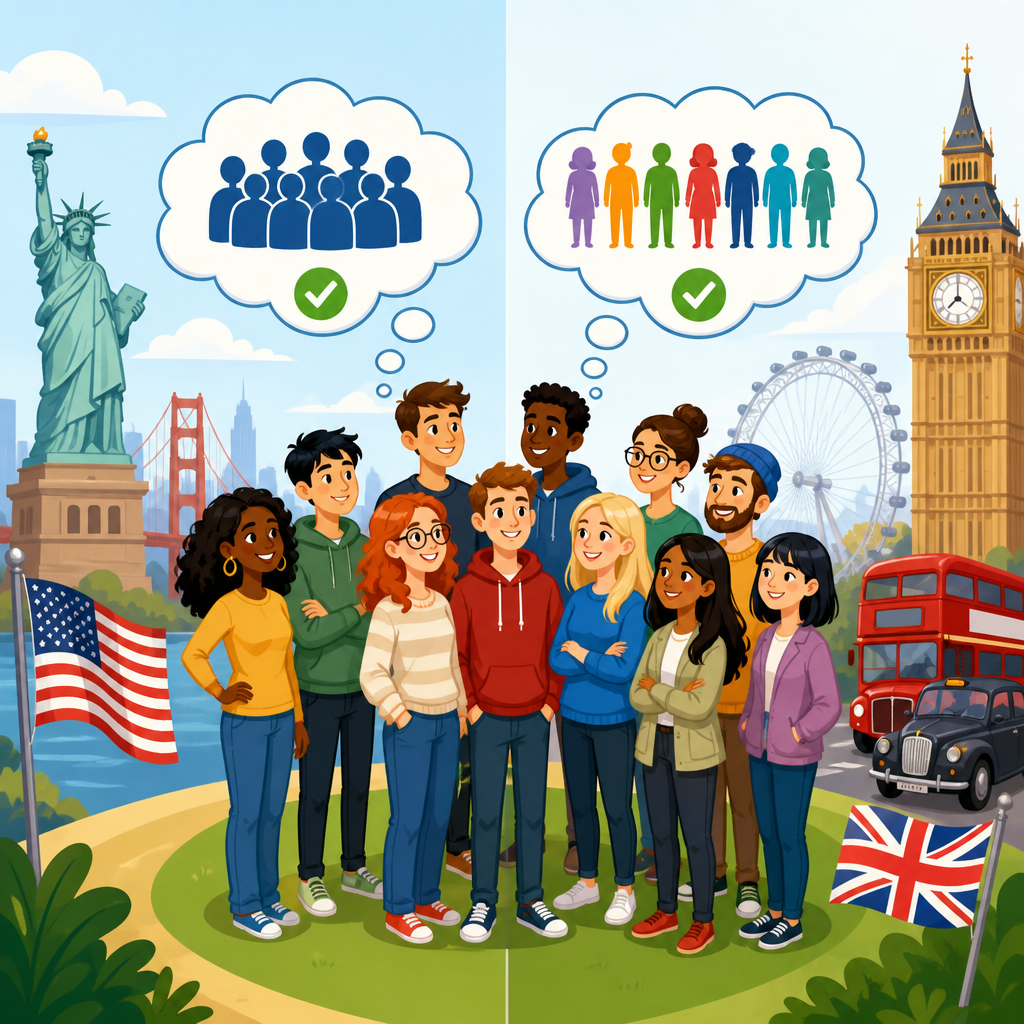
With collective nouns such as team, committee and family, agreement depends on the noun, meaning, variety of English and relevant style. American usage generally favours a singular verb for a group: “The team is ready.” British usage more readily allows plural agreement: “The team are ready.” These are tendencies, not a rule that every British collective is plural or every American one is singular. This guide compares the choices and distinguishes them from nouns such as police.
Compare “The committee has reached a decision” with “The committee are arguing among themselves.” The first presents the group as a body; the second highlights members and is especially natural in British usage. Pronouns can also refer to the group or its members. Check their referents and the context rather than deciding every later word mechanically from the first verb.
What subject-verb agreement with collective nouns means
A noun such as committee is singular in form but denotes a group. Singular agreement can follow that form; plural agreement can follow the members understood in the meaning, often called notional agreement. The Cambridge account of singular and plural nouns explains this unit-and-members distinction. Dialect and the particular noun still influence the available choices.
Examples show the distinction clearly. “The committee meets on Thursday” presents the committee as one decision-making unit. “The committee are divided on the budget” presents disagreement among members. Both patterns are grammatical within the right dialect and context. The key is not memorizing a fixed list of nouns but identifying how the sentence frames the group’s action. This is a sentence structure issue because the verb does not stand alone; complements, pronouns, and nearby modifiers all reinforce the intended reading. In clean prose, every part of the sentence points in the same direction.
US and UK dialectal patterns in real usage
In edited American English, singular agreement is a common choice for company, board and team: “The company is expanding.” It is not an exceptionless national rule. When you specifically mean the individuals, a rewrite such as “The board members disagree” can make that reference explicit without requiring a disputed collective construction.
British English permits singular and plural agreement with many human group nouns. Illustrative examples include “The government has announced a plan” and “The government have announced a plan.” The choice can reflect a unit or its members, but also conventional usage, especially with organisation and team names. These examples are not quotations from a newspaper or evidence about one publication’s current style.
| Collective noun | Typical US pattern | Typical UK pattern | Meaning emphasis |
|---|---|---|---|
| team | The team is winning. | The team are playing well. | Unit vs players |
| government | The government has announced a plan. | The government have announced a plan. | Institution vs ministers |
| staff | The staff is small. | The staff are meeting now. | Workforce as whole vs employees |
| family | My family is supportive. | My family are all arriving separately. | Household unit vs members |
For a particular document, check its audience and any stated house style, then decide what the sentence refers to. A UK audience does not automatically require a plural verb in every sports sentence, and a US audience does not make every plural collective construction impossible. If the choice distracts from the meaning, use an explicit plural noun such as staff members or a singular organisation.
How collective nouns affect the rest of sentence structure
Matching patterns can be useful: “The committee has reached its decision” treats the body as a unit, while “The committee have expressed their differing views” foregrounds members. Pronouns can reflect a plural meaning in a singular-form collective, so check meaning and the relevant style rather than declaring every later their wrong solely because an earlier verb was singular. If the reference is unclear, write “The committee members have expressed their views.”
An intervening phrase does not by itself choose the main verb. In “The group of researchers is publishing its findings,” the collective head is group, not researchers. British plural agreement with group can also occur when members are intended. Similarly, an appositive describing a jury does not independently determine agreement. The noun’s collective use and context still need to be checked.
Check each reference in a longer sentence. “The board has reviewed the proposal and issued its statement” presents the board as a body. “The board members have reviewed the proposal and issued their separate responses” makes the individuals explicit. A shift of pronoun may signal a changed referent; identify it before labelling the sentence a parallelism error.
High-frequency problem cases and reliable solutions
Do not put every group-related word under the same rule. Police and cattle normally take plural verbs in standard English: “The police are investigating” and “The cattle are grazing.” They are not singular-form collectives like committee with the same unit-versus-members choice. Data and media have their own plural and mass-noun usage conventions; check the intended sense and relevant dictionary or style guide separately.
A proper name’s spelling does not always predict its agreement. “The Beatles were influential” and “The United Nations is an organisation” illustrate different conventional patterns despite their final s. Names of companies, bands and teams can also vary with usage and dialect. Check the particular name in context rather than applying a rule that every plural-looking name must take a plural verb.
The most reliable solution is to decide what the sentence means before choosing the verb. Ask two questions. First, is the group acting as one body or as individual members? Second, which dialect and style guide govern the document? If both answers point the same way, the sentence will usually sound natural. If not, revise the noun or rephrase. Instead of forcing a difficult agreement pattern, write “team members are arguing” or “the organization is revising its policy.” Strong sentence structure often comes from choosing a cleaner subject, not from defending a borderline construction.
Editing for consistency across a grammar and sentence structure hub
Use a practical check: identify the collective head, decide whether the passage refers to a body or its members, check the variety and style, then review later references. Reading aloud may help you notice an awkward sentence, but it is not evidence that a form is grammatical or a measured test of editing speed.
Keep collective agreement separate from other constructions. “The team is ready” and “The team are ready” involve a group noun; “The coach and players are ready” has coordination; “The coach, along with the players, is ready” has an accompanying phrase. Each needs its own agreement analysis. No single nearest-noun rule covers all three.
Frequently Asked Questions
1. What is a collective noun, and why does subject-verb agreement with it vary between US and UK English?
A collective noun is a singular-looking noun that refers to a group made up of multiple individuals, such as team, committee, government, family, staff, or jury. The agreement issue arises because these nouns can be understood in two different ways: as one unit acting together or as several people acting individually. That difference in interpretation is what drives the verb choice.
In American English, collective nouns are usually treated as singular when the group is viewed as a single entity. For example, “The team is winning” is the standard US pattern. In British English, however, collective nouns more often take plural verbs when the writer or speaker wants to emphasize the members within the group: “The team are playing well.” Both dialects are grammatical, but they follow different preferences.
This is why subject-verb agreement with collective nouns is not just a rule-memorization issue. It depends on meaning, regional convention, and style. If your audience is primarily American, singular agreement will usually sound more natural. If your audience is British, plural agreement may sound more idiomatic in many contexts, especially with nouns like government, staff, and committee. Understanding that distinction helps writers make choices that are clear, consistent, and appropriate for their readers.
2. When should a collective noun take a singular verb, and when should it take a plural verb?
Meaning is a useful starting point: “The committee has reached a decision” presents a body, while “The committee are arguing among themselves” foregrounds members. Do not treat that contrast as a mandatory test that uniquely determines every choice. Dialect, the particular noun and conventional usage also matter. “The committee members are arguing” makes the plural reference explicit.
In American English, the singular form is generally preferred even in many cases where multiple people are involved. Sentences such as “The audience was enthusiastic” and “The government is considering new measures” are standard in US usage. American writers may still shift to plural in limited cases, but that is much less common and can sometimes sound awkward unless the emphasis on individual members is very strong.
In British English, writers have more flexibility. They may say “The government is united” when the institution is being treated as one body, but “The government are divided” when attention is on the people within it. That distinction is especially common in journalism, political writing, and sports reporting. The key is not randomness but perspective: are you presenting the collective noun as one entity or as a collection of individuals?
Check that pronouns have a clear reference. In “The staff are meeting because they want to discuss scheduling,” they refers to the employees. If a later it refers to the organisation instead, make that change clear. Matching number can help, but clear reference and the intended group-or-members meaning need to be assessed together.
3. Are some collective nouns more likely than others to be singular or plural?
Yes. Although the basic rule depends on meaning and dialect, certain collective nouns tend to attract particular patterns more often than others. Nouns such as team, government, committee, family, staff, jury, and audience are among the most frequently discussed because they regularly appear in contexts where a writer may focus either on the group as a whole or on the individuals inside it.
In American English, nouns like team and company are strongly inclined toward singular agreement: “The team is practicing,” “The company has announced a new policy.” In British English, these same nouns often appear with plural verbs when the context emphasizes members: “The team are wearing their new uniforms,” “The company are reviewing their options.” Sports coverage is a classic example of this UK preference.
Some collective nouns also vary because of the sentence’s internal clues. If the sentence includes words like among themselves, disagree, argue, or references to individual members, plural agreement becomes more likely, especially in British usage. On the other hand, if the sentence stresses unity, structure, or institutional action, singular agreement is more natural: “The jury has delivered its verdict,” “The board is responsible for final approval.”
There is flexibility with nouns such as team and committee, but it is not permission to vary every group-related noun freely. “The police are” is the ordinary plural pattern; it is not the same choice as “The committee is/are.” Check the specific noun as well as the intended meaning and dialect.
4. How should I handle pronouns with collective nouns in US and UK usage?
Pronoun agreement should match the way you are treating the collective noun. If the noun takes a singular verb and is being presented as one unit, use singular pronouns such as it and its. For example: “The committee has announced its recommendation.” This is the standard pattern in American English and is common in formal writing because it keeps grammatical number tightly aligned.
If the collective noun takes a plural verb and the members are being emphasized, use plural pronouns such as they, them, and their: “The committee have announced their views.” This is especially natural in British English, where plural agreement with collective nouns is far more accepted and often preferred in contexts involving human members acting individually.
Make the intended reference clear throughout the passage. “The family is large, and its history is well documented” describes the group as a unit. “The family are all arriving separately” foregrounds members. A passage can discuss a group in one clause and its members in another; check that the transition is understandable rather than banning every change of perspective.
Pronoun choice is not a reliable way to identify a writer’s nationality. Both varieties can refer to an institution or to its members. For practical guidance, the Language Portal of Canada distinguishes unit and individual meanings. Use an explicit noun phrase when a pronoun would leave the reference unclear.
5. What are the best style tips for using collective nouns consistently in academic, business, and online writing?
First, decide which variety of English you are using before you draft or edit. If your article, report, or website is aimed at an American audience, defaulting to singular agreement with collective nouns is usually the safest choice. If your audience is British, you can allow more flexibility, especially when the context highlights individual members of the group. Consistency across the document matters more than isolated preferences.
Second, let meaning guide the grammar. Ask yourself whether the group is functioning as one body or whether the sentence is really about the people within it. “The board is responsible for policy” emphasizes the institution. “The board are divided on the proposal” emphasizes the differing views of individual members. That meaning-based approach produces writing that sounds deliberate rather than mechanical.
Review the actual references and verb forms in each clause. A group can be discussed as an institution in one sentence and as individual people in the next if the change is clear. A relevant house style may request a more uniform pattern. Rewriting with members is an option when the intended reference would otherwise be ambiguous.
Finally, remember that style guides and house preferences can override general patterns. News organizations, academic departments, publishers, and global brands often maintain their own standards on collective nouns. If you are writing for a client, publication, or institution, check whether they prefer forms like “The team is” or “The team are.” When no specific style guide applies, choose the pattern that fits your audience and stick to it.





