
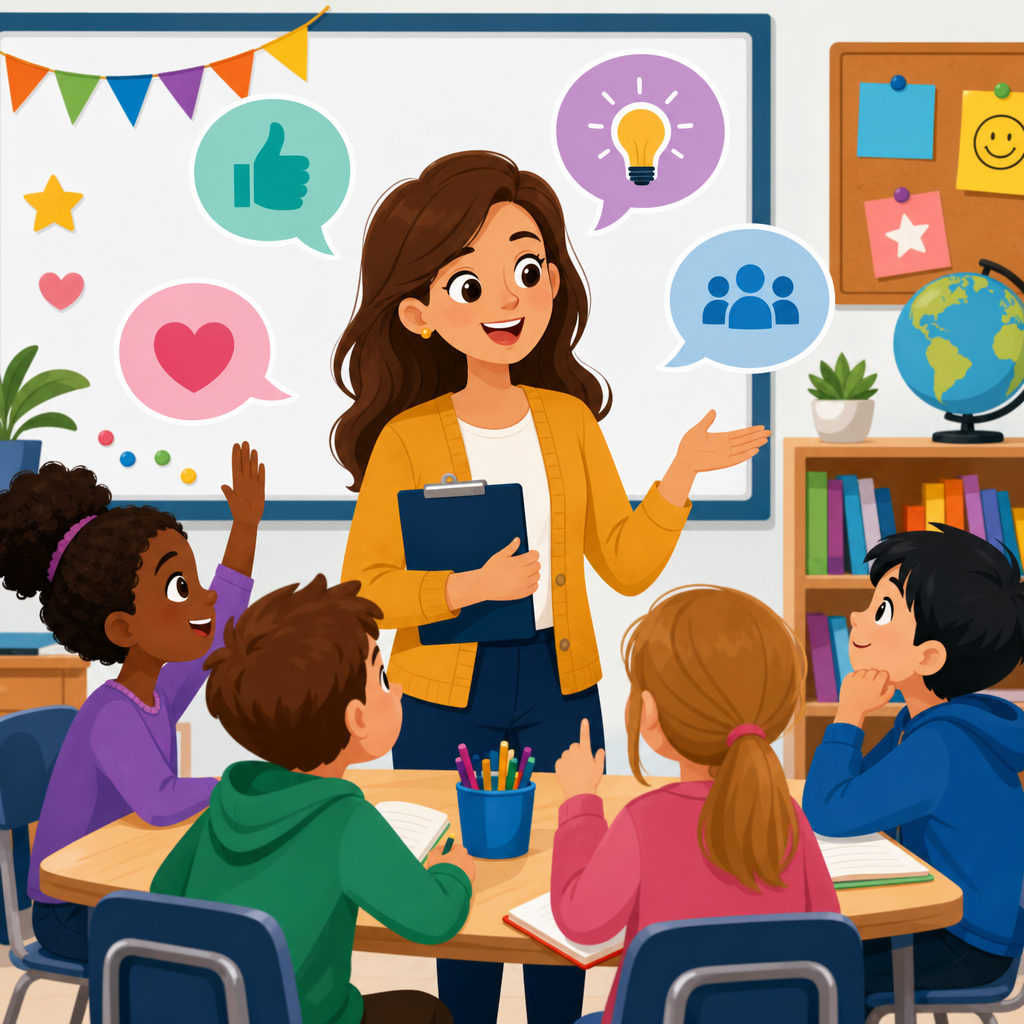
Every teacher needs a reliable bank of classroom phrases for teachers in English because the right words shape routines, reduce confusion, and create a calmer learning environment from the first bell to the final goodbye. In practical terms, classroom phrases are the short, repeatable expressions teachers use to give instructions, manage behavior, check understanding, transition between activities, and build rapport. I have seen the difference these phrases make in beginner language classrooms, mainstream elementary rooms, and adult training sessions: when instructions are predictable and concise, students spend less time decoding what the teacher wants and more time learning. This matters especially in mixed-ability groups, multilingual classes, and fast-paced lessons where attention can drift quickly. A teacher toolkit is not just a list of commands; it is a structured set of language patterns that support consistency, confidence, and inclusion. For schools, tutors, and trainee educators, mastering these phrases improves classroom management, supports clearer communication, and helps students feel secure enough to participate. This hub article covers the essential categories of English classroom phrases, shows when to use them, and explains how to adapt them for age, proficiency, and context.
Starting and framing the lesson
The opening minutes of a lesson set the tone, so teachers need phrases that are warm, direct, and easy to follow. Useful starters include “Good morning, everyone,” “Let’s get started,” “Take your seats, please,” and “Today we’re going to learn about…”. These phrases do more than begin class; they establish attention, routine, and purpose. In my own teaching, I found that stating the objective in plain English—“By the end of this lesson, you will be able to describe a picture using five adjectives”—immediately improved focus because students knew what success looked like. For younger learners, shorter phrasing works best: “Books open,” “Eyes on me,” and “Listen carefully.” For teens and adults, slightly fuller language sounds more natural and respectful, such as “Please have your notebooks ready” or “Let’s review what we covered last time.” Teachers should also use signposting phrases to structure the lesson: “First, we’ll review,” “Then you’ll work in pairs,” and “Finally, we’ll check the answers together.” Signposting reduces uncertainty and supports learners who process spoken instructions more slowly.
Giving instructions clearly and efficiently
Clear instructions are the backbone of effective teaching, and the best classroom phrases for teachers in English are brief, sequenced, and concrete. Strong examples include “Work in pairs,” “Read the first paragraph,” “Circle the correct answer,” “Write three sentences,” and “You have five minutes.” The most common mistake teachers make is over-explaining. Students often need one instruction at a time, especially in lower-level English classes. I learned to replace long explanations with short steps and visual support on the board. Instead of saying, “What I’d like you to do now is look at the worksheet and, after reading the text, discuss it with your partner before completing the final section,” say, “Step one: read. Step two: discuss. Step three: complete the worksheet.” Checking comprehension matters too. Ask, “What do you have to do first?” rather than “Do you understand?” because students often say yes even when they are unsure. Time markers help maintain pace: “You have two more minutes,” “Finish this line,” and “Stop there.” These phrases create momentum without sounding harsh.
Managing behavior and maintaining a positive climate
Behavior language works best when it is calm, specific, and consistent. Effective phrases include “Please lower your voices,” “One person at a time,” “Raise your hand if you want to speak,” and “Let’s focus on the task.” In experienced classrooms, teachers avoid vague reprimands like “Behave yourselves” and instead name the expected action: “Chairs on the floor, please,” “Face the front,” or “Keep your hands to yourself.” Positive phrasing is especially powerful. “Walk, please” usually works better than “Don’t run,” and “Use a quiet voice” is clearer than “Stop shouting.” Restorative language also matters when correcting behavior. Phrases such as “That choice is stopping others from learning,” “Let’s try that again,” and “What should you be doing right now?” preserve dignity while redirecting conduct. For recurring disruption, private, low-volume correction is often more effective than public confrontation. In bilingual or English-learning settings, teachers should pair behavior phrases with gestures, routines, and predictable consequences. Consistency is what gives the language authority. Students learn not only the rule but the exact words that signal the rule every time.
Checking understanding and encouraging participation
Good teachers do not assume learning has happened; they verify it using purposeful classroom phrases. To check understanding, use “Tell me in your own words,” “Show me your answer,” “Which part is difficult?” and “Why did you choose that?” These prompts reveal whether students can explain, not just repeat. For formative assessment, simple response systems work well: “Thumbs up if you’re ready,” “Hold up your whiteboard,” or “Turn and tell your partner.” Participation also improves when teachers provide language that lowers the risk of speaking. Encourage learners with “Take your time,” “It’s okay to make mistakes,” “Who wants to give it a try?” and “Can anyone add to that answer?” In language classrooms, sentence starters are especially useful: “I think the answer is…,” “In my opinion…,” and “I agree because…”. These frames help quieter students contribute without building each response from scratch. If a student is struggling, supportive recasting keeps the flow moving: “You mean…,” “Try saying it this way,” or “Almost—listen and repeat.” The goal is to correct without shutting down confidence, a balance every effective teacher works hard to maintain.
Useful classroom phrases by teaching purpose
Organizing phrases by function makes them easier to learn and reuse across subjects. The table below shows practical examples that teachers can adapt for primary, secondary, tutoring, or adult lessons.
| Teaching purpose | Useful English phrases | When to use them |
|---|---|---|
| Starting class | “Let’s begin.” “Take out your books.” “Today’s goal is…” | At the bell, after settling students, before introducing objectives |
| Giving instructions | “Listen first.” “Work in pairs.” “You have five minutes.” | Before tasks, activities, games, or written work |
| Checking understanding | “What do you do first?” “Can you explain your answer?” | After directions, during guided practice, before independent work |
| Managing behavior | “Eyes on me.” “Use a quiet voice.” “Wait for your turn.” | During transitions, noise spikes, or off-task behavior |
| Giving feedback | “Good effort.” “Check your spelling.” “Try one more time.” | During review, correction, conferencing, and assessment |
| Ending class | “Let’s recap.” “Hand in your work.” “See you next lesson.” | Final minutes, homework assignment, dismissal |
Giving feedback, correction, and praise
Feedback phrases influence motivation as much as accuracy. Effective praise is specific: “Excellent use of evidence,” “Your pronunciation was clear,” or “You organized your paragraph well.” Generic comments like “Good job” have limited instructional value unless paired with a reason. Corrective feedback should also be precise and proportionate. Try “Check the verb tense,” “Remember the capital letter,” or “Read the question again.” This keeps ownership with the learner instead of simply supplying the answer. In spoken English practice, delayed correction often works better than immediate interruption because it protects fluency. A teacher might note common errors, then say, “I heard some strong ideas. Let’s improve two grammar points together.” For written work, margin comments such as “Add an example,” “Clarify this point,” and “Use a linking word here” guide revision effectively. Praise should recognize progress, not just high performance. Phrases like “That’s better than last time,” “You used the strategy correctly,” and “I can see you checked your work carefully” reinforce habits that lead to long-term improvement.
Transitions, endings, and adapting phrases for different learners
Many classroom management problems happen during transitions, so teachers need language that moves students smoothly from one stage to the next. Useful transition phrases include “Finish the sentence you’re on,” “Now put your pencils down,” “Move into groups of three,” and “Let’s come back together.” These cues should be paired with timing and visible routines. Ending the lesson also deserves clear language: “Let’s review today’s key point,” “For homework, complete questions one to five,” and “Before you go, tell me one thing you learned.” Exit questions and recap phrases improve retention because they force retrieval, a principle supported by cognitive science and widely used in explicit instruction models. Adaptation is equally important. Young children need shorter sentences, repetition, and gesture support. Teen learners respond better when tone is firm but respectful. Adults generally prefer direct, professional phrasing without sounding childish. For multilingual students, high-frequency classroom language should be taught explicitly, displayed on walls, and recycled often. This hub connects naturally to related resources on teacher language, lesson planning, behavior support, speaking activities, and English learning tips because classroom phrases are the bridge between planning and real teaching.
A strong teacher toolkit begins with language that is simple enough to repeat every day and precise enough to guide learning without confusion. The most effective classroom phrases for teachers in English help you open lessons clearly, give instructions efficiently, manage behavior calmly, check understanding accurately, and close lessons with purpose. They also make classrooms more predictable for students, which improves participation and reduces wasted time. From experience, the biggest gains come not from using more words, but from using better ones consistently. Choose phrases that fit your learners, model them often, and keep them visible until they become part of your routine. Over time, students learn the language of learning itself: how to listen, respond, collaborate, reflect, and improve. That is why this topic sits at the center of a practical teaching toolkit and links naturally to broader learning tips and classroom resources. Start by selecting ten phrases you can use tomorrow, practice them deliberately, and build your own dependable classroom language bank from there.
Frequently Asked Questions
What are classroom phrases for teachers in English, and why are they so important?
Classroom phrases for teachers in English are the everyday expressions teachers use to keep lessons clear, organized, and supportive. These are the short, practical sentences that guide students through the day, such as giving directions, starting activities, checking whether students understand, redirecting behavior, encouraging participation, and ending lessons smoothly. Examples include phrases like “Please open your books,” “Work with a partner,” “Can you repeat that?”, “Let’s listen carefully,” and “You have two minutes left.” While these phrases may seem simple, they play a major role in shaping the rhythm of a class.
They are especially important because consistency in teacher language reduces confusion and creates predictability. When students hear the same phrases regularly, they begin to understand expectations faster and respond with more confidence. This is particularly valuable in beginner or multilingual classrooms, where too much variation in teacher language can overwhelm learners. Clear, repeated classroom English supports comprehension, saves time, lowers anxiety, and helps students focus on the task instead of trying to decode new instructions every few minutes. In other words, strong classroom phrases are not just helpful expressions; they are a core classroom management tool and a foundation for calm, effective teaching.
What types of classroom phrases should every teacher have in their toolkit?
Every teacher should build a toolkit that covers the main moments of classroom life. The most useful categories include starting the lesson, giving instructions, managing transitions, checking understanding, encouraging students, correcting mistakes, handling behavior, and closing the lesson. For example, to begin class, teachers might use phrases such as “Good morning, everyone,” “Let’s get started,” or “Please take your seats.” For instructions, dependable phrases include “Listen carefully,” “Write this down,” “Work in groups of three,” and “Raise your hand if you need help.” Transition phrases are also essential because they help classes move smoothly from one activity to another, with expressions like “Now let’s move on,” “Finish your sentence,” or “Put your materials away.”
It is also important to include phrases for checking understanding, such as “Do you understand?”, “Can you tell me what to do first?”, or “Who can explain the task?” Encouragement phrases matter just as much because they build confidence and rapport: “Good try,” “That’s a thoughtful answer,” and “You’re improving” can change the tone of a classroom. Teachers also need respectful correction and behavior-management language, such as “Let’s focus,” “Please wait your turn,” “Use a quieter voice,” or “Try that again.” Finally, end-of-lesson phrases like “Let’s review,” “What did we learn today?”, and “See you next class” help provide structure and closure. A strong toolkit is balanced, repeatable, and suited to the age and language level of the students.
How can teachers use classroom phrases effectively with beginner English learners?
With beginner English learners, the most effective classroom phrases are short, clear, repetitive, and supported by context. Teachers should avoid long explanations when a simple sentence will do. Instead of giving several directions at once, it is better to break instructions into small steps using familiar wording, such as “Take out your notebook,” “Write the date,” and “Listen and repeat.” Repetition is a strength, not a weakness, in beginner classrooms. When learners hear the same useful expressions daily, they begin to connect words with actions, routines, and expectations. Over time, this repeated exposure helps them understand more English naturally, even before they can produce it confidently themselves.
Teachers can make these phrases even more effective by pairing them with gestures, visual cues, modeling, and consistent routines. For example, if a teacher says “Stand up” while standing, or says “Work with a partner” while pointing to two students, comprehension improves immediately. It also helps to establish a small core set of phrases and use them consistently across lessons. Rather than introducing too many new ways to say the same thing, teachers should prioritize stable language patterns that students can recognize quickly. Another useful approach is to teach classroom phrases explicitly, treating them as part of the lesson itself. Posting them on the wall, practicing them through repetition, and inviting students to respond with set phrases like “I don’t understand” or “Can you repeat that, please?” turns classroom language into a practical part of language learning.
How do classroom phrases help with classroom management and student behavior?
Classroom phrases are one of the most effective tools for classroom management because they make expectations clear and reduce unnecessary tension. When teachers use calm, direct, and predictable language, students know what is expected and what will happen next. This lowers uncertainty and helps prevent small disruptions from growing into larger behavior problems. Phrases such as “Eyes on me,” “Voices off, please,” “One person at a time,” or “Let’s come back together” can redirect attention without creating confrontation. The key is that these phrases are short, respectful, and familiar. Students respond better when they recognize the language and associate it with established routines.
Consistent classroom phrases also support a positive tone. Effective management is not only about stopping unwanted behavior; it is also about reinforcing productive behavior and building a safe environment. Phrases like “Thank you for being ready,” “I like how this group is working quietly,” and “Let’s show respect when someone is speaking” model the kind of classroom culture teachers want to create. In many cases, this kind of language is more powerful than repeated warnings because it teaches students how to behave, rather than simply telling them what not to do. Over time, repeated use of positive and corrective classroom English helps create routines that feel normal, fair, and manageable for both teachers and students.
How can teachers build and improve their own bank of classroom phrases in English?
The best way for teachers to build a reliable bank of classroom phrases in English is to start with real classroom needs. Instead of collecting random expressions, teachers should identify the situations they face every day: starting lessons, getting attention, organizing pair work, checking homework, giving praise, correcting errors, and ending class. From there, they can create a practical list of useful phrases for each situation. It helps to choose language that feels natural to say and easy for students to understand. A smaller set of dependable phrases used consistently is usually more effective than a large collection that changes constantly.
Improvement comes through reflection and repetition. Teachers can notice which phrases work well, which ones confuse students, and which moments in class need clearer language. Keeping a teaching notebook or simple phrase list can be useful for recording successful expressions. Observing experienced teachers, listening to classroom English in training videos, and rehearsing instructions before class can also strengthen delivery. Another smart strategy is to simplify. If students regularly misunderstand an instruction, the phrase may be too long or too abstract. Teachers should revise it into clearer, more direct English. Over time, a personal toolkit becomes stronger when it is tested in real lessons, adjusted for student level, and used with confidence. The goal is not to sound formal or impressive, but to communicate clearly, manage smoothly, and create a supportive learning environment every day.





